Imagine yourself before a millennial tomb, where the Egyptian desert meets the lush palm groves of Siwa. You expect majestic hieroglyphs, animal-headed gods, sophisticated ritual scenes in the style of classic pharaonic art. But your eyes discover something radically different: bold geometric patterns, simplified human representations, an almost Mediterranean aesthetic. This striking contrast is not accidental; it is the fascinating testimony of a unique cultural fusion.
Here's what the Siwa wall paintings reveal: an exceptional cultural crossroads where Berber traditions, Greek influences and pharaonic heritage have mingled to create a totally original visual language, a lesson in aesthetic hybridization that still inspires contemporary creators today, and proof that in decoration as in art, geographical isolation can engender the most daring styles.
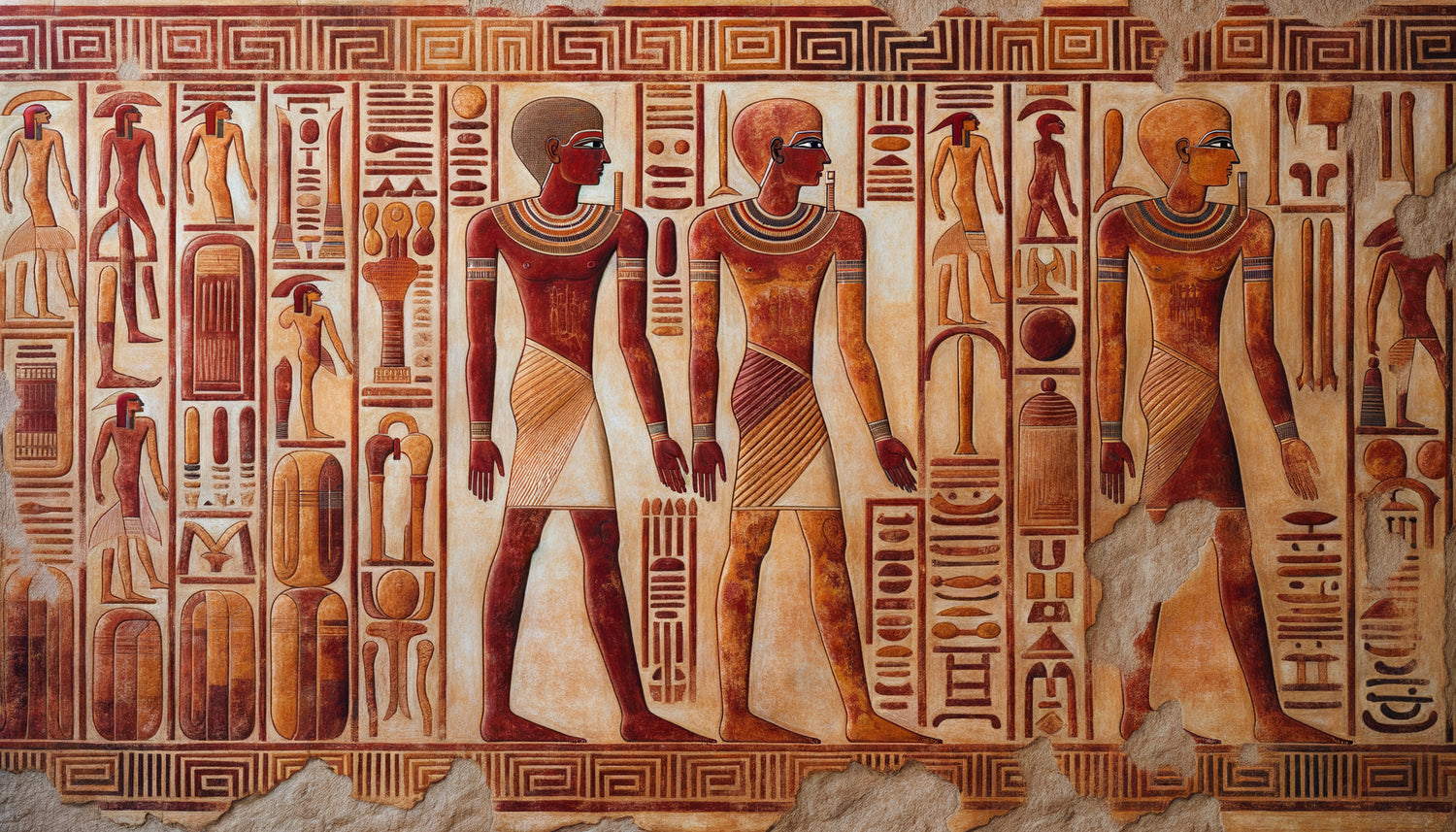
You might think that all Egyptian tombs look alike, frozen in this canonical iconography that is systematically associated with ancient Egypt. This uniformizing vision deprives us of a more nuanced understanding of the cultural richness of this civilization. The Siwa wall paintings remind us that beyond power centers like Thebes or Memphis, there existed peripheral artistic expressions, just as legitimate and infinitely more surprising.
Rest assured: understanding these stylistic differences requires no expertise in Egyptology. It is enough to observe with curiosity and accept that cultural diversity always enriches our vision of the world. These variations speak as much about Antiquity as about our contemporary relationship to aesthetics and cultural identity.
In this article, I'll take you on an exploration of the fascinating reasons why the wall paintings of the Siwa oasis differ so radically from the classic pharaonic style, and how this singularity can inspire your own approach to decoration.
A geographical isolation that shapes visual identity
The Siwa Oasis is located more than 500 kilometers southwest of Alexandria, lost in the immensity of the Libyan desert. This considerable distance from the major pharaonic centers is not just a geographical data point; it's the first factor explaining the specificity of the Siwa wall paintings. Far from the royal workshops of Memphis or the scriptoriums of Karnak, the artists of Siwa have never been subject to the strict artistic canons that governed representation in central pharaonic Egypt.
This geographical freedom has translated into remarkable creative freedom. Where classic wall paintings followed rigid proportion grids and precise color codes, the artists of Siwa developed a more spontaneous visual vocabulary, almost naive in its simplicity. Human figures are represented with an astonishing economy of means, without these hieratic postures characteristic of Theban tombs.
Isolation also preserved traditions predating the complete pharaonic domination of the region. The wall paintings of Siwa incorporate elements dating back to the indigenous Berber populations, creating a hybrid aesthetic where Berber geometric patterns and simplified Egyptian references blend together. This fusion produces a unique visual style, almost proto-modernist in its approach to abstraction.
The Greco-Roman influence: when the Mediterranean meets the Nile
The Ptolemaic and Greco-Roman period profoundly marked the wall paintings of Siwa more evidently than elsewhere in Egypt. The oasis, located on important trans-Saharan trade routes, welcomed Greek and Libyan populations who brought their own artistic traditions. The famous oracle of Amun at Siwa, consulted by Alexander the Great himself, transformed the oasis into a major cultural meeting point.
This Mediterranean influence is reflected in the color palette of the wall paintings of Siwa. Unlike traditional Egyptian pigments – intense Egyptian blue, ocher yellow, brick red – the tombs of Siwa feature softer shades, pale pinks, nuanced browns, subtle greens that evoke Greek frescoes more than the tombs of the Valley of the Kings.
The compositions themselves reveal this cultural hybridization. There are scenes of banquets reminiscent of Greek symposiums rather than pharaonic ritual offerings. Representations of daily life are more naturalistic, less codified, as if the artists of Siwa had absorbed the Hellenistic view of the world while preserving their local identity.
Pictorial techniques adapted to local conditions
The materials available in Siwa differed considerably from those used in the pharaonic artistic centers. The local limestone, softer and more porous than that of the Tourah quarries near Cairo, imposed different pictorial techniques. The wall paintings of Siwa thus present a more matte texture, a more direct application of pigments, without the multiple layers of preparation characteristic of royal tombs.
This material constraint turned into stylistic opportunity. The rapid absorption of pigments by the support encouraged a freer gesture, more spontaneous strokes, creating what could be described as an early expressionist style. The artists of Siwa compensated for technical limitations with remarkable formal inventiveness.

An evolving religious symbolism
The pantheon venerated in Siwa differed significantly from that of the rest of Egypt. Amon certainly reigned there as master, but in a particular Libyan form, Amon-Ra of Siwa, whose representation in murals departs from classical canons. The gods appear less formalized, more accessible, almost familiar in their visual rendering.
This theological evolution is reflected in the iconography of the mural paintings of Siwa. Scenes of offerings are less rigid there, interactions between humans and deities more direct. We even find representations that would be considered heretical in strict pharaonic contexts: the deceased represented on the same scale as the gods, asymmetrical compositions that break the traditional sacred balance.
This religious freedom allowed local families to commission more personalized mural paintings, reflecting their syncretic beliefs rather than the orthodoxy of the great temples. The result is a expression artistique plus intime, less monumental, which touches by its immediate humanity.
The Berber heritage: geometry as a visual language
The Amazigh (Berber) populations of the region have left an indelible mark on the mural paintings of Siwa. Their millennial tradition of geometric decoration – which can still be found today in carpets, pottery and vernacular architecture – has imbued local funerary art with a dimension totally absent from the classical pharaonic repertoire.
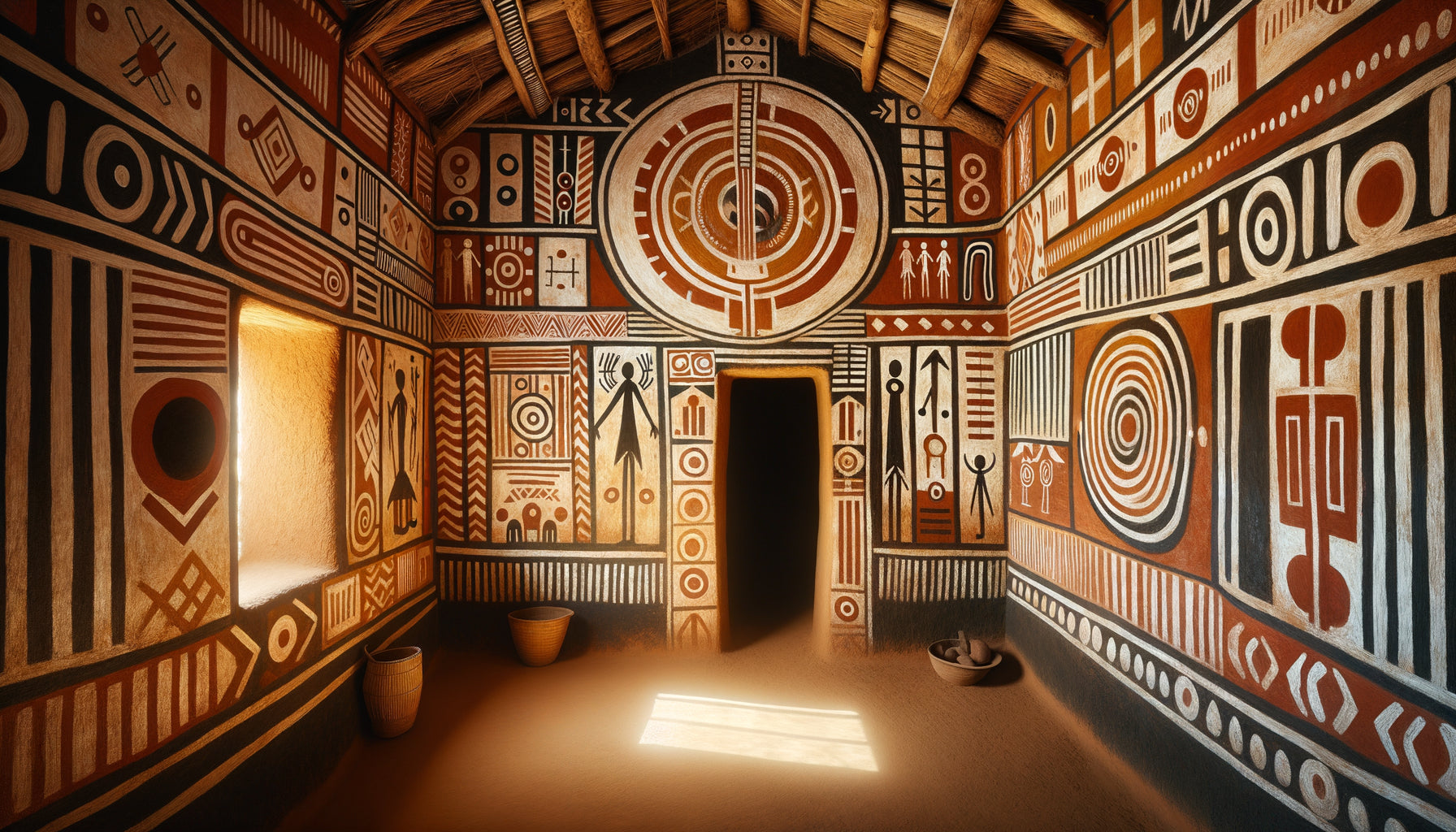
The geometric motifs of the mural paintings of Siwa – interlaced lozenges, repeated chevrons, stylized spirals – create decorative borders and background compositions that have nothing to do with the floral friezes or columns of hieroglyphs in Theban tombs. This esthétique géométrique confers on the mural paintings of Siwa a stunning visual modernity, as if they anticipated the research of artists of the 20th century on abstraction.
The Berber influence is also evident in the symbolism of colors and shapes. Some motifs in the mural paintings of Siwa correspond to Berber protective signs rather than Egyptian symbols, testifying to a profound cultural syncretism where indigenous traditions have never been completely erased by pharaonic domination.
Local workshops and practices passed down orally
Unlike the royal scriptoriums where apprentices tirelessly copied the same models for centuries, the workshops of Siwa operated according to a logic of family and artisanal transmission. The mural paintings of Siwa bear the mark of this tradition orale: individual variations, personal innovations, creative adaptations that would be unthinkable in a pharaonic academic context.
This lack of standardization explains the stylistic diversity observed from one tomb to another in Siwa, while the royal tombs of Luxor exhibit remarkable homogeneity. Each master artisan in Siwa developed their own visual signature, transmitted their particular techniques, thus creating a richness of expressions that the constraints of pharaonic workshops would have stifled.

When funerary art becomes a declaration of cultural identity
The wall paintings of Siwa are not simply different from the classic pharaonic style by accident or negligence – they constitute a deliberate cultural affirmation. By choosing not to servilely reproduce the models of centers of power, the local elites of Siwa proclaimed their distinct identity, their pride in belonging to a unique cultural crossroads.
This political dimension of aesthetics resonates powerfully with our contemporary questions about cultural authenticity. The wall paintings of Siwa teach us that there is no single legitimate way to express a tradition, that margins often produce the most innovative creations, and that faithfulness to oneself sometimes implies deviating from dominant models.
For a lover of contemporary decoration, this historical lesson is valuable. It validates the approach of mixing influences, creating one's own visual language rather than reproducing established styles. The wall paintings of Siwa embody what we would today call an assumed hybrid style, a cultural fusion that does not seek to conceal its multiple sources but celebrates them openly.
Get inspired by the richness of African traditions
Discover our exclusive collection of African paintings that capture this unique cultural fusion between ancestral traditions and contemporary aesthetics.
Siwa inspiration for your contemporary interior
The aesthetic principles of the wall paintings of Siwa offer fascinating avenues for contemporary interior decoration. This approach to cultural mixing – Berber, pharaonic, Greek, Libyan – fully validates eclectic interiors that dare to juxtapose diverse geographical and temporal influences.
The color palette of the Siwa murals – these soft ochres, nuanced browns, touches of olive green – creates warm and timeless atmospheres, perfect for interiors seeking to escape fleeting trends. The use of Berber geometric patterns as a counterpoint to more figurative elements finds a direct echo in interiors that mix patterned textiles and figurative art.
The Siwa murals also teach us the virtue of expressive simplicity. Their stripped-down, almost naive style recalls that visual impact does not depend on technical complexity but on the authenticity of expression. In an interior, this translates to choosing pieces that tell a personal story rather than reproducing standardized arrangements.
Imagine your living space transformed by this aesthetic philosophy: walls in mineral tones evoking desert and oasis, artworks blending geometric abstraction and simple figurative representations, textiles celebrating Berber artisanal traditions. You would thus create an environment that, like the Siwa murals, affirms a hybrid cultural identity and proudly unique character.
The murals of the Siwa Oasis differ from classical pharaonic style because they are the product of an exceptional cultural crossroads, creative geographical isolation, and a desire to assert a distinct identity. They remind us that margins often produce the most daring innovations, and that cultural fidelity does not require stylistic uniformity. For any enthusiast of decoration and art, Siwa offers an invaluable lesson: your space should reflect no established canon, only the richness of your own influences and the sincerity of your personal vision.
Frequently Asked Questions
Can I visit the tombs of Siwa to see these murals with my own eyes?
Absolutely, and I strongly encourage you to do so! The most accessible tombs are those of Djebel al-Mawta (the Mountain of the Dead), located a few kilometers from the center of the Siwa Oasis. Among them, the tomb of Si-Amon and that of Mesu-Isis feature remarkably well-preserved murals that perfectly illustrate this unique aesthetic we have discussed. The desert light, filtering through the openings in the tombs, reveals the pigments in a way that cannot be reproduced in photography. Plan your visit early morning or late afternoon to avoid the intense heat and enjoy optimal lighting. A local guide can explain the cultural specifics that only oral tradition has preserved. This experience will transform your understanding of the Siwa murals, as nothing replaces direct confrontation with these millennial works in their original geographical and luminous context.
How can I incorporate the aesthetics of Siwa murals into my decor without falling into pastiche?
The key lies in embracing principles rather than copying forms. The Siwa murals teach us three lessons applicable to any contemporary interior: the freedom of cultural mixing, the power of simple geometric patterns, and the warmth of mineral palettes. Specifically, you can choose authentic Berber textiles – kilim rugs, woven cushions – which you will combine with African or Mediterranean contemporary artworks. Prioritize a palette of warm neutrals – sienne earth, ocher, beige rosé – that you will punctuate with touches of olive green or pale blue. Incorporate geometric elements through tiles, wall patterns, or frames, but keep them understated and repetitive rather than overloaded. The essential thing is to create an atmosphere that evokes cultural encounter rather than transforming your living room into an archaeological reconstruction. Your interior should tell your own story of cultural fusion, not reproduce that of Siwa.
Are the Siwa murals as well preserved as those of Luxor's tombs?
The conservation of the Siwa murals presents specific challenges related to the oasis environment. Unlike the Valley of the Kings’ tombs, carved into compact limestone and benefiting from an extremely dry climate, the Siwa tombs have been affected by humidity fluctuations due to the proximity of underground water sources. Some mural paintings therefore show alterations, erased areas or crystallized salts on the surface. However, this patina of time paradoxically contributes to their charm and authenticity – they visibly bear the marks of their history, which makes them even more moving. The best-preserved tombs offer remarkable visual testimonies that allow us to fully appreciate the stylistic specificity we have spoken about. Conservation efforts are underway to stabilize the most fragile murals while respecting their historical integrity. Their current condition also reminds us of the fragility of cultural heritage and the importance of documenting and protecting it for future generations.