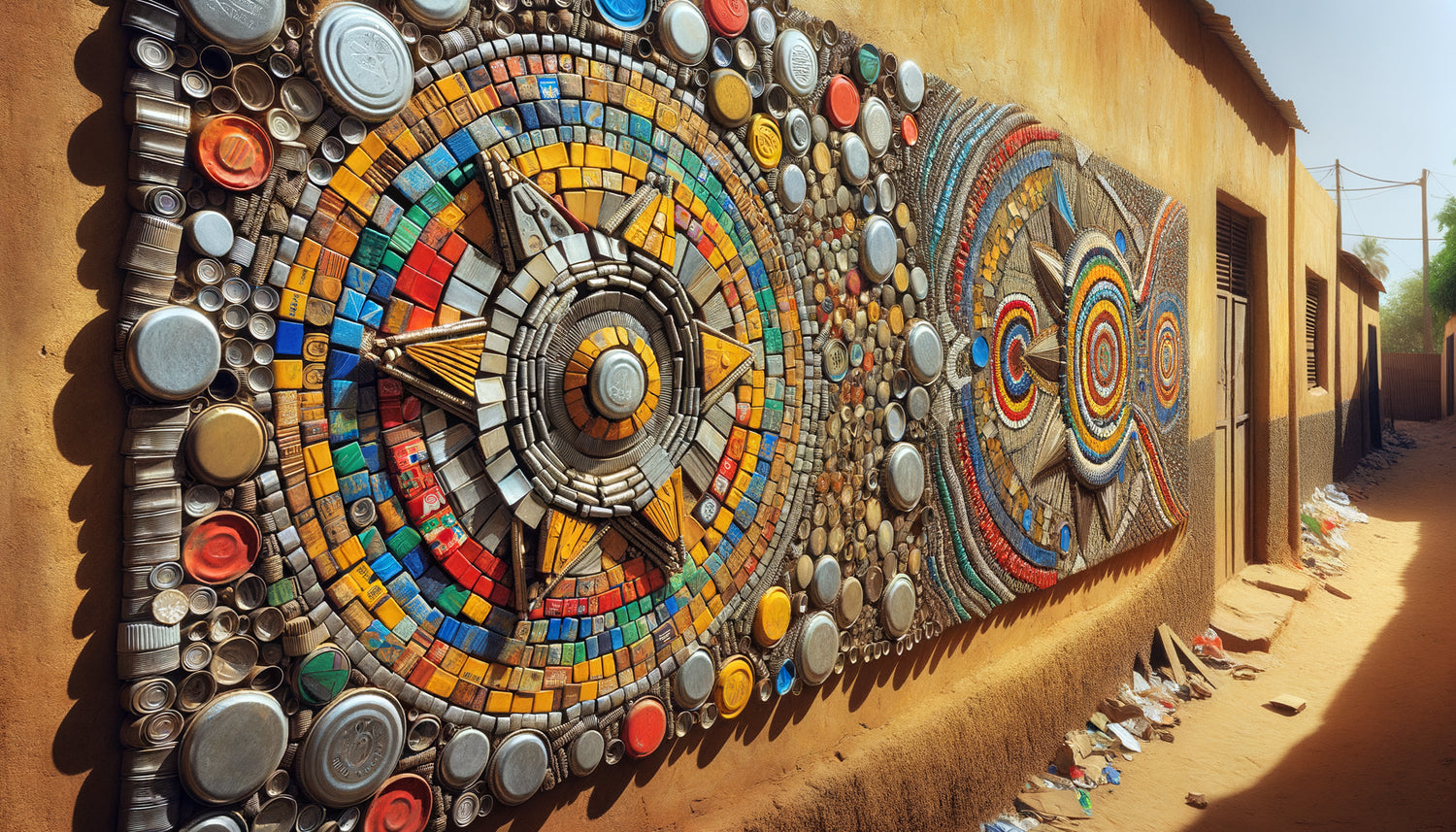
In the dusty backstreets of Bamako, between the horns of sotrama vehicles and the acrid smell of burning garbage, I discovered what New York galleries take years to understand. On a crumbling wall in the Medina Coura district, a hypnotic fresco displayed its vibrant colors: thousands of bottle caps, fragments of metal, pieces of plastic arranged with the precision of a goldsmith. Malian artists transform urban waste into veritable visual cathedrals, creating mural mosaics that tell the soul of their city.
Here's what this artistic practice brings: a creative response to the urban waste crisis, a new contemporary aesthetic rooted in African reality, and an inexhaustible source of inspiration for rethinking our relationship with recycled materials. After fifteen years of traveling through the workshops of artists from Lagos to Dakar, I can say that Bamako is home to one of the most innovative scenes on the continent.
The problem? Most decorating magazines continue to present African art through the reductive prism of tribal masks and bogolan fabrics, completely ignoring this creative urban effervescence. Are you looking for authentic visual references, concrete techniques, a deep understanding of this artistic movement that reinvents the codes of mosaic? Rest assured: I will take you into workshops, on mural construction sites, to the heart of this aesthetic revolution where waste becomes visual poetry.
When necessity breeds innovation: birth of a movement
Bamako is drowning in nearly 600,000 tons of waste annually, only 30% of which is collected. Faced with this suffocating reality, a generation of artists has made a radical choice: transform the invader into a noble material. Abdoulaye Konaté, a tutelary figure of Malian contemporary art, paved the way in the 1990s with his textile installations incorporating found objects. But it was truly in the early 2010s that urban waste mural mosaics exploded in the Bamako public space.
Pioneers like Sékou Traoré began obsessively collecting: Coca-Cola caps, oil can lids, fragments of broken mirrors, pieces of earthenware, multicolored plastic stoppers. Each piece of waste becomes a potential tessellation, a pixel in a monumental composition. The color palette emerges directly from urban life: the red of Fanta caps, the blue of water bags, the metallic green of tin cans, the golden hue of biscuit wrappers.
This approach resonates with a deeply Malian philosophy: the concept of nyama, this vital force that inhabits every object, even abandoned. By recycling, the artist not only creates an ecological work; he reactivates the latent energy of materials, offering them a second spiritual life as well as aesthetic.
Techniques for collecting and preparing materials
Observe an artist mosaicist from Bamako at work: their first step isn't preparatory drawing, but urban wandering. Collecting urban waste becomes a creative ritual in its own right. Some scour the Dibida or Medina Coura markets at dawn, negotiating with scrap metal vendors. Others establish partnerships with klantchis, these young informal collectors who crisscross the city with their carts.
Preparation requires monastic patience. Metal capsules must be cleaned, flattened sometimes, sorted by chromatic shade. Plastics are washed with bleach, cut into precise geometric shapes. Broken glass fragments are polished to avoid dangerous edges. Each recovered material undergoes a methodical transformation before integrating the final composition.
The Chromatic Classification System
Workshops resemble alchemist's laboratories: hundreds of containers aligned, organized according to a sophisticated color gradient. A blue can present fifteen variations depending on its origin: water sachet, detergent bottle, painted sheet metal fragment. This material library constitutes the artist's visual vocabulary, their infinite palette constantly renewed by urban flows.

Anatomy of a Bamako Wall Mosaic
Unlike Byzantine or Roman mosaics that use calibrated tesserae, urban waste mosaics celebrate irregularity. This aesthetic of heterogeneity becomes the signature of the movement. On the same panel coexist circular capsules, rectangular pieces of plastic, triangular mirror shards. The texture becomes three-dimensional, playing with the Saharan light which changes intensity throughout the day.
Recurring themes draw from the Malian imagination: portraits of griots, market scenes, representations of the Niger River, reinterpreted adinkra symbols. But also sharp social commentary on overconsumption, pollution, and rapid urbanization. Urban mosaic becomes a visual manifesto, questioning our development model while sublimating its rejects.
The assembly technique varies depending on the support. On traditional banco walls, artists use heat-resistant cement glue (up to 45°C in the shade). For temporary installations, some prefer removable metal structures where waste is fixed by welding or ligature. Each mosaic mural adapts to the climatic constraints of the Sahel: torrential rains during the winter, drying harmattan winds, ubiquitous dust.
Iconic places of this artistic revolution
The Lafiabougou district is home to the Bogolan Kasobane collective, a pioneer in integrating urban waste mosaics into the facades of homes. Over nearly 200 square meters, a monumental fresco tells the story of the neighborhood through 50,000 metal capsules. Every morning, residents gather there as if in front of a living picture book.
The Bamako Youth House has commissioned several mural interventions that transform its exterior walls into an open-air gallery. Artists experiment with mixed techniques, combining recycled plastic mosaics and traditional murals. The dialogue between ancestral techniques and contemporary materials creates a fascinating aesthetic tension.
More confidential, the Sebenikoro artist residency welcomes international artists to learn these specific techniques. I met a Danish designer who was completely reinventing her approach to furniture after three months of immersion. The urban mosaics of Bamako now radiate far beyond Mali, influencing creative practices on all continents.

The social and environmental impact of this practice
Beyond aesthetics, this movement generates tangible transformations. Several workshops employ young people who have dropped out of school, offering them artistic training and income. Organized collection of urban waste creates a micro-circular economy where each capsule has a marketable value. Entire neighborhoods embrace this approach, organizing community collections to supply collective mural projects.
The ecological impact remains modest on the scale of the Bamako waste crisis, but highly symbolic. An average mosaic incorporates between 5,000 and 15,000 recovered items. Each work removes several kilograms of waste from illegal dumps or gutters where they obstruct rainwater runoff. More significantly, these creations educate: residents realize that their waste has potential value, which gradually changes sorting and management behaviors.
Collaborations with international institutions
UN-Habitat has funded several participatory murals projects in disadvantaged neighborhoods, recognizing their potential for social cohesion. The Institut Français du Mali regularly organizes residencies bringing together local and international artists around these practices. This institutional recognition legitimizes the movement while sometimes risking to soften it, a tension that artists negotiate with lucidity.
Get inspired by Bamako: applications for your interior
How to transpose this radical aesthetic into a European domestic context? The idea is not to plagiarize, but to draw inspiration from the fundamental principles. Valorizing neglected materials can start modestly: a kitchen wall panel decorated with Nespresso coffee capsules, a mirror framed with fragments of broken tableware, a screen made up of assembled wallpaper scraps.
The Bamako spirit lies in accepting imperfection, celebrating irregularities. Unlike the minimalist Scandinavian aesthetic that dominates our magazines, urban waste mosaic embraces visual saturation, density, organized accumulation. It is particularly suitable for transitional spaces: entrances, hallways, sheltered exteriors.
Technically, prioritize adhesives adapted to your materials (E6000 glue for plastics, cement-based adhesive for heavy elements) and work in sections. Start with a simple geometric pattern before tackling figurative compositions. Document your collection process: it is an integral part of the artwork, telling your relationship to consumption and the life cycles of objects.
Let the African creative energy transform your interior
Discover our exclusive collection of African paintings that capture the same visual intensity and spirit of innovation from contemporary artists on the continent.
Challenges and future of the movement
Despite its dynamism, this artistic movement faces significant obstacles. The durability of the works remains problematic: outdoor mosaics suffer from extreme weather conditions, requiring regular maintenance that few community budgets can ensure. Some spectacular creations have disappeared after only two winters, their elements torn away by strong winds or dislodged by torrential rains.
The question of monetization divides the artistic community. Some categorically refuse commercialization, considering that urban waste mosaics must remain in public space, accessible to all. Others develop transportable versions for international galleries, aware that external visibility brings recognition and funding. This creative/commercial tension runs through the entire history of art, but takes on a particular sharpness in a context of economic precariousness.
The future could lie in hybridization: several artists are experimenting with integrating technologies (solar LEDs, QR codes linking to augmented content) into their traditional mosaics. Others explore ecological resins allowing compositions to be frozen while protecting them. Technical innovation accompanies aesthetic audacity, ensuring that this movement does not stagnate in a picturesque folklore but continues to evolve.
Close your eyes and imagine: your next trip takes you to Bamako, in the golden light of late afternoon. On an ochre earth wall, a constellation of metal capsules captures the last rays, transforming waste into urban jewelry. You suddenly understand that beauty does not lie in the nobility of materials, but in the creative intention that transforms them. Back home, you no longer look at your trash cans the same way. This empty yogurt pot, this crumpled can: what if it was the beginning of your own mosaic, your way of dialoguing with artists from Bamako thousands of kilometers away?
The movement of urban waste mosaics does not only recycle materials; it recycles our gaze, teaching us to detect aesthetic potential in what we have too quickly condemned to oblivion. It is this philosophical as well as artistic lesson that Bamako offers the world: creativity as a response to crisis, beauty as an act of resistance, art as radical transformation of everyday life.
Frequently asked questions about urban waste mosaics
Can a mosaic of waste be made without prior artistic skills?
Absolutely, and that's precisely the beauty of this practice! Unlike traditional mosaic techniques which require mastery of precise cutting and geometric assembly, urban waste mosaics celebrate intuition and experimentation. The Bamako artists I worked with often received no academic training. Their learning was through practice, observation, fertile error. Start with a small panel (30x30 cm), choose a simple pattern (spiral, checkerboard, color gradient) and let yourself be guided by your materials. The constraint of available shapes often generates unexpected creative solutions. The most difficult thing is not the manual technique, but the development of what I call the “collector’s gaze”: this ability to see aesthetic potential in everyday discards. Allow yourself three months of collecting before even starting to assemble. Your color palette will naturally emerge from your consumption habits, creating a deeply personal work.
What adhesives really resist outdoor conditions?
This question is crucial as it determines the durability of your creation. In Bamako, I observed three main approaches depending on supports and budgets. For mural mosaics on facades, polymer cement adhesive remains the standard: it offers excellent adhesion to mineral supports and resists extreme temperature variations. Artists mainly use products like Weber or Sika, applied in a thick layer (3-5 mm) to compensate for irregularities in the waste. For lightweight plastics on metal or wood supports, bi-component epoxy glue (type E6000 or Araldite) creates almost indestructible bonds. Its high cost limits its use to small surfaces or strategic elements. Finally, several creators are experimenting with ecological resins based on casein or vegetable glues, more respectful but less durable. My pragmatic advice: systematically test your adhesive on a sample of your materials, let it dry for 48 hours, then subject it to constraints (soaking, freezing if relevant, traction). Each material-support-adhesive combination is unique, and these preliminary tests will save you the frustration of seeing your mosaic crumble after the first storm.
How does this practice differ from traditional Mediterranean mosaics?
The fundamental difference lies in the very philosophy of the material. Roman, Byzantine or Moroccan mosaics use tesserae specifically produced for art: cut marbles, colored glass pastes, precious enamels. Standardization of the elements allows millimeter precision in figurative representations. Artists from Bamako work with what the city offers them: non-standardized materials, with random shapes and sizes. This constraint generates an aesthetic of improvisation where the three-dimensional texture becomes as important as the pattern itself. Technically, classical Mediterranean mosaics use the indirect method (assembly on paper then transfer) to guarantee a perfectly flat surface. Urban waste mosaics prefer the direct method, accepting or even seeking reliefs and irregularities. Symbolically finally, where traditional mosaic affirms human mastery over matter (transforming raw stone into a sophisticated image), waste mosaic practices a form of creative humility: it reveals the latent potential of objects already transformed industrially, offering them a third life after their initial function and abandonment. It is an art of material redemption rather than technical domination.