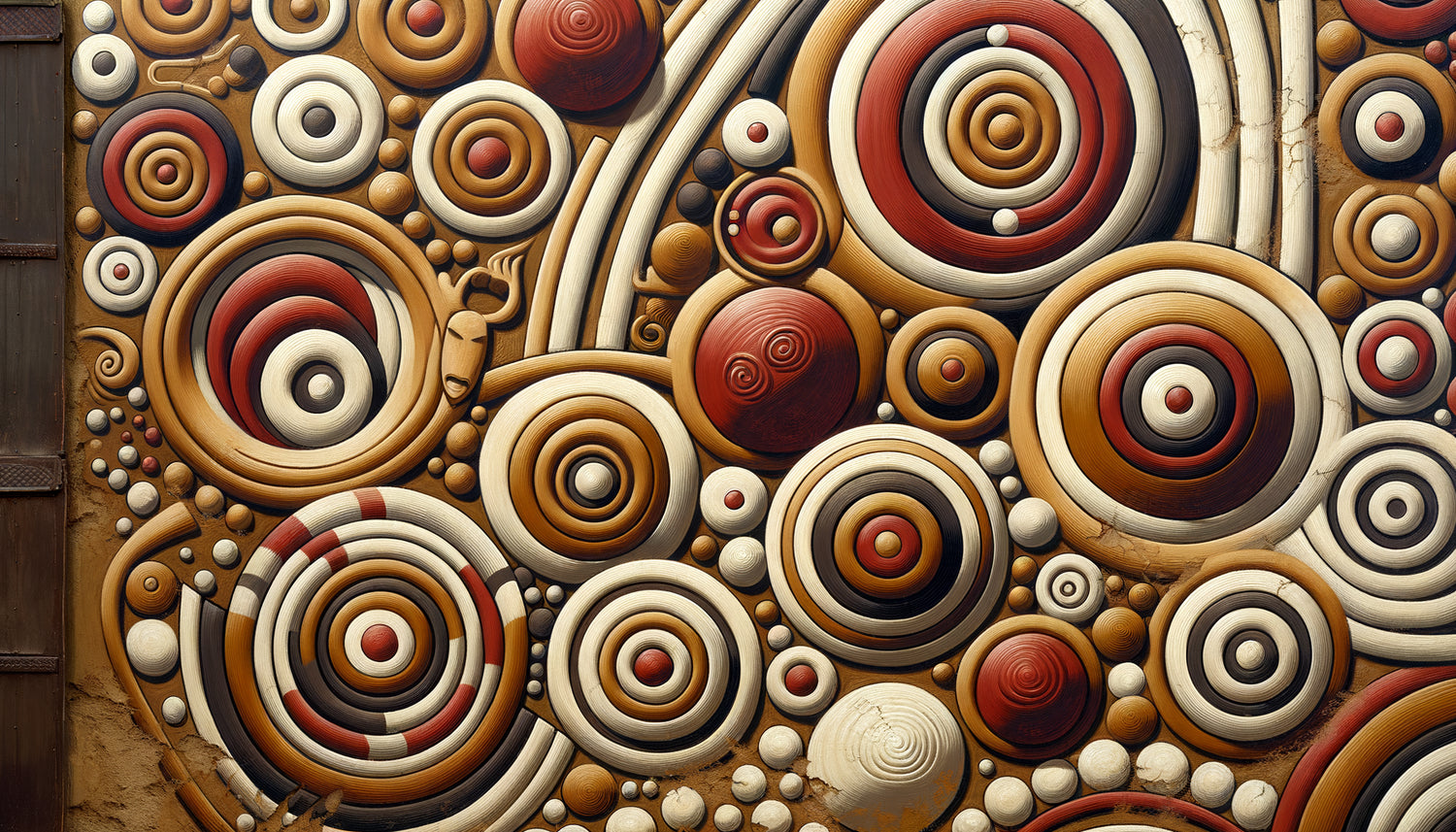
On the walls of a traditional house in central Côte d’Ivoire, a composition stopped me dead during my first ethnographic fieldwork in 2009. No sharp angles, no aggressive straight lines. Only curves that seemed to breathe, ovals interlocking like successive breaths. This organic fluidity was not an aesthetic coincidence: it carried within it an entire cosmology, a worldview where gentleness is not weakness but ancestral wisdom.
Here's what Guro wall art reveals: a philosophy of harmony that refuses brutal rupture, a celebration of the feminine as universal creative force, and a visual language that transforms each home into a living sanctuary. Yet, many perceive these motifs as mere folkloric decorations, failing to grasp the symbolic depth that animates each curve.
If you are fascinated by tribal arts but intimidated by their apparent complexity, rest assured. Guro wall art speaks a universal language, that of forms which soothe the eye and mind. In this article, I take you to the heart of this millennial tradition to understand why these peoples have made the circle and oval their aesthetic signatures, and how this wisdom can nourish our contemporary relationship with space.
The circular cosmology: when the universe rejects angles
For the Guro, the universe is not a rigid geometric construction. It is perpetual movement, an eternal cycle of birth, growth, decline and rebirth. The oval and rounded shapes that adorn the walls of homes, granaries and sacred places are not mere decorative choices: they are the visual translation of this cosmological vision.
During my interviews with mural artists – for it is mainly women who perpetuate this art – one of them explained to me: 'The angle cuts, divides. The circle welcomes, unites.' This sentence summarizes an entire philosophy. In Guro thought, the rounded shape symbolizes harmony with the invisible world, that of ancestors and spiritual forces watching over the community.
Oval motifs often represent gourds (symbols of fertility and abundance), maternal bellies (source of life), or the sun and moon in their cyclical course. Each curve is a visual prayer, a gentle invocation for life to circulate unimpeded within the domestic space.
The sacred feminine: the oval as universal matrix
What struck me most about Guro wall art is the central place given to feminine symbols. The oval is not just a shape: it is a matrix, a space of gestation and transformation. In this culture, the creative power of women is visually celebrated through these gentle forms that evoke the maternal belly, nourishing breasts, a gourd filled with vital water.
Wall paintings often accompany fertility rituals or mark the spaces where female initiation ceremonies take place. Young girls learn very early on to reproduce these motifs, thus transmitting knowledge that goes far beyond the technical gesture. It is a spiritual initiation: understanding that the curve is generous, that it never completely closes space but always invites circulation.
I have observed how these rounded shapes create a feeling of protective embrace in the habitat. Unlike angles which create areas of shadow and visual tension, ovals guide the gaze in a fluid movement, soothing. They transform the wall into a visual caress.
The pigments of the mother earth
The colors used reinforce this connection to telluric femininity. Gouro artisans make their pigments from ochre earths, white kaolin (sacred clay), and vegetable soot for deep blacks. These raw materials, extracted from the soil, create a soft chromatic palette, never aggressive. The ovals unfold in warm tones that evoke skin, fertile earth, the setting sun.

Architectural harmony: walls that breathe
Traditional Gouro architecture uses organic materials – raw earth, straw, wood – whose lines are naturally curved. Round or oval houses blend into a landscape of undulating hills, winding rivers. Wall art extends this organic continuity.
Unlike colonial architecture which imposed the right angle as a sign of 'modernity', Gouro habitat favors gentle transitions. The wall motifs accentuate this fluidity: they do not define rigid zones but create visual flows that accompany the movement of inhabitants in space.
I have measured the psychological impact of these rounded environments. They produce a soothing effect similar to what neuroscience observes when facing natural landscapes. Our brain, shaped by millennia of evolution in organic environments, reacts positively to curves that recall nature.
The language of motifs: when each oval tells a story
Oval shapes organize themselves into narrative compositions. A series of concentric ovals can symbolize the successive generations of a lineage. Ovals connected by undulating lines evoke the paths of life, never linear. Groupings of three ovals often represent the cosmic triad: sky, earth, underworld.
What I particularly appreciate is the infinite variability in repetition. No oval is identical; each bears the mark of the hand that created it. This assumed imperfection – which would horrify a modernist designer obsessed with standardization – is precisely what brings these compositions to life. They vibrate with human energy.
The visual rhythms of the community
Gouro wall patterns are not read in isolation but in relation to one another. Several houses in the same neighborhood can develop variations on a common theme, creating a kind of visual conversation at the scale of the village. This collective approach to aesthetics reflects a society where the individual only fully exists within their community affiliation.

The contemporary heritage: reinterpreting the wisdom of curves
Today, Gouro wall art inspires designers and interior architects seeking alternatives to the cold lines of industrial minimalism. These rounded shapes offer visual breathing space in our spaces often saturated with right angles and flat surfaces.
I have seen fascinating projects where patterns inspired by Gouro art are integrated into contemporary interiors – not as decorative cultural appropriation, but as a respectful dialogue with a millennial aesthetic wisdom. A coat of paint with gentle curves in a bedroom, textiles with oval motifs in a living room, are enough to transform the atmosphere of a room.
The profound teaching of Gouro wall art for our time? That gentle forms are not sentimentality but sophistication, that curves create more human and welcoming spaces. In an architectural world dominated by rationalizing straight lines, these ovals remind us of our visceral need for protective roundness.
Let the wisdom of curves transform your interior
Discover our exclusive collection of African artworks that celebrate organic shapes and bring a soothing visual harmony to your living space.
Bringing roundness back into our angular lives
The art of the Gouro teaches us that a wall is never neutral. It can divide or welcome, close off or invite. The oval and rounded shapes they have favored for centuries embody a civilizational choice: that of gentleness as an organizing principle of space.
In your own habitat, ask yourself: where can you introduce roundness? Perhaps with an oval mirror, cushions with circular patterns, or simply by hanging a work that celebrates curves. Every gesture counts to soften the angles of our lives, which are too often rectilinear.
The next time you contemplate a circle, an oval, a spiral, remember that it is not just a shape. It's an ancestral invitation to slow down, breathe, and recognize that life itself refuses straight lines and prefers the sinuous dance of eternal cycles.
Frequently Asked Questions about Gouro Wall Art
Why do rounded shapes dominate Gouro art rather than angular geometric patterns?
The rounded shapes in Gouro wall art reflect a cosmological vision where the universe functions through cycles rather than ruptures. Angles are perceived as points of division and tension, while curves symbolize the continuity of life, fertility, and harmony with spiritual forces. This aesthetic preference is not arbitrary: it translates a philosophy where gentleness is wisdom, where the circle and the oval represent the feminine creative matrix, source of all life. The artisans who create these patterns perpetuate an ancestral knowledge that intimately links visual form and spiritual meaning. That's why each oval is never 'just' decorative but carries within it a protective and beneficial intention for the space and its inhabitants.
Can we integrate the aesthetics of Gouro motifs into a modern interior without falling into cultural appropriation?
Absolutely, provided you adopt a respectful and informed approach. Problematic cultural appropriation occurs when symbols are detached from their context to become mere exotic decorative objects. On the other hand, drawing inspiration from the aesthetic philosophy of rounded shapes – their ability to create soothing spaces, their celebration of organic curves – constitutes an enriching dialogue. Prioritize works by contemporary African artists who reinterpret these traditions, or creations that draw on the principle of soft forms without literally copying sacred motifs. The key is to understand the deep meaning of these shapes rather than treating them as a mere visual style. Educate yourself, acknowledge the cultural origin of these influences, and choose pieces that honor rather than exploit this millennial aesthetic wisdom.
What are the psychological effects of rounded shapes on our perception of interior space?
Research in environmental neuroscience confirms what the Gouro intuitively knew: rounded shapes create a sense of security and well-being. Our brains, shaped by evolution in natural environments with organic lines, perceive sharp angles as potential threats and remain alert. Conversely, curves and ovals activate brain areas associated with pleasure and relaxation. In an interior space, rounded shapes promote a smooth visual flow that reduces eye and mental fatigue. They also create a sense of protective enclosure rather than rigid partitioning. That's why introducing elements with curved lines – oval mirrors, paintings with circular compositions, furniture with softened angles – immediately transforms the atmosphere of a room, making it more welcoming and harmonious. Gouro wall art masterfully illustrates this millennial aesthetic wisdom.