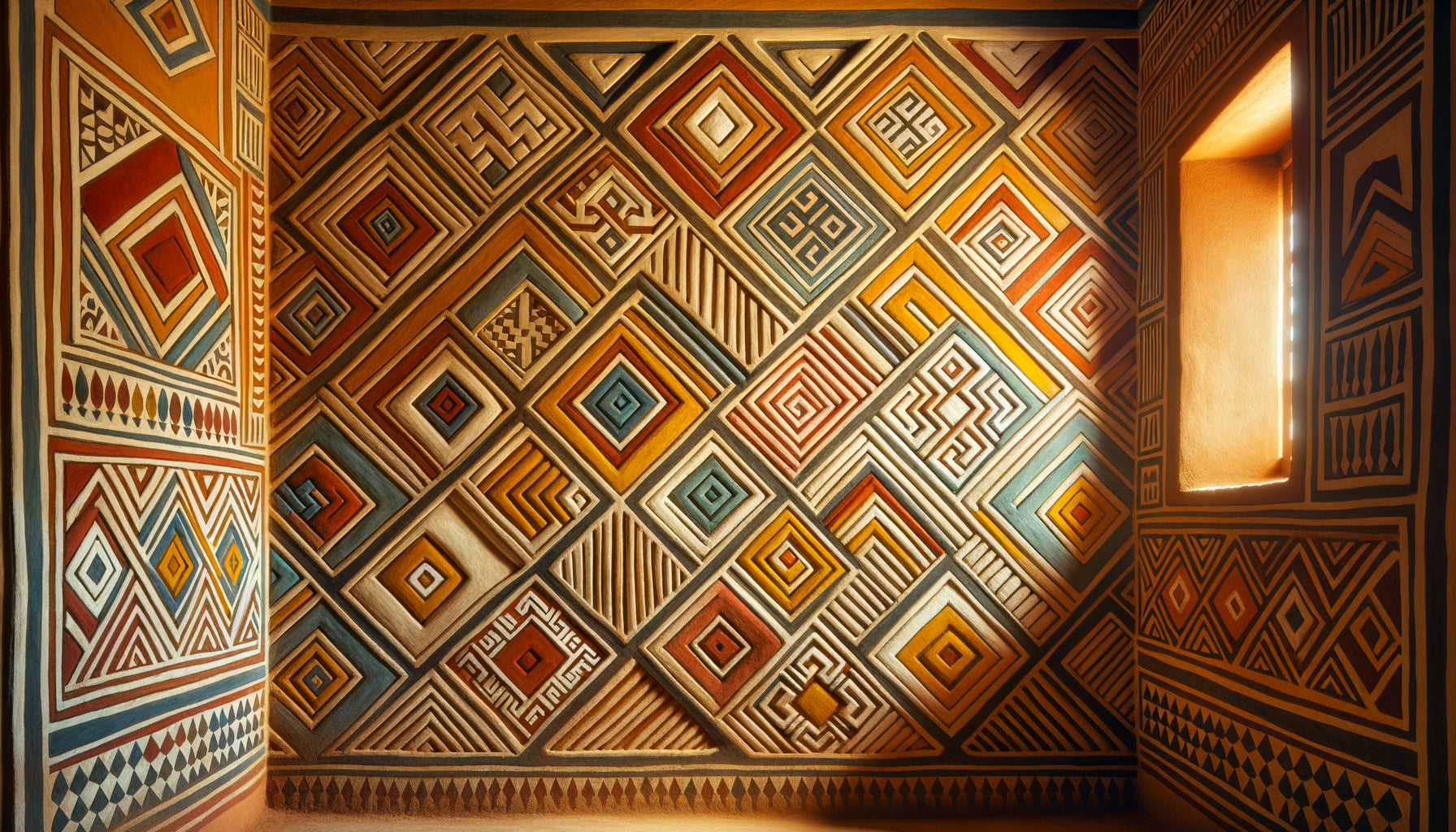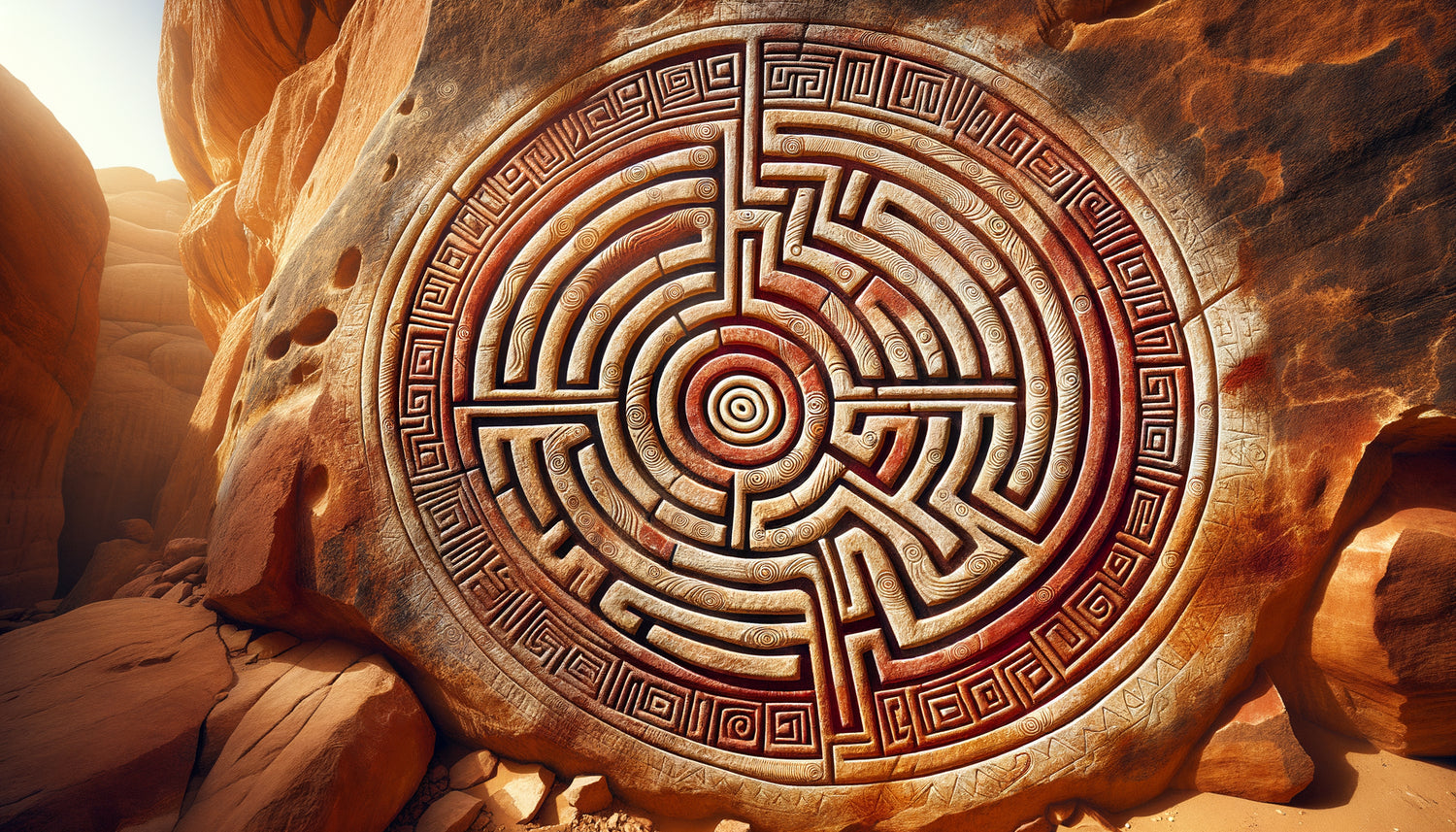
In the immensity of Western Sahara, on the ochre walls of ancestral caves and the millennial ksour, a mysterious motif winds its way, fascinating as much as it questions. These intertwined lines, these paths that cross and elude each other, tell a story far deeper than their apparent geometric simplicity.
Here's what the meaning of labyrinth patterns in Saharan wall art reveals: a complex cosmology of spiritual journey, a symbolic cartography of initiation journeys, and a millennial philosophy of life as a winding path to knowledge.
You may admire these interlacements in art books or ethnographic exhibitions, captivated by their graphic mystery. Yet, their language eludes you, as if these lines jealously guarded their secrets behind a veil of sand and time. This frustration is natural: these symbols belong to an oral tradition where each curve carries several levels of reading, accessible only to those who know the keys of interpretation passed down from generation to generation.
But rest assured, this Saharan wisdom is not inaccessible. By understanding the fundamental principles that animate these compositions, you will discover how these desert peoples have developed a visual system of remarkable sophistication, capable of transmitting abstract philosophical concepts through pure geometry.
Allow me to guide you in this fascinating maze where art, spirituality and daily life intertwine with astonishing coherence.
The Saharan labyrinth: much more than just decoration
Unlike purely aesthetic decorative motifs, the wall labyrinths of Western Sahara function as veritable visual texts. Each tracing obeys a precise grammar, inherited from the Berber and Sahrawi traditions dating back several millennia.
These patterns mainly appear in three architectural contexts: traditional houses where they adorn facades and courtyards, places of worship where they accompany meditation and prayer, and funeral sites where they symbolically guide the deceased on their posthumous journey.
The particularity of these labyrinths lies in their unicursal structure: unlike Greek or Cretan labyrinths, there is only one possible path, without dead ends or choices to be made. This design reveals a deterministic philosophy where the course of life, although winding, follows a trajectory predetermined by fate.
Geometry as spiritual language
Saharan artisans mainly use three forms of labyrinths: the circular labyrinth symbolizing eternity and cosmic cycles, the square labyrinth representing the earth and the material world, and the spiral labyrinth evoking the ascending movement towards transcendence.
Each configuration carries a specific meaning. The patterns painted in ochre red evoke protection and vitality, while those traced in black charcoal recall the trials and the austerity necessary for any inner transformation.
The seven symbolic dimensions of the labyrinthine motif
In the oral tradition of Saharan peoples, labyrinth patterns function on several levels of interpretation simultaneously, accessible according to the degree of initiation of the viewer.
The cosmological level identifies the labyrinth with the sun's journey across the sky, from the darkness of dawn to the zenith, and then back at night. This reading transforms each decorated wall into a metaphorical sundial, recalling humanity’s place in the universal order.
The initiatory level compares the tracing to the stages of spiritual learning. Sudden turns correspond to moments of revelation, long straight sections to periods of patience and endurance, the center of the labyrinth to final enlightenment.
The genealogical level sometimes encodes family and tribal lineages. Some complex labyrinths constitute veritable abstract genealogies, where each branch represents an alliance, each curve a generation.
The territorial level symbolically maps trade routes, water sources, and sacred territories. These labyrinths function as mnemonic maps, allowing the memorization of complex itineraries across the desert.
When the motif becomes prayer
The meditative level transforms the labyrinth into a support for contemplation. The faithful follows mentally or physically (with their finger) the tracing, synchronizing their breathing with the meanders of the path. This practice induces an altered state of consciousness conducive to spiritual reflection.
The protective level attributes to labyrinths an apotropaic function: these complex motifs are believed to trap malevolent spirits, too primitive to decipher the course and reach the center of the dwelling they protect.
The narrative level, finally, encodes mythological tales and significant historical events. Some labyrinths tell the epic of legendary ancestors, others commemorate battles or migrations.

How these ancestral motifs inspire contemporary design
The influence of Saharan labyrinths extends far beyond the borders of the desert. Architects and designers are now drawing on this graphic repertoire to create spaces that combine refined aesthetics with symbolic depth.
In contemporary interiors, these motifs bring a rare contemplative dimension. Their rigorous geometry naturally integrates into minimalist aesthetics, while their symbolic charge enriches the space with subtle storytelling.
Contemporary creators are reinterpreting these millennial tracings through various techniques: textured wallpapers, openwork screens, woven carpets, graphic tiles. Each application preserves the essence of the motif while adapting it to contemporary visual codes.
Particularly striking is the ability of these motifs to structure space without weighing it down. A wall labyrinth naturally guides the eye, creates movement, generates a visual dynamic that animates even the flattest surfaces.
Saharan wall art in your interior
Integrating a Saharan labyrinth motif into your decor is not simply about applying an exotic symbol. It's about understanding its compositional logic to adapt it harmoniously to your space.
Prioritize large, continuous surfaces: circulation walls, headboards, partition panels. The labyrinth needs amplitude to deploy its visual complexity. On a small surface, it loses its readability and impact.
Play on material contrasts rather than colors. A slightly raised labyrinth on a plain wall, a matte motif on a satin background, creates a much more subtle sophistication than a glaring chromatic opposition.
Combine these motifs with furniture with clean lines. The complexity of the labyrinth requires compensatory simplicity in the furnishings. It is the balance between ornamental density and formal sobriety that creates harmony.
The transmission of a heritage at risk
Today, the tradition of Saharan labyrinth wall art is threatened by rapid urbanization and the progressive disappearance of nomadic lifestyles which constituted its cultural breeding ground.
The master artisans capable of tracing these motifs according to traditional rules are now few and far between. Their knowledge, essentially oral and practical, risks disappearing with them if documentation and transmission efforts are not undertaken.
Several encouraging initiatives are emerging nevertheless. Training workshops bring together young local creators and traditional artisans, heritage restoration projects give life back to motifs erased by time, international designers collaborate with Saharan communities to develop contemporary collections inspired by these legacies.
This growing recognition is gradually transforming the perception of these motifs: from simple folk decorations, they gain the status of full-fledged works of art, worthy of study, preservation and reinterpretation.
Towards a new appreciation of Saharan art
The renewed interest in the labyrinthine motifs of Western Sahara is part of a broader movement to re-evaluate non-Western arts. Long relegated to the ethnographic sections of museums, these creations are now integrated into contemporary art collections and prestigious exhibition spaces.
This evolution reflects a more nuanced understanding: these motifs are neither primitive nor naive, but result from remarkable conceptual sophistication, the fruit of centuries of reflection on the relationship between form, meaning and function.
Transform your interior into a space for contemplation
Discover our exclusive collection of African paintings that capture the mystical essence of Saharan traditions and bring symbolic depth to your decor.

Creating your own dialogue with the labyrinth
Beyond intellectual understanding, Saharan labyrinthine motifs invite a personal and sensitive experience. Each person can develop their own relationship with these forms, project their questions onto them, find their answers.
Start by observing carefully a labyrinth. Mentally follow its path, note where your attention naturally falls, which segments attract or resist you. This simple contemplation often reveals unexpected resonances with your own life journey.
Try to trace your own simple labyrinth. This seemingly trivial exercise immediately confronts the difficulty of maintaining a balance between regularity and variation, between overall plan and detailed execution. You will viscerally understand the mastery required by traditional artisans.
Integrate these patterns into your meditative or creative practice. Use them as a focus for concentration, as a generator of forms for your own creations, as visual vocabulary to express concepts that escape words.
This personal appropriation, respectful yet vibrant, paradoxically ensures the best transmission of the spirit of these patterns: not as frozen forms in a bygone past, but as a living language capable of evolving while preserving its essence.
The invitation of the labyrinth
Ultimately, the true meaning of labyrinthine motifs in Sahrawi people's wall art may lie less in a definitive reading than in their ability to generate meaning indefinitely, to adapt to the questions of each era, of each observer.
These millennial tracings remind us that the journey is as important as the destination, that apparent complexity often hides a deep logic, that formal beauty can carry existential wisdom.
When contemplating these labyrinths, we are not simply looking at ancient decorative motifs: we are dialoguing with a worldview where art, spirituality and daily life were one, where every creative gesture participated in a quest for meaning and harmony.
Perhaps it is this completeness, this ability to connect aesthetics to metaphysics, the visible to the invisible, that explains the lasting fascination exerted by these Saharan labyrinths. In our fragmented existences, they offer the soothing image of a possible coherence between all aspects of our being.
So, the next time you come across one of these intertwined patterns, take the time to truly get lost in it. Follow its winding path, accept its detours, trust its invisible logic. For it is precisely by accepting to get lost in the labyrinth that we find our way.