The first time I observed a young Samburu woman meticulously applying her beadwork, I was struck by the geometric precision of each row, each color. Months later, invited into a traditional manyatta, I recognized these same patterns rippling across clay walls. It wasn't coincidence: it was a millennial visual language that transcended the body to inhabit space.
Here’s what this transition from body adornment to wall motifs reveals: a continuity of aesthetics that unifies personal identity and habitat, a symbolic system that transforms the house into an extension of the social body, and ancestral decorative wisdom surprisingly relevant to our contemporary interiors.
We all seek to create spaces that truly reflect us. Yet, our walls often remain neutral, disconnected from our deep identity. The Samburu, however, have never separated adornment and architecture. For them, adorning one's body and decorating one's home are part of the same creative gesture, the same cultural affirmation. This holistic approach offers a valuable lesson: our living spaces can be as expressive as our clothing choices, carrying the same codes, the same values.
I invite you to discover how this pastoral people developed a coherent decorative language, from necklace to facade, and how this philosophy can inspire our own interiors.
From body to home: an unbroken aesthetic
Samburu body ornaments are never mere accessories. Each bead necklace, each colorful bracelet indicates a social status, an age, sometimes even a clan. Young moran warriors wear red and white necklaces. Married women accumulate rows of multicolored beads whose arrangement follows precise rules. This visual grammar structures the entire society.
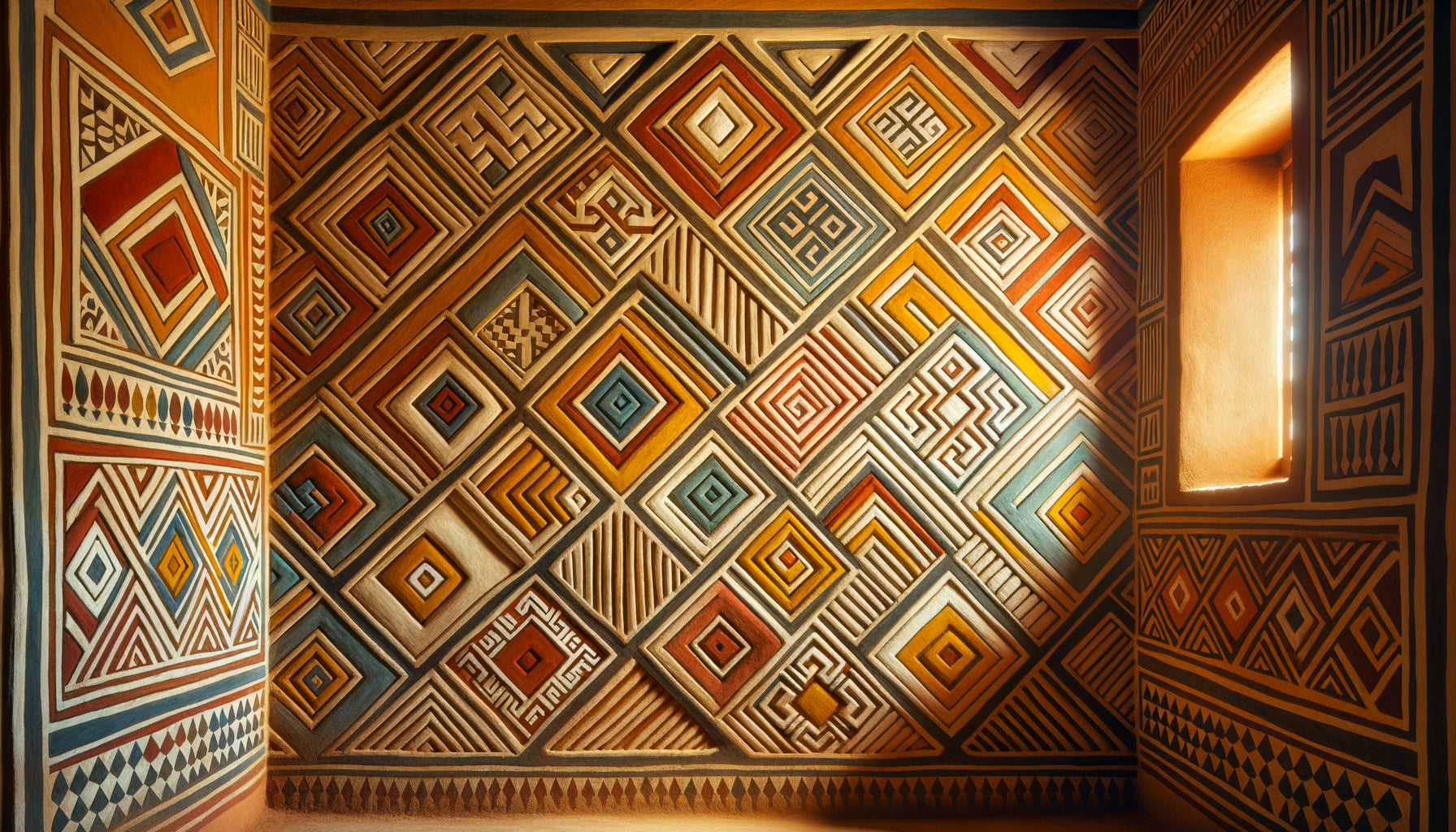
When a Samburu woman builds or renovates her traditional hut, she naturally transposes these codes onto the clay walls. The wall motifs take up the horizontal bands of necklaces, the chromatic alternations of bracelets. Red ochre recalls the dye used for hair and skin. White limestone evokes the white beads of ceremonial adornments. Charcoal black echoes the dark necklaces worn during certain rites.
This continuity is not accidental. In Samburu thought, the body and habitat form a continuum. The house is literally an extension of the social body. Decorating one's home with the same motifs as one’s adornments creates a visual harmony that reinforces cultural and personal identity.
The symbolic palette: when each color tells a story
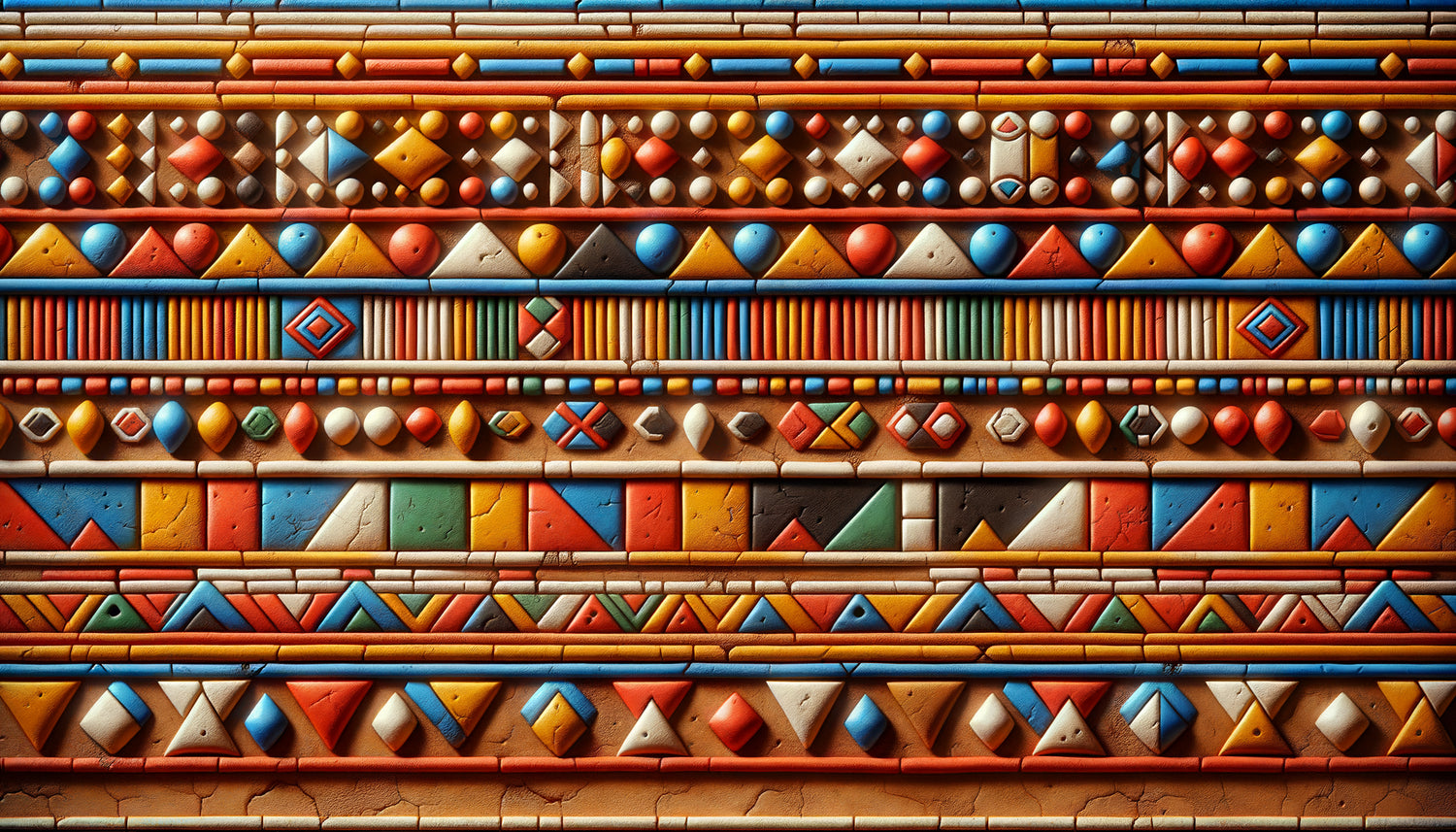
Red dominates the Samburu visual universe. On the body, it comes from a mixture of ochre and animal fat that warriors apply daily. On the walls, this shade appears in wide horizontal bands, often at eye level, creating an immediately recognizable chromatic signature. Red symbolizes vital force, courage, and the link with livestock, which constitutes the people's wealth.
The white of the pearls finds its equivalent in lime or white ash plasters. These clear lines traverse facades, delineate openings, emphasize important areas. They evoke purity, moments of transition, celebrations. A woman who has just given birth will wear more white; her home will also receive additional touches of white.
The blue and green, rarer in traditional adornments but appearing with commercial beads, are now found in some contemporary wall patterns. They testify to the aesthetic evolution of the Samburu people, their ability to integrate new influences without losing their visual coherence.
Geometric patterns: from necklace to wall
The parallel horizontal bands constitute the fundamental motif. On a necklace, they stack red, white, and blue beads according to a codified order. On a wall, they unfold into continuous friezes that run around the dwelling. This repetition creates a soothing visual rhythm, a silent music that structures space.
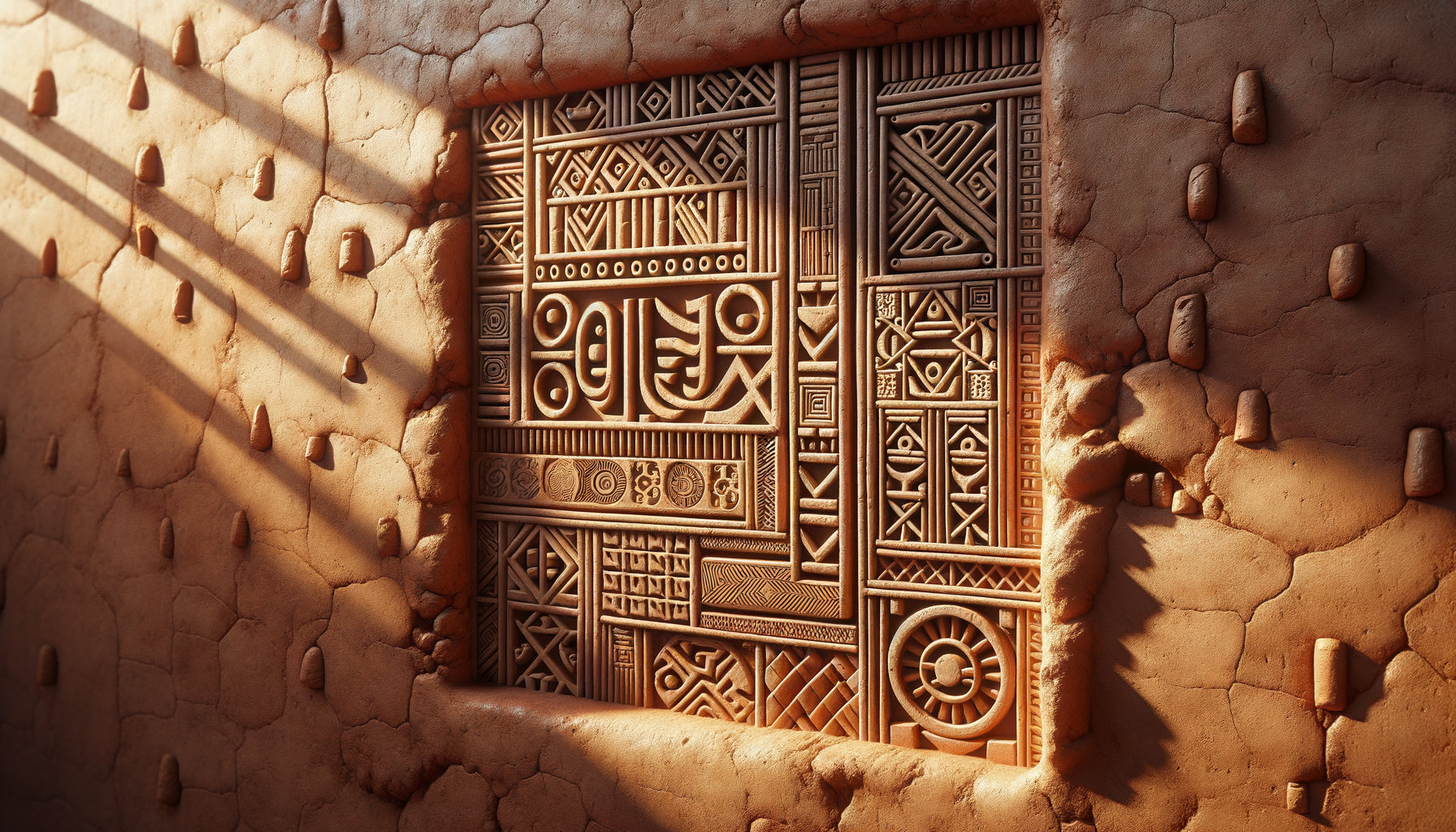
The triangles and chevrons appear in the most elaborate beaded ornaments, notably ceremonial pectorals. The same geometric shapes are found engraved or painted near entrances, windows, and reception areas. They guide the eye, mark spatial transitions, and symbolically protect passages.
The concentric circles, frequent in earrings and some pendants, inspire circular patterns on facades, often around openings. They represent the community, the cattle enclosure (the kraal), the circularity of time and seasons that rhythm pastoral life.

The ancestral technique: from bead to plaster
Making a Samburu necklace requires patience and precision. Each bead is threaded according to a mental pattern passed down from mother to daughter. The colors alternate in memorized sequences, never random. The same rigor applies to wall decorations.
Women – for they hold this decorative knowledge – first prepare their pigments. Red ochre comes from ferruginous earth collected from specific locations. White comes from ground limestone or bone ash. Black is obtained by calcining wood. These natural materials create a limited but harmonious palette, identical to that of body adornments.
The application follows a precise order. First, the base plaster made of cow dung mixed with clay – a material that regulates temperature and humidity. Then, once dry, the first bands of color, generally horizontal. Finally, the secondary patterns, the details, the personal touches. Each layer must dry before the next, just as one lets a pearl necklace rest between work sessions.
The gestural itself is similar. The fingers that meticulously align the pearls on a thread find the same precision in tracing a perfectly straight line on a clay wall. It's the same eye training, the same mastery of detail, the same pride in artisanal excellence.
Habitat as collective adornment
If body ornaments distinguish the individual within the group, wall patterns unify the community. A Samburu manyatta – this circular village of temporary huts – presents a remarkable visual coherence. Each house displays variations on the same decorative themes, creating an overall harmony without stifling uniformity.
This approach transforms the village into a collective artwork. Walking through a manyatta is like walking through a gallery where each facade dialogues with the others. Patterns respond to each other, colors harmonize, rhythms complement each other. Habitat becomes aesthetic performance, a visible cultural affirmation from afar in the savanna.
The celebrations and rites reinforce this link. During a wedding, the new bride receives her most beautiful pearl adornments. Simultaneously, her future home is redecorated with particularly elaborate patterns. Body and architecture are embellished together, prepared together for this new chapter. Guests admire as much the splendor of the necklaces as that of the freshly decorated walls.
A decorative philosophy relevant today
This total aesthetic coherence questions our contemporary practices. We often separate our clothing style from our interior decoration. We wear geometric patterns but live in minimalist neutral spaces. We like bright colors on our clothes, but we fear them on our walls.
The Samburu teach us another path: that of harmony between oneself and one's space. Imagine transferring your favorite colors, your favorite motifs, your personal aesthetic sensitivity into your wall decoration. Not literally, but in spirit: creating a visual continuity that makes your interior the authentic extension of your identity.
This approach resonates particularly with current trends in interior design: personalization, authenticity, storytelling. A wall decorated according to this Samburu philosophy does not follow a fleeting fashion but expresses a lasting personal truth.

Inspiring without appropriating: respectful adaptation
How to integrate this wisdom into our interiors without falling into cultural appropriation? The key lies in the inspiration of principles rather than copying forms.
The principle of rhythmic repetition: instead of copying the Samburu red and white stripes, identify your own signature colors and create horizontal friezes that resemble you. The principle works with any palette.
The principle of body-space continuity: observe the patterns, textures, colors that you naturally wear. What jewelry do you choose? Which prints attract you? Transpose these elements into your wall decor, textiles, and decorative accessories.
The principle of personal symbolism: just as the Samburu use red for courage and white for purity, define what your colors mean. This layer of meaning transforms decoration into language, an affirmation of identity.
Natural materials constitute another valuable lesson. Samburu pigments come from local earth, plants, and minerals. Prioritize ecological paints, natural plasters, raw materials that age with grace rather than perfect but cold synthetic finishes.
Ready to create this aesthetic continuity between you and your space?
Discover our exclusive collection of African artworks that celebrate authentic artistic traditions and transform your walls into vibrant expressions of culture and identity.
Towards a decor that tells your story
Samburu artists have never conceived decoration as mere embellishment. Their wall motifs, direct heirs to their body ornaments, constitute a visual communication system where each color, each shape, each arrangement tells something essential about individual and collective identity.
This philosophy reminds us that our living spaces can be much more than just functional shells. They can become authentic extensions of who we are, visual narratives of our values, our journeys, our aspirations. Just as a Samburu woman proudly places her beaded necklaces on the walls of her home, we can create this aesthetic harmony between our personal presentation and our domestic environment.
The beauty of this approach lies in its universality. Whether you love Scandinavian minimalism, bohemian exuberance, or classic elegance, the principle remains the same: identify your personal visual language and deploy it consistently throughout your space. Your walls then become surfaces of expression, canvases on which your unique identity is inscribed.
Start simply. Observe the colors you instinctively wear. Note the patterns that attract you – geometric, organic, abstract? Then look for a wall – just one to start with – where you can transpose these elements. A colorful frieze in a hallway. A geometric pattern behind your bed. Horizontal stripes in your entrance. Let your space truly reflect who you are.
FAQ : Your questions about the Samburu inspiration
Can I use Samburu patterns in my decor without cultural appropriation?
Excellent question that demonstrates a necessary sensitivity. Cultural appropriation is taking elements of a culture without understanding their meaning or crediting their origin. To avoid this, draw inspiration from the principles of the Samburu – aesthetic continuity body-space, rhythmic repetition, symbolism of colors – rather than directly copying their specific patterns. Create your own visual language using their creative strategies. If you integrate authentic Samburu works or patterns, be sure they come from fairly compensated Samburu artists, and share their story. Respectful inspiration honors the source while creating something new and personal.
What colors should I choose to recreate this harmony in a modern interior?
There's no need to reproduce the red-white-black palette of the Samburu! The essential thing is to create your own color consistency. Start by identifying three to five colors that you regularly wear or that define you emotionally. Perhaps earthy tones if you love nature, deep blues if the ocean inspires you, dusty roses and grays if you prefer softness. Use these colors as the basis of your decorative palette: the dominant on large walls, the secondary in accents (cushions, frames, textiles), the tertiary in touches. This consistency instantly creates the desired harmony. The Samburu teach us less a specific palette than a method: building a consistent color language and deploying it everywhere.
How to integrate geometric patterns without overwhelming the space?
The fear of clutter is legitimate, but observe the Samburu manyattas: despite the abundance of patterns, the effect remains harmonious thanks to repetition and consistency. For a modern interior, adopt the rule of the single accent wall: choose a surface – behind the sofa, in the entrance, around a window – and concentrate your geometric patterns on it. Keep other walls neutral to balance. Favor clean-lined patterns: simple horizontal stripes, minimalist chevrons, discreet circles. The masking tape technique allows you to experiment before painting definitively. Start modestly: three horizontal stripes in two colors already create a significant visual impact. You can always enrich gradually. The Samburu approach does not require complexity, but consistency and intentionality.