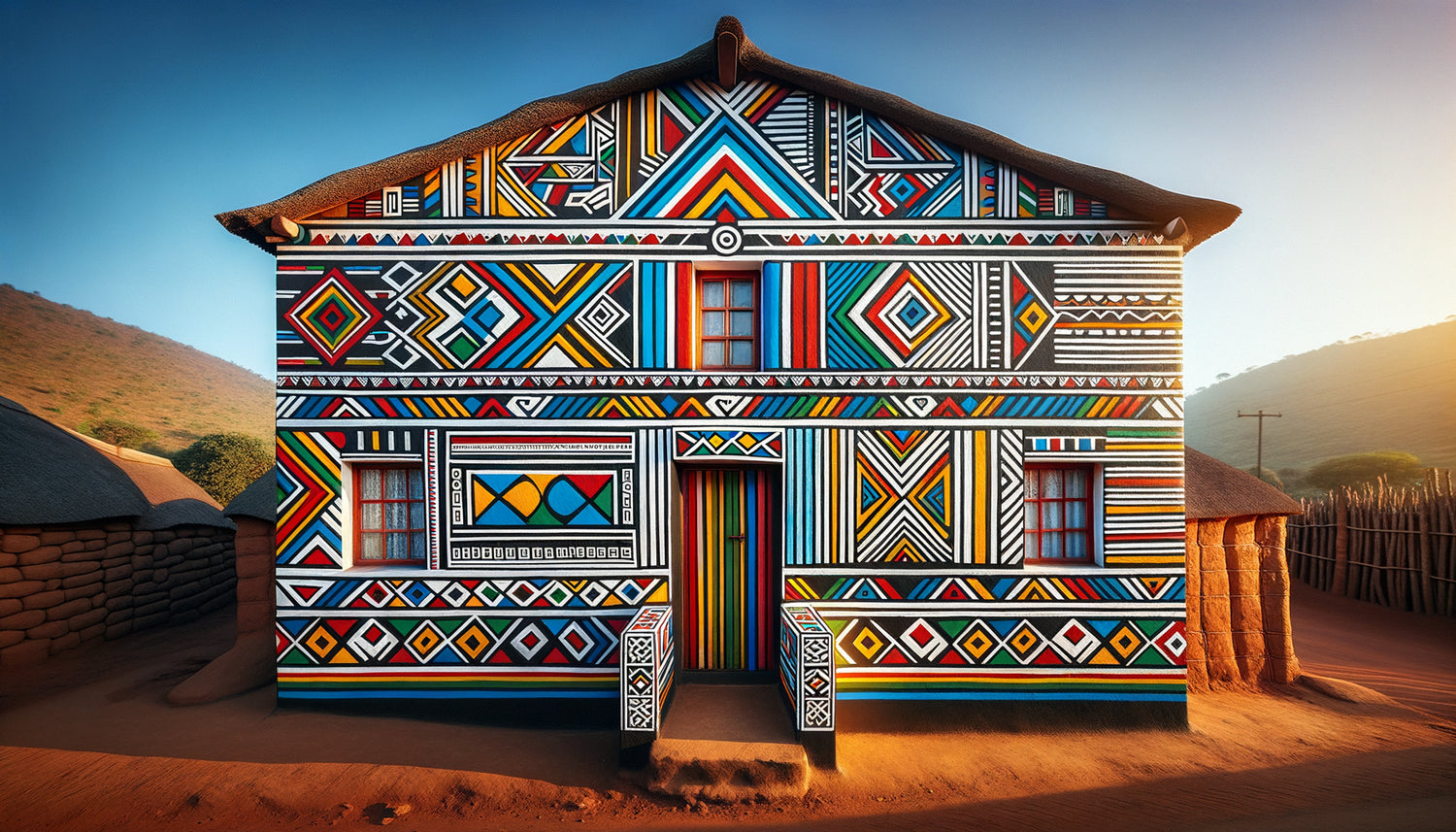
I still remember that morning in 2018, at the heart of Mpumalanga province in South Africa. Before me, a Ndebele house literally exploded with colors: fuchsia triangles, electric turquoise zigzags, black and white checkerboards of astonishing architectural precision. This sacred geometry, applied freehand to earth walls, told a story of resistance, identity and pure creativity that I had never seen elsewhere. In ten years of documentaries on African wall art, this discovery profoundly transformed my understanding of what a wall can mean.
Here's what Ndebele murals bring to the world of contemporary design: a radical geometric aesthetic that challenges our Western codes, a visual communication system of rare sophistication, and a masterful lesson on transforming the ordinary into the extraordinary. Three dimensions that explain why these homes have become the absolute icon of African wall art, copied but never equaled.
You may have already come across these patterns on Instagram, clumsily reproduced on cushions or posters. You may have wondered where this particular aesthetic came from, this visual language that seems both ancestral and resolutely modern. The frustration is that no one has explained the context to you, the deep history that makes these paintings much more than a simple decorative style.
Rest assured: understanding the iconic status of Ndebele homes does not require a degree in anthropology. It simply takes going back to the sources, understanding three key moments in their history, and grasping how these female artists have transformed oppression into a visual manifesto. In this article, I take you to the heart of this aesthetic revolution that continues to influence designers, architects and muralists around the world.
The birth of a language: when wall painting becomes an act of resistance
The history of Ndebele murals truly begins in the 19th century, in a context of violent confrontation. After a military defeat against the Boers in 1883, the Southern Ndebele people lost their land, their livestock, and their social structure. Families are scattered, men sent to work on farms and in mines. It is in this context of oppression that Ndebele women take up the brushes.
Because yes, Ndebele murals are exclusively made by women, and that detail is nothing anecdotal. Faced with the prohibition of speaking their language publicly, faced with the systematic destruction of their traditions, these artists invented a visual communication system of remarkable ingenuity. Each pattern, each color, each geometric combination becomes a visual alphabet, a way to transmit cultural identity without words.
The house itself transforms into a monumental canvas. Exterior walls, courtyards, door frames: everything becomes a support for expression. Initially using natural pigments – ochre earths, charcoal, white lime – the Ndebele women develop an aesthetic based on straight lines, right angles, perfect symmetry. No curves, no apparent improvisation: each stroke is calculated, each composition obeys strict rules passed down from mother to daughter.
The chromatic explosion: when modernity meets tradition
A major turning point occurs in the 1940s-1950s, with the arrival of industrial acrylic paints. This technological revolution will propel Ndebele wall art into a totally new aesthetic dimension. Imagine: overnight, the palette limited to natural tones explodes into electric blues, fuchsia pinks, emerald greens, flamboyant oranges. It's as if black and white suddenly went Technicolor.
This enthusiastic adoption of modern color does not betray tradition: it amplifies it. Ndebele women intuitively understand that these bright colors will give unprecedented visibility to their art. And they are right. In a South African landscape dominated by ochre and khaki tones, Ndebele homes become impossible-to-ignore visual beacons. Each house becomes a screaming affirmation of identity, visible for miles.
The motifs themselves evolve subtly. While geometry remains fundamental, new symbols appear: stylized representations of razors, light bulbs, cars. These elements of modern life are integrated into the traditional visual vocabulary, creating a fascinating hybrid language. This ability to adapt, this assumed modernity without renunciation of ancestral codes, largely explains why Ndebele aesthetics resonate so strongly today.

Sacred geometry: decoding the composition system
What immediately fascinates in an Ndebele home is the apparent mathematical order of the composition. Nothing is left to chance. The walls are divided into rectangular zones, each receiving a specific motif. These zones dialogue with each other according to principles of symmetry, repetition and chromatic contrast of rare sophistication.
The main patterns constitute a limited but infinitely combinable vocabulary: the isihlangu (triangle), the lipopo (rectangle), chevrons, checkerboards, staircases. Each shape possesses multiple symbolic meanings. A triangle can represent a sacred mountain, but also femininity, family, protection. Staircases symbolize growth, social advancement, and passage between worlds.
True mastery is revealed in the balance of solids and voids. An Ndebele artist knows that a densely decorated area must be counterbalanced by a more subdued area. That intense black makes bright colors stand out. That repetition of a pattern creates an hypnotic visual rhythm. This intuitive understanding of compositional principles makes these women true visual architects, long before the emergence of modern graphic design.
From village to museum: international consecration
The shift towards international recognition begins in the 1980s. Anthropologists, photographers, and art historians discover these dwellings and realize they are facing a major form of art, unjustly ignored. Images begin to circulate in design magazines, contemporary art exhibitions, and architecture books.
The most famous artist, Esther Mahlangu, becomes the global ambassador for this art. Born in 1936, trained from childhood by her mother and grandmother, she achieves the unthinkable in 1991: BMW commissions her to decorate a collector's car. A BMW Art Car entirely covered with traditional Ndebele patterns. The visual impact is immediate. Suddenly, this rural wall art dialogues on equal terms with Western avant-garde.
International orders pour in: monumental murals in New York, collaborations with luxury houses, exhibitions in the world's leading museums. But this success raises a crucial ethical question: how to preserve authenticity when cultural appropriation threatens? Ndebele women respond by maintaining control of their art, refusing commercial simplifications, and rigorously training new generations. Iconicity, yes, but not at any price.

The influence on contemporary design: from Africa to the world
Today, Ndebele aesthetics permeate global design. Architects draw inspiration from it for building facades. Graphic designers reinterpret these geometries in visual identities. Fashion creators transpose these patterns onto fabrics. This influence goes far beyond simple formal borrowing.
What contemporary design retains from Ndebele homes is a philosophy of maximum visual impact. The idea that a wall is never just a wall, that it can become a manifestation, a poem, a cry. That color is not decoration but necessity. That geometry can be both rigorous and joyful, structured and exuberant. These apparent paradoxes constitute the very DNA of Ndebele mural art.
Street artists around the world also acknowledge their debt. This idea of transforming public space into a territory of expression, of visually asserting one's identity in the face of oppression: that is exactly what graffiti artists have been doing since the 1970s. Ndebele women were street artists before the term was invented, armed not with spray cans but with artisanal brushes and an unwavering determination.
Why this aesthetic still speaks to us today
If painted Ndebele homes remain iconic, it is because they respond to deep contemporary aspirations. In a digital world saturated with soft curves and subtle gradients, their frank and assumed geometry refreshes the gaze. At a time when Scandinavian minimalism dominates, their chromatic maximalism offers a liberating alternative.
More deeply, these murals embody a form of creative resistance that resonates particularly strongly today. Faced with global standardization, faced with the homogenization of aesthetics, Ndebele art demonstrates that it is possible to remain radically oneself. That constraint can become a creative engine. That oppression can be transcended by beauty.
It is also a lesson in accessibility: this art does not require expensive materials, no academic training, no institutional validation. Just earth, pigments, walls, and a sacred intergenerational transmission. In our era obsessed with the democratization of creativity, Ndebele women have been showing the way for over a century.
Let the energy of African wall art transform your interior
Discover our exclusive collection of African artworks that capture the same visual power and cultural authenticity. Each work tells a story, carries a tradition, affirms an identity.
Integrating the Ndebele spirit into your home: beyond imitation
The temptation is great to directly reproduce Ndebele motifs in our interiors. But the true tribute does not lie in servile copying. It is rather about understanding the fundamental principles and adapting them to our context.
First, learn this lesson in contrast: dare to juxtapose bright colors that you would never spontaneously pair. Fuchsia pink and turquoise blue can coexist harmoniously if you respect the balance of surfaces. Then, embrace geometry: straight lines, sharp angles create a visual structure that allows for bold chromaticism to work.
Also think of space like the Ndebele women do: each wall can have its own personality while participating in an overall harmony. One wall becomes the colorful focal point, others remain neutral to let it breathe. This zoned, architectural approach radically transforms the perception of a space.
Towards a Bright Conclusion
The painted homes of the Ndebele people have become iconic because they embody a fundamental artistic truth: creativity often arises from constraint, and identity is most strongly affirmed in the face of adversity. These explosive walls of color and geometry are not mere decorations. They are declarations of existence, visual manifestos, acts of joyful resistance.
In your own space, you can draw inspiration from this philosophy. Not by clumsily copying sacred motifs, but by daring to affirm your own visual identity with the same conviction. By transforming your walls into territories of expression rather than neutral surfaces. By understanding that color and form can be bearers of meaning, not just aesthetics.
The next time you contemplate a photograph of an Ndebele home, look beyond the immediate beauty. See the hands of these women artists, the millennial transmission that guides each stroke, the determination that transforms earth into canvas. It is this depth that creates iconic status. It is this authenticity that transcends decades and continents. And it is this same authenticity that you can cultivate, on your scale, in your own environment.
FAQ
Can I buy authentic paintings made by Ndebele artists?
Yes, absolutely, and it's the best way to honor this art while directly supporting communities. Several Ndebele artist cooperatives offer authentic works on canvas or panels. Look for galleries specializing in contemporary African art that work directly with artists and guarantee fair compensation. Esther Mahlangu herself sells some artworks through internationally recognized galleries. Beware of industrial reproductions that do not contribute anything to the communities of origin. Authenticity has a price, but it guarantees that your purchase contributes to perpetuating this living tradition and training new generations of artists.
Is it cultural appropriation to use Ndebele motifs in my decor?
This legitimate question deserves a nuanced answer. Problematic appropriation occurs when one takes possession of cultural symbols without understanding their meaning, without crediting the origin, and especially without the communities of origin benefiting from it. On the other hand, appreciating this art, studying it, acquiring authentic works from Ndebele artists fairly compensated: that's called cultural respect and admiration. The key lies in intention and action. If you integrate Ndebele elements into your home, do so by knowing their history, crediting them properly to your guests, and favoring authentic creations over anonymous commercial copies. Art builds bridges between cultures when it is approached with awareness and respect.
How to get started if I want to create my own geometric compositions inspired by this art?
Start by immersing yourself visually: study dozens of photos of Ndebele homes to understand the principles of composition rather than copying specific patterns. Note how artists balance full and empty, how they use repetition and symmetry, how colors respond to each other. Then, work on paper with simple tools: ruler, set square, colored pencils. Initially limit yourself to three or four colors to understand color dynamics. Practice freehand straight lines; it's more difficult than it seems but that’s what gives compositions a lively and human touch. Finally, when you move to the wall, start small: a door frame, a removable panel. The essential thing is to develop your own geometric language rather than servilely reproducing.