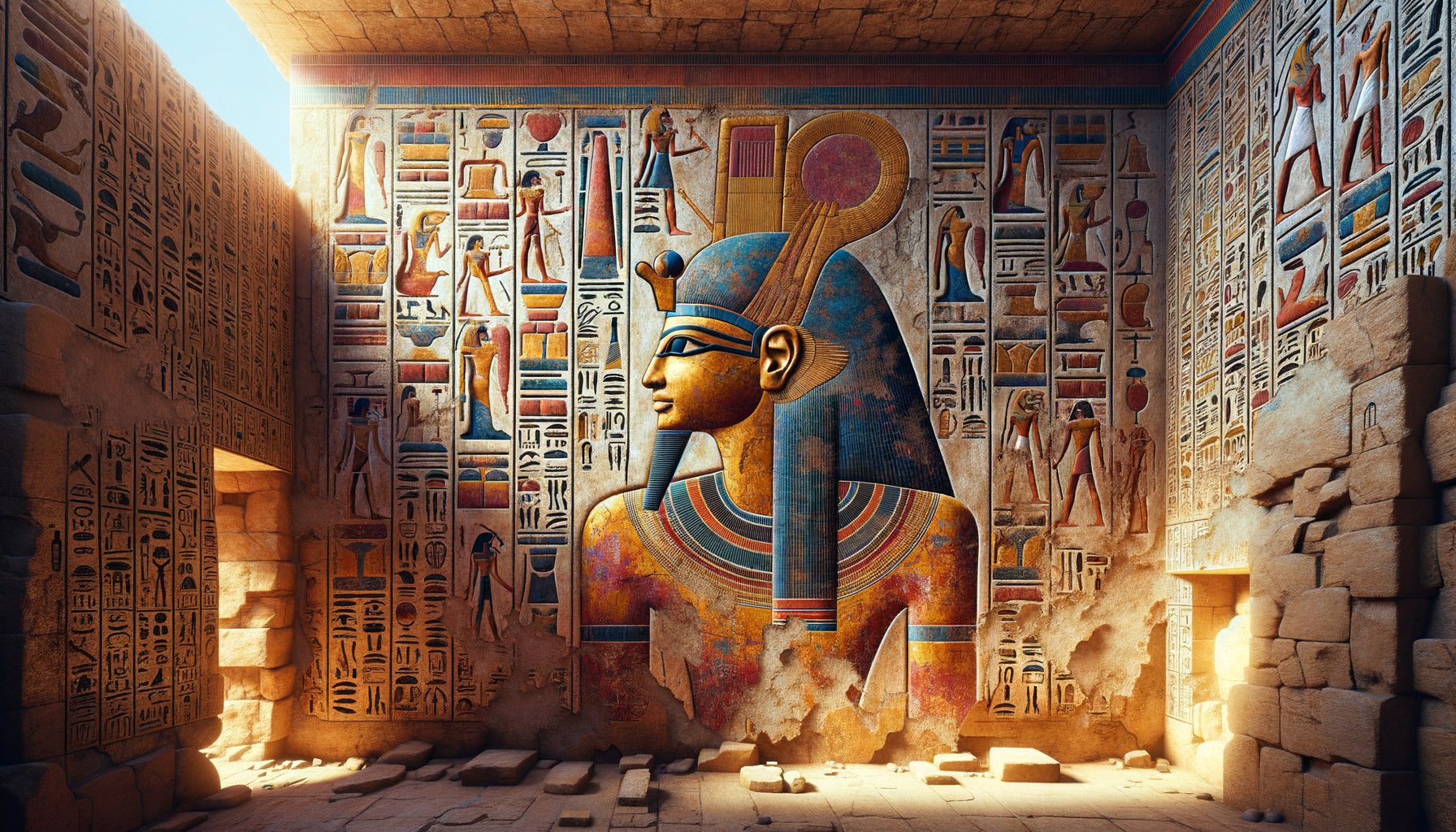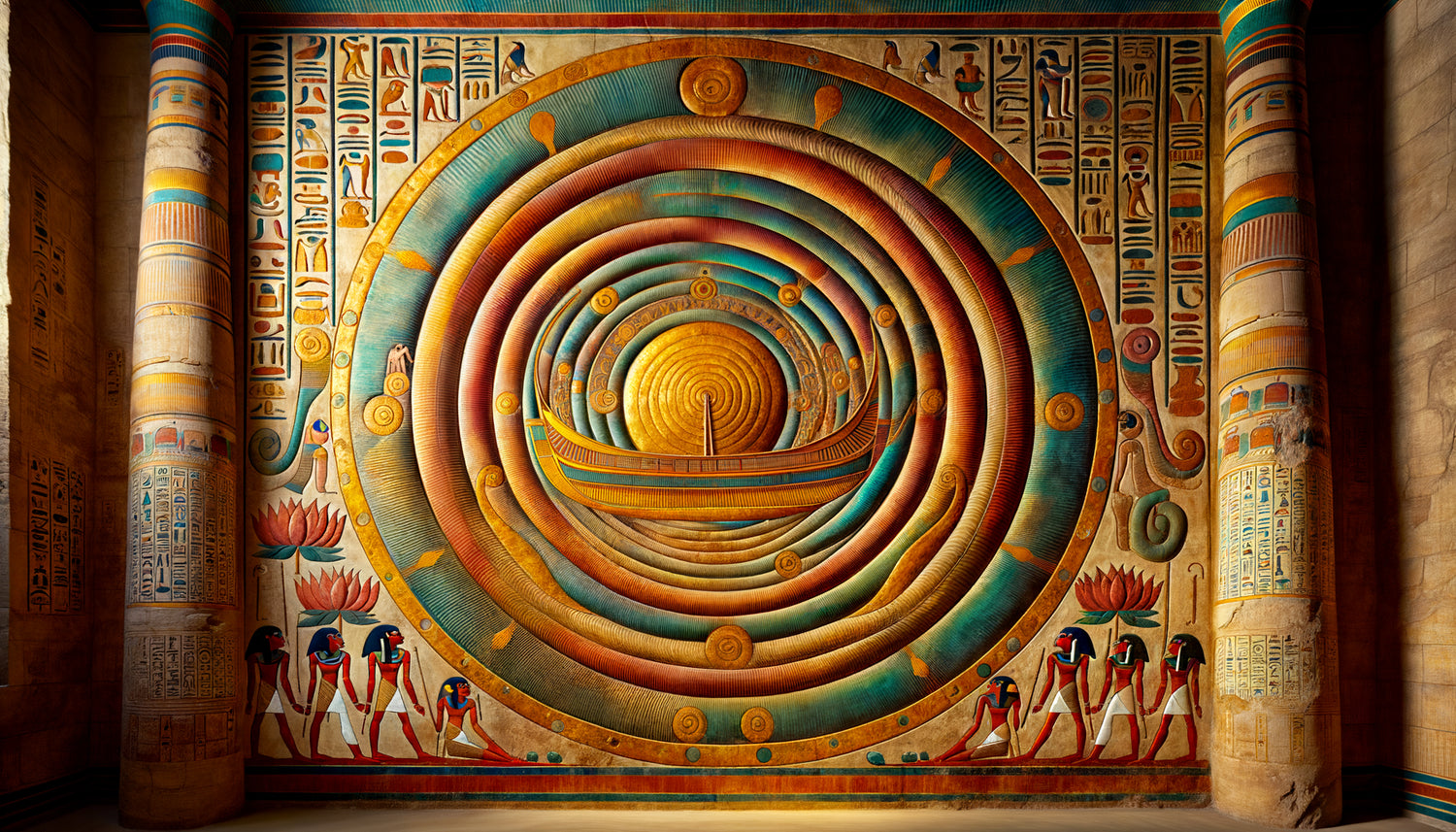
The first time I photographed a spiral carved into the walls of the Temple of Kom Ombo, I felt an immediate connection with something universal. This hypnotic form, repeated for over 5000 years in Nile Valley wall art, is not merely decorative ornamentation. It's a profound visual language that has traversed pharaonic dynasties, carrying symbolism as rich as the river itself.
Here’s what the spirals of Nilotic wall art reveal: a representation of the eternal cycle of life and death, an invocation of the creative power of primordial waters, and a mystical connection with the cosmos and its circular energies. These recurring motifs transform each ancient wall into a visual meditation on infinity.
You may admire the aesthetics of Egyptian hieroglyphs and bas-reliefs without grasping the depth of the geometric symbols that accompany them. The spirals seem decorative, almost accessory to the spectacular figurative representations. Yet, neglecting their meaning is missing an essential key to understanding Egyptian cosmology.
Rest assured: decoding the symbolism of spirals in Nile Valley wall art does not require years of Egyptology. Once you understand the three fundamental dimensions of this motif – aquatic, cosmic and spiritual – your view of Nilotic art changes radically. Each spiral becomes a window open onto the mindset of a millennial civilization.
In this article, I take you on a visual and symbolic journey along the Nile, from the mastabas of Saqqarah to the temples of Nubia, to reveal how these enchanting curves continue to inspire our relationship with space and the sacred.
Primordial water: when the spiral tells the birth of the world
In Egyptian mythology, everything begins with Nun, that primordial ocean from which the first land emerges. The wall spirals of funerary temples precisely embody this emergence movement. Look carefully at the frescoes in the Temple of Seti I in Abydos: the spirals evoke aquatic whirlpools, those eddies that announce creation.
This aquatic symbolism is not abstract for the ancient Egyptians. The Nile itself draws spirals in its course, creating these fertile meanders that punctuated their entire existence. The spiral thus becomes the visual expression of the nourishing river, this vital force that brought the annual flood, guaranteeing abundance and survival.
On the walls of the Theban tombs, artisans engraved intertwined spirals to represent the union of celestial and terrestrial waters. This duality - so characteristic of Egyptian thought - finds in the spiral its most elegant expression: a movement that descends from the sky and rises from the depths simultaneously.
Double spirals: dialogue between the two kingdoms
Particularly fascinating are the double spirals found in the architectural decorations of the Old Empire. They symbolize Upper and Lower Egypt, these two lands unified under the pharaoh's crown. Each volute winds in an opposite direction, creating a dynamic balance - a visual metaphor for political and cosmic harmony.
The solar journey: spirals and cosmic cycles
Look up at the ceilings of the hypogea in the Valley of the Kings. Spirals coexist with astronomical representations, and this is no coincidence. For the Egyptians, the spiral embodied the cyclical path of the sun: Re who is born at dawn, culminates at noon, dies at dusk and is reborn after his nocturnal journey through the underworld.
This circular conception of time - so different from our modern linear vision - finds its perfect form in the spiral. Unlike the closed circle, the spiral suggests a return that is never identical, a progression in repetition. Each sunrise resembles the previous one while being unique: this is what these enigmatic curves tell.
In Ptolemaic temples such as Dendera, the ornamental spirals of the Hathor capitals also evoke the goddess's hair curls, but also celestial trajectories. The architecture itself becomes cosmological, each decorative detail carrying multiple levels of symbolic reading.

How spirals guide the soul towards eternity
The funerary dimension of spirals in Nilotic mural art is perhaps the deepest. On sarcophagi and walls of burial chambers, these motifs literally trace the path that the deceased must take. The spiral becomes an initiatory labyrinth, a graphic representation of the journey to the afterlife.
I spent hours studying the spirals painted in the tombs of nobles from the Ramesside period. Their arrangement is never random: they create a visual movement that guides the gaze - and symbolically the soul - from the earthly world to the celestial spheres. It is a spiritual map inscribed in stone.
The direction of rotation: a reversed meaning
A crucial detail: the direction of a spiral's winding radically changes its meaning. Dextrogryre spirals (turning to the right) evoke expansion, growth, life unfolding. Levorotatory spirals (to the left) suggest a return to origins, introspection, sometimes regenerative death. This subtlety often escaped Greek and Roman copyists, but never Egyptian artisans.
From Nagada to Meroe: regional variations of a universal motif
The symbolism of spirals evolves as you travel up or down the Nile. In predynastic Egypt, ceramics from the Nagada culture feature simple, almost abstract spirals that already seem to evoke water and movement.
Further south, in the Nubian temples of Meroe and Napata, spirals take on a more vegetal dimension. They intertwine with floral motifs, evoking fertility and the perpetual regeneration of nature. This regional adaptation shows how a symbol can remain fundamentally identical while taking on local nuances.
The Greeks, fascinated by Egypt, adopted and transformed this spiral motif. But by transplanting it into their architecture (think of Ionic volutes), they often lost the original symbolic depth to retain only formal elegance. The spiral became decoration where it was once cosmogony.

Contemporary resonances: why these spirals still move us
Today, when a designer incorporates spirals inspired by Nilotic wall art into a contemporary interior, they activate - consciously or unconsciously - this millennial symbolic reservoir. These forms speak to us at a preverbal level, evoking universal archetypes: flow, cycle, transformation.
In my photographic practice, I have found that Egyptian wall spirals create an incomparable hypnotic effect. They invite the eye to a circular movement, never to a definitive stop. This is exactly what modern interior decoration seeks: visual elements that create dynamism without aggression, energy without tension.
The spirals of the Nile Valley also embody a fascinating mathematical sophistication. Long before the Western discovery of the golden spiral or the Fibonacci sequence, Egyptian artisans intuitively mastered these harmonious proportions that resonate with our innate perception of beauty.
Integrate this symbolism into your living space
Unlike hieroglyphs that require a literal translation, spirals communicate directly through their form. A painting depicting spiral patterns inspired by Nilotic mural art immediately brings a contemplative dimension to a space. It creates a focal point that invites the eye to move, to visual meditation.
Let the millennial symbols of the Nile transform your interior
Discover our exclusive collection of African paintings that celebrate the symbolic richness of ancestral mural art and create an atmosphere of timeless serenity.
Spirals as a bridge between past and present
What makes the spirals of Nilotic mural art so powerful is their ability to cross millennia without losing their evocative power. They are not relics frozen in museums, but living forms that continue to inspire artists, architects and decorators.
Whenever you contemplate a spiral - whether engraved on a wall of Karnak or reproduced in a contemporary composition - you participate in a symbolic continuity that goes back to the origins of civilization. You connect with this fundamental intuition: that life is not linear but cyclical, that every end announces a new beginning.
The Nile Valley bequeathed us much more than spectacular monuments. It passed on to us a visual vocabulary of unfathomable depth, where each curve tells the story of the universe. Spirals are perhaps its purest expression: simple in appearance, infinite in meaning.
By integrating these motifs into your everyday environment, you are not just adopting an aesthetic style. You invite this millennial wisdom into your life that saw in every geometric form a cosmic truth. You create a space where time slows down, where the eye can follow these soothing curves and rediscover, for an instant, that primordial connection with the natural cycles that our era too often makes us forget.
Frequently Asked Questions
Where can we see the most beautiful spirals of Egyptian mural art?
The most remarkable examples are found in the temples of Karnak and Luxor, particularly on the columns' capitals. The tombs of the Valley of the Kings also present magnificent painted spirals, notably in the tomb of Seti I. For a more intimate approach, the mastabas of Saqqara offer spirals engraved with extraordinary finesse. If you visit Egypt, do not neglect Nubian sites such as Philae where the spirals take on more vegetal forms. The Cairo, Louvre and British Museum museums also preserve precious architectural fragments adorned with these fascinating motifs.
Did Egyptian spirals influence other cultures?
Absolutely. The influence of Nilotic wall art spread throughout the Mediterranean basin. The Minoans of Crete adopted and adapted the spirals in their palace frescoes, creating their own decorative language. The Greeks subsequently integrated these motifs into their architecture, particularly in the volutes of Ionic capitals. Further afield, echoes of this spiral symbolism can be found in Celtic art and even in some sub-Saharan African traditions. It is a fascinating testament to how symbols travel and transform while retaining their essence.
How to incorporate the symbolism of Nilotic spirals into my decor without falling into pastiche?
The key is to prioritize spirit over literal copying. Opt for contemporary works that reinterpret spiral motifs with a modern sensibility – think abstract paintings that evoke cyclical movement rather than direct reproductions of ancient frescoes. Earthy colors, ochre and turquoise naturally recall the Nilotic palette without being too literal. A single strong element is enough: a large painting with stylized spirals can anchor an entire room. Combine it with minimalist furniture to create a dialogue between tradition and modernity. The goal is to capture the contemplative energy of these millennial symbols while remaining resolutely contemporary.