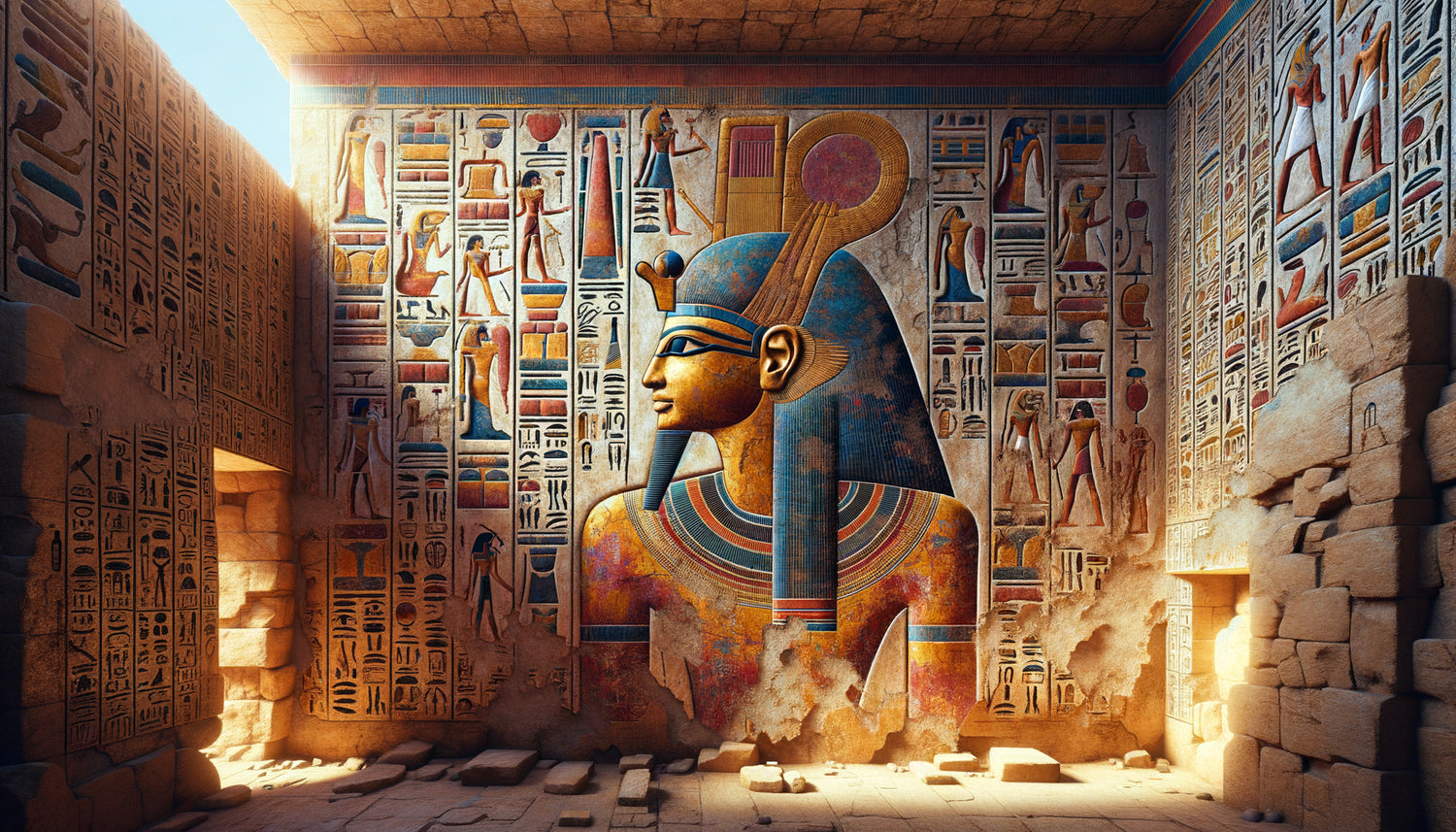
Imagine standing before an ochre millennium-old wall, somewhere between the Nile and the Nubian desert. The crimson red, cobalt blue, and pale gold pigments tell a fascinating story: that of a kingdom in Africa which, for nearly 1000 years, dialogued with Egypt while asserting its own identity. The frescoes of the Kingdom of Meroë pose a troubling question to anyone contemplating these faces with delicate features and hieratic silhouettes: are we admiring Egyptian gods transplanted to the south, or witnessing the emergence of a deeply Nubian spirituality?
Here's what the frescoes of Meroë reveal: an extraordinary religious syncretism where Egyptian deities and Nubians coexist in a reinvented iconography, a cultural affirmation that transcends imitation to create a unique visual language, and a valuable testimony on the spiritual autonomy of an African empire too often reduced to the shadow of its northern neighbor. This divine ambiguity is not confusion; it is precisely what makes these works extraordinary.
For enthusiasts of African history and decoration inspired by ancient civilizations, these frescoes represent a frustrating mystery. The temples of Meroë have come down to us fragmented, their colors erased by 2000 years of sand and wind. How can we distinguish Egyptian influence from local innovation when archaeologists themselves still debate the interpretation of each symbol?
Rest assured: by exploring recent discoveries at the sites of Meroë, Naga, and Musawwarat es-Sufra, we can now trace the contours of this hybrid spirituality. This article takes you into the sacred halls of a forgotten kingdom, where gods bear Egyptian names but Nubian faces, where hieroglyphs coexist with a partially indecipherable Meroitic script. Prepare to discover how a people transformed the heritage of their neighbors into a resolutely original artistic expression.
When Egyptian Gods Cross the First Cataract
The frescoes of the Kingdom of Meroë first testify to an undeniable fascination with the Egyptian pantheon. On the walls of the Temple of Amun in Naga, built in the 1st century AD, Amon-Rê reigns majestically, adorned with his two-feather crown. Isis and Osiris appear regularly in ritual scenes, recognizable by their traditional attributes: the throne and the ansate cross for one, the atef crown and the scepter for the other.
This massive presence of Egyptian deities in Meroitic art is explained by a long common history. For centuries, Nubia was under Egyptian domination, gradually absorbing the cults of its conquerors. The god Amon, in particular, became central to Nubian spirituality, to the point that the priests of Amun played a major political role in designating Meroitic rulers.
But look more closely at these wall paintings. The proportions differ subtly from classical pharaonic art. The bodies are stockier, the faces rounder, Negroid features asserted. The artists of Meroë did not slavishly copy Egyptian models: they adapted them, africanized them, imbued them with a distinctly Nubian aesthetic.
Apedemak, the lion-god who roared in Nubian
It is in the most remote sanctuaries that the true spiritual personality of Meroë reveals itself. Apedemak, the three-headed lion god, does not appear in any Egyptian pantheon. A local warrior deity, he majestically appears on the walls of the temple of Musawwarat es-Sufra, brandishing weapons and trampling enemies.
The wall paintings depicting Apedemak demonstrate the existence of a purely Meroitic cult, independent of northern influences. This protector god embodied the military power of the kingdom, its victories against nomadic desert tribes, its domination over trade routes. Represented sometimes anthropomorphic with a lion's head, sometimes as a majestic feline, Apedemak possessed his own temples, his specific rituals, his dedicated clergy.
Other local deities populate the wall paintings: Sebiumeker, the creator god represented with a complex feather crown, or various protective goddesses whose Meroitic names are still debated by researchers. These divine figures coexist peacefully with Egyptian gods, sometimes in the same ritual scene, testifying to an assumed and harmonious religious syncretism.
Meroitic iconography, between borrowing and invention
Detailed analysis of the wall paintings of Meroë reveals a sophisticated visual language that borrows from Egypt its grammar while creating its own vocabulary. The codes of representation – profile posture, hierarchy of sizes according to social importance, horizontal registers – come directly from pharaonic art. But the details betray a different sensibility.
The clothing depicted in the wall paintings shows local fabrics, jewelry with specifically Nubian geometric patterns, elaborate hairstyles distinct from Egyptian wigs. The Meroitic rulers proudly display their unique royal insignia: complex pectoral cords, particular ritual sandals, crowns that combine Egyptian elements and local innovations.
The colors themselves tell this hybridity. If the pigments used – ochres, Egyptian blues, charcoal blacks – are similar to those employed in the Nile Valley, their application reveals specific aesthetic preferences. Meroitic artists favored more marked contrasts, sometimes darker backgrounds, a palette that evokes the desert landscapes of Nubia rather than the black lands of Egypt.

The temples tell : architecture and spirituality intertwined
To fully understand the deities depicted in the frescoes, one must consider the architecture that houses them. The temples of Meroë present a fascinating mixed typology. Some, like the temple of Amun at Naga, follow the classic Egyptian plan: entrance pylon, peristyle courtyard, hypostyle hall, sanctuary. Others, such as the kiosk of Naga with its Hathor-capitaled columns, blend Egyptian, Greco-Roman influences and local traditions in a unique architectural synthesis.
This architectural diversity is reflected in the iconographic programs of the wall frescoes. In temples of the Egyptian type, the deities of the Nile naturally predominate. But even there, Nubian elements intrude: inscriptions in cursive Meroitic, representations of kings with assumed African features, scenes of local ceremonies interspersed between canonical Egyptian rituals.
The funerary chapels of the pyramids of Meroë – smaller and steeper than their Egyptian counterparts – housed frescoes that are now unfortunately very degraded. The surviving fragments show royal deceased being guided by a mixed pantheon to the afterlife, suggesting that even in death, the Meroitics navigated between two spiritual universes.
Deciphering the mystery : what the inscriptions reveal
One of the major challenges in interpreting the frescoes of the Kingdom of Meroë lies in the inscriptions that accompany them. Meroitic, written in an alphabet derived from Egyptian writing, can be phonetically read but remains largely misunderstood. We can identify the names of deities without always grasping their exact meaning or their precise theological role.
Some hieroglyphic Egyptian inscriptions accompany representations of Amun, Isis or Osiris, providing familiar keys to interpretation. But when Meroitic characters appear near Apedemak or other local deities, we enter a fascinating area of shadow. Researchers still debate: are these local adaptations of Egyptian concepts, or entirely original deities?
This linguistic veil adds an enigmatic dimension to the frescoes. Unlike Egyptian art, largely decoded thanks to the Rosetta Stone, the Meroitic wall paintings retain a share of mystery that stimulates the imagination and reminds us humanly that not all ancient civilizations have given up all their secrets.
A nuanced response to the question of divine origins
So, did the murals of the kingdom of Meroë depict local or Egyptian deities? The answer is delightfully complex: both, simultaneously and inextricably. Meroë was neither a simple cultural colony of Egypt nor a kingdom developing its spirituality in isolation.
The Meroitic elites practiced what could be called a religious bilingualism. They sincerely venerated Amun and Isis, gods who had acquired a profound local significance over the centuries. At the same time, they maintained vibrant indigenous cults such as that of Apedemak, thus affirming their distinct Nubian identity.
This coexistence was not contradictory in Meroitic logic. It testified to a theological sophistication where pantheons could interpenetrate without neutralizing each other. The wall paintings visually translate this spiritual fluidity: the same wall can show a Meroitic god-king receiving the blessing of Amun while bearing the attributes of Apedemak.

The legacy of the Meroë murals in contemporary African art
Today, the murals of the kingdom of Meroë inspire a new generation of African artists who are rediscovering these iconographic treasures. The Meroitic aesthetic – with its slender silhouettes, geometric motifs and assumed syncretism – resonates particularly within the contemporary context of reconciliation with pre-colonial heritage.
From Sudanese creators to diaspora designers, many draw on this millennial visual vocabulary to create contemporary works. The characteristic traits of the Meroitic deities – the power of Apedemak, the grace of the protective goddesses, the majesty of the deified rulers – are reinvented in painting, sculpture, textile design or interior decoration.
This rediscovery is not just artistic: it is part of a broader historical reassessment. Meroë demonstrates that there were civilizations in Africa with complex systems of theology, refined artistic production and an ability to integrate external influences without losing their identity. The Meroitic murals thus become symbols of cultural resilience and creative innovation.
Let ancient African civilizations inspire your interior
Discover our exclusive collection of African paintings that celebrate the rich iconography of the Nubian kingdoms and the artistic heritage of the continent, transforming your walls into galleries of living history.
Contemplate to understand: your own dialogue with history
The frescoes of the kingdom of Meroë ultimately teach us that there is no pure, isolated culture. Each civilization is a permanent dialogue between tradition and innovation, between inherited heritage and creativity. These millennial works, with their gods of multiple identities, embody this fundamental truth.
Imagine your own living space enriched by this timeless aesthetic. A wall adorned with motifs inspired by the Meroitic frescoes, reminding you daily that beauty often arises from the encounter between different traditions. Ochre and cobalt colors evoking the temples of Naga. Stylized silhouettes honoring both Amun and Apedemak, Egypt and Nubia, borrowing and invention.
Start modestly: an art book on Nubian civilizations, a photographic reproduction of the Musawwarat temples, a decorative piece inspired by Meroitic geometric motifs. Let these images dialogue with your daily life, as the Egyptian and Nubian gods dialogued on stone walls two millennia ago. History is never fixed: it comes alive when we invite it into our spaces and reflections.
Frequently Asked Questions
Where can we see the frescoes of the kingdom of Meroë today?
The original frescoes of Meroë are mainly located in Sudan, on the archaeological sites of Meroë, Naga and Musawwarat es-Sufra, although many are very fragmentary due to erosion. The National Museum of Sudan in Khartoum holds important fragments as well as reconstructions that allow you to appreciate the original colors and details. Some international museums such as the British Museum or the Berlin museum also possess elements from old archaeological expeditions. For those who cannot travel, numerous high-definition photographic resources are now available online, allowing you to explore these artistic treasures from home and draw inspiration for contemporary decorative projects.
How to distinguish an Egyptian deity from a Meroitic deity on the frescoes?
The distinction is not always obvious, which precisely reflects the religious syncretism of Meroë! Generally, Egyptian classic deities such as Amun, Isis or Osiris are identifiable by their traditional iconographic attributes: specific crowns, characteristic ritual objects (looped cross, scepter), and names written in Egyptian hieroglyphs. Local deities like Apedemak present unique characteristics: multiple leonine heads, warrior weapons, postures non-conforming to Egyptian canons, and inscriptions in Meroitic. However, many representations deliberately mix the two traditions, with gods bearing Egyptian names but Nubian attributes, or vice versa. This ambiguity is not a defect of our knowledge, but reflects the complex theological reality of Meroë, where divine boundaries were intentionally fluid.
How to integrate the aesthetics of Meroitic frescoes into contemporary decoration?
Integrating Meroitic aesthetics into a modern interior rests on a few key principles. First, prioritize the characteristic color palette: warm ochres, deep blues (reminiscent of Egyptian blue), intense blacks and touches of pale gold. These shades harmonize perfectly with natural materials such as linen, raw wood or terracotta. Then, incorporate geometric patterns inspired by the borders of frescoes – intersecting lines, chevrons, stylized checkerboards – through textiles, wallpapers or decorative objects. Stylized profile silhouettes, characteristic of Meroitic art, work beautifully in large wall formats, creating a dramatic focal point. Finally, don't hesitate to mix this ancient heritage with contemporary elements: the contrast between the millennial and the modern creates precisely the cultural dialogue that Meroë itself embodied. A minimalist approach with a few statement pieces avoids clutter while honoring this rich aesthetic tradition.