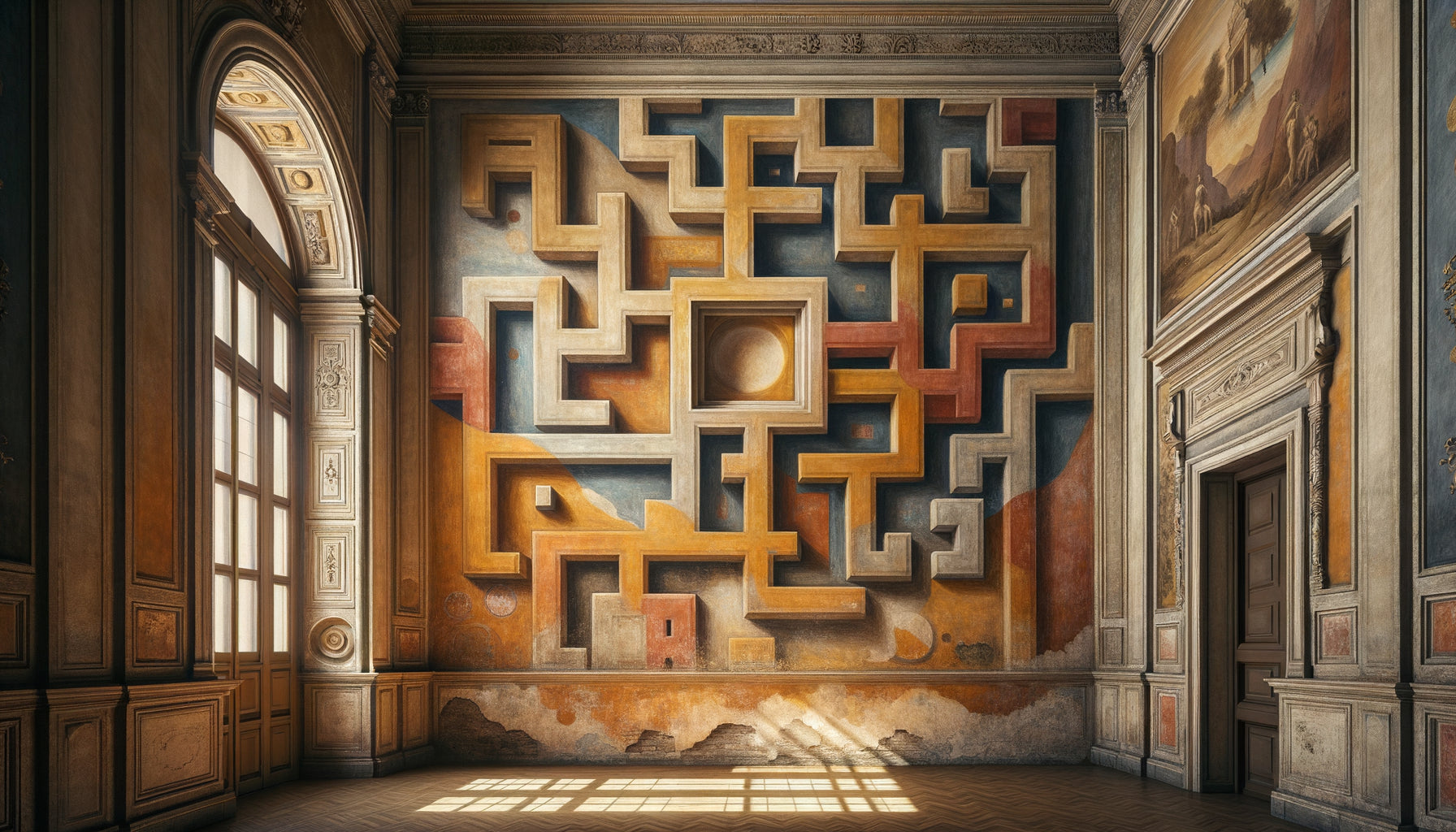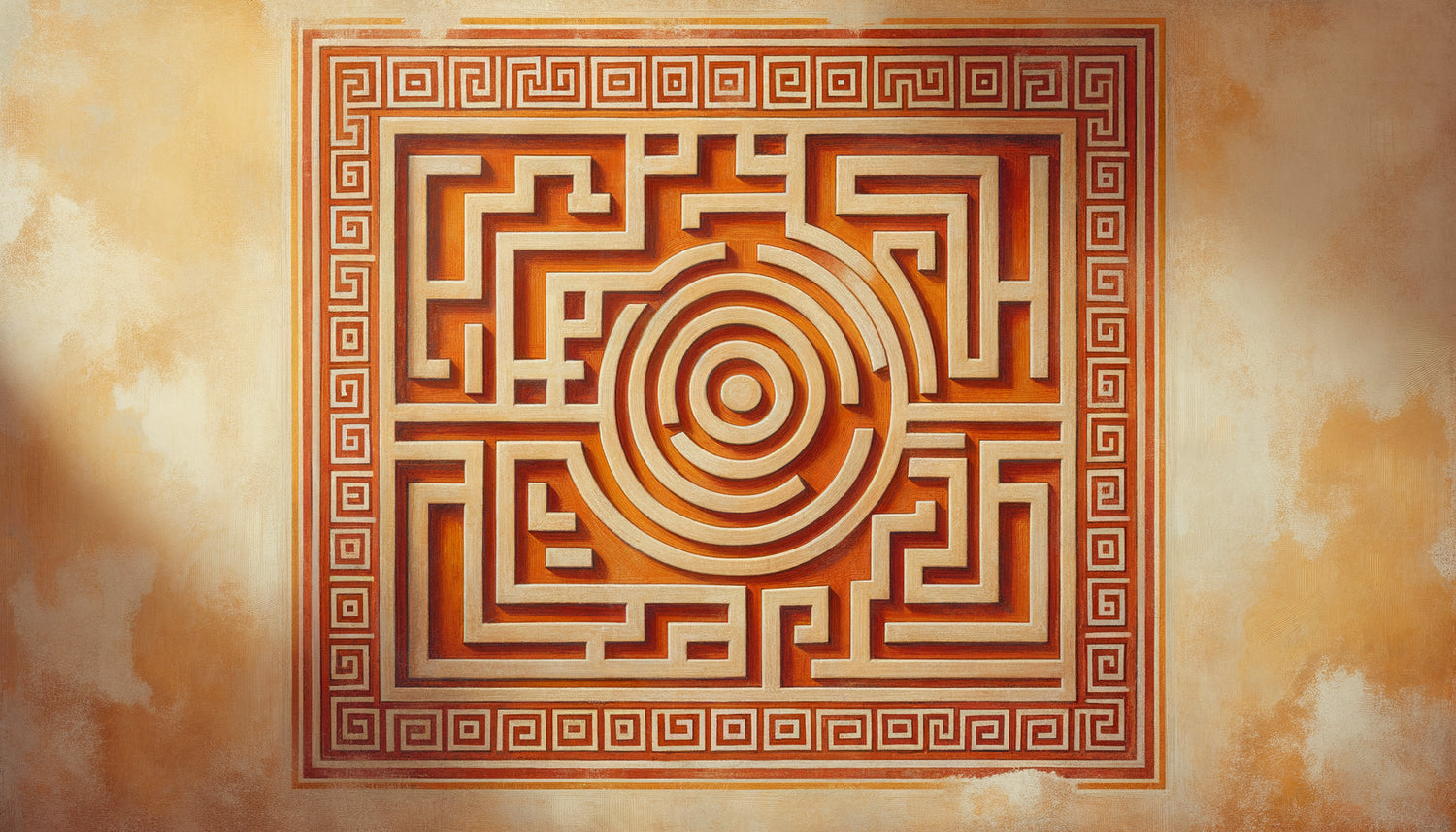
The other day, while restoring a client's villa on the hills of Nice, I discovered under three layers of modern paint a perfectly preserved Greek key pattern, hand-traced in the 1920s. This moment reminded me why these geometric lines continue to fascinate: they carry within them millennia of Mediterranean history.
Here's what Greek key patterns bring to your interior: a timeless connection with ancient Greece, a visual structure that naturally guides the eye, and a geometric elegance that transcends eras and decorative styles.
Many hesitate to incorporate these classic motifs, fearing a dusty museum effect or an overly academic atmosphere. I understand this apprehension. But after twenty years of working on murals in Provence and on the Côte d'Azur, I can assure you that a Greek key pattern well used becomes the subtle thread that unifies a space.
In this article, I invite you to explore the ancient roots of these broken lines that have adorned our walls for centuries, and how they have imposed themselves in Mediterranean wall abstraction.
The Greek meander: when geometry becomes spiritual
The Greek key pattern, also called a meander or fret, originates from ancient Greece in the 8th century BC. Contrary to what one might think, these broken lines are not just a simple decorative ornament: they symbolized the journey of life, with its incessant detours and returns.
The ancient Greeks traced these geometric patterns on their ceramics, temples, and clothing. Legend has it that the motif takes its name from the Meander River (now Menderes in Turkey), famous for its sinuous curves. But in reality, the geometric form stylizes this natural movement into a pure abstraction, almost mathematical.
On Attic vases that I have studied at the Louvre museum, one observes how the Greek key pattern defines narrative scenes, creating visual boundaries that structure the pictorial space. This function of border, of frame, will remain constant for three millennia.
The hidden symbolism in each angle
Each right angle of the Greek key pattern represented for the Greeks the idea of infinity and eternity. The line that always returns on itself without ever closing evoked the perpetual cycle of life and death, a central concept in ancient Greek philosophy.
From Ancient Rome to Pompeian villas
When Rome conquered Greece, it also adopted its aesthetics. Greek key patterns then spread throughout the Mediterranean basin, adorning mosaic floors, frescoed walls, and coffered ceilings.
In Pompeii, the vestiges of which have inspired many of my projects, wall frescoes systematically use the meander as a structuring element. In the Villa of the Mysteries, for example, the Greek bands delineate ritual scenes with precision that perfectly guides the viewer's gaze.
The Romans enriched the decorative vocabulary of the Greek key motif by combining it with palmettes, tendrils and other plant ornaments. This hybridization marks the beginning of what could be called Mediterranean classical wall abstraction: a visual language that blends pure geometry and stylized natural references.

The Renaissance of the motif: from Byzantium to European Renaissance
After the fall of Rome, the Greek key motif finds refuge in Byzantine art. In the Ravenna mosaics, I have always been struck by how Byzantine artisans use these geometric lines to create transitions between the earthly and the divine.
In the 15th century, the Italian Renaissance passionately rediscovers Greco-Roman antiquity. Greek key motifs return strongly in wall decorations, particularly in Raphael's grotesques at the Vatican. These ornaments become a marker of intellectual refinement and knowledge of ancient texts.
Neoclassicism: the golden age of the Greek motif
It was in the 18th century, with the neoclassical movement, that the Greek key motif reached its peak in interior decoration. The excavations of Pompeii and Herculaneum reveal to the world preserved wall frescoes, triggering a veritable antiquarian fever.
Architects such as Robert Adam in England or Charles Percier in France systematize the use of Greek geometric motifs in their projects. I have restored several Parisian private mansions from this era, and the finesse of execution of hand-painted meanders remains impressive.
Modern Mediterranean abstraction: when the motif is reinvented
In the early 20th century, something fascinating happens. Modernist painters such as Matisse, who settled in Nice, or Picasso during his Mediterranean period, reinterpret these classical motifs with a new eye.
The Greek key motif simplifies, becomes refined, and evolves into abstraction in the modern sense. In the Art Deco villas of the French Riviera that I was fortunate enough to document, you can see how decorators use the meander not as a figurative ornament, but as a pure rhythmic structure.
Architect Eileen Gray, in her E-1027 villa in Roquebrune-Cap-Martin, integrates geometric variations inspired by Greek keys into a resolutely modernist vocabulary. The antique motif becomes a tool for contemporary wall abstraction.
Mediterranean light as a revealer
What makes Greek key motifs particularly powerful in the Mediterranean context is their interaction with light. Shadows create a third dimension, transforming the flat line into living relief that evolves throughout the day.

How to integrate this heritage into your interior today
You don't need to live in an antique villa to enjoy the elegance of Greek key motifs. In my contemporary projects, I like to use this classic vocabulary subtly: a discreet frieze at the top of a wall, a border that frames a door, or even an abstract painting that picks up on the geometry of the meander in a modern palette.
The trick is to respect the motif's original function: structuring space, guiding the eye, creating rhythm. A Greek key motif works wonderfully as a transition between two spaces or two colors. In a contemporary living room with white walls, a simple line of ochre or Sienna Greek key is enough to evoke all the warmth of the Mediterranean.
Modern decorators also appreciate the meander's ability to dialogue with other styles. I have seen Scandinavian minimalist interiors enhanced by a discreet black Greek key, and industrial lofts softened by this nod to antiquity.
Want to bring the timeless geometry of the Mediterranean into your home?
Discover our exclusive collection of abstract paintings that reinterpret classic Mediterranean motifs in a refined contemporary aesthetic.
Three Millennia of Beauty Within Reach
Greek motifs have traced their origin from Attic ceramics to contemporary wall abstractions, we realize that no other ornamentation has crossed so many civilizations while preserving its visual power.
What I deeply like about these broken lines is that they embody the very essence of Mediterranean culture: clarity, measure, balance between rigor and sensuality. Each right angle is an affirmation of Greek rationality, but the whole forms a fluid, almost dancing movement.
The next time you come across a Greek motif, whether on an ancient vase in a museum or on an abstract painting in a contemporary gallery, take a moment to follow the line of sight. You will instantly travel from the Aegean Sea to the Tuscan hills, from Roman baths to the workshops of artists in the French Riviera.
This continuity, this millennial conversation between eras, is precisely what makes the Greek motif more than just an ornament: it is a universal language that still speaks today to our aesthetic sensitivity. And in a world of perpetual change, what joy to be able to rely on these eternal lines that connect us to our Mediterranean roots.