In the Pamir Mountains, I discovered an architectural secret that revolutionized my vision of abstraction. Facing the shimmering walls of an ancient caravanserai in Pendjikent, I understood why Tajik artisans had chosen ceramics over painting: they were not simply creating decorative patterns, they were sculpting light itself. These glazed ceramic wall compositions capture sunlight with an intensity that no painting could match.
Here's what Tajik abstraction brings to your understanding of wall decor: a lesson in millennial durability that defies time, a mastery of light that transforms space at every hour of the day, and an approach to abstraction where the material becomes the true artistic language. These ancestral principles resonate powerfully with contemporary interior design research.
You might wonder why this civilization, so rich in natural pigments extracted from its mountains, would have abandoned painting in favor of a process as complex as glazed ceramics. This question has long haunted me during my research on Central Asian art. The answer is not just aesthetic: it is deeply pragmatic, spiritual and technical.
Rest assured, understanding this choice requires no expertise in art history. It simply takes observing how these artisans solved universal challenges: protecting the beauty of time's passage, creating bright spaces in extreme climates, and expressing abstraction with the material itself. These solutions deserve your full attention if you are looking to integrate timeless abstract works into your interior.
I invite you to discover together why ceramics became the preferred medium of Tajik abstraction, and how this ancestral wisdom can inspire your contemporary decorative choices.
Eternity facing time: a question of artistic survival
The continental climate of Tajikistan imposes relentless constraints. During my stay in Samarkand and the Tajik valleys, I witnessed temperature variations of more than 40°C between the scorching summer and the glacial winter. The ceramic wall compositions I examined date back to the 9th century, and their colors remain vibrant.
Wall painting, even the most sophisticated, would never have survived these repeated cycles of freezing and intense heat. Seasonal humidity would have degraded organic pigments in a few decades. Tajik artisans knew this: they had witnessed the rapid deterioration of frescoes in other regions. Their Tajik abstraction had to cross the centuries without losing its soul.
Glazed ceramics offered a radical solution. Abstract patterns were fired at over 900°C, literally fusing with the terracotta. This vitrification created an impermeable surface, resistant to weathering, temperature variations and even frequent earthquakes in this seismic region. Each tile became a fragment of eternity.
I have touched these ancestral surfaces: they possess a tactile presence that painting cannot offer. This millennial durability was not a luxury but a cultural necessity. In a civilization where religious and civic buildings served as collective memory, losing wall decorations was equivalent to losing the very identity of the community.
When light becomes matter: the genius of enamels
What fascinated me about the Tadjik ceramic wall compositions is their symbiotic relationship with natural light. Unlike painting, which passively absorbs and reflects, enameled ceramics actively transforms rays of light.
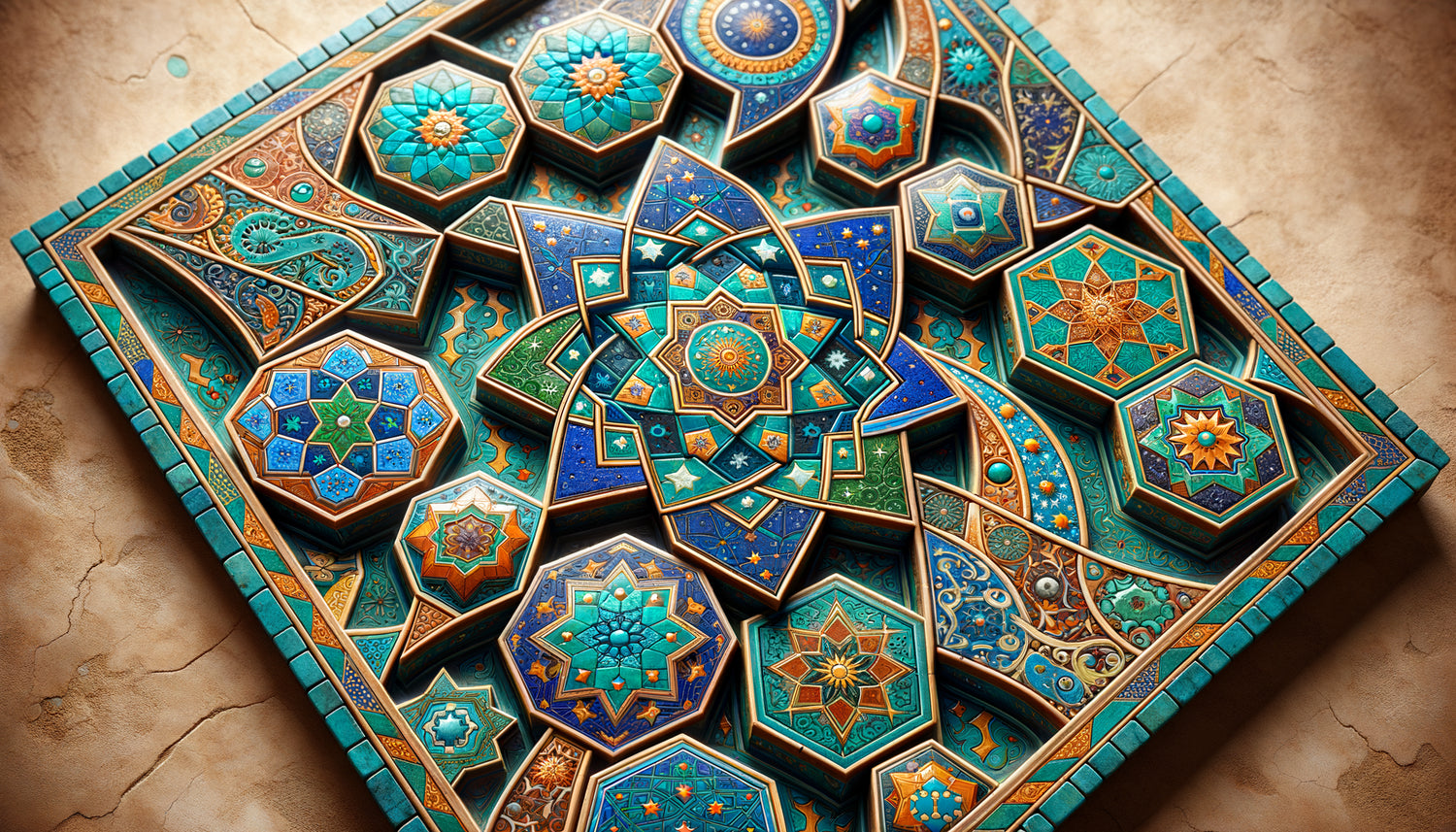
The artisans perfectly mastered the chemistry of metal oxides. Cobalt produced these deep blues characteristic of Tadjik abstraction, copper gave emerald greens and vibrant turquoises, manganese created mysterious purples. But the genius lay in the transparent enamel that covered these pigments: this glassy layer acted as a natural prism.
At sunrise, I observed how the walls gradually lit up, the geometric abstract patterns seeming to vibrate from within. At noon, under the zenithal light, the compositions revealed invisible nuances at dawn. At dusk, warm hues literally engulfed the surfaces. This light dynamic was impossible to achieve with paint, however talented it may be.
The artisans strategically positioned their tiles according to solar orientation. South-facing walls received soothing blue compositions, while north facades were adorned with bright yellows and dazzling whites to compensate for the lack of direct sunlight. This architectural approach to abstraction went far beyond simple decoration.

Relief as a hidden dimension of abstraction
An often overlooked aspect of Tadjik abstraction is its three-dimensionality. Unlike painting, which remains confined to the flat surface, ceramic wall compositions subtly played with relief.
Upon close examination of the panels in the Khoja Mashad mosque, I discovered that the tiles were not simply flat. Some presented slight convexities, others almost imperceptible concavities. These variations of just a few millimeters created shadow plays that accentuated the geometric abstract patterns throughout the day.
This technique, which I call surface micro-architecture, allowed artisans to add a temporal dimension to their works. The same panel revealed itself differently depending on the angle of observation and the time of day. Abstract compositions became alive, breathing, in constant dialogue with their environment.
Painting, confined to its flatness, could not rival this spatial richness. Tajik artisans had understood that the most powerful abstraction engages all senses: sight obviously, but also potential touch, and even the movement of the viewer who must move to grasp all facets of the work.
A modular abstraction: the wisdom of assembly
During my research in restoration workshops, I discovered a major pragmatic advantage of ceramic wall compositions: their modular nature. Each panel was composed of multiple individual tiles, creating an infinitely adaptable system.
If an earthquake damaged a section of the wall, artisans would replace only the broken tiles without compromising the entire abstract composition. This reparability was impossible with a painted fresco where even the slightest crack could ruin months of work.
Even more fascinating, this modular system allowed for collective creativity. Several artisans worked simultaneously on different sections, each creating tiles according to predefined geometric patterns but with their own subtle variations. Tajik abstraction thus became a symphony where each musician brought his unique voice while respecting the overall harmony.
This approach surprisingly foreshadowed the principles of contemporary design: creation of standardized elements allowing infinite personalization, durability through reparability, collaboration rather than solitary work. Ceramic wall compositions embodied a philosophy of creation far broader than a simple decorative technique.

The spiritual dimension: when abstraction transcends matter
Beyond technical considerations, Tajik ceramic abstraction carried a profound spiritual meaning that painting could not express with the same power. In Central Asian Islamic tradition, figurative representation was discouraged, orienting artists towards the exploration of geometric abstraction.
But why favor ceramic to express this abstract spirituality? The answer appeared to me while meditating in front of the mihrab of the Hissar mosque. The creation process itself was a metaphor for the sacred: the earth transformed by fire, raw matter transcended by human art, the four elements (earth, water, air, fire) necessary for creating glazes.
Each ceramic wall composition told this spiritual alchemy story. The infinite geometric patterns symbolized divine unity and the mathematical structure of the universe. Vibrant colors evoked paradise as described in sacred texts. Light dancing on glazed surfaces recalled the divine presence illuminating creation.
Painting, however beautiful it may be, remained color applied to a surface. Ceramic, transformed by purifying fire, attained an almost sacred status. Artisans were not simply decorating walls: they were creating interfaces between the terrestrial world and the divine. This spiritual dimension explains why so much collective energy was invested in these monumental abstract compositions.
Contemporary legacy: when the past inspires the present
What makes Tajik abstraction so relevant today is its resonance with our contemporary concerns. In a world saturated with ephemeral images, these ceramic wall compositions remind us of the value of permanence and quality.
Contemporary designers are rediscovering these ancestral principles. The use of sustainable materials rather than quick solutions, the creation of works that dialogue with natural light, the appreciation of relief and texture in a two-dimensional digital world: all lessons passed down by Tajik artisans through the centuries.
When you choose an abstract work for your interior, consider these millennial criteria: does it resist time? Does it change with the light? Does it engage multiple senses? Does it carry depth beyond simple decoration? The best contemporary abstract creations, whether in ceramic or painting, unconsciously honor these principles.
Tajik abstraction teaches us that the choice of medium is never trivial. It not only determines the final appearance but also the relationship the work will have with its environment and observers for decades, even centuries.
Be inspired by the millennial wisdom of abstraction
Discover our exclusive collection of abstract paintings that capture the same timelessness and living relationship with light, to transform your spaces into true havens of inspiration.
Conclusion: matter as the ultimate language
Tajik abstraction favored ceramic wall compositions over painting because the artisans understood a fundamental truth: in monumental wall art, the medium IS the message. Ceramic offered what paint could not: eternity facing the elements, a perpetual dance with light, a three-dimensional presence, repairable modularity, and a spiritual dimension rooted in the alchemical transformation of matter.
When contemplating these shimmering walls that have crossed centuries, imagine your own space transformed by an abstract work chosen with the same intention: not as mere decoration, but as a visual companion that will evolve with you, reflecting variations in light and mood, resisting the passage of time while remaining eternally alive.
Today, explore the abstract creations that embody this philosophy of permanence and dialogue with space. Look for those that change according to the hour, which possess a tactile texture, which invite repeated contemplation. You will thus honor the legacy of Tajik masters who, a thousand years ago, understood that the most durable art is born from the perfect fusion of intention, material, and technique.
FAQ : Your questions about Tajik ceramic abstraction
Did the Tajiks never use paint in their decorative art?
Excellent question! Tajik artisans did indeed use paint, but mainly for manuscripts, mobile objects and some interior ceilings protected. The distinction was clear: paint suited small and sheltered supports, while ceramic wall compositions were essential for large exposed surfaces. In palaces, you sometimes find both techniques complementary: delicate paintings on wood for doors and ceilings, durable ceramics for exterior walls and courtyards. This hierarchy of mediums reveals a sophisticated understanding of the properties of each material. The most ambitious Tajik abstraction, destined for eternity, was systematically entrusted to ceramic, reserving painting for more ephemeral or intimate works.
How do these ceramic compositions resist the frequent earthquakes in the region?
This is one of the most ingenious aspects of Tadjik ceramic wall panels! The artisans had developed a flexible mounting system that allowed for slight movement in each tile. Unlike a rigid fresco which cracks at the slightest tremor, the ceramic tiles were laid with a slightly elastic mortar, sometimes mixed with straw or animal hair. This technique, which I call structural flexibility, allowed the compositions to follow the movements of the building without breaking. Moreover, the modular nature of the installation meant that even if some tiles fell off, they could be replaced individually. Archaeologists have discovered reserves of replacement tiles in some buildings, proving that this maintenance was planned from the design stage. This seismic resilience was impossible to achieve with traditional wall painting.
Can I incorporate the spirit of Tadjik abstraction into a contemporary interior?
Absolutely, and it's particularly relevant today! The spirit of Tadjik abstraction transcends eras. You don't need to install ancient ceramic tiles to capture this essence. Look for contemporary abstract works that share the same principles: quality materials that age well, textures that catch the light differently depending on the time of day, geometric patterns that invite repeated contemplation. Favor creations with relief or depth rather than flat prints. Position them strategically so they dialogue with the natural light in your space. The Tadjik approach teaches us above all a philosophy: to choose pieces that will be long-lasting visual companions rather than ephemeral trends. A well-chosen abstract work, even modern, can embody the same timelessness as the millennial wall compositions of Central Asia.