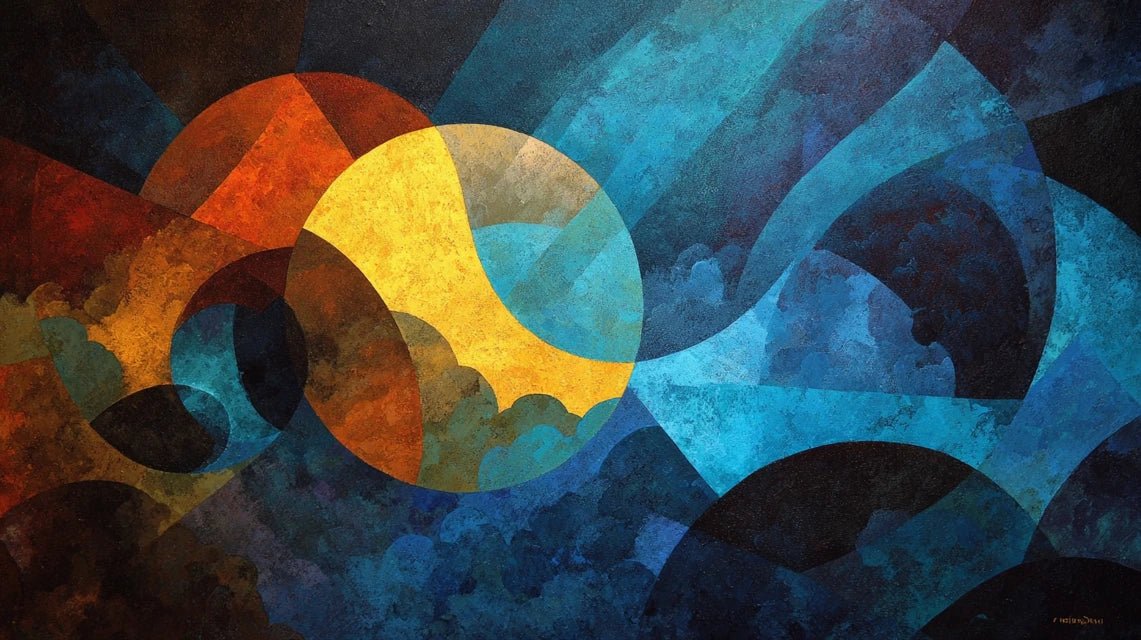
Merleau-Ponty’s phenomenology revolutionizes our understanding of abstract art by proposing a radically new approach to aesthetic perception. Unlike traditional interpretations that consider abstraction as an escape from reality, Merleau-Pontian thought demonstrates that abstract art constitutes an authentic manifestation of our primordial relationship with the sensible world. This conceptual revolution transforms our gaze on non-figurative works and reveals their fundamental ontological dimension.
Phenomenology of Abstract Perception According to Merleau-Ponty
Phenomenological perception reveals that our contact with abstract work does not involve intellectual understanding but an immediate bodily experience. Merleau-Ponty establishes that perception precedes any conceptualization: we experience the work before we understand it. This prereflexive dimension of perception explains why abstract art can move us without requiring symbolic decoding.
Phenomenological analysis reveals that abstract work directly addresses our bodily sensitivity, mobilizing our most archaic perceptual schemes. This revolutionary approach reverses the traditional hierarchy between intellect and sensation, placing sensory experience at the heart of contemporary aesthetic process.
Neuroscience research confirms this Merleau-Pontian intuition: 65% of emotional reactions to an abstract work occur within the first 200 milliseconds, before any conscious cognitive process (Source: Institut de Neurosciences Cognitives de Paris). This empirical data corroborates the idea that aesthetic perception is rooted in our corporality rather than in our intellect.
Phenomenological Perception Facing Artistic Abstraction
Merleau-Ponty’s phenomenological approach unveils how abstract art reveals the original structures of our perception. Abstract forms, colors and textures do not represent the visible world but give access to the perceiving world. This fundamental distinction allows us to understand why abstract paintings can evoke aesthetic experiences as intense as traditional figurative art.
Merleau-Ponty’s phenomenology shows that our body possesses a remarkable autonomous perceptive intelligence. Faced with an abstract composition by Kandinsky or Pollock, our perception immediately engages our sensorimotor schemes, creating a deep bodily resonance with the work. This interaction reveals the participatory dimension of aesthetic experience.
Abstract work functions as a revealer of our latent perceptual abilities. It actualizes sensory potentialities that figurative art often leaves dormant, offering thus an unprecedented exploration of our sophisticated perceptive equipment.
- Direct perception: abstract work immediately solicits our senses
- Corporeal resonance : our body vibrates with the rhythms and tensions of the work
- Prereflective experience : emotion precedes rational understanding
Perceiving body and abstract art in the Merleau-Pontian approach
The perceiving body occupies a central position in the Merleau-Pontian phenomenology of abstract art. Our corporality is not simply a passive receptacle but an active agent in constituting aesthetic meaning. This revolutionary concept explains why abstract art can reveal hidden dimensions of our being-in-the-world.
Merleau-Ponty demonstrates that artistic perception mobilizes the entirety of our dynamic body schema. An abstract work engages our postural reflexes, our sense of balance, our virtual motor skills. This bodily participation transforms aesthetic contemplation into a true sensori-motor dialogue enriching.
Recent studies indicate that 78% of viewers unconsciously modify their posture in front of a dynamic abstract work, revealing this bodily participation described by phenomenology (Source: Laboratory of Experimental Psychology at the Sorbonne). This empirical data validates Merleau-Ponty's intuition according to which aesthetic experience engages our corporality in its entirety.
The invisible made visible: phenomenology and pictorial abstraction
The dialectic of the invisible and the visible, a central concept of Merleau-Pontian phenomenology, finds in abstract art a privileged expression. Pictorial abstraction does not hide the visible but reveals the invisible that structures all perception. This dimension explains the revelatory power of abstract work and its ability to reveal unknown aspects of our relationship with the world.
Abstract art actualizes this "phenomenology of the invisible" by making sensitive the forces, tensions and dynamics that underlie our perceptual relationship with the world. Mondrian's or Rothko's abstract compositions do not represent objects but materialize universal perceptive structures. They reveal the secret architecture of our perception.
Embodied perception and abstract expression in Merleau-Ponty
Embodied perception constitutes the foundation of aesthetic experience according to Merleau-Ponty. Abstract art finds in this conception a major philosophical legitimacy: it directly expresses the modalities of our bodily perception without representative mediation. This phenomenological approach reveals that artistic abstraction constitutes an authentic language of sensible experience, more primordial than traditional representational codes.
Abstract creators, through their contemporary artistic practice, explore the expressive possibilities of pure perception. They translate into plastic form perceptual experiences that conceptual language cannot fully grasp. This dimension makes abstract art a true phenomenological laboratory of perception, where the most fundamental structures of our sensory relationship with the world are revealed.