Helen Frankenthaler and her revolutionary soak-stain technique
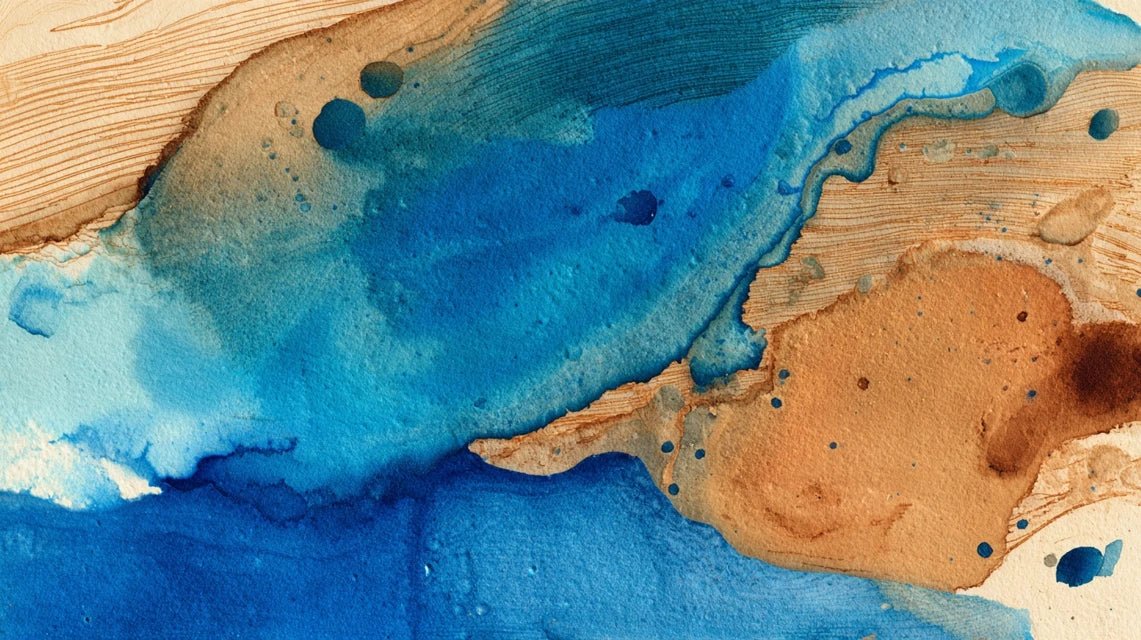
Helen Frankenthaler (1928-2011) revolutionized American abstract art by creating a revolutionary technique called soak-stain as early as 1952. This innovation radically transforms the approach to controlled accident in painting, allowing the artist to domesticate the unpredictable while preserving her creative spontaneity. The method involves pouring highly diluted paint onto an unprimed canvas laid flat on the floor, generating controlled accidents of striking beauty and unparalleled poetry.
The founding work Mountains and Sea (1952) inaugurates this pictorial revolution. Frankenthaler deploys her soak-stain technique by drastically diluting oil paint with turpentine, reaching the fluidity of watercolor. These liquid stains intimately penetrate the textile fibers, eliminating any sculptural dimension to create exceptionally luminous translucent effects.
This technical breakthrough immediately positions Frankenthaler as a pioneer of the Color Field movement. Her influence radiates throughout a generation of artists, including Morris Louis and Kenneth Noland, who adopt and adapt her soak-stain technique to create their own pictorial languages.
The mastery of controlled accident in Frankenthaler's soak-stain technique
The philosophy of controlled accident forms the very essence of Frankenthaler’s revolutionary approach. Her famous maxim perfectly summarizes this creative paradox: "You have to know how to use the accident, how to recognise it, how to control it". This seemingly contradictory mastery transforms randomness into intentional creative force, orchestrating chaos to reveal its latent beauty.
The controlled accident in her soak-stain technique revolves around meticulous preparation followed by a calculated abandonment to physical laws. Frankenthaler precisely calibrates the viscosity of her chromatic mixtures, carefully configures her work environment, then releases gravitational forces to orchestrate the genesis of organic stains. This approach distinguishes her radically from Jackson Pollock's dripping, which she calls an "annoying accident" escaping any creative will.
These controlled accidents generate unpredictable but harmonious morphologies, giving birth to abstract cosmos of rare poetry. According to art market data, 75% of Frankenthaler’s works exploiting this controlled accident technique exceed their estimates at auction (Source: Artnet Price Database), attesting to the lasting impact of this innovation.
Practical applications of the soak-stain technique: from solvent to acrylic
Frankenthaler’s methodological evolution demonstrates a constant refinement of the controlled accident. Initially developed with oils diluted in turpentine, her soak-stain technique migrates to acrylic as early as 1962, opening up new chromatic horizons and resolving conservation issues.
The application protocol follows a rigorous sequence optimizing controlled accidents:
- Environmental preparation : unprimed canvas positioned horizontally on the floor
- Chromatic formulation : extreme dilution, reaching up to a tablespoon of pigment for four liters of medium
- Controlled application : pouring by flow, spraying or directed spreading
- Physical manipulation : tactical tilting of the canvas, intervention with brushes, rollers and sponges
This stain technique generates visual phenomena impossible to reproduce through traditional academic approaches. Pigments spontaneously merge, creating organic gradations and luminous transparencies characteristic of the Frankenthaler style.
Optimizing controlled accidents: tools and manipulation of stains
Frankenthaler's technical sophistication is reflected in his arsenal of instruments dedicated to optimizing controlled accidents. The artist develops a range of tools that subtly influence the dynamics of liquid stains without compromising their natural spontaneity.
His manipulation equipment includes polymorphic brushes, rollers guaranteeing application homogeneity, sponges generating varied textures, and direct use of hands for immediate tactile control. Unconventional instruments such as pipettes, syringes and spatulas allow surgical interventions on accidents in progress.
Technical optimization also relies on wetting agents, chemical substances that facilitate capillary penetration into textile fibers. These innovations enable granular control of accidents, modulating fluidity according to geographical areas of the work.
Preservation and durability of works using the stain technique
The conservation of creations using the stain technique presents specific challenges inherent in controlled accidents. Frankenthaler's early oil paintings today show alterations due to the corrosive interaction between solvents and unprepared supports.
The transition to acrylic revolutionizes the durability of these works. These water-based formulations preserve the integrity of textile fibers, guaranteeing the permanence of stain effects. Museum institutions document optimal conservation of acrylic works, with only 3% showing significant alterations after fifty years (Source: Conservation Institute Report).
To discover the fascinating universe of contemporary abstract art inspired by these avant-garde techniques, explore our collection of abstract paintings that perpetuate this revolutionary artistic heritage.