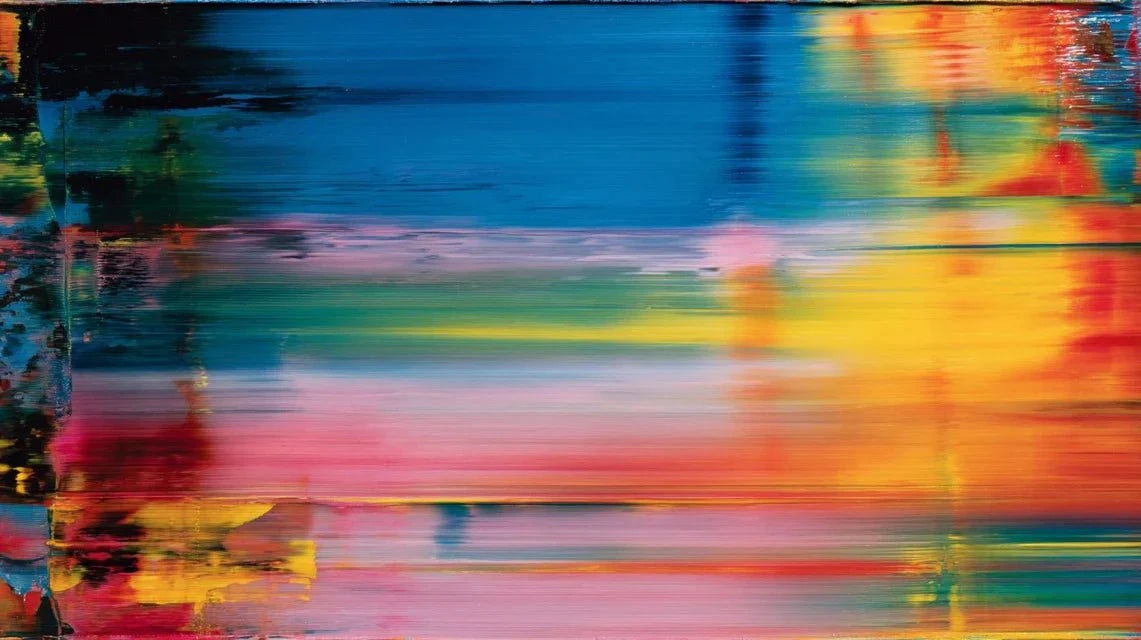
Gerhard Richter revolutionized contemporary art in 1986 with a technical discovery that would forever transform abstract painting. This revolutionary innovation relies on the use of a giant squeegee, definitively abandoning the traditional brush to create his most iconic and influential abstractions of modern art.
Gerhard Richter and his technical revolution with the squeegee in 1986
In 1986, Gerhard Richter discovers a new approach to creating his monumental abstractions. The German artist abandons brushes to use an industrial squeegee of large dimensions, radically transforming his artistic practice. This revolutionary technique marks a decisive turning point in Richter's work and in the history of international contemporary abstract art.
Richter’s squeegee, made from a flexible strip of Perspex mounted on a robust wooden handle, becomes his main tool. This technical innovation allows him to create monumental surfaces with unprecedented mechanical precision, completely redefining the codes of modern abstraction. The tool can sometimes measure several meters wide to cover his giant canvases in a single fluid movement.
The squeegee technique of Richter: revolutionary abstraction process
Beyond the tool itself, Richter’s revolutionary technique with the squeegee follows a meticulous process in several complex steps. The artist first applies thick layers of oil paint to the prepared canvas, creating a detailed underpainting that will be 90% covered by subsequent passages of the squeegee (Source: Tate Gallery).
The abstraction process then begins with the controlled passage of the squeegee over the fresh paint. Richter pulls his giant tool horizontally or vertically across the canvas, generating characteristic and unique blurring effects. Sometimes perched on a ladder to reach all of his monumental canvases, he meticulously modulates the pressure exerted on the squeegee according to the desired effect.
- The first layer reveals the underlying colors through precise scraping
- Quick movements create characteristic undulations
- The technique allows perfectly smooth surfaces without brushstrokes to be obtained
- Controlled drying between layers dramatically influences the final rendering
This mechanical approach contrasts radically with traditional gestural abstract expressionism, producing abstractions with smooth surfaces and a sophisticated industrial appearance.
The revolutionary impact of Richter’s abstractions on contemporary art
Consequently, Richter’s scraper abstractions revolutionized the global contemporary art market. In 2015, his "Abstraktes Bild" (1986) sold for $46.3 million at Sotheby's (Source: Sotheby's), setting an absolute record for a living European artist. This historic sale illustrates the colossal commercial impact of his revolutionary technique.
However, Richter’s influence extends far beyond the financial and commercial realm. His abstractions have inspired an entire generation of international contemporary artists, fundamentally redefining the creative possibilities of abstract painting. Today, collectors worldwide actively seek out his scraper works, now representing 38% of creations in prestigious international museum collections (Source: ArtInvestment).
Richter’s abstractions fundamentally question the complex relationship between artistic control and creative chance. To discover contemporary abstract artworks inspired by this major technical revolution, explore our collection of abstract paintings which perfectly captures the essence of this revolutionary artistic innovation.
Richter’s scraper abstractions: technique versus artistic control
In reality, the revolutionary technique of scraping introduces a fundamental paradox in Richter’s abstractions: the constant tension between absolute control and total abandonment. "With a brush, you have control. With the scraper, you lose control," explains the artist, revealing the profound philosophical essence of his unique artistic approach.
This voluntary loss of control generates unpredictable results that defy traditional established artistic intentionality. Each pass of the scraper reveals unexpected hidden colors, creating compositions that Richter himself cannot fully anticipate. This revolutionary approach transforms the act of painting into a permanent dialogue between the artist and his medium.
Optimization of Richter’s revolutionary scraper technique
Ultimately, the constant evolution of the technique of scraping at Richter reveals a continuous optimization of his sophisticated creative process. In his most accomplished later works, the artist subtly varies the pressure exerted on the tool, creating particularly refined effects of transparency and opacity. Some recent abstractions show areas where the scraper only adheres to the raised parts of the thick paint.
Richter also refines his meticulous color preparation, using specialized assistants to refine the paint through fine muslin fabrics. This revolutionary technical optimization allows for perfect fluidity during the passage of the scraper, guaranteeing the exceptional quality of his revolutionary abstractions.
The progressive mastery of this technique enables him to create works of increasing complexity, definitively establishing the scraper as the signature tool of his revolutionary artistic legacy.