




Abstract Black and White Face Wall Art
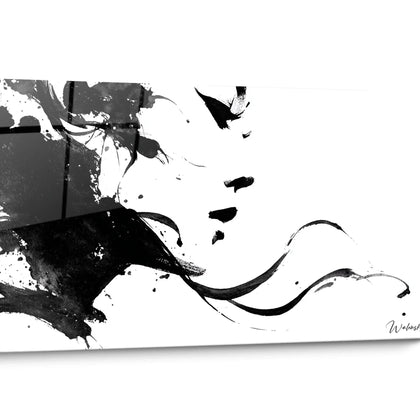
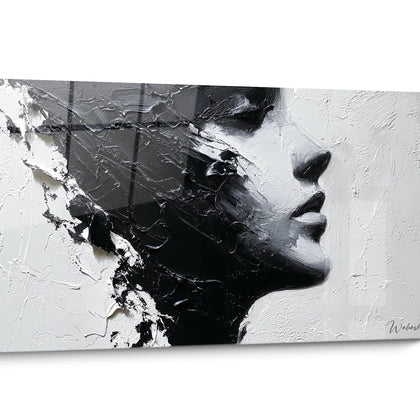
Our Tableau visage noir et blanc Abstract collection celebrates contemporary expressionism in all its minimalist splendor. These captivating works explore striking contrasts and clean forms, creating remarkable portraits abstract black and white for a contemporarywall decoration. These paintings bring depth and character to your interior.
 Abstract Women's Painting - Silent Melody - Black and White Face Edition273,90 €
 Women's Profile Artistic Painting - Abstract Elegance - Black and White Face Edition273,90 €
 Fluid Female Face Wall Art - Liquid Metamorphosis - Black and White Edition273,90 €
 Fragmented Face Painting - Poetic Metamorphosis - Black and White Face Edition228,90 €
 Abstract Woman Face Painting - Fluid Expression - Black and White Face Edition228,90 €
 Female Profile Wall Art - Expressionist Abstract Portrait - Black and White Face Edition228,90 €
 Inner Cosmos Canvas - Black and White Face Edition228,90 €
 Human Constellation Wall Art - black and white face edition273,90 €
 Pointillist Metamorphosis Painting - Black and White Face Edition273,90 €
Explore further
In Abstract Black and White Face Wall Art



All about Abstract Black and White Face Wall Art
- Black and White Abstract Face Wall Art Presentation
- Emotional Power of Monochrome Contrast
- Visual Decoding of Facial Forms
- Architectural and Psychological Impact
A black and white abstract face wall artwork transcends classical portrait representation to explore the psychological territories of human perception. This artistic category uses chromatic reduction as an expressive language, transforming facial features into emotional geometries that dialogue with the viewer's unconscious. The abstraction of faces in monochrome nuances creates a fascinating visual tension, where each shadow suggests an unsuspected psychological depth.
Radical Expressivity of Monochrome Contrast in Facial Representation
A black and white abstract face wall art exploits chromatic duality to amplify the emotional intensity of the composition. The absence of color forces the eye to decode tonal nuances, transitions between light and darkness becoming powerful narrative vectors. This chromatic purification reveals the emotional architecture of the face beyond its realistic appearance.
How does monochrome amplify the psychological dimension of abstract portraiture?
The restriction to black and white concentrates attention on essential compositional structures: the tension between dark masses and luminous zones creates visual rhythms that evoke emotional states and inner resonances. Subtle gradations become emotional cartographies, while stark contrasts translate psychological ruptures. This chromatic economy transforms each artwork into a mirror for introspection where viewers project their own existential questions.
Strategies for deciphering monochrome visual codes
Black planes can symbolize zones of the unknown, unexplored psychic territories, while luminous whites suggest revelations or moments of cognitive clarity. Intermediate grays create transition spaces, ambiguous emotional states that invite prolonged contemplation. For collectors seeking maximum conceptual depth, exploring the black and white expressionist face artwork offers complementary perspectives on dramatic intensification.
Semantic accumulation and symbolic charge
In monumental format, each graphic element acquires imposing physical presence. Fragments of abstract faces become contemporary totems, silent presences that subtly modify spatial atmosphere. The eye circulates between partial recognition and perceptual disorientation, creating a dynamic cognitive experience that renews itself with each observation. This oscillation between familiarity and strangeness generates lasting fascination, transforming the space into a territory for continuous visual exploration.
Geometric Deconstruction and Semantic Recomposition of the Face
Facial abstraction operates a deliberate fragmentation of traditional physiognomic landmarks. A black and white abstract face artwork reorganizes face components according to non-narrative logic: an eye becomes an autonomous circular form, a mouth transforms into an expressive line detached from any representational function. This dissociation frees facial elements from their mimetic servitude to elevate them to the rank of pure plastic signs.
What compositional techniques structure monochrome facial abstraction?
The superposition of transparent planes creates illusory depths where multiple faces coexist simultaneously. Techniques of displacement and repetition generate effects of psychological movement, as if the represented identity traversed different emotional states. Artists frequently employ strategies of radical simplification: reduction of the face to three tonal values, elimination of details in favor of structural masses, exaggeration of proportions to accentuate visual impact.
Interaction between organic geometry and facial architecture
Curved forms evoking facial contours dialogue with rectilinear elements that introduce tension and dynamism. This hybridization between biomorphism and geometricism constructs paradoxical visual identities, simultaneously recognizable and mysterious. Negative spaces acquire importance equal to positive forms, creating multiple reading games where background becomes figure and vice versa.
Protocols for reading monumental formats
On large dimensions, black and white abstract face artwork demands sequential apprehension: the eye travels across the work by sections, progressively reconstructing a global coherence that never fully appears. This perceptual fragmentation imitates the very process of facial recognition, where the brain assembles partial clues to construct identification. The experience becomes kinesthetic, the viewer needing to physically move to grasp different informational strata, transforming contemplation into cognitive choreography.
Spatial Resonances and Environmental Transformations of Abstract Portraiture
The integration of black and white abstract face artwork into an architectural environment generates subtle yet profound perceptual modifications. The chromatic neutrality establishes a particular dialogue with surrounding surfaces: absorption of fluctuating natural light, creation of ghostly reflections, projection of silent presence that alters the volumetric perception of space. This artwork functions as an atmospheric catalyst redefining existing visual equilibria.
Why does monumental format intensify the psychological impact of abstract facial imagery?
At large scale, the monochrome abstract portrait acquires an almost human corporeality that establishes a relationship of direct confrontation with the viewer. This imposing physical presence activates unconscious mechanisms of social recognition: even when abstract, facial configuration triggers primitive emotional responses linked to human interaction. Monumental format transforms the artwork into a silent interlocutor, a witnessing presence that observes space and its occupants, inverting the traditional subject-object relationship.
Strategies for architectural integration to maximize visual power
Generous volumes allow sufficient distance to apprehend the artwork in its entirety, while authorizing close approaches revealing textures and technical subtleties. Installation facing indirect light sources accentuates modeling and tonal transitions, creating perceptual variations according to times of day. Pared-down environments with neutral surfaces serve as optimal settings, eliminating competing visual distractions and concentrating attention on formal dialogues internal to the composition.
Temporal evolution of the viewer-artwork relationship
Progressive familiarity with black and white abstract face artwork never fully diminishes its fascination capacity. The constitutive ambiguity of facial abstraction preserves a zone of indeterminacy that resists interpretive exhaustion. Each observation reveals new configurations, unprecedented formal associations, variable emotional suggestions depending on the viewer's psychological state. This semantic plasticity guarantees rare experiential longevity, transforming acquisition into a durable relational investment rather than simple decorative transaction.
Is black and white abstract face artwork suitable for contemporary professional spaces?
Absolutely, as chromatic sobriety integrates harmoniously into corporate visual codes while introducing an essential humanistic dimension. The presence of the face, even when abstract, recalls human centrality in sometimes excessively technological environments, creating a welcome emotional counterpoint without compromising required visual professionalism.
How to distinguish museum-quality black and white abstract face artwork?
The complexity of tonal transitions constitutes a reliable indicator: a sophisticated artwork presents nuanced gradations and wealth of intermediate values rather than simplistic contrasts. Compositional coherence, where each element justifies its presence through its contribution to overall balance, also differentiates conceptually accomplished creations from superficial decorative productions.
What durability can be expected from large-format black and white abstract face artwork?
Monochrome artworks generally present excellent chromatic stability, the absence of colored pigments eliminating problematic degradation through oxidation or photosensitivity. Monumental formats created according to professional protocols maintain structural integrity for several decades, provided direct solar exposure and extreme hygrometric variations are avoided.
Further reading
Our articles on this topic
- The Use of Black in Abstract Art: Emptiness, Mystery and Spiritual Depth
- What are the best modern abstract paintings for an elegant minimalist entryway?
- How Can a Monochrome Abstract Painting Complement Scandinavian Decor?
- Abstract Art & Personal Interpretation: Unlocking Imagination
- How to Integrate a Colorful Abstract Painting into a Modern Minimalist Bedroom?


