



Minimalist Black and White Face Wall Art
The Minimalist Black and White Face Artwork embodies the essence of sobriety contemporary artistry. This collection celebrates the beauty of minimalist black and white portraits, where each feature captures pure and authentic emotion. These refined works sublimate your interiors with timeless elegance, creating spaces for contemplation and serenity. Minimalist face art is expressed here in its most refined form, offering sophisticated wall decor that transcends trends.
 Woman Striped Shadows Painting - Interplay of Light - Black and White Face Edition273,90 €
 Women's Profile Painting - Silent Expression - Black and White Face Edition273,90 €
 Abstract Women's Painting - Silent Melody - Black and White Face Edition273,90 €
 Fluid Female Face Wall Art - Liquid Essence - Black and White Edition273,90 €
 Veiled Woman Wall Art - Ethereal Mystery - Black and White Face Edition273,90 €
 Veiled Feminine Face Wall Art - Ethereal Mystery - Black and White Face Edition228,90 €
 Woman Window Shadows Painting - Captive Light - Black and White Face Edition273,90 €
 Abstract Female Face Wall Art - Reflections of Emotion - Black and White Face Edition273,90 €
 Inner Cosmos Canvas - Black and White Face Edition228,90 €
Explore further
In Minimalist Black and White Face Wall Art



All about Minimalist Black and White Face Wall Art
- Minimalist Black and White Face Wall Art Presentation
- Pure Art & Contemporary Design
- Silent Expression & Visual Impact
- Ambiances & Decor Integration
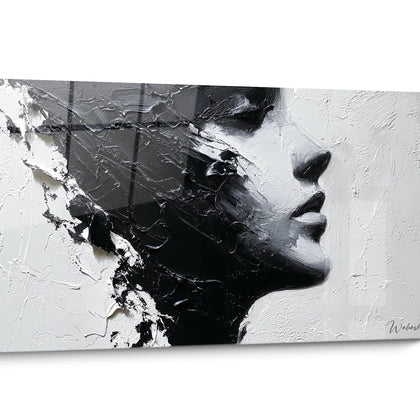
The minimalist black and white face wall art embodies the very essence of contemporary artistic sobriety. This form of mural expression privileges the purification of lines, chromatic reduction, and the power of suggestion rather than exhaustive description. By eliminating any superfluous color and simplifying facial contours, these works capture attention through their evocative force and their ability to create intense visual presence in space. The absence of chromatic nuances reinforces concentration on the lines, shadows, and volumes of the human face, transforming each portrait into a silent meditation on identity and pure emotion.
The Reductionist Aesthetic of Monochrome Facial Portraiture
The minimalist black and white face wall art rests on a radical artistic philosophy: saying more with less. This stripped-down approach to human portraiture eliminates all superfluous decorative elements to retain only the essential characteristics of facial features. Contemporary artists exploit this economy of means to create works where every line counts, where every shadow zone becomes meaningful. The two-tone palette transforms the face into a territory of graphic exploration, where sharp contrasts replace subtle tonal transitions.
Why does black and white intensify the mural presence of a portrait?
The absence of color in facial representation concentrates the gaze on the very structure of the face, on the architecture of features rather than on superficial appearance. This chromatic radicality creates a form of timelessness that anchors the work outside passing trends. Large formats exploit this sobriety to generate magnetic presence in contemporary spaces, transforming a wall into a meditative focal point. The black-white duality establishes a binary visual rhythm that dialogues with the streamlined lines of modern furniture.
Visual codes of expressive simplification
Facial minimalism expresses itself through several formal reduction techniques: partial face fragmentation showing only a significant section, contour vectorization transforming organic curves into geometric segments, negative space play where the unpainted becomes as significant as the traced line. This graphic economy creates breathing, aerated compositions where emptiness actively participates in visual narration. Large-dimension works amplify this effect by creating essential spatial respirations in dense urban interiors.
How does chromatic reduction sculpt emotion?
Paradoxically, the elimination of color nuances intensifies the emotional charge of the gaze. A minimalist black and white portrait captures the psychological essence of the subject without the distraction of hues. Shadow zones become metaphors for interiority, while light areas evoke revelation and openness. This shadow-light dialectic transforms each face into an abstract emotional landscape, offering different readings depending on viewing angle and ambient lighting in the room. For those seeking more conceptual explorations of facial representation, the abstract black and white face wall art proposes formal deconstructions pushed to the extreme.
The Communicative Power of Facial Austerity
A minimalist black and white face wall art communicates through subtraction rather than accumulation. This inverted visual strategy refuses descriptive detail in favor of evocative suggestion. The simplified facial traits become universal signs rather than individual characteristics, allowing each observer to project their own interpretation. This semantic openness transforms the work into a psychological mirror, a surface for personal reflection rather than simple representation.
Spatial amplification through monumental format
The large dimensions of a minimalist facial portrait create direct confrontation between observer and work. This monumental scale transforms the represented face into architectural presence, into a structuring element of inhabited space. The simplified gaze captures attention from different points in the room, creating constant visual connection. The empty zones of a large-format portrait generate essential mural respirations, avoiding visual saturation while maintaining affirmed presence.
What emotions does a pared-down black and white face convey?
Formal and chromatic reduction does not mean emotional neutrality. On the contrary, the monochrome minimalist portrait distills concentrated affects: contemplative melancholy of a half-erased profile, magnetic intensity of a frontally simplified gaze, mystery of a partially fragmented face. The absence of color context or environment focuses all attention on facial expression reduced to its essence. This emotional concentration creates meditative works that slow the gaze in contemporary living spaces.
Minimalist compositional strategies for portraiture
Creators of pared-down facial portraits exploit various compositional tactics: radical off-center placement positioning the face at the margin of the frame, profile superimposition creating depth through layering, extreme contrast between saturated black zones and pure whites, anatomical fragmentation isolating mouth, eye, or contour. These formal choices transform each work into a visual enigma demanding prolonged observation time. Imposing formats amplify these strategies by creating immersive experiences where the spectator physically enters the portrait field.
Decorative Integration of Pared-Down Monochrome Facial Portraiture
Installing a minimalist black and white face wall art radically transforms the perception of contemporary interior space. This typology of work functions as a visual anchoring point in streamlined spaces, creating natural dialogue with design furniture, mineral surfaces, and geometric volumes. The chromatic sobriety of the portrait allows harmonious integration without competition with other decorative elements, while maintaining undeniable magnetic presence.
In which spaces does the minimalist portrait express its maximal potential?
Environments with stripped-down architecture constitute ideal terrain for these pared-down facial works. Industrial lofts with raw walls, Scandinavian apartments with neutral tones, contemporary professional spaces seeking discrete sophistication: all benefit from the silent yet powerful presence of a large monochrome portrait. The simplified face creates humanization of cold volumes without introducing decorative overload. Reception areas, bedrooms seeking meditative atmosphere, creative offices gain in psychological depth thanks to this stylized facial presence.
Decorative associations with the pared-down facial portrait
The minimalist black and white face pairs ideally with raw natural textures: polished concrete, whitewashed wood, wrinkled linen, limestone. These organic materialities create tactile contrast with the graphic flatness of the portrait. Indirect raking lighting reveals subtle nuances of deep black and intensifies luminous white. Architectural plants with graphic foliage – monstera, ficus lyrata, palm – establish formal dialogue with the simplified lines of the face. Furniture with pure geometric lines responds to the compositional rigor of the work.
How does monumental format redefine spatial perception?
A large-dimension minimalist facial portrait restructures interior architecture visually. Positioned on a blank wall, it instantly creates a focal point that organizes gaze circulation and furniture arrangement. The imposing size transforms the face into quasi-physical presence, into a silent cohabitant that subtly modifies room atmosphere. This monumentality does not overwhelm space thanks to the compositional lightness of minimalism: the empty zones of the work allow the wall to breathe, maintaining balance between affirmed presence and contemplative discretion.
Frequently asked questions about minimalist black and white face wall art
Does a minimalist black and white face wall art suit colorful interiors?
Absolutely. The chromatic neutrality of the monochrome portrait functions as a visual calming element in environments with vibrant colors. It creates a contemplative pause, visual rest, while bringing graphic sophistication that elevates the entire decorative composition without conflicting with surrounding hues.
What optimal viewing distance for appreciating a large-format pared-down facial portrait?
Minimalist monumental works offer double reading: from afar, global composition and graphic impact; from near, subtleties of tonal transitions and surface texture. A distance equivalent to 1.5 times the work's width allows embracing total compositional scope while perceiving nuances of simplified facial treatment.
Does the minimalist black and white portrait work in reduced spaces?
Contrary to common belief, a large pared-down format can visually enlarge small space. The empty zones of the portrait create sensation of openness, while depth suggested by contrasts generates additional dimension. The absence of fussy details avoids perceptual saturation, making the work suitable even for limited wall surfaces of contemporary urban studios.
Further reading


