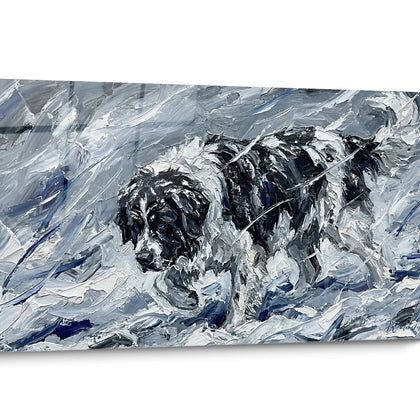
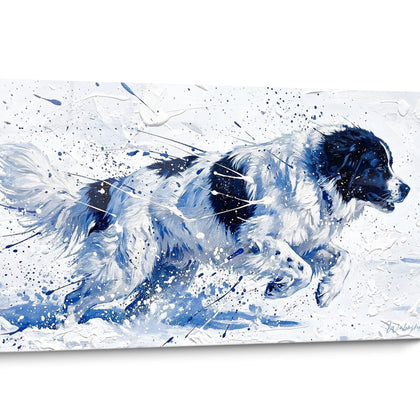
The black and white Landseer dog painting embodies the timeless elegance of a mythical canine breed. This pictorial representation captures the nobility and commanding presence characteristic of the Landseer, the emblematic Newfoundland breed immortalized by painter Sir Edwin Landseer in the nineteenth century. The monochromatic approach enhances the majestic silhouette of this benevolent giant, highlighting the striking contrast between its natural bicolored coat and the expressive intensity of its gaze. These large-scale wall creations instantly transform the atmosphere of a space by asserting an imposing canine presence while maintaining the sought-after chromatic sobriety. The visual power of black and white reveals every anatomical detail with photographic precision, paying homage to this breed historically associated with aquatic rescues and legendary loyalty.
Monochrome Aesthetics Serving the Landseer Breed
The black and white Landseer dog painting masterfully exploits the reduced palette to transcend simple canine representation. This chromatic approach concentrates attention on the Landseer's impressive muscular architecture, revealing infinite nuances between deep shadows and luminous zones that sculpt its athletic morphology. The panoramic formats of grand scale amplify this breed's naturally imposing stature, creating a wall presence comparable to an open window onto Norwegian fjords.
How Does Contrast Enhance Its Distinctive Physiognomy?
The chromatic duality inherent in the Landseer's coat finds perfect resonance in black and white aesthetics. The characteristic dark patches on a light background become visual anchor points that naturally guide the eye toward expressive areas: the voluminous nose, the eyes filled with intelligence, the pronounced cranial structure. This refined stylization eliminates any color distraction to concentrate on racial quintessence, transforming each representation into a genuine contemporary anatomical study.
Complementarity with Contemporary Geometric Aesthetics
For enthusiasts seeking stylistic variation while maintaining the Landseer theme, the abstract Landseer dog painting offers a deconstructed interpretation where geometric shapes and visual fragmentation reinvent the canine silhouette. The opposition between monochromatic photorealism and geometric abstraction provides complementary decorative possibilities according to interior architecture.
Which Environments Benefit from This Monumental Canine Presence?
Spaces with generous volumes such as cathedral-like entrance halls, personal libraries with high ceilings, or reception lounges find in these large-format representations the perfect balance. The Landseer's natural stature, often exceeding 70 centimeters at the shoulder and 70 kilograms, fully justifies proportionate wall dimensions. Scandinavian interiors, industrial lofts, or mountain chalets harmonize particularly well with this imagery that evokes simultaneously raw power and protective gentleness.
Historical Symbolism and Cultural Resonance of the Landseer
Choosing a black and white Landseer dog painting transcends simple animal decoration to invoke a rich cultural heritage. This breed takes its name from British painter Edwin Landseer (1802-1873), the famous Romantic animal artist whose canine representations adorned Victorian aristocratic homes. Owning this imagery inscribes you in a centuries-old aesthetic tradition where the animal's character nobility reflected that of its owner.
Why Does the Landseer Embody Values of Bravery and Protection?
Unlike purely ornamental breeds, the Landseer carries profound operational symbolism. Historically employed for sea rescues, particularly off the coast of Newfoundland, this aquatic giant possesses legendary cold resistance and exceptional swimming power. Integrating this representation into residential space subtly evokes these admirable qualities: selfless courage, strength tempered by kindness, absolute reliability. Families with children intuitively perceive this reassuring protective dimension.
Chromatic Duality as Behavioral Metaphor
The Landseer's naturally bicolored coat becomes a visual metaphor for its balanced temperament: dark areas evoking raw physical power, light areas symbolizing legendary gentleness toward humans. This symbolic reading enriches daily contemplative experience, transforming each glance toward the artwork into a silent reminder of fundamental canine virtues. Large panoramic formats accentuate this duality by visually separating contrasting chromatic masses.
What Psychological Impact for Professional Spaces?
Veterinary clinics specializing in giant breeds, professional breeding kennels, or offices of aquatic rescue associations find in these representations a powerful identity marker. The Landseer's monumental presence instantly communicates expertise, respect for canine heritage, and commitment to historical breed standards. Waiting rooms particularly benefit from this soothing imagery that emotionally connects visitors before any verbal interaction.
Selection and Integration of Large-Format Landseer Representation
Acquiring a black and white Landseer dog painting requires specific spatial consideration linked to this breed's monumental proportions. Authentic representations scrupulously respect distinctive anatomy: wide and rounded skull, square muzzle, robust bone structure, thick tail carried low. Vertical panoramic formats (120x80 cm minimum) allow capturing the animal in characteristic sitting posture, while extra-wide horizontal orientations (150x100 cm) suit representations in motion or full profile.
How to Evaluate Morphological Authenticity of the Representation?
Connoisseurs immediately distinguish a Landseer representation complying with FCI (International Canine Federation) criteria: massive head without exaggeration, soft facial expression despite imposing build, correct rear angulations, obligatory black nasal pigmentation. Artistic creations taking excessive stylistic liberties with these standards lose the documentary dimension prized by canine enthusiasts. Prioritize artists demonstrating in-depth knowledge of racial specifics rather than generic canine interpretations.
Which Contextual Elements Strengthen Narrative Impact?
Representations situating the Landseer within its natural historical environment amplify emotional resonance: rocky coastlines, traditional fishing vessels, misty Nordic maritime landscapes. These contextualizations transform the artwork into a narrative vignette evoking days of labor alongside Newfoundland fishermen. Conversely, neutral abstract backgrounds concentrate attention exclusively on canine presence, a minimalist approach suited to ultra-contemporary interiors refusing any superfluous visual anecdote.
Hanging Strategies to Maximize Monumental Presence
Standard positioning height proves inadequate for these giant formats representing an animal itself monumental. Rather than traditional center placement at 150 cm from floor, consider lower positioning (100-120 cm) creating the illusion that the Landseer physically shares the living space. Uncluttered walls without competing furniture allow the imposing silhouette to express itself fully. Room corners or architectural alcoves create visual niches where canine presence appears naturally settled rather than artificially suspended.
Is a black and white Landseer dog painting suitable for compact spaces?
Paradoxically, even compact apartments can accommodate these monumental representations by exploiting the "visual window" effect that perceptually enlarges space through narrative depth. A single focal wall receiving full decorative attention creates more impact than multiple scattered small elements.
How to combine this canine imagery with other decorative themes?
Maritime universes, Scandinavian Nordic aesthetics, mountain retreats, or classic English libraries constitute naturally harmonious thematic environments. Avoid associations with tropical, desert, or ultra-futuristic aesthetics creating conceptual dissonance.
What durability to expect for these large-scale wall creations?
Contemporary high-resolution printing processes on rigid supports guarantee chromatic stability over several decades under standard display conditions, without prolonged direct UV radiation or excessive humidity. Black and white monochrome intrinsically presents less vulnerability to chromatic degradation than complex polychromatic palettes.


 Black and White Landseer Jumping in Brilliant Turquoise Water - Aquatic Momentum - Landseer Edition233,90 €
 Black and White Newfoundland Dog Rolling in Sunny Grass Canvas - Canine Happiness - Landseer Edition233,90 €
 Landseer Painting Storm at Sea Rocky Shores Foaming Waves - Heroes of the Tides - Landseer Edition233,90 €
 Landseer in Water with Golden Reflections - Luminous Swim - Landseer Edition233,90 €
 Black and White Newfoundland Dog Painting with Marine Anchor - Maritime Loyalty - Landseer Edition233,90 €
 Stoic Landseer on Moss-Covered Rocks in the Storm - Sentinel of the Heights - Landseer Edition233,90 €
 Landseer Dog Painting Grey and Turquoise Waters - Aquatic Majesty - Landseer Edition233,90 €
 Black and White Newfoundland Dog Canvas in Marsh with Ducks - Retriever Instinct - Landseer Edition213,90 €
 Newfoundland Lying Down with Small Orange Kitten - Touching Friendship - Landseer Edition213,90 €