Japanese cherry blossom paintings embody the millennia-old art of hanami, that ephemeral contemplation of sakura blossoms that marks each spring in Japan. These large-scale wall creations capture the essence of mono no aware, that poignant consciousness of impermanence celebrated in Japanese culture. Each floral representation transports into your space the poetry of cherry blossoms in bloom, transforming your walls into open windows onto the ancestral gardens of Kyoto or the blooming pathways of Ueno Park. Far more than mere decoration, these monumental artworks diffuse an Oriental philosophy of life where ephemeral beauty and contemplative serenity meet.
Japanese Cherry Blossom Paintings: Bearers of Symbolism and Zen Energy
Japanese cherry blossom paintings constitute far more than a botanical representation. They convey the fundamental concept of mujō, Buddhist impermanence where each ephemeral petal reminds us of the precious fragility of existence. This visual philosophy radically transforms the atmosphere of a commercial or residential space.
What spiritual significance do sakura bring to your interior?
In Japanese tradition, sakura symbolizes spring renewal but also acute awareness of passing time. A large-scale Japanese cherry blossom painting installed in a meditation space or alternative therapy office instantly creates an atmosphere conducive to introspection. The sinuous branches laden with pink flowers evoke wabi-sabi, that aesthetic acceptance of imperfection and transition.
The influence of cherry blossoms on Japanese minimalism practice
Wall representations of sakura naturally integrate into the ma approach, that concept of negative space essential to Japanese aesthetics. Unlike cluttered Western compositions, these artworks breathe through the blank surfaces surrounding the delicate branches. A large-format Japanese cherry blossom painting becomes the unique focal element of a refined space, eliminating the need for decorative accumulation.
How do sakura hues modify the energy of a space?
The subtle shades from pale pink to pristine white of cherry blossoms act according to feng shui principles as vectors of gentle and soothing energy. These natural tonalities promote harmonious chi circulation in living spaces, particularly effective in zen bedrooms or yoga studios. The monumental presence of a Japanese cherry blossom wall painting establishes a permanent visual connection with natural cycles, anchoring the occupant in organic rather than mechanical temporality.
Compositions representing cherry branches in different states – closed buds, explosive bloom, falling petals – offer a visual narrative of seasonal passage. This temporal dynamic captured on a vertical surface transforms your wall into a perpetual poetic calendar, daily reminding of the transient beauty celebrated by traditional hanami ceremonies.
Creating an Authentic Japanese-Inspired Atmosphere with Sakura Paintings
Integrating a Japanese cherry blossom painting into your décor requires an understanding of Japanese aesthetic codes to avoid the pitfalls of superficial Japonisme. These monumental artworks dialogue with interior architecture according to specific compositional principles inherited from byōbu folding screens and suspended kakemonos.
Which Japanese architectural elements complement cherry blossom paintings?
A decorative Japanese cherry blossom painting reaches its full potential when associated with natural surfaces: sliding washi paper panels, bamboo lattice screens, or tatami flooring. This material synergy recreates the atmosphere of traditional houses where nature and habitat merge. The recommended large dimensions allow you to visually replace an absent window, an ancestral technique from ryokans where wall representations compensated for the absence of external views.
The art of asymmetrical composition in sakura placement
Unlike Western symmetry, Japanese aesthetics favors dynamic balance. Positioning a panoramic Japanese cherry blossom painting slightly off-center on a main wall creates that controlled visual tension characteristic of Japanese design. Branches extending naturally toward one side generate directional movement that guides the eye and structures space without resorting to rigid geometric divisions.
How do Japanese cherry blossom paintings dialogue with natural light?
Japanese tradition places paramount importance on shadow and penumbra, what Jun'ichirō Tanizaki calls "in praise of shadows". A large-scale Japanese cherry blossom painting benefits from positioning where indirect natural light progressively reveals chromatic nuances throughout the day. Avoid direct exposure that would flatten tonal subtleties; favor zones receiving diffuse luminosity reminiscent of light filtered through traditional shōji screens.
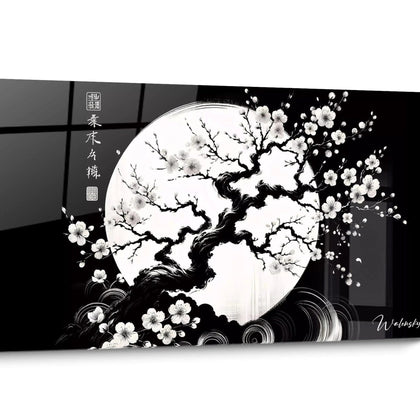
Representations of sakura under moonlight, called yozakura, offer a dramatic alternative to classic daytime scenes. These wall compositions capture the mystical atmosphere of nighttime cherry tree contemplations, a festive tradition still alive in Japan. Integrating an artistic Japanese cherry blossom painting representing this twilight ambiance transforms a reception space into a visual theater evoking hanami evenings beneath lanterns.
Selecting and Installing Your Monumental Japanese Cherry Blossom Painting
Selecting a large-format Japanese cherry blossom painting requires precise evaluation of several technical and aesthetic parameters to ensure harmonious integration. These imposing artworks become permanent visual anchor points that completely redefine spatial perception of a room.
What characteristics distinguish an authentic Japanese cherry blossom painting?
Faithful representations capture the specific morphology of sakura branches: sinuous lines, characteristic gray-brown bark, and that airy arrangement of flowers in delicate clusters. Premium-quality artworks reproduce different botanical varieties – somei yoshino with white-pink flowers, yaezakura with double petals, or shidarezakura with weeping branches. An authentic Japanese cherry blossom wall painting also respects Japanese pictorial conventions: generous negative space, atmospheric perspective suggested rather than geometric, and restricted, refined color palette.
Optimal sizing for contemporary spaces
Monumental formats – often exceeding two meters in width – correspond to the proportions of traditional Japanese folding screens that visually structured vast interiors. For a contemporary living room, a panoramic Japanese cherry blossom painting covering 60 to 70% of wall width creates the necessary impact without oppressing the space. High ceilings particularly benefit from vertical compositions showing ascending branches, a technique borrowed from suspended kakemonos that elevate the gaze.
In which environments do Japanese cherry blossom paintings excel?
These artworks radically transform transitional spaces – entrance halls, corridors, landings – into contemplative moments. A design Japanese cherry blossom painting installed facing the main entrance reproduces the Japanese tradition of tokonoma, that decorative alcove welcoming visitors. Professional zen spaces – medical offices, spas, wellness centers – exploit the immediate soothing charge of these floral representations to positively condition visitors' emotional state upon arrival.
Asian fusion restaurants and boutique hotels frequently use large-format Japanese cherry blossom paintings as visual identity signatures. These monumental installations instantly create an authentic cultural connection, transcending superficial decorative clichés. The imposing presence of a sakura wall mural establishes coherent aesthetic coding that positively influences the overall customer experience.
Which Japanese cherry blossom painting suits a meditation space?
Favor minimalist compositions showing a single blooming branch against a neutral background, promoting meditative focus. Wide horizontal formats create a soothing horizon line similar to contemplative zen gardens.
How to maintain a large-scale Japanese cherry blossom painting?
Avoid prolonged exposure to direct UV rays that alter delicate pigments. Gentle monthly dusting with a dry microfiber cloth suffices. Maintain stable humidity between 40-60% to preserve material integrity. To complete your search, feel free to browse our collections to discover compositions with varied themes.
Do Japanese cherry blossom paintings suit minimalist modern interiors?
Absolutely. Their refined aesthetics naturally integrate into contemporary spaces with pure lines. The contrast between the delicate organic quality of sakura and modern architectural rigor creates a sophisticated visual tension particularly sought after in current design.


 Scent of Freedom Wall Art - Birds Animals Edition233,90 €
 Canvas Flower Painting - Asia Edition233,90 €
 Cherry Blossom Wall Art No. 1 - Nature Edition233,90 €
 Tree of Destiny Painting - Japan Edition233,90 €
 Black Cat on Flowering Branch Wall Art - Japanese Serenity - Bombay Cat Edition232,90 €
 Enchanted Peaks Painting - mountain edition232,90 €
 Japanese Cherry Blossom Golf Wall Art - Zenitude on the Green - Golf Edition233,90 €
 Birman Cat with Cherry Blossoms Painting - Azure Spring Gaze - Birman Cat Edition233,90 €
 Sakura Soul of Time Painting - zen edition213,90 €
 Mountain landscape painting with cherry blossoms - Glacial Harmony - other landscapes edition233,90 €
 Starry Efflorescence Wall Art - Black and White Speckled Edition213,90 €
 Siberian Cat Under Cherry Blossoms Painting - Feline Serenity - Siberian Cat Edition233,90 €
 Passage Under the Sakura Wall Art - Japanese Asia Edition233,90 €
 Black Cat on Cherry Blossom Branch Wall Art - Japanese Serenity - Bombay Cat Edition233,90 €
 Spring Elegance Painting - Chinese Asia Edition233,90 €
 Japanese Landscape Cherry Blossom Painting - Temple of Thousand Colors - Wild Color Edition233,90 €
 Koi Carp Wall Art Garden of Eternity - Koi Carp Edition233,90 €
 Spring Renaissance Wall Art - Crochet Style Edition233,90 €
 Reverie Lacustre Painting - mountain edition232,90 €
 Dancing Cherry Blossom Canvas - landscape edition232,90 €
 Flower Meadow Painting - Japan Edition233,90 €
 Blood Flower Wall Art - Japan Edition233,90 €
 Cherry Blossom Wall Art No. 2 - Nature Edition233,90 €
 Japanese Cherry Blossom Wall Art No. 1 - Japan Around the World Edition233,90 €