

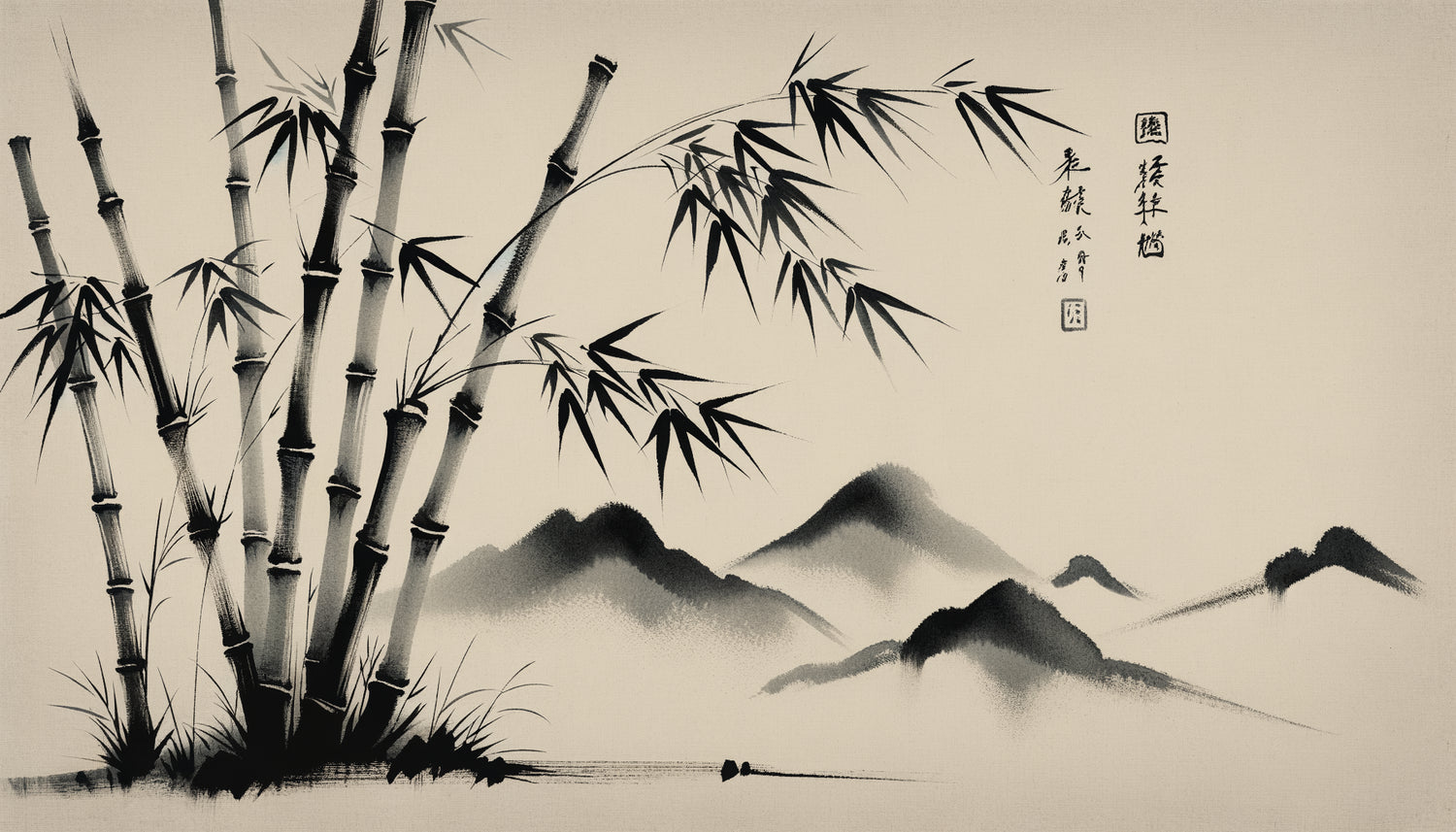
I spent three months in a Zen temple in Kyoto where I observed a master painting for hours. Or rather, I learned to look differently: it wasn't hours of painting, but hours of silence, breathing, and three brushstrokes. An incomplete circle. A bamboo branch. The void occupying 90% of the canvas. This radical economy shook me more deeply than any work saturated with color.
Here is what the economy of means in Zen paintings reveals: a gateway to present moment awareness, a liberation from attachment to superfluity, and a path to the very essence of what makes our existence vibrate. In our cluttered interiors where every surface cries out for attention, this minimalist approach offers a spiritual breath that we desperately need.
You contemplate these purified works and may wonder: how can a few ink strokes convey a spiritual depth that entire canvases do not reach? Why does what seems « unfinished » resonate so powerfully within us? This apparent simplicity hides centuries of Eastern philosophy, and I am going to reveal how these principles can transform not only your space, but your view of existence itself.
The void that speaks louder than a thousand words
In Zen tradition, the concept of ma (間) refers to this negative space, this intentional emptiness which is not an absence but a silent presence. I understood this notion by seeing a master trace a single plum branch: the unpainted flowers existed in the white space, suggested by the movement, present in the imagination.
This economy of means is not creative laziness; it is a fierce spiritual discipline. Each eliminated stroke is a conscious decision. Each empty space is cultivated with as much intention as a Zen garden where every stone counts. The painter does not remove elements due to lack of technique, but because he has reached that spiritual maturity where he knows how to distinguish the essential from ornamentation.
The Zen paintings embody this philosophy of less to reveal more. In a world where we accumulate objects, information, solicitations, these works remind us that fullness often arises from deprivation. They do not fill the space: they reveal it.
The fleeting moment captured in eternity
The spiritual meaning of economy of means lies deeply in the practice of satori, that sudden awakening to reality as it is. A Zen master paints in a few seconds what he has meditated on for days. These rapid, irreversible gestures capture the essence of the present moment.
Spontaneity as a spiritual discipline
I've learned that this apparent spontaneity takes years of practice. The brush doesn't tremble because the mind doesn't doubt. The economy of means in Zen paintings reflects a state of consciousness where the ego disappears: there is no longer an artist who paints, but painting manifesting through him.
This approach radically transforms our relationship to creation and existence. We live in anxiety about control, wanting to master everything, perfect everything. Zen paintings teach us that there is perfection in acceptance, a beauty in what unfolds naturally without forcing.
Look at an enso: incomplete, irregular, alive. Its radical economy (a single circular gesture) contains the entire cosmos. Its spiritual meaning goes beyond the symbol: it is the whole universe in its fertile emptiness, it is our own imperfection accepted as ultimate perfection.

Why less detail means more presence
The economy of means in Zen paintings creates a perceptual revolution. By eliminating the superfluous, these works create space for our consciousness to awaken. They don't tell us what to think: they invite us to be present.
I discovered that facing an authentic Zen canvas, something strange happens: the chattering mind slows down. These few strokes of black ink on white paper do not saturate our sensory circuits. On the contrary, they create a breach, a breath in the incessant flow of stimulation.
This visual economy corresponds to an attentional economy. In an interior where every object demands our gaze, a Zen painting offers a soothing anchor point. Its simplicity is not devoid of meaning: it is saturated with presence. It's the difference between dead silence and the vibrant silence of possibilities.
The paradox of perfect incompletion
Zen paintings celebrate the concept of wabi-sabi, this beauty of impermanence and imperfection. The economy of means is not a technical culmination but a spiritual acceptance: nothing is ever completely finished, and that is precisely where the beauty lies.
This philosophy overturns our Western quest for perfection and exhaustiveness. We want to say everything, show everything, control everything. Zen art teaches us that suggestion has more power than explicitness. A half-painted bamboo leaves our imagination to complete the rest, making us co-creators of the work.
Visible meditation: when each stroke becomes prayer
The spiritual meaning of economy of means culminates in this understanding: these paintings are not representations, they are traces of meditation. Each brushstroke is an act of mindfulness, a moment of total fusion with the present.
In my practice, I realized that these works function as visual mantras. Their radical simplicity creates a focal point for meditation. They do not tell a story, do not convey a complex message: they simply are, inviting those who contemplate them to be equally, without artifice.
This economy of means also reflects the Buddhist concept of non-attachment. The painter does not cling to his line: he releases it. He doesn't retain, accumulate, or overload. This artistic practice becomes a spiritual exercise in letting go.

How this philosophy transforms our living spaces
Integrating zen paintings into your interior is not only a decorative choice, it's inviting a way of life. This economy of means particularly resonates in our era of sensory and mental saturation.
I observe that people who live with these purified works gradually develop a different relationship with their environment. They begin to question: do I really need this object? Does this accumulation nourish me or exhaust me? The economy of means becomes contagious, spreading from the canvas to the space, then to lifestyle habits.
Art as a daily spiritual guide
These paintings act as silent reminders. Every morning, when you come across this incomplete circle or this solitary branch, you receive an invitation: simplify, return to the essential, honor the fertile void rather than compulsive filling.
The spiritual meaning of economy of means goes far beyond aesthetics: it proposes a ecology of attention. In a world that pulls us in a thousand directions, these works create a calming center of gravity. They remind us that we don't need more: we need to perceive better what is already there.
Let serenity into your daily life
Discover our exclusive collection of Zen paintings that transform every glance into a moment of contemplative meditation.
The path to essence: your own inner journey
The ultimate beauty of the economy of means in Zen paintings lies in this constant invitation: what is truly essential in your life? These few strokes of ink pose a radical question to our civilization of accumulation.
Imagine your space transformed not by addition, but by revelation. A clean wall welcoming a Zen artwork becomes a portal to another way of inhabiting the world. You are no longer simply looking at a painting: you breathe with it, you find in its empty spaces the mental oxygen that everyday life compresses.
Start small: one painting, one wall, one moment each day where you stop in front of this radical economy of means. Let these few strokes of ink teach you what years of spiritual quest sometimes struggle to convey: fullness is not found in accumulation but in conscious presence to what is.
This millennial philosophy simply awaits your acceptance of its simplest and most transformative invitation: less to reveal more, silence to hear the essential, emptiness to welcome life in all its vibrant density.
Frequently Asked Questions
Why are Zen paintings often unfinished or minimalist?
This apparent simplicity reflects a profound spiritual philosophy. The economy of means in Zen paintings is not a lack of skill but a supreme discipline: it requires distinguishing essence from ornamentation. These unfinished works celebrate the concept of wabi-sabi (beauty of imperfection) and invite your imagination to complete the work, making you an active participant in the artistic experience. Emptiness is not absence: it is a breathing space for your consciousness, an invitation to meditative contemplation rather than visual consumption. This radical economy paradoxically creates more presence and depth than a saturated canvas.
How can a Zen painting have a spiritual impact on my daily life?
Zen artworks act as anchors of mindfulness in your living space. Their simplicity creates a visual resting point that naturally calms the restless mind. Each time your gaze meets these few clean lines, you receive a silent invitation to slow down, breathe, and return to the present moment. This daily practice, even brief, gradually cultivates a different relationship with your environment and yourself. The spiritual meaning of these works operates through gentle impregnation: they impose nothing on you, but their constant presence diffuses a philosophy of less is more that gradually influences your choices, your attention, your connection to what is essential.
Do you need to know Buddhism to appreciate Zen art?
Absolutely not! The beauty of the simplicity in Zen artworks lies precisely in their universality. These works speak directly to something deep within us, beyond beliefs or intellectual knowledge. Your body and nervous system naturally react to this soothing simplicity: it is a physiological response as much as a spiritual one. Of course, understanding concepts like ma (negative space) or enso (circle of enlightenment) enriches the experience, but it is not a condition. The essential thing is to let these works touch you, to observe how they transform your space and your inner state. The wisdom they convey operates even without words, even without concepts: that is their deepest power.


