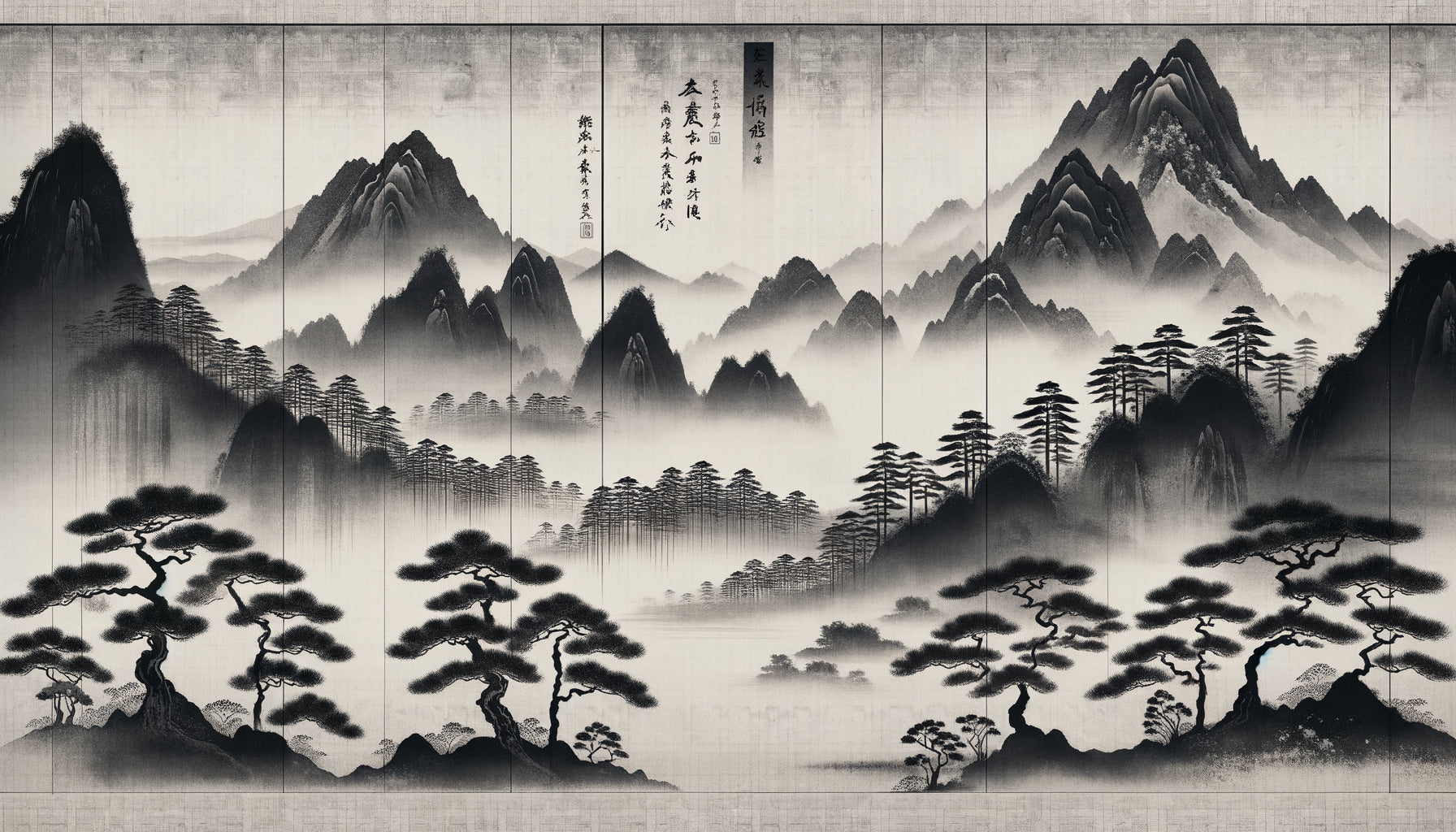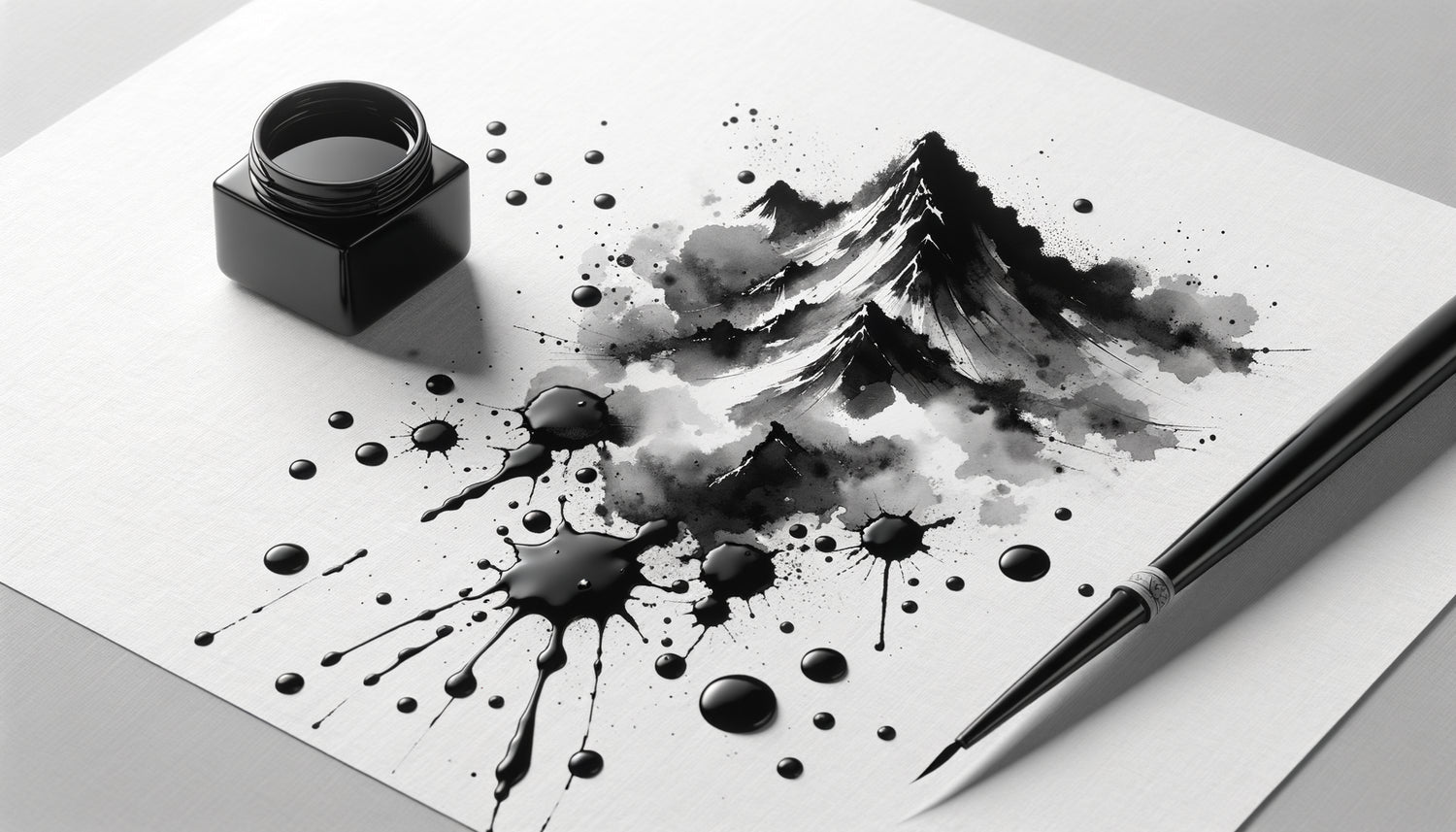
The first time I observed a true haboku in a Kyoto temple, I thought I was seeing an error. Splashes of black ink scattered on rice paper, barely suggested forms, a landscape that seemed to emerge from chaos itself. Then the monk who accompanied me murmured: "It is when the brush ceases to control that truth appears." That sentence changed my perception of Zen art forever.
Here's what the haboku technique brings: a liberation of artistic gesture that transcends realistic representation, a moving meditation that captures essence rather than form, and an aesthetic of non-control that deeply resonates with our contemporary need to let go.
We live in a world of hyper-control, digital perfectionism, clean lines. Yet, faced with a Zen painting made in haboku, many feel lost. These ink splashes seem random, these blurry shapes appear unfinished. How can one appreciate what looks like an accident? How can this aesthetic of controlled chaos be integrated into a contemporary interior?
Rest assured: understanding haboku does not require years of Zen studies. It simply requires grasping its profound intention and recognizing its radical beauty. I invite you to the universe of this fascinating technique that transforms accident into perfection.
The essence of haboku: when ink dances with emptiness
The term haboku (破墨) literally translates to "broken ink" or "splattered ink." This Japanese pictorial technique, inherited from Song Chinese painting, represents one of the peaks of Zen art. Unlike conventional pictorial techniques that seek to master every stroke, haboku celebrates creative non-control.
Specifically, the artist generously loads their brush with diluted black ink of varying degrees, then projects, splashes or lets the ink flow onto absorbent rice paper. The ink splashes spread unpredictably, creating nuances ranging from deep black to translucent gray. It is this very unpredictability that constitutes the heart of the technique.
What radically distinguishes haboku from other Zen painting styles such as traditional sumi-e is its relationship with chance. Where sumi-e precisely controls every brushstroke, haboku invites accident, welcomes the unexpected, transforms "fault" into beauty. The artist becomes a partner of chaos rather than its master.
Zen philosophy embodied in the gesture
For Zen monks who developed this approach in the 15th century, haboku was much more than a simple pictorial technique. It was a meditative practice that embodied the fundamental principles of Zen: non-attachment, acceptance of impermanence, the beauty of imperfection.
Sesshu Toyo, the undisputed master of haboku, explained that this technique required a state of mushin – an empty mind, free from any intention. The artist does not plan their work: they enter a state of total presence where the gesture emerges spontaneously, where ink splashes reveal what must be revealed.
The technical secrets behind apparent spontaneity
Paradoxically, mastering non-control takes years of rigorous practice. Artists who excel in haboku have first spent decades perfecting the classic brush techniques. This prior technical mastery then allows them to let go authentically.
Ink preparation is the first crucial step. In haboku, artists work with several simultaneous dilutions: a very concentrated ink for deep accents, medium dilutions for suggested forms, and very pale washes for atmospheres. These different intensities of ink, projected and superimposed, create surprising depth despite the apparent simplicity.
The support also plays a decisive role. Traditional rice paper (washi) absorbs ink in a unique way, allowing splashes to diffuse with characteristic blurred outlines. This diffusion is never identical twice, giving each haboku work its absolutely unique character.
The fundamental gestures of controlled splashing
Although haboku embraces randomness, certain technical gestures recur constantly. The lateral projection of the brush creates elongated streaks evoking rain or bamboo. Vertical tapping produces concentrated spots suggesting rocks or mountains. Letting the brush simply touch the paper soaked with ink generates perfect organic halos for mists.
Masters of haboku develop an extraordinary sensitivity to timing. They know precisely when to add a new ink splash while the previous one is still wet (creating fusions), or wait for it to dry (creating clear superimpositions). This temporal dance with ink drying distinguishes a successful haboku from a simple stain.

Recognizing an authentic haboku in zen paintings
When faced with a Zen painting, how can you distinguish a true haboku from other ink painting styles? Several visual characteristics immediately betray it. First, the predominance of emptiness: in an authentic haboku, unpainted space often occupies 70% of the composition. This void is not a lack, but an active element that gives meaning to the ink splashes.
Next, observe the absence of defined outlines. Unlike classic sumi-e where forms are delineated by precise brushstrokes, haboku suggests shapes through diffuse masses of ink. A mountain landscape is not drawn: it emerges from the arrangement of spots and tonal gradations.
Finally, look for this particular quality of intentional incompleteness. A Zen painting in haboku always seems to be able to receive an additional stroke, but does not need one. This tension between completeness and openness creates a unique visual dynamic that invites the eye to mentally complete what is only suggested.
The preferred subjects of haboku
Although theoretically applicable to any subject, haboku excels particularly in the representation of atmospheric landscapes. Mountains shrouded in mist, bamboo in the rain, cliffs emerging from fog: these themes allow the technique of ink splashes to reveal all its evocative power.
Masters of haboku generally avoid subjects requiring precise details. You will practically never see portraits or detailed still lifes in this style. The essence of haboku lies in its ability to capture atmosphere, vital energy (ki), rather than the superficial appearance of things.
Integrating a haboku into your living space
A Zen painting made in haboku radically transforms the energy of an interior. Unlike colorful works that actively attract attention, a haboku creates a silent, almost meditative presence. It functions as a visual anchor that soothes rather than stimulates.
For a contemporary living room, a large haboku landscape painting above a sleek sofa creates a striking contrast with the straight lines of modern furniture. The organic and unpredictable aspect of ink splashes brings a welcome humanity to spaces that are sometimes too geometric.
In a bedroom, a haboku of bamboo in the rain naturally promotes relaxation. These vertical and flowing compositions, with their splashes suggesting the movement of water, induce a contemplative state conducive to rest. Place it facing the bed so that it is the last thing you see before sleeping.
Hanging mistakes to avoid
The main mistake is to frame a haboku too ornately. These works require minimalist frames, or even the absence of a frame in favor of a simple mounting on panel. A gilded or overly imposing frame directly contradicts the philosophy of non-attachment that the haboku conveys.
Also avoid overloading the wall around the zen painting. The ink splash technique creates compositions that breathe through emptiness: they need white space around them to fully deploy their visual impact. Allow a minimum of 30 cm of empty space on each side.

The contemporary heritage of haboku
Today, haboku is experiencing a fascinating revival. Contemporary artists are embracing this ancestral technique to explore unprecedented visual territories. Some combine haboku and photography, projecting ink splashes onto silver prints. Others integrate modern pigments while respecting the fundamental gestural principles.
What makes haboku particularly relevant for our time is its invitation to let go. In a world obsessed with control and digital perfection, these zen paintings celebrating creative accident offer a valuable philosophical breath. They remind us that beauty can emerge from the unexpected, that perfection sometimes lies in accepting imperfection.
Discerning collectors are now actively seeking works in haboku, recognizing their unique ability to transform the atmosphere of a space. An authentic haboku is never simply decorative: it is a presence that silently dialogues with the observer, inviting them to their own contemplation.
Ready to welcome the serenity of haboku into your home?
Discover our exclusive collection of Zen paintings that capture the contemplative essence of this ancestral technique and will transform your interior into a sanctuary of tranquility.
Towards your own contemplation
Understanding haboku is accessing a worldview where perfection arises from abandoning control, where beauty emerges from the acceptance of impermanence. These ink splashes that seemed random gradually reveal their profound intentionality, their organic coherence.
The next time you observe a zen painting made in haboku, don't try to « understand » what it represents. Simply let your gaze get lost in the gradations of ink, follow the fluid streaks, rest in the empty spaces. It is in this abandonment of analysis that the true experience of haboku reveals itself.
Start with a single zen painting in your space. Observe how its silent presence subtly transforms the atmosphere, how your eyes naturally return to it during moments of reflection. Haboku doesn't shout: it whispers an invitation to presence, acceptance, and inner peace that we all seek.