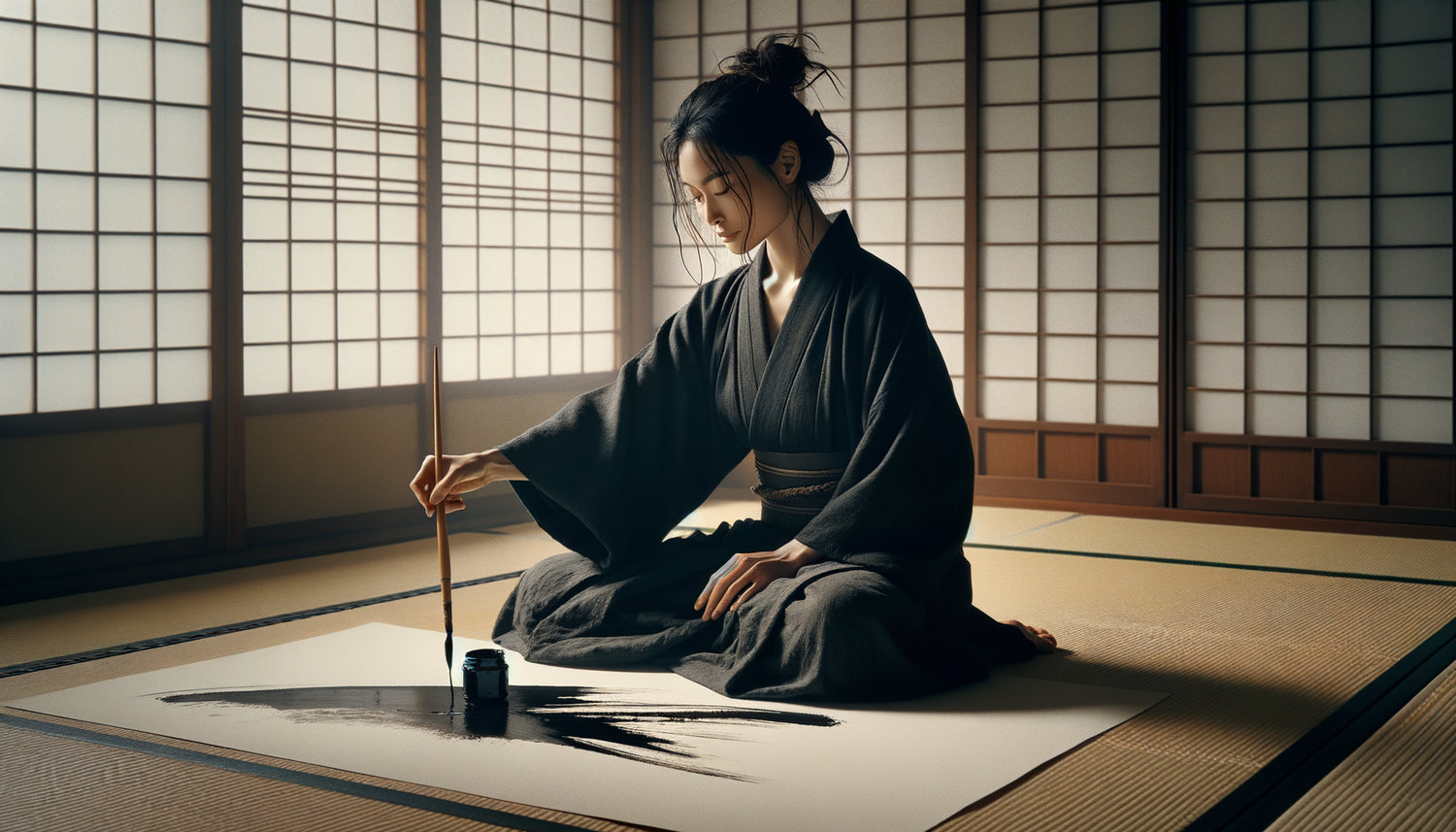
In the workshop of a master calligrapher in Kyoto, I observed a moment that shook my understanding of Zen art. The brush didn't rest on the paper: it passed through it. No thought, no hesitation, just a perfect stroke born from emptiness. It was mushin in action — this state of no-mind that radically transforms artistic creation.
This is what the concept of mushin brings to Zen paintings: a spontaneity that captures the pure moment, an authenticity impossible to feign, and a vital energy that transcends technique. This ancestral philosophy does not only influence the artist's gesture — it completely reinvents the very nature of the created work.
You admire these refined Zen paintings, these ink strokes that seem to contain the universe within their simplicity? You may wonder how to recreate this magic in your interior, this soothing presence that transforms an ordinary space into a sanctuary of serenity. Yet, behind this apparent simplicity lies a bewildering paradox: the more you try to create Zen, the less you achieve it.
Rest assured: understanding mushin requires neither years of meditation nor a doctorate in Oriental philosophy. It simply involves grasping how the absence of mental calculation creates an incomparable artistic presence — and why that changes everything in the choice and appreciation of an authentic Zen painting.
I invite you on a journey to the heart of this philosophy that revolutionizes our relationship with contemplative art, so that you can recognize and welcome into your home works truly inhabited by this particular energy.
Mushin: when the mind fades to make way for essence
The term mushin literally translates as mu (void, no) and shin (heart-mind). It is not a passive mental void, but a fluid state of consciousness where the analytical ego dissolves. In Zen tradition, mushin represents the moment when the artist, their tool, and their support become one.
Contrary to the Western approach that values planning and control, mushin invites letting go. The artist does not think their stroke: they become it. This fundamental distinction radically transforms the creative act. The brush no longer reproduces a preconceived mental image — it reveals what spontaneously emerges from the present moment.
I have noticed that Zen paintings created in this state possess a particular energetic quality. You can literally feel the difference between a calculated work and a work born of no-mind. The first explains, demonstrates, convinces. The second simply is — and this pure presence immediately captures the gaze.
The creative paradox: mastering to forget
Here's the secret few understand: mushin is not accessible to beginners. Paradoxically, it takes years of rigorous technical discipline to achieve the freedom of the no-mind. The Zen master repeated the same gesture ten thousand times, until the technique integrated into his body and disappeared from his consciousness.
This apparent contradiction explains why authentic Zen paintings simultaneously possess impeccable technical mastery and childlike spontaneity. The artist has internalized all the rules to the point of being able to completely forget them. The gesture then becomes pure expression, freed from the shackles of reflection.
The visible imprint of mushin in Zen composition
How does mushin manifest itself concretely in a Zen painting? Several visual characteristics betray this profound influence, and recognizing them will help you identify authentic works.
First, natural asymmetry. Unlike calculated symmetry which reveals the intervention of intellect, compositions born of the no-mind present an organic balance, almost accidental. An ensō circle is never perfectly round, and it is precisely this spontaneous imperfection that gives it its spiritual perfection.
Secondly, variation of line. Observe carefully the lines of an authentic Zen painting: they breathe. The thickness varies, the intensity of the ink fluctuates, some areas seem hesitant while others assert themselves forcefully. These nuances impossible to premeditate are the signature of mushin — the brush reacts to the energy of the moment rather than a preconceived plan.
Empty space as protagonist
In Western art, one paints forms. In Zen art influenced by mushin, one reveals the void. This conceptual reversal changes everything. Negative space is not a passive backdrop but an active element of the composition.
I observe that authentic Zen paintings use emptiness with disconcerting audacity — sometimes 70 to 80% of the surface remains untouched. This radical economy of means is a direct consequence of the no-mind: the artist does not seek to fill space but to capture the essence. A single line is enough when it contains all the rightness of the moment.
This extreme austerity exerts a profound soothing effect in an interior. Where Western art stimulates and activates the gaze, the Zen painting created in a state of mushin offers a visual breathing space, a silence that soothes the overstimulated mind.

The speed of execution: capturing the ephemeral
Here is a fascinating aspect of the influence of mushin: the speed of execution is not a technical constraint but a spiritual necessity. The greatest zen paintings are often created in seconds, sometimes in a single breath.
Why this urgency? Because mushin is a fleeting state, a window that opens briefly between two thoughts. The artist must seize this moment of grace before the intellect regains control. Any hesitation, any correction, any regret betrays the return of the calculating mind — and the work immediately loses its zen authenticity.
This forced spontaneity creates a visible dynamic tension in the brushstroke trace. One perceives the controlled urgency, the fluidity under pressure. It is this contained energy that gives zen paintings their vibrant presence, as if the moment of creation remained suspended in the finished work.
The impossible retouch
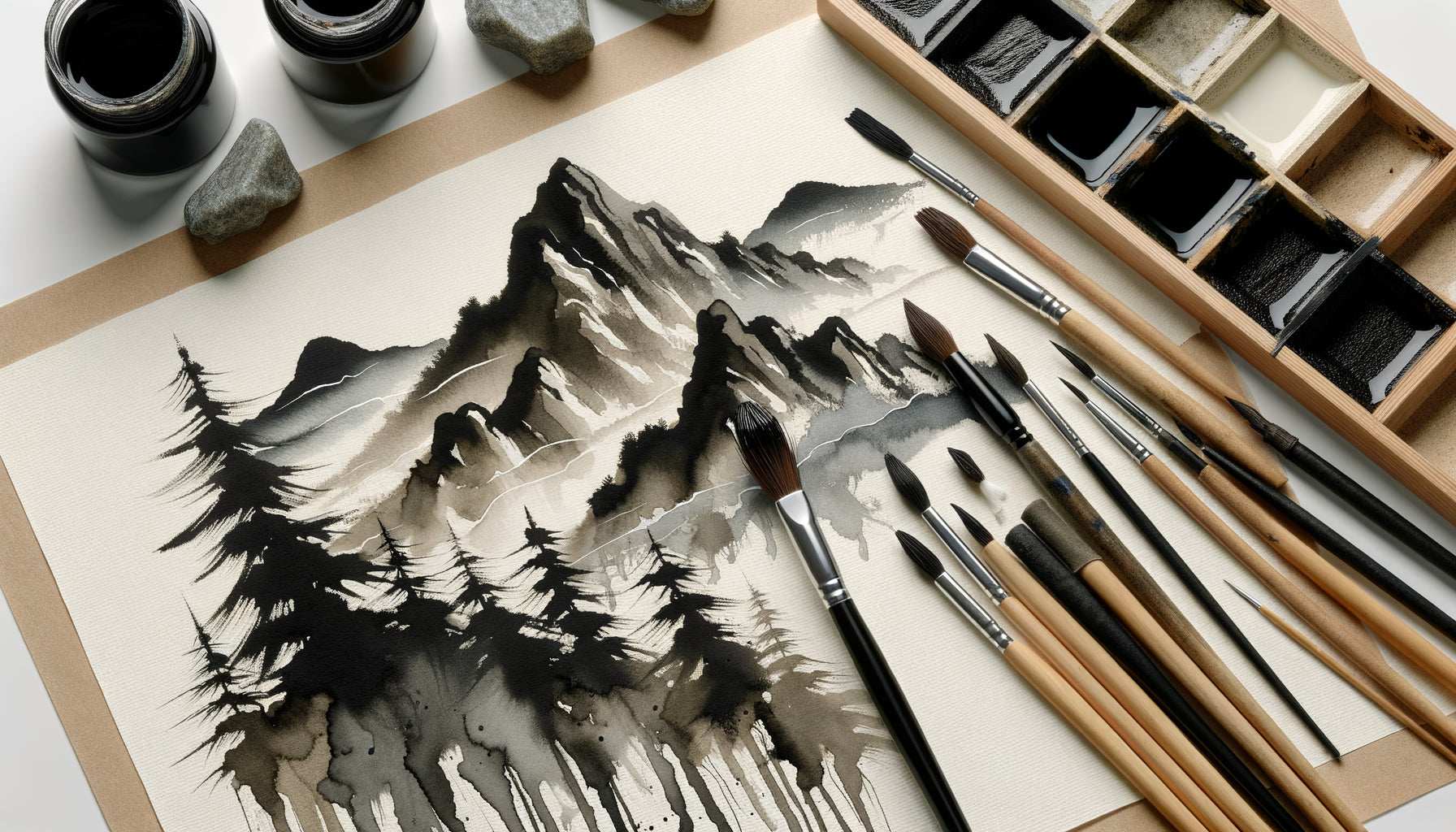
In Western art, oil painting allows for corrections, superimpositions, and repentances. Ink on rice paper forgives nothing. This technical impossibility is not an accident: it perfectly embodies the philosophy of mushin.
Each stroke is definitive, irreversible. This irreversibility forces the artist to abandon mental control, to trust their gesture. One cannot create in this state without completely letting go. The non-mental thus becomes the only possible path, transforming a material constraint into spiritual liberation.
Mushin and symbols: when meaning emerges without intention
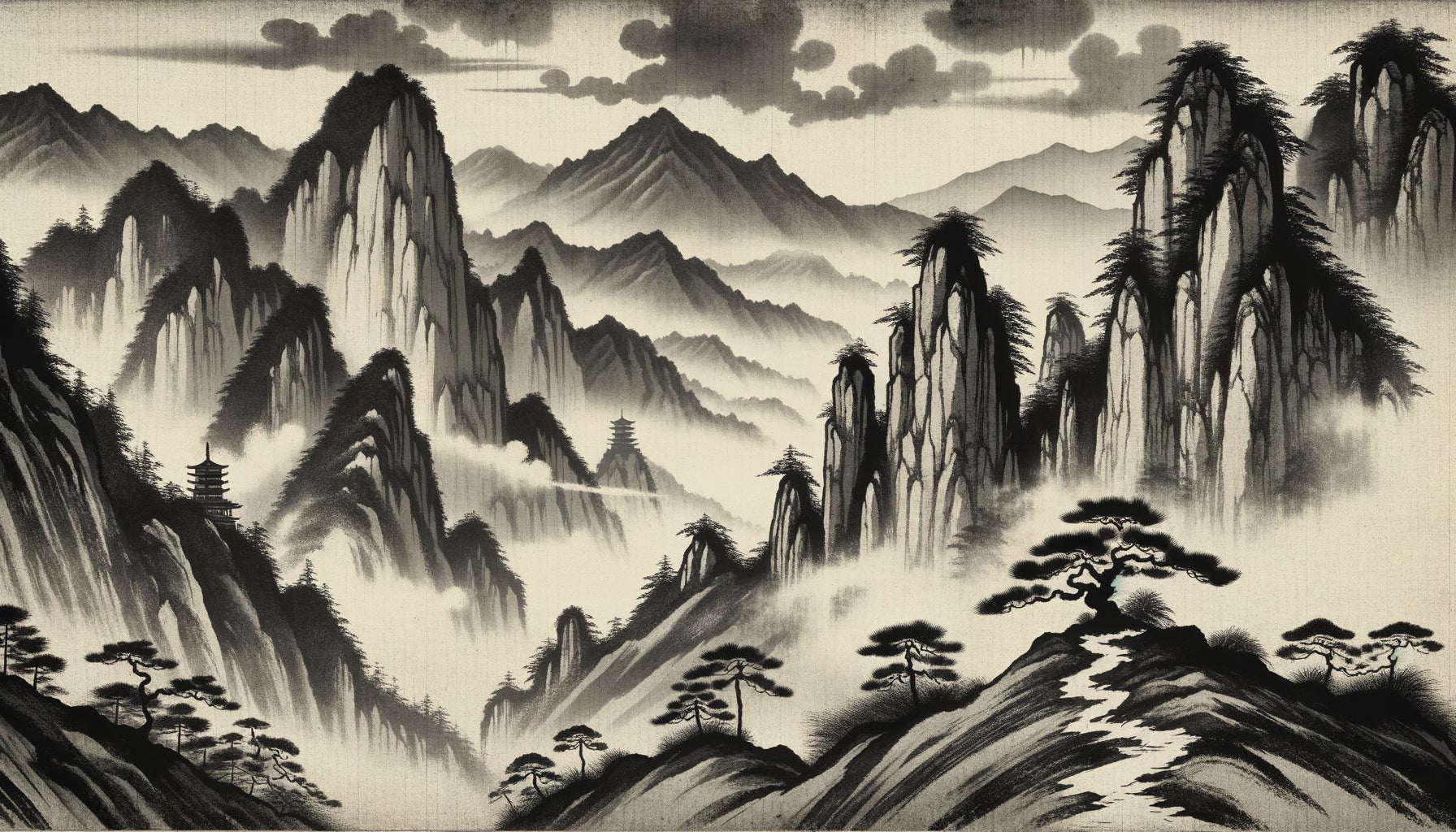
Zen paintings are full of recurring motifs: ensō circles, bamboos, mountains in mist, solitary paths. But the influence of mushin radically transforms the way these symbols are created and perceived.
In an intellectual approach, the artist chooses a symbol for its philosophical meaning, then executes it. In the state of non-mental, the symbol emerges spontaneously, without premeditation. The ensō circle is not drawn to represent enlightenment — it becomes enlightenment in its very realization.
This subtle distinction profoundly changes the impact of the work. A conceived symbol remains external to the observer, an object of intellectual contemplation. A symbol born from mushin acts directly on consciousness, short-circuiting mental analysis to touch a deeper, almost visceral understanding.
The power of energetic resonance
Practitioners of meditation often report a disturbing experience when facing authentic zen paintings: their mind spontaneously calms down. This is not suggestion or projection—it's a direct energetic resonance.
A work created in a state of mushin carries within it the imprint of that state of consciousness. It becomes, so to speak, a recording of pure presence, capable of reactivating this same quality in the receptive observer. That is why an authentic zen painting is not simply decorative—it is functional, a tool for inner transformation.
In a living room or bedroom, this presence acts like a silent tuning fork, gently reminding the overheated mental space that another modality exists. There's no need to look at it actively: its mere presence in the environment diffuses a quality of appeasement.

Recognizing authenticity: mushin versus imitation
The market is full of decorative zen paintings, but not all bear the imprint of mushin. How to distinguish the authentic from superficial aesthetics?
First, observe the quality of the line. A calculated line, even skillful, remains uniform and predictable. A line born from the non-mental breathes: it accelerates and slows down, thickens and thins according to an organic logic impossible to plan. This controlled irregularity is the signature of the liberated gesture.
Next, evaluate your visceral reaction. When facing a zen painting authentically created in a state of mushin, something relaxes within you before your intellect analyzes the image. This instant resonance precedes aesthetic judgment—it operates at a deeper level.
Finally, look for perfect imperfection. The paradox of mushin produces works technically mastered but never polished, refined but never cold. If everything seems too calculated, too clean, too intentional, the artist's ego has probably taken over the non-mental.
Transform your space into a sanctuary of serenity
Discover our exclusive collection of Zen paintings that capture the essence of mushin and bring this soothing presence into your daily life.
Integrating the energy of mushin into your interior
Welcoming a Zen painting carrying the spirit of mushin is not just a decorative choice — it's inviting a particular quality of awareness into your living space.
Location matters enormously. These works work best in transitional or pause areas: entrance, meditation corner, space above the bed. Avoid cluttered walls or visually noisy environments that would cancel out their soothing effect. The Zen painting needs empty space around it to breathe — just like the composition itself uses emptiness.
Indirect natural light particularly reveals the subtleties of the line, the variations in ink intensity that artificial lighting flattens. If possible, position the work where daylight can play with its nuances without creating aggressive reflections.
Finally, resist the temptation to accumulate. A single Zen painting authentic in a room is quite sufficient. Mushin speaks the language of the essential, the sufficient, the just enough. Multiplying works dilutes their impact rather than amplifying it.
Create a silent dialogue
The most fascinating thing about a Zen painting imbued with mushin, is that it evolves with you. Your perception of the work changes according to your inner state. Some days, you will notice details that had escaped you for months. Other times, it's the empty space that will capture all your attention.
This changing quality is not subjective in the ordinary sense — it reveals that the work functions as a mirror of consciousness. The non-mental crystallized in the Zen painting meets your own mental state, creating a unique interaction with each glance. That's why these works never tire: they remain alive, always new.
Imagine yourself in three months, returning home after an intense day. Your gaze crosses this unique ink stroke suspended on the wall. Something relaxes instantly. No need for formal meditation, no conscious effort — the simple presence of this trace of mushin reminds your nervous system that another mode exists. The chattering mind calms down by itself, even if only for a few seconds. And those few seconds change everything.
The concept of mushin is not a philosophical abstraction reserved for Zen monks. It lives concretely in these Zen paintings that transform a simple wall into a gateway to presence. Begin by truly observing—not analyzing, simply seeing—and let the work's non-mental awaken your own.
Frequently Asked Questions
Do I need to understand Zen philosophy to appreciate a painting created in a state of mushin?
Absolutely not—and that's precisely the magic of mushin. These works operate at a preconceptual level, before language and intellectual analysis. You may have no knowledge of Zen Buddhism and still feel the soothing effect of an authentic Zen painting. Your body and nervous system directly capture the energetic quality of the work. Philosophical understanding can enrich the experience, but it is not a prerequisite. Trust your immediate feeling: if something relaxes within you in front of the work, then mushin is at play, regardless of what your intellect understands or not. Authentic Zen art speaks a universal language that precedes any specific culture.
Can a Zen painting printed transmit the energy of mushin?
This is a legitimate question and the answer nuances: yes, but with reduced intensity. The original created in a state of mushin bears the direct energetic imprint of the gesture, the moment, the artist's presence. It is a unique object charged with a specific history. A quality reproduction can nevertheless transmit the composition, balance, proportions—all these elements that also reflect the non-mental. The impact will be more intellectual and aesthetic than energetic, but it remains valid, especially for beginning your exploration of Zen art. Consider the print as an accessible introduction: if the effect touches you, you can then search for original pieces. The essential thing is that the source work was authentically created in a state of mushin—even reproduced, it retains something of this quality.
How to maintain a Zen painting to preserve its energy?
Maintenance is simple: avoid direct exposure to sunlight which degrades the ink, and gently dust with a dry soft cloth. But your question touches something deeper — how to preserve energetic quality? The answer might surprise you: it's your own presence that keeps the work alive. A neglected zen painting, becoming invisible through habit, indeed loses its impact. Regularly take a few moments to really look at it, without purpose or analysis, simply being present with it. This attention reactivates the resonance between your consciousness and the mushin crystallized in the work. Some go so far as to ritually clean the space around the painting as a meditative practice. True maintenance is not technical but relational: remain in living dialogue with your zen painting, and it will continue to offer you its soothing presence.