Imagine a workshop bathed in soft light in Kyoto, in the 18th century. A brush glides across rice paper with disconcerting freedom, tracing mountains that seem to rise from the mist. These strokes, both spontaneous and deeply mastered, bear the signature of Ike no Taiga, this visionary painter who managed the impossible: marrying Zen meditation to Chinese literary erudition in a single creative breath. Here's what the fusion of Zen and literary traditions brings to his paintings: an expressive freedom that transcends academic rules, a palpable spirituality that soothes the eye and mind, and an intellectual elegance that dialogues with classical poetry. You may admire Asian art without really understanding what makes certain works so particular, so vibrant with an energy that is both calm and intense. This impression is not by chance. At Taiga, each brushstroke results from a rare alchemy between contemplative discipline and learned culture. I invite you to discover how this Japanese master created a unique visual language, and why his approach still resonates today in our interiors seeking authenticity.
A painter between two worlds: the legacy of Taiga
Born in 1723 in a modest family in Kyoto, Ike no Taiga was destined neither for Zen temples nor for literary circles. Yet, from his adolescence, he immersed himself in both universes with insatiable curiosity. On one hand, he frequented monasteries where the practice of zazen (seated meditation) shapes his relationship to presence and emptiness. On the other hand, he devours classical Chinese texts, studies the calligraphy of Tang dynasty masters, is initiated into the poetry of Confucian scholars.
This double training, far from creating tension, becomes the fertile ground for his genius. Where Zen tradition values immediacy, letting go and the simplicity of the line, literary culture demands technical mastery, literary references and compositional sophistication. Taiga does not choose: he weaves these two threads into a new fabric, creating what art historians call the bunjinga or Japanese literati painting style.
The revolution of the free brush
In his landscapes, you immediately recognize this freedom of gesture. The mountains are not drawn with the academic rigor of court painters, but suggested by quick, sometimes almost abstract touches. Trees bend like living calligraphy. This spontaneity comes directly from Zen practice: painting as one breathes, without mental calculation, letting energy (the ki) circulate from the body to the paper.
But look closer: each composition reveals a learned architecture, subtle balances between full and empty spaces, references to the poems of Du Fu or Wang Wei. This invisible structure is the contribution of literary tradition. Taiga does not paint in total improvisation: he improvises with his culture, like a jazz musician dialogues with standards.
Emptiness as a space for creative breathing
One of the most striking features of Taiga's paintings remains the use of emptiness. Unlike Western paintings where every square centimeter is often treated, his compositions allow large areas of unpainted paper to breathe. This emptiness is not a lack: it is an active element, a silent presence inherited from Zen Buddhism.
In Zen philosophy, emptiness (mu in Japanese) represents infinite potential, the space where all forms can be born. By leaving these white spaces, Taiga invites your gaze to complete the image, to participate in creation. You do not contemplate passively: you inhabit the work, you complete it with your own imagination.
But this emptiness is always articulated with a precise literary composition. The calligraphy he integrates into his landscapes is never decorative: it prolongs the movement of the mountains, creates visual bridges between the elements, anchors the scene in a poetic temporality. A four-line poem can thus dialogue with a rocky peak, mist and a solitary pine tree, weaving together painting, calligraphy and literature.
The colors of contemplation
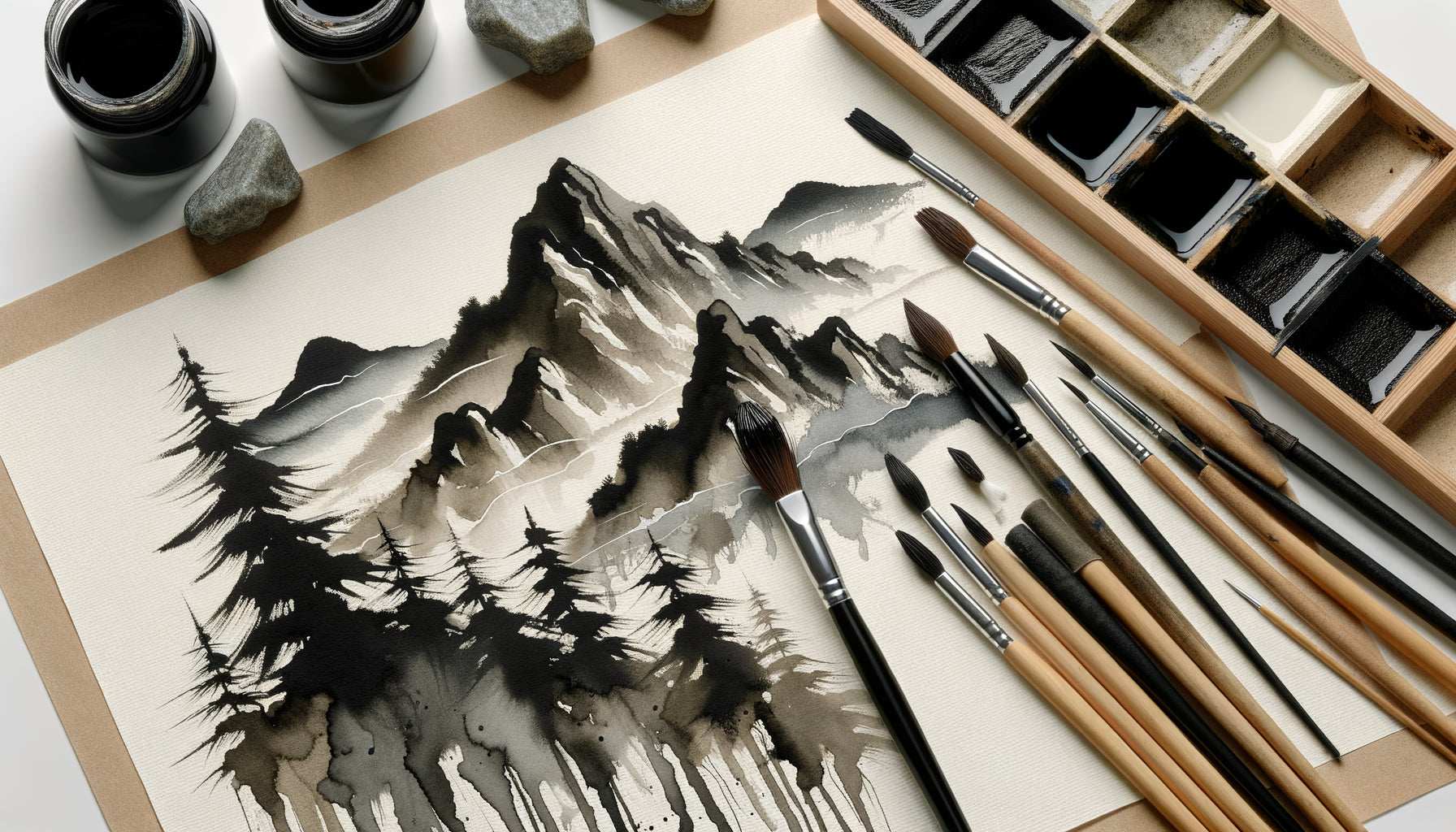
Taiga's palette also deserves your attention. He favors diluted inks, subtle washes where black is declined in countless shades of gray. These monochrome tones directly evoke the Zen practice of sumi-e, this ink painting that captures the essence rather than the appearance.
When he uses color, it is with a restraint typical of literary tradition: touches of mineral blue for the distances, soft ochres for the paths, delicate greens for the vegetation. Never a glaring saturation. Each color finds its rightful place in a balance that soothes the eye while nourishing the mind.

When nature becomes visual meditation
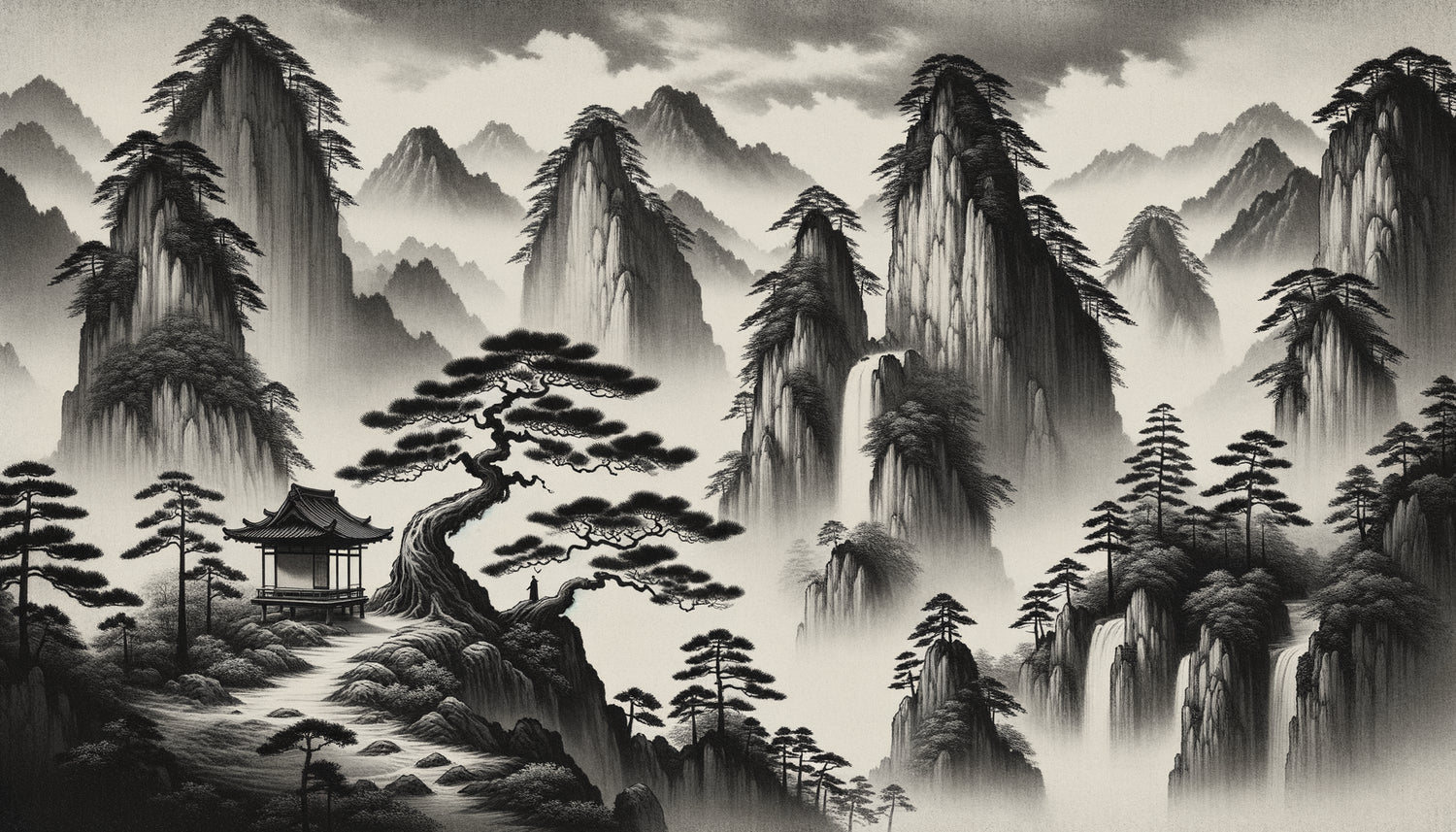
Taiga’s landscapes never accurately represent real places with topographic precision. They are interior landscapes, syntheses of his contemplative experiences and readings. In this, he follows the Chinese literate tradition for whom landscape (shanshui, literally mountains-and-waters) is as much a spiritual exercise as it is an aesthetic one.
But where Chinese literati often favored a certain monumentality, Taiga infuses a zen lightness. His mountains seem to float, his rivers meander effortlessly, his hermitages melt into the mist. Everything suggests impermanence, that Buddhist concept according to which all form is transient, constantly transforming.
This approach creates a unique atmosphere in his paintings: they invite both erudition (understanding references, deciphering poems) and silent meditation (allowing oneself to be absorbed by the visual rhythms, feeling the peace that emanates from the compositions). It is this duality that still fascinates collectors and lovers of contemplative art.
Technique serving the liberated mind
To achieve this fusion, Taiga develops innovative pictorial techniques. He often works on paper rather than silk, preferring the absorbent texture that allows for characteristic diffusion effects. His brush alternates between firm strokes and almost transparent touches, creating rhythmic variations that evoke breathing.
One of his major innovations remains the use of tarashikomi, this technique of depositing ink onto a wet surface while it is still wet, creating unpredictable halos and gradations. This process introduces an element of controlled chance, very zen in its acceptance of imperfection, while producing visually sophisticated literate effects.
The lasting influence on Japanese aesthetics
Taiga’s legacy extends far beyond his time. His ability to fuse traditions that seem contradictory has paved the way for a whole generation of Japanese artists who dared to create their own cultural synthesis. His influence can be seen even in contemporary art, among creators seeking to reconcile tradition and innovation, discipline and freedom.
In our modern interiors, the spirit of his works resonates strongly. At a time when we seek to slow down, to create spaces of serenity and reflection, his landscapes offer a model: that of a beauty which nourishes the intellect without agitating the mind, which invites contemplation without imposing a single interpretation.
Transform your space into a sanctuary of contemplation
Discover our exclusive collection of Zen paintings that capture this same fusion between refined aesthetics and spiritual depth, to create a soothing visual refuge in your home.

Integrate the spirit of Taiga into your daily life
You don't need to be a collector of ancient art to benefit from Taiga's approach. His essential teaching – merging discipline and freedom, structure and spontaneity – applies to any creative or decorative endeavor.
When you choose a work for your interior, look for this paradoxical quality: an image that calms you while stimulating your imagination, which offers a framework without imposing it, which lets your gaze breathe. This is exactly what Taiga's paintings achieved: visual spaces where the mind can both settle and travel.
In arranging your rooms, you can also apply his principle of active void. Rather than filling every surface, dare to leave breathing spaces, purified zones that highlight essential elements. This minimalist approach is not cold: it creates a quality of presence, an attention to detail that transforms the ordinary into the extraordinary.
The legacy of Ike no Taiga reminds us that there is no contradiction between intellectual depth and visual simplicity, between refined culture and spontaneity of gesture. His paintings, by fusing Zen and literary traditions, created a universal language that still speaks to our contemporary sensibilities. They invite us to seek our own synthesis, our personal way of harmonizing the influences that nourish us.
Start today by observing differently the works around you. Look for those that create this subtle dialogue between structure and freedom, between silence and expression. You may discover that your space only needs a touch of this pictorial wisdom to transform into a true haven of creative peace.
Frequently asked questions about Taiga's art
Why do Taiga's paintings seem so soothing?
The soothing effect of Taiga’s works comes directly from his zen training. He used empty spaces that allow your gaze to rest, soft colors in monochrome shades that never assault the eye, and balanced compositions where nothing cries out for attention. This approach creates a meditative quality: you don't have to decipher the image with effort, you can simply inhabit it. At the same time, the literate sophistication of his cultural references offers depth that prevents boredom – your mind always finds new subtleties to discover. It is this combination of visual simplicity and intellectual richness that explains why his paintings work so well in contemporary living spaces seeking serenity.
How to recognize the zen influence in his paintings?
The zen influence is manifested in several characteristic aspects of his work. First, the spontaneity of the stroke: his brushstrokes retain an immediate freshness, as if they were applied without hesitation or regret, reflecting the zen practice of the right gesture at the present moment. Then, the acceptance of imperfection: you will notice drips, variations in intensity, deliberate asymmetries that celebrate the ephemeral and imperfect nature of all things. Finally, the strategic use of void as a compositional element in its own right, not as a simple background, embodies the zen concept of mu. Conversely, the literate influence is recognized in the integration of careful calligraphy, references to famous poetic places, and an overall composition that reveals a profound literary culture. It is their harmonious coexistence that defines his unique style.
Can Taiga’s spirit be integrated into a modern decor?
Absolutely, and it is particularly relevant today! Taiga’s approach resonates perfectly with current trends towards conscious minimalism and soothing interiors. To integrate his spirit, prioritize works with clean compositions with generous visual breathing spaces. Opt for monochrome palettes or desaturated colors rather than bright hues. Look for pieces that suggest more than they impose, that leave room for your imagination. In practical terms, a large format in soft tones can anchor a contemporary living room, while a smaller ink painting will bring contemplation to an office or bedroom. The essential thing is to choose works that create a dialogue between structure and freedom, that calm you without boring you. Contemporary zen creations often extend this heritage by adapting it to current sensibilities.