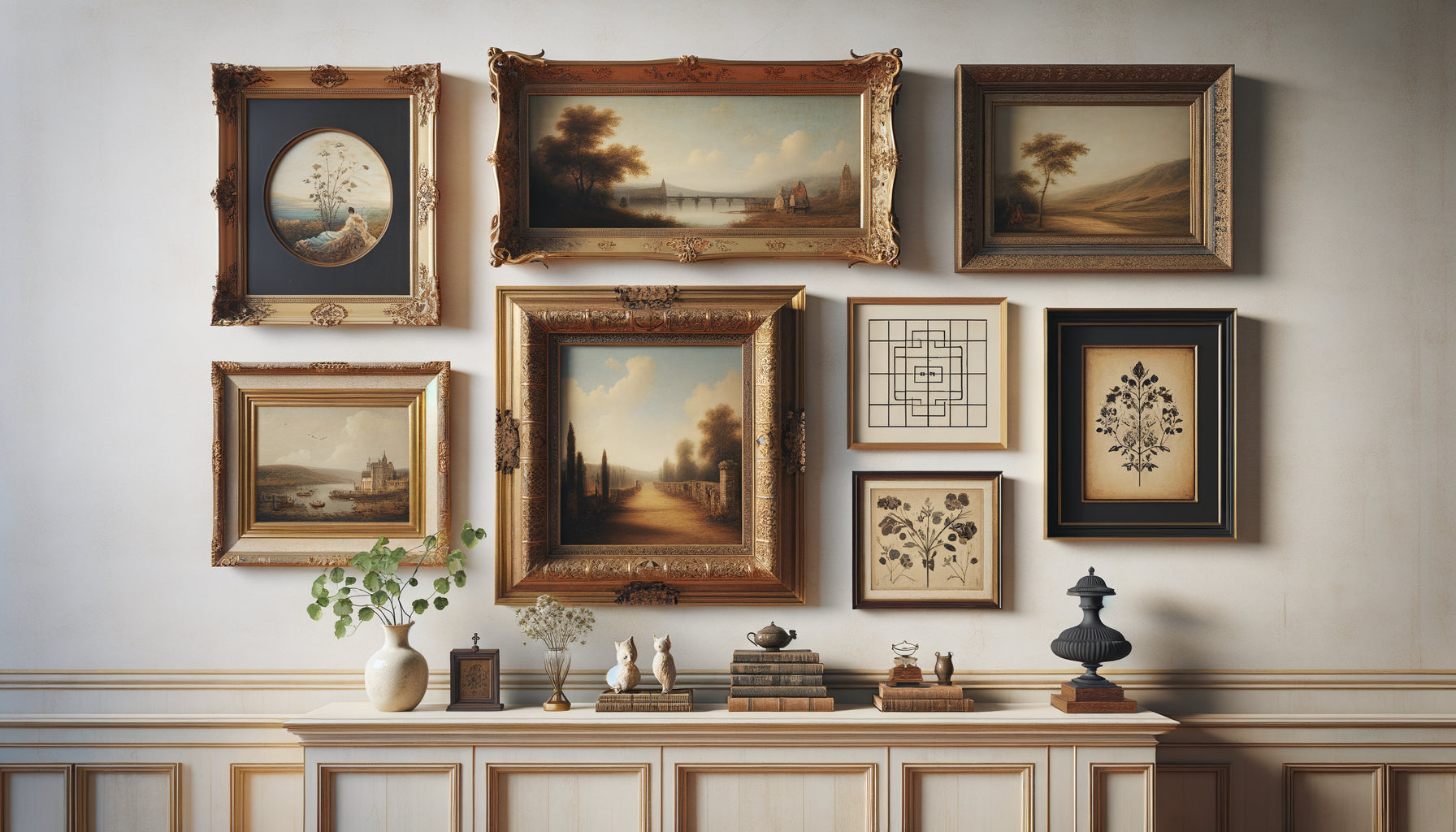
This wall art piece, discovered in a Parisian flea market, literally mesmerized me. Its faded colors, its patinated frame... but it was impossible to know if it dated back to the 30s or 70s. After fifteen years of authenticating works for private collectors and auction houses, I've learned one essential thing: precise dating of materials transforms a simple decorative object into a collector's item. This expertise radically changes the sentimental and market value of a vintage find.
Here's what dating analysis tools bring: scientific authentication that reveals hidden history, objective valuation of your piece, and the certainty of investing in a genuine antique work. Too many enthusiasts rely solely on their intuition or the seller's words, only to later discover they own a recent reproduction. I experienced this frustration myself when I started.
Rest assured: dating a vintage painting doesn't always require the costly intervention of a laboratory. Some analysis methods remain accessible to informed amateurs, while other more sophisticated techniques are essential for high-value pieces. I will guide you through the tools I use daily in my expert appraisal office, from the simplest to the most sophisticated.
The visual examination: your first investigation tool
Before any technical analysis, methodical observation remains your most valuable ally. Armed with a simple jeweler's loupe (x10 magnification), I systematically examine the surface of the painting from different lighting angles. This inspection reveals fascinating clues about the actual age of the materials.
The natural craquelures are the first indicator. On an authentic painting from the 40s-50s, these microscopic cracks form an organic, irregular network, impossible to artificially reproduce convincingly. Conversely, mechanical cracks in a recent reproduction show a suspicious uniformity. I also analyze the patina of the varnish: a genuine gum-lacquer varnish yellows unevenly, concentrating its coloration in the reliefs and angles.
The back of the painting often holds more information than the visible face. Labels, stamps and handwritten inscriptions become valuable historical documents. I systematically photograph each mark, even partially erased, before deciphering them. The nature of the support - linen canvas, wooden panel, cardboard - and its mode of attachment to the frame also tell the story of the creation period.
UV light: revealing the invisible
My ultraviolet lamp is probably the most profitable investment in my career as an expert. This non-invasive analysis tool instantly reveals recent restorations, repaints and varnishes that are invisible to the naked eye. Under UV, modern materials fluoresce differently from ancient pigments and binders.
An original varnish from the 1950s emits a characteristic greenish fluorescence, while a recently applied synthetic varnish produces a bluish or purplish glow. Paint retouching appears as dark spots contrasting with the homogeneous fluorescence of the original pictorial layer. This technique allows for quickly assessing the integrity of a vintage painting without touching it.
I use my portable UV lamp during visits to flea markets or private homes. In seconds, I detect traps: this magnificent Art Deco landscape that reveals under UV a complete repaint dating from last year, or this seemingly restored portrait which turns out to be perfectly intact under its century-old patina. This immediate knowledge guides my acquisition decisions and negotiations.

X-ray radiography: delving into the heart of the material
For paintings of significant value, radiographic analysis becomes essential. This imaging technique penetrates successive layers of paint to reveal the internal structure of the work. I collaborate with a specialized laboratory equipped with an X-ray generator adapted for works of art.
Radiographs reveal crucial information about the materials used. The density of the support, the presence of forged nails (indicators of age) in the frame, hidden compositional changes under the surface... An authentically vintage painting often presents pentimenti - these compositional changes made by the artist during creation - visible only with X-rays.
This analysis method also allows to identify metallic pigments. Lead white, massively used until the 1950s and then gradually abandoned for health reasons, appears very opaque in radiography. Its presence confirms a dating prior to the 60s-70s, period when titanium white replaced it. These technical details transform a supposition into documented certainty.
Infrared spectrometry: identifying the chemical signature
When a collector brings me a potentially exceptional painting, I recommend Fourier-transform infrared spectroscopy (FTIR) analysis. This scientific tool identifies the exact chemical composition of pigments, binders and varnishes without taking a visible sample.
The portable infrared spectrometer I use analyzes a point of a few square millimeters producing a characteristic spectrum of each molecule present. This chemical fingerprint reveals the age of the materials with remarkable precision. Synthetic resins, nonexistent before 1950, instantly betray a modern work disguised as vintage.
I recently authenticated a superb abstract painting purportedly dated 1948. Infrared spectrometry detected the presence of acrylic pigments, which were not marketed until 1955. This objective analysis corrected the dating and prevented my client from making an investment based on inaccurate information. Science triumphs over romantic legends.

Dendrochronology: When Wood Tells Its Story
For paintings on wooden panels, dendrochronology offers a dating method of fascinating precision. This technique analyzes the growth rings of the tree used as support. Each year leaves its unique imprint, influenced by specific climatic conditions.
A dendrochronologist compares the pattern of the panel's rings with regional databases established over centuries. This comparison determines the year the tree was felled with a margin of error of only a few years. Of course, a period of wood drying (generally 5 to 20 years depending on the era) must be added before the artist uses the panel.
This analysis technique remains particularly relevant for vintage wall paintings in Flemish or Dutch style, traditionally made from oak. I was able to confirm that a decorative panel acquired as a work from the 1920s actually dated from the late 19th century, instantly multiplying its historical and market value.
Carbon-14 Dating: The Ultimate Scientific Recourse
For exceptional cases involving considerable financial stakes, carbon-14 dating represents the absolute reference. This analysis measures the radioactive decay of carbon present in organic materials - linen canvas, linseed oil, animal glue.
The principle is based on an immutable physical constant: carbon 14 decays at a perfectly known rate. By measuring the residual amount in a micro-sample taken from the painting, specialized laboratories determine the age of the materials with an accuracy of a few decades. This method requires a tiny sample (a few milligrams) generally invisible after restoration.
The high cost of this analysis (between 500 and 1500 euros) reserves it for works whose authentication justifies this investment. I used it for a magnificent Art Deco wall painting whose provenance remained mysterious. The results confirmed a dating between 1925 and 1940, definitively validating its attribution to the period and significantly increasing its value among collectors.
Combining Approaches for Comprehensive Expertise
My experience has taught me that '
An authentic 1950s painting will present perfect consistency between all indicators: natural craquelure, characteristic UV fluorescence, pigments of the era in spectrometry, and possibly composition of the support confirmed by additional analyses. Conversely, '
This methodical approach protects collectors from increasingly sophisticated forgeries. It also enhances the value of genuine vintage pieces by providing undeniable scientific documentation. A painting accompanied by its analysis report always sells at a higher price, as it offers the security sought by demanding buyers.
Your next favorite deserves an authentic story
Discover our exclusive collection of Vintage paintings that will bring true soul to your interior, each piece selected for its authenticity and timeless charm.
Preserving integrity during analysis
A legitimate concern accompanies any expertise process: '
Only carbon-14 dating and certain chemical analyses require a micro-sample. These samples, smaller than a pinhead, are taken from discreet areas - edge of the frame, back of the canvas - by experienced restorers. The visual impact remains imperceptible, even to a trained eye.
I always advise documenting the painting photographically before any intervention. These detailed photos, taken under different lighting conditions, constitute a '
Choosing the right level of analysis according to your objectives
The budget question naturally influences the choice of analysis tools. For a vintage decorative painting acquired for a few hundred euros, a thorough visual examination and UV test (investment of less than 100 euros for a quality lamp) is usually sufficient. These accessible methods detect major restorations and gross reproductions.
When the estimated value exceeds one thousand euros, infrared spectrometry (cost: 200-400 euros) provides significant additional security. It formally identifies modern materials and confirms consistency between claimed dating and actual chemical composition.
For exceptional pieces whose authenticity conditions a value of several thousands of euros, the complete protocol - radiography, spectrometry, possibly carbon 14 - becomes a worthwhile investment. The overall cost (1000-2000 euros) remains marginal compared to the price difference between an authenticated work and an object of uncertain dating.
Scientifically dating a vintage wall art transforms your view of this unique piece. Beyond its undeniable aesthetics, you now possess its documented history, its true material identity. This in-depth knowledge enriches your collector's pleasure and protects your investment. Imagine explaining to your guests the precise provenance of this painting, backed by scientific certainties rather than vague assumptions. This assurance transforms a simple decorative element into a genuine piece of personal heritage.
Start by carefully observing your current collection with a new eye. Note the details that intrigue you, any possible inconsistencies. This sharpened curiosity represents the first step towards authentic expertise of your vintage treasures.