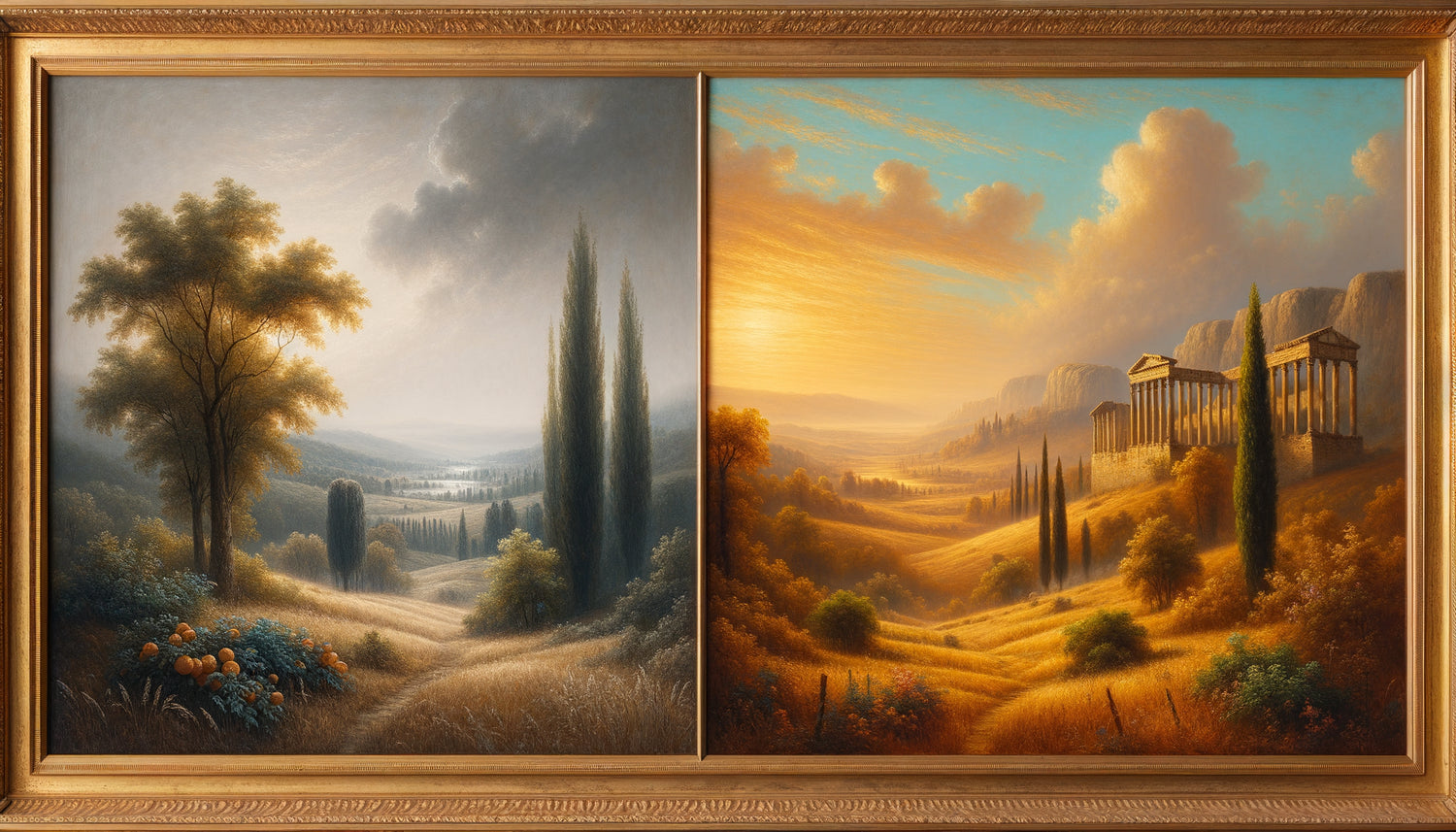
This morning, at a Nice flea market, I observed two collectors politely arguing in front of an oil on canvas depicting a Mediterranean landscape. "It's typically Provençal," one asserted. "No, look at this golden light, it's Tuscan!" retorted the other. This scene perfectly illustrates the confusion surrounding French and Italian vintage landscape wall art. Yet, distinguishing these two schools is more than just an exercise in erudition: it’s understanding two radically different visions of nature, two artistic legacies that will transform the atmosphere of your interior.
Here's what mastering this distinction brings you: the ability to instantly recognize the origin of a painting during your treasure hunts, an understanding of the color harmonies that will work with your decor, and above all, the pleasure of hanging a work whose history and sensitivity you know intimately. Because these vintage landscapes are not mere backdrops: they are windows open onto two centuries-old pictorial traditions.
Many enthusiasts give up investing in these wonders for fear of making a mistake, paying the price of an Italian school for an approximate French copy, or simply because they don't know how to decode visual clues. Rest assured: a few observation keys are enough to develop a discerning eye. Even without academic training, you can learn to read these canvases like an open book.
Revealing Light: The First Clue to Authenticity
The light is the most obvious marker for differentiating the French school from the Italian school in vintage landscape paintings. French painters, particularly those of the Barbizon or Provence schools, capture a diffused, almost velvety luminosity. Observe how shadows gradually blend, how the morning mist softens the contours of the hills. This atmospheric approach translates the temperate and changing climate of France, where the sun constantly plays hide-and-seek with the clouds.
Conversely, Italian landscapes explode with a frank, almost violent light. Shadows are sharp and defined, drawing precise geometries on ochre facades or slender cypresses. This Mediterranean clarity transforms every element of the painting into a sculptural volume. When you examine a vintage wall art, ask yourself: does the light gently caress the landscape or cut it with assurance? This simple question will already guide your identification.
Transalpine artists inherit a tradition dating back to the masters of the Renaissance, where scientific understanding of perspective and lighting nourished every composition. In an authentic vintage Italian landscape, you will notice this underlying rigor, even in the most bucolic scenes.
Color Palettes: When Colors Tell a Territory
The colors of French landscape paintings draw from a range of deep greens, earthy browns, and silvery grays. French painters adored the forests of Fontainebleau, Norman fields after the rain, Provençal lavender under a veiled sky. Even in the South, the palette remains subtly muted, as if a natural filter attenuated chromatic excesses. Ochres are more discreet there, blues more nuanced.
The Italian school, on the other hand, never hesitates before intensity. The golden yellows of Tuscan wheat, the red terra siena earth, the ultramarine blue of the Neapolitan sky create vibrant contrasts. An authentic vintage Italian painting often presents dominant warm tones: these lands burned by the sun, these weathered walls where pink meets apricot, these dark green cypresses punctuating the composition like vertical exclamations.
For your walls, this chromatic distinction is crucial. A French landscape will naturally harmonize with contemporary interiors in neutral tones, bringing that touch of rural poetry without ever dominating the space. An Italian landscape will require more decorative boldness: it dialogues wonderfully with natural materials such as terracotta, raw linen, and patinated woods.

Composition and architecture of the gaze
The composition reveals the cultural DNA of each school. French painters often prefer a horizontal approach, celebrating the expanse of landscapes: cereal plains, rows of poplars, marine horizons. The eye glides laterally, invited to contemplate rather than explore. This structure creates a soothing sensation, ideal for a living room or bedroom where tranquility is sought.
Vintage Italian paintings frequently organize space in depth, using the codes of classical perspective. A path winds towards a distant villa, arcades frame a view of the countryside, a hill leads the eye to a perched village. This visual architecture invites imaginary travel, each spatial plane constituting an invitation to enter more deeply into the scene.
Also examine the presence of humans: French landscapes willingly integrate farmers at work, intimate rural scenes that testify to a social vision of nature. Italians often prefer ancient ruins, bucolic shepherds in the arcadian tradition, or simply virgin nature magnified. These narrative choices clearly differentiate sensibilities.
Regional stylistic signatures
Even within the French school, regional variations exist. Breton landscapes are recognizable by their stormy skies, granite rocks, and marine horizons. Provence brings its lavender fields, houses with blue shutters, and a more pronounced light that sometimes brings it closer to Italy. Normandy offers its orchards, lush meadows, and changing reflections.
The Italian school also has its own particularities: Tuscany with its rolling hills and isolated farms, the lake region with its alpine mountains and shimmering waters, Campania with its spectacular coasts and omnipresent Vesuvius. These variations enrich your reading of vintage wall art.
Painting techniques: the gesture that marks the origin
The painting technique often betrays belonging to a school. French painters of the 19th century, influenced by the naturalist and then impressionist movement, frequently adopted a visible, expressive touch. Take a closer look at a vintage French painting: you will often distinguish the brushstrokes, this living matter that translates the spontaneity of the gesture. Even in academic works, a certain freedom of execution shines through.
The Italian school, more attached to the academic tradition from the Fine Arts, generally prefers a smoother rendering where the touch is discreet in favor of a subtle modeling. The surface of the painting appears smoother, the transitions between tones more progressive. This technical difference does not imply any qualitative judgment: it is simply two philosophies of representation.
Successive glazes, a technique inherited from old masters, remain more common in Italian landscapes, creating that characteristic luminous depth. The French were more inclined to alla prima painting, in a single session, capturing the fleeting impression of a particular moment.

Contextualize to authenticate: the importance of peripheral clues
Beyond pure pictorial analysis, several clues will help you differentiate these vintage paintings. The original frame is a valuable marker: French frames favored sober gilded woods or natural baguettes, while Italian frames often featured more elaborate ornamentation, gilded stuccos, neoclassical motifs.
The inscriptions on the back of the canvas provide crucial information. A stamp from a Parisian, Lyon or Marseille merchant will obviously point to the 'French school'. A label from a Florentine, Roman or Venetian gallery will confirm its transalpine origin. Handwritten titles in French or Italian are also solid leads, although some international dealers may have added inscriptions in several languages.
The canvas itself and its dimensions can reveal regional habits. Standard formats varied slightly between the two countries; frames presented different assemblies. These technical details fascinate informed collectors and add an extra layer of authentication to your 'vintage wall art'.
Cross influences: when borders blur
Historical reality sometimes complicates this clear distinction. Many French painters received their training in Italy, considered the cradle of Western art. These artists, imbued with Mediterranean light, returned to France with a transformed palette and vision. Conversely, Italians settled in Paris, the artistic capital of the 19th century, absorbing French innovations.
These 'hybrid landscapes' are precisely the most fascinating pieces for a collector: a French painter representing the Roman countryside with his Nordic sensibility, or an Italian capturing the Côte d’Azur with his classical heritage. These bridge works testify to the circulation of ideas and artists across Europe.
Integrating these treasures into your contemporary decor
Understanding the 'difference between schools' transforms your decorative approach. A 'vintage French landscape' brings a romantic softness, perfect for creating a soothing cocoon. Hang it in a bedroom with natural tones, pair it with linen bedding and distressed furniture. It dialogues beautifully with the country chic or slow living contemporary style.
An 'Italian landscape painting' instantly injects character and Mediterranean warmth. It enhances an interior with bohemian accents, blends with ethnic textiles, artisanal pottery, terracotta tones. In a minimalist loft, it will create a striking contrast, bringing that touch of history and soul that humanizes purified spaces.
The size of the 'wall art' also guides its positioning. Large French formats, particularly horizontal panoramas, magnify a wall above a sofa or in a dining room. Vertical Italian compositions, with their slender cypresses or plunging views, elegantly structure a hallway or narrow space.
Transform your walls into personal art galleries
Discover our exclusive collection of Vintage paintings that capture the soul of European landscapes and tell timeless stories.
Develop your collector's eye
This ability to differentiate schools is cultivated gradually. Visit regional art museums which often preserve beautiful collections of 19th-century landscapes. Observe carefully, compare, let your eyes soak up the nuances. Browse auction catalogs, even without intending to buy: they are excellent educational tools with their detailed descriptions and estimates.
Frequent flea markets, antique shops, specialist galleries. Handle the vintage paintings, examine them under different lighting conditions, turn them over to study their technical secrets. Talk to antiques dealers: their empirical experience often complements academic knowledge advantageously. Some, passionate, generously share their knowledge with sincere enthusiasts.
Photograph the works that strike you, create a personal visual directory. Over time, patterns emerge, your intuition sharpens. What seemed mysterious gradually becomes readable, as if you were learning a new visual language. This skill not only enriches your future acquisitions but transforms each visit to a museum or market into an exciting adventure.
Emotional investment takes precedence over market value
Certainly, some landscape paintings have a significant market value, especially if they are signed by listed painters. But the real treasure lies in the emotional connection you establish with the work. A vintage landscape that evokes your Tuscan vacation, that resembles your grandmother's village, that captures that precise light you love: this is the most profitable investment.
Anonymous or school paintings deserve just as much of your attention. They testify to artisanal know-how, an era when landscape painting was a formative exercise for hundreds of artists. These accessible works allow you to compose real gallery walls without breaking your budget, while benefiting from the authenticity of an original oil painting.
Conclusion : Differentiating the French school from the Italian school in vintage landscape wall art transcends simple erudition. It's about acquiring the keys to a sensitive reading of art, understanding how geography, light and culture shape the painters’ gaze. Imagine yourself in six months, browsing an antique market, instantly recognizing the origin of a painting, negotiating knowingly, returning home with a rare pearl that will transform your interior. This expertise is built observation after observation, comparison after comparison. Start today: choose a virtual museum, explore online collections, sharpen your eye. Your next artistic crush awaits somewhere, and you will now know how to recognize it.
Frequently Asked Questions
Can we learn to differentiate these schools without artistic training?
Absolutely, and it's even simpler than you might imagine. Differentiating between French landscapes and vintage Italian landscapes mainly relies on observing accessible visual criteria: the quality of light, color palettes, composition. No complex technical vocabulary is necessary to get started. By regularly practicing observation of reproductions online or in art books, you will naturally develop this sensitivity. Start with striking examples: a Provence landscape from the Barbizon school versus a view of the Tuscan countryside. The differences will be obvious. Gradually, you will refine your judgment on more subtle works. Regular practice is essential, not degrees. Many knowledgeable collectors are self-taught and have simply cultivated their passion consistently.
Do vintage landscape paintings without a signature have value?
The value of a vintage painting is not measured solely by its signature. Certainly, a work by a listed master will reach significant prices on the art market. But anonymous landscapes or school pieces have their own assets: financial accessibility, artisanal authenticity, undeniable decorative charm. These paintings bear witness to the work of artists trained according to the same techniques as their famous counterparts, sometimes students of great names or talented regional painters who have fallen into oblivion. For your interior decoration, a unsigned painting of good quality will bring exactly the same visual presence as a secondhand signed artwork. What matters is the condition, the quality of execution and above all your personal favorite. Many decorators deliberately prefer anonymous works to compose coherent gallery walls, without the pressure of the artist's name.
How to maintain and preserve a vintage landscape painting?
Preserving your vintage wall art requires some simple but essential precautions. Avoid direct exposure to sunlight, which gradually discolors the pigments, especially reds and blues. Opt for a location with indirect light or install suitable artificial lighting. Humidity is the other major enemy: avoid bathrooms and poorly ventilated kitchens that promote mold growth on the canvas. For dusting, use a soft duster or a brush with soft bristles, never a damp cloth that could alter the varnish. If your landscape painting has cracks, material lifting, or significant dirtiness, consult a professional restorer rather than attempting an amateur intervention. A good frame with UV-protective glass effectively protects the artwork while allowing its appreciation. Finally, photograph your acquisition as soon as it arrives: this documentation will serve for insurance purposes and will be a valuable record of its initial condition.