


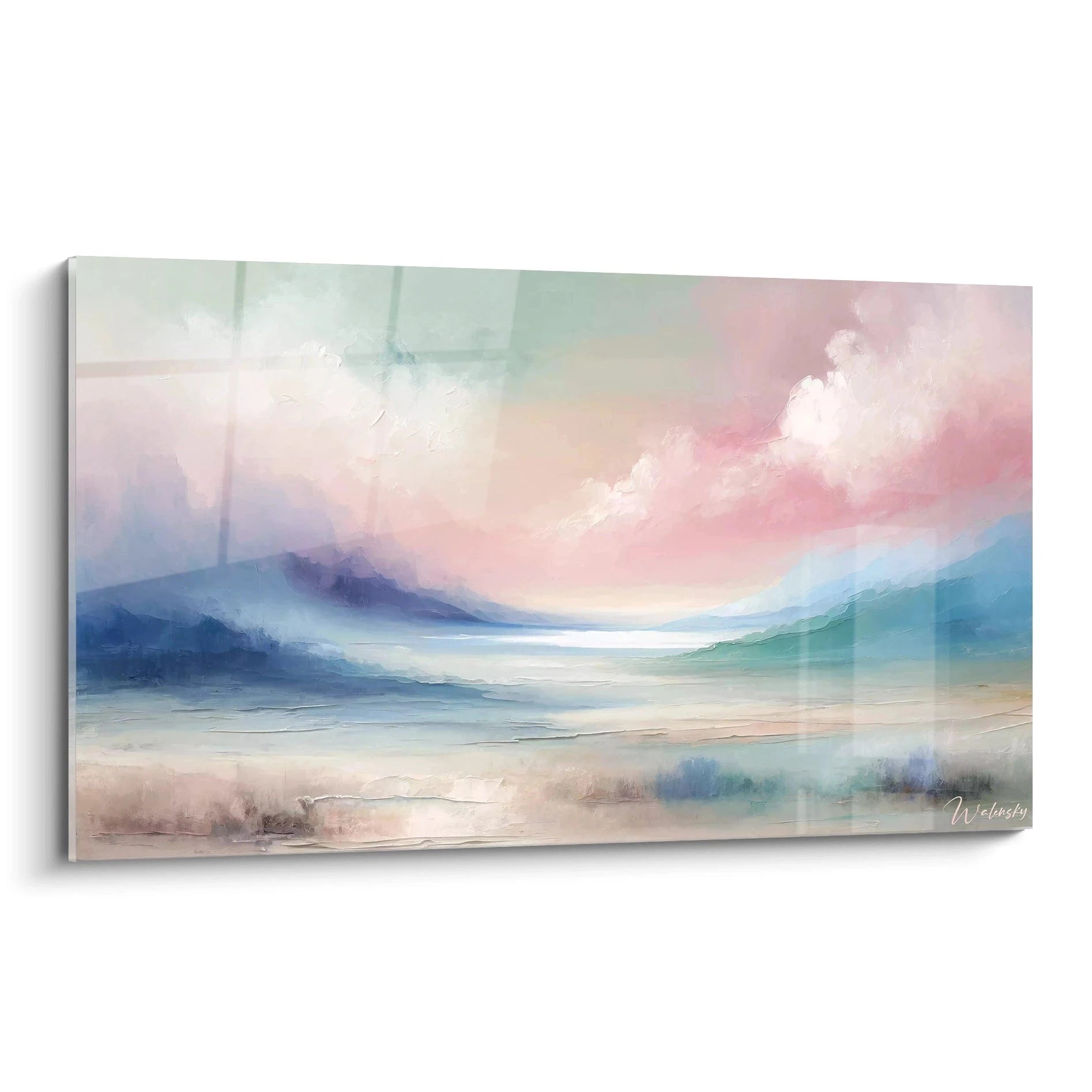

Artwork inspired by a city or significant place
October 11, 2025 · 18 min read · by Walensky
Returning home after an unforgettable trip to Venice, Prague or Marrakech, you feel that familiar frustration: how to recreate this urban magic in your interior without falling into the cliché of a postcard on the wall?
Your travel photos remain lost on your phone, and the few souvenirs brought back seem disconnected from the atmosphere you loved so much. That golden sunset over Florence's rooftops, that particular light of Lisbon’s alleyways, that vibrant energy of New York... all of this escapes you.
You may have tried classic photographic reproductions or tourist posters, but the result disappoints: they lack character and blend into the decor without creating that sought-after emotional connection.
This is perfectly normal! The problem isn't your taste or budget, but the approach: a simple reproduction cannot capture the artistic essence of a place. It takes a creative interpretation that transcends the image itself.
By the end of this article, you will know exactly how to choose and integrate an authentic urban painting that will transform your space into a window onto the world, creating that particular atmosphere you are looking for.
Why Urban Paintings Revolutionize Modern Decor?
In a world where authenticity is rare, owning a work that captures the soul of a city represents much more than just a decorative choice. It's creating an emotional bridge with your most memorable experiences. Imagine: every glance at your wall instantly transports you to that Parisian alleyway where you discovered that little café, or onto that Barcelona terrace where time stood still.
🎨 Collector's testimonial: “I have long sought to recreate the atmosphere of my favorite neighborhood in Rome. It wasn’t until I found this painting with ocher and earth tones of Siena, with those characteristic plays of shadows, that my living room finally regained that Mediterranean warmth that I missed so much.”
Conversation with a Decor Expert

Our highlight
Montmartre Wall Art N°3 - Paris Around the World Edition
233,90€
Discover this artwork →Understanding what isn’t working with your current approach
Do you find yourself in these situations? Do you go around in circles in decor stores without finding "the" piece, do you hesitate between several styles without ever deciding, or do you impulsively buy a work that ends up boring you after a few months?
What you are experiencing reveals a gap between your deep emotions and the standardized offer of the market. You’re not looking for simple decoration, but a work that tells your story, that reflects your inner journeys and aspirations.
It's like trying to reproduce the taste of a dish discovered on a trip with industrial ingredients: authenticity cannot be copied, it must be recreated with passion and know-how.
First hidden cause: You confuse reproduction and inspiration
Most people think that a "city painting" should be a faithful copy of a monument or urban landscape. Mistake! The most captivating works are those that capture the atmosphere rather than architectural details.
Imagine the difference between a photograph of the Eiffel Tower and a canvas that captures the golden light of a summer evening in Paris reflecting on the Haussmann facades. The second transports you, the first informs you.
This approach transforms your relationship with decoration: you no longer seek to "show" that you have visited such a place, but to relive the emotion you felt there. Your interior becomes an extension of your personal universe.
🔍 Immediate test: Look at the urban works that instinctively attract you. Close your eyes and ask yourself: "What emotion does this work give me?" If you first think about the place represented rather than what you feel, then the work reproduces without inspiring.
Each city has its unique color palette, forged by its history, architecture and light. This color signature is more important than the subject represented.
It's like the olfactory signature of a perfume: top notes (dominant colors) create the first impression, heart notes (intermediate nuances) develop emotion, and base notes (chromatic details) anchor memory.
When you ignore this dimension, you get artworks that seem disconnected from your space, even if you like the subject matter. Your eye subconsciously perceives this chromatic dissonance.
Third hidden cause: You underestimate the importance of the support
Here's the secret few people notice: the texture of the support influences the visual impact as much as the artwork itself. A view of Venice on rough canvas evokes artisanal authenticity, while the same image on a smooth support suggests modernity.
Observe your interior: are the materials rather raw (wood, stone, linen) or refined (metal, glass, silk)? This observation guides you towards the ideal support.
This tactile coherence creates a sensory harmony that reinforces the emotional impact of the artwork. Your space gains natural sophistication.
🎯 The 3 signals that don't lie:
- Your gaze instinctively returns to the artwork: This means it dialogues with your personal universe, like a friend who understands you without words Guests ask questions about the artwork: It generates conversation and curiosity, proof that it tells a captivating story The ambiance of the room changes with the lighting: The artwork lives with the light, revealing different facets like a city transforms from morning to evening
What really makes the difference is this invisible alchemy between your personal story and the artistic interpretation of the place. Like a tuning fork that vibrates a string at the right frequency, the ideal artwork awakens your most precious memories and your most inspiring projects. You recognize it by that feeling of "this is exactly it!" that overwhelms you, even if you don't always know why.
The rule of instant connection: If an urban artwork makes you think of a specific moment in your life in less than 10 seconds, it has this magical resonance. Check by closing your eyes: does the emotion persist?
| ❌ Tourist approach | ✅ Artistic approach | 💡 Key difference | 🎯 Benefit felt |
|---|---|---|---|
| Seeks to recognize the place | Seeks to feel the atmosphereEmotion takes precedence over informationPermanent inner journey|||
| Colors faithful to reality | Palette that evokes the essence of the placeAssumed creative interpretationHarmony with your interior|||
| Support chosen by chance | Texture consistent with the artworkOverall sensory coherenceNatural sophistication|||
| Standard size from stores | Dimensions thought for the spaceReflected architectural integrationPerfect visual balance

The 3-step method to choose your ideal urban artwork
Rassurez-vous, this process is more intuitive than technical. Like a chef composing a three-course menu, we will build your project step by step, starting with the emotional foundations to arrive at concrete realization. At each stage, you will feel your confidence and excitement grow.
🗺️ Overview of your journey: We will first identify your heart city and its emotions (foundations), then translate this inspiration into concrete visual criteria (construction), and finally integrate the artwork into your space for maximum impact (finishing). Each step brings you closer to that magical feeling of "coming home" in your own interior.
Step 1: Revealing Your Emotional Geography
Starting with this introspection is essential because it avoids impulsive purchases that you might regret. Like an architect studying the terrain before building, we must understand your emotional roots to build a lasting choice. This step will already provide you with great satisfaction as you rediscover aspects of your personality that you may have forgotten.
What You Need for This Exploration
- A notebook or a sheet of paper: To note your intuitions without filtering them. Handwriting activates different areas of the brain than the keyboard, revealing deeper associations of ideas. Avoid the phone which would distract you with notifications.
- Your favorite travel photos: They contain visual clues about your unconscious preferences. Observe the colors, lights, atmospheres that recur. Even a poorly framed photo can reveal an authentic emotion more telling than a perfect image.
- 30 minutes of tranquility: This time allows you to overcome automatic responses to access your true motivations. Choose a moment when you feel relaxed, not between appointments.
Now let's move on to practical discovery
How to Reveal Your Heart Cities
The mental travel exercise: Close your eyes and naturally let come the first urban place that soothes you. Note it without thinking, then ask yourself: "What do I feel in this city?" It is about capturing the raw emotion before your mind analyzes it.
⏱️ Time: 5 minutes | ✅ Successful when: You have noted at least 3 precise emotions (e.g., “freedom”, “nostalgia”, “energy”) | ⚠️ Attention: Do not look for the "right" answer, trust your spontaneous feeling
Analyzing your favorite photos: Select 5 urban photos that still evoke an emotion in you today. For each, identify an element that touches you: the color of the sky, the architecture, the street atmosphere... This method reveals your personal visual codes.
⏱️ Time: 10 minutes | ✅ Success when: You have identified constants (colors, atmospheres, styles) | ⚠️ Attention: Focus on what moves you, not the technical quality of the photo
Projecting into your interior: Imagine yourself in your living room looking at a work that evokes your city of heart. What sensation do you want to feel? Escape, serenity, inspiration, nostalgia? This visualization guides your search towards the desired emotional impact.
⏱️ Time: 5 minutes | ✅ Success when: You can precisely describe the emotion sought | ⚠️ Attention: Stay connected to your true desires, not to what would "look good"
✨ Validation of your exploration: You should now have a city of heart identified, 3-4 key emotions, and emerging visual preferences. If some elements remain vague, that's normal! Keep your notes handy, the answers will become clearer as you go through the steps. The important thing is to have laid the first stones of your project.
— Our selection


OUR RECOMMENDED PRODUCTS
Step 2: Translating Your Emotions into Visual Criteria
Now that you know your emotional geography, we are going to translate it into artistic language. This step is exciting because you will see your intuitions take concrete form. It's like going from scent to formula: you keep the magic while acquiring the tools to recognize and choose it.
The visual elements to master
- Dominant color palette: Every city has its color signature forged by its architecture and light. Paris evokes pearl grays and ochres, Marrakech the Sienna earths and reds, Tokyo the black-and-white contrasts punctuated with bright colors. Learn to recognize these palettes to create emotional consistency. Artistic technique: Impressionism captures the atmosphere and movement, contemporary art plays on contrasts and geometry, watercolor evokes softness and poetry. Each technique conveys a different emotion that must be matched to your project. Proportions and framing: A panorama suggests escape and scope, a close-up framing of architectural details creates intimacy, a bird's eye view evokes domination and perspective. The format directly influences the emotional impact.
How to decode the visual language of cities
Identifying your emotional palette: Review your notes from step 1 and associate each emotion with an instinctive color. "Serenity" might evoke blue, “nostalgia” sepia tones, “energy” bright colors. This method reveals your personal color language, different from classic codes.
⏱️ Time: 8 minutes | ✅ Success when: You have 3-4 colors that correspond to your key emotions | ⚠️ Attention: Don't look for logic, follow your color instinct
Choosing your artistic style: Visualize your city of heart under different treatments: impressionistic (artistic blur, blended colors), realistic (sharp details, faithful colors), contemporary (geometry, strong contrasts), abstract (suggested shapes, free colors). Which one transports you the most?
⏱️ Time: 10 minutes | ✅ Success when: One style provides you with a stronger emotion than the others | ⚠️ Attention: Choose according to your feelings, not current trends
Defining your ideal dimensions: Measure the available wall space, but above all visualize the impact. A large work (80x120cm) dominates and structures the space, a medium one (50x70cm) dialogues with the furniture, a small one (30x40cm) creates intimacy. Which presence corresponds to your project?
⏱️ Time: 7 minutes | ✅ Success when: You can visualize the work in your space | ⚠️ Attention: Think about visual balance, not just technical constraints
🎯 Validation of your design brief: You now have a clear visual profile: color palette, artistic style, optimal format. If you hesitate between two options, it means your project is maturing! Keep both possibilities open; the next step will help you decide definitively.
Step 3: Harmoniously integrate your artwork into the spaceThis final step transforms your project into a tangible reality. You are going to create a true decorative ecosystem where your urban painting becomes the heart of a coherent atmosphere. This is where all the sophistication of your approach is revealed, because you do not just hang a work, you orchestrate a visual experience.
Elements to consider for integration
- Dedicated lighting: An LED light that can be directed reveals the nuances of colors and creates a theatrical staging. Avoid spotlights that create reflections, prefer diffused lighting that caresses the work. Investing in good lighting multiplies the visual impact by three. Decorative accents: A cushion echoing a color from the artwork, a decorative object evoking the represented city, or a plant with harmonious tones create subtle visual echoes. These details weave a link between the work and the space, reinforcing immersion.
- Professional mounting system: An invisible and secure mounting enhances the artwork without distorting it. Invest in fixings suitable for the weight and support, as a poorly mounted artwork loses 50% of its visual impact and generates subconscious anxiety.
How to create a perfect staging
Location optimization: Test different heights with a piece of paper the size of the artwork. The rule: the center of the artwork at 1m60 from the floor, but adapt according to your proportions and the use of the room. In a living room, prioritize visibility from the main seating areas.
⏱️ Time: 15 minutes | ✅ Success when: The location looks natural from all angles | ⚠️ Attention: Avoid locations where the artwork competes with other strong visual elements
Creation of a decorative ecosystem: Identify 2-3 existing elements in your room that can dialogue with the artwork (color, material, shape). Create subtle visual links without overloading. A rug with harmonious tones or accessories reminiscent of the represented city is enough.
⏱️ Time: 12 minutes | ✅ Success when: The artwork seems to be an integral part of the decor | ⚠️ Attention: Less is more: 2-3 echoes are enough to create coherence
Ambient lighting adjustment: Observe your artwork at different times of the day and adjust the general lighting accordingly. A dimmer allows you to modulate the atmosphere according to your moods. The artwork must remain visible and attractive even in subdued lighting.
⏱️ Time: 8 minutes | ✅ Success when: The artwork remains attractive in all lighting conditions | ⚠️ Attention: Test the lighting in the evening, when you enjoy your interior the most
🌟 Validation of your installation: Your urban artwork should now seem to have always been there, as if it were born with your interior. If the integration seems forced, adjust one detail at a time until you achieve this natural harmony. Success is measured by this visual evidence that cannot be explained, it is felt.
The rule of decorative evidence: A perfectly integrated urban artwork no longer stands out, it is felt. Your guests should not say "I like your painting" but "I love the atmosphere of this room". When the artwork becomes invisible as it blends with the space, you have achieved excellence.
Congratulations! You now master the subtle art of urban integration. Here are expert secrets that make the difference between a successful decoration and an exceptional atmosphere. These details separate connoisseurs from enlightened enthusiasts.
🎖️ Decorator's master technique: Create a "visual triangle" by arranging three elements of different heights that pick up the colors of your urban artwork. This visual balance technique, used by professionals, naturally guides the eye and creates a sophisticated harmony that your guests will feel without being able to explain it.
Question from a passionate reader
"I would like a New York artwork but I live in a Provencal style... Could that work?"
Excellent question that reveals a right intuition! This apparent contrast can create extraordinary sophistication. Imagine an interpretation of Manhattan in ochre and Sienna earth tones, or a view of Central Park in autumnal colors reminiscent of Provence. The trick is to choose a work that captures the energy of New York while respecting your regional color palette. This unexpected fusion creates a unique decorative personality.
🎨 Immediate practical advice: Search for New York artworks treated in warm tones (ochres, sands, earths) rather than black and white. You will get that urban energy you are looking for while keeping harmony with your environment.
— You may also like


The pitfalls to absolutely avoid in your project
Before making your project a reality, let's take a few minutes to identify the common pitfalls that can turn a good intention into disappointment. These mistakes are so common that even experienced decorators sometimes fall into these traps. You have been warned!
- 🚫 Choosing according to fashion rather than your emotions: It is tempting to follow Instagram or Pinterest trends, but these "cool" artworks quickly lose their charm. Your interior is not a showroom! Resist social pressure and trust your deep feelings. A work that touches you personally will give you 10 years of daily pleasure.
- 🚫 Neglecting proportions in relation to your furniture: An artwork that is too small disappears visually, an artwork that is too large crushes the space. Many underestimate this crucial aspect. Always measure the available space and visualize the impact before deciding. A well-proportioned work naturally structures the room.
- 🚫 Forgetting the evolution of light in your room: This costly mistake reveals its extent after purchase: the beautiful artwork in store becomes dull at home. Each room has its unique light that evolves with the seasons. Observe your space at different times before finalizing your choice.
- 🚫 Multiplying urban artworks in the same space: Accumulation dilutes emotional impact. You risk creating a "museum" rather than a cozy interior. A strong urban artwork needs space to express itself. It's better to have one exceptional piece than three average pieces competing with each other.
- 🚫 Ignoring harmony with your existing colors: Even the most beautiful artwork can create an unpleasant chromatic dissonance. This error generates a permanent subconscious discomfort. Before any purchase, check that the dominant colors of the artwork dialogue harmoniously with your current decorative palette.
🛡️ Your safety checklist before purchasing: Does the artwork provide me with a feeling after 5 minutes of observation? Are the dimensions suitable for my space and furniture? Can I visualize precisely where it will be hung? Do the colors harmonize with my existing interior? If one answer is negative, take time to reflect.
— In the same vein


Your most frequently asked questions about urban artworks
The impact is immediate visually, but complete emotional transformation takes about 2-3 weeks, the time it takes your brain to naturally integrate this new visual reference. To accelerate the process, spend 5 minutes per day consciously observing your artwork under different lighting conditions. You will discover details that enrich your daily experience.
For a handcrafted artwork (50x70cm), count 200-600€ depending on the technique and artist. Add 50-100€ for suitable LED lighting and 30-50€ for professional hanging. This investment of 300-750€ will provide you with 10-15 years of daily pleasure, or less than 20 cents per day. It's profitable compared to other fleeting pleasures!
Use the rule of 3 colors: identify the 3 dominant colors in your room, then check that the artwork picks up at least one. For style, trust your gut feeling: if the artwork gives you a positive emotion despite a different style, it's bringing the enriching contrast that your eye subconsciously seeks. Emotional coherence is more important than stylistic coherence.
An urban artwork in a bedroom can be amazing! Opt for soothing tones (blues, greens, powdery shades) and nighttime scenes or serene urban landscapes. Avoid overly dynamic works or those with bright colors that may disrupt sleep. A view of Paris at night or a Venetian canal at dusk create the perfect romantic atmosphere.
An original work possesses a presence and energy that no technology can reproduce. Variations in material, paint reliefs, subtle nuances create visual depth that naturally "catches" the eye. However, a high-quality reproduction on a noble medium can offer 80% of the pleasure for 30% of the price. The key is the quality of execution and your emotional connection.
Your new life with your urban artwork
In a few weeks, you will enter your home with that inner smile of someone who feels perfectly at their place. Your gaze will naturally rest on this work that dialogues with your personal story, and you will feel the deep satisfaction of having created a space that truly resembles you. Your guests will immediately notice this unique atmosphere without necessarily identifying why it touches them so much.
Beyond simple decoration, you will have developed an artistic eye that will transform your relationship with space and colors. This newly acquired sensitivity will enrich all of your future decorative choices and give you the quiet assurance of someone who masters their visual environment.
The most beautiful gift you can give yourself? This permanent window on your fondest memories and dreams of escape, accessible with a simple glance. Your first gesture tomorrow morning? Observe the wall space that will soon welcome your artwork from the heart, and let yourself be carried away by the excitement of this upcoming transformation.
✨ Your moment has arrived: You now have all the keys to make the perfect choice. Trust your intuition guided by this new knowledge. In 6 months, you will wonder how you could have lived without this artistic presence that now illuminates your daily life!
</div
More selected pieces
Musee d'Orsay Wall Art N°1 - Paris Around the World Edition
233,90€
Discover this artwork →Explore our collections


