Finally understand why your previous attempts didn't work
Do you recognize yourself in these situations? You bought "one-size-fits-all" reproductions that lack character, installed frames that are too small and get lost on your large walls, or chose colors that don’t harmonize with your existing furniture.
The real problem isn't your artistic sense, but the overly rational approach you've taken. You tried to "fill" your walls instead of creating emotional connections. It's like trying to learn to dance by counting steps instead of feeling the music.
Imagine your decor as an orchestra: each element must play its part in harmony. Portraits are your first violins - they set the tone and guide the overall emotion of the room.
Size: Your First Hidden Mistake
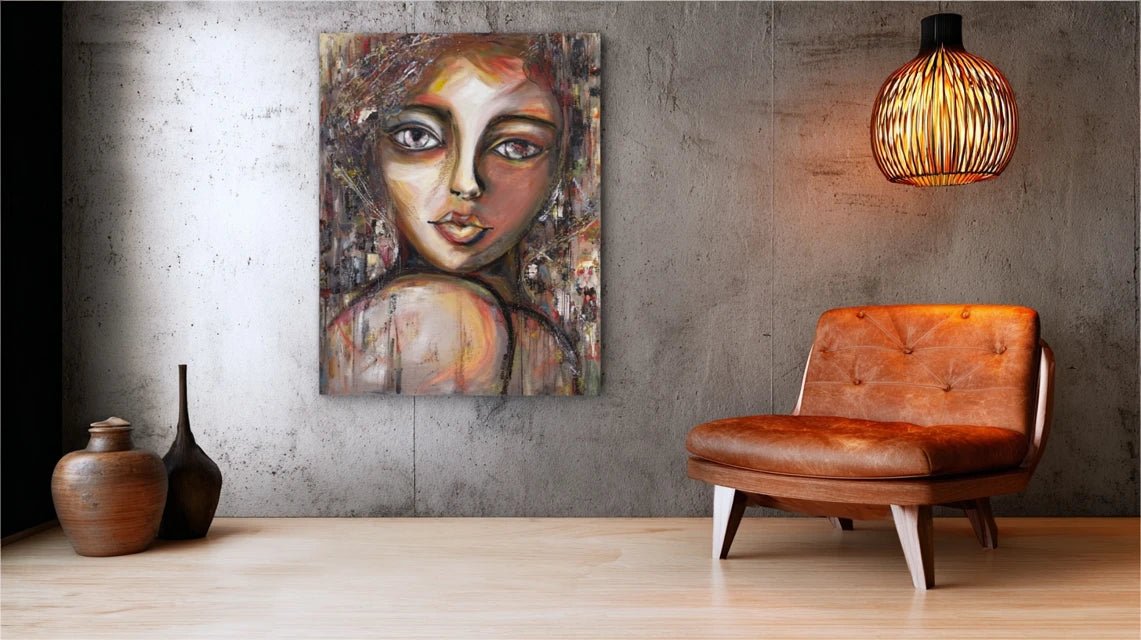
Contrary to expectations, most people choose paintings that are too small. You think "discreet" when your room calls for "assertive". A 40x50cm portrait on a 4-meter wall is like wearing a doll's watch - the desired effect completely evaporates.
Think of your wall as a theater stage: your portrait is the main actor, it needs enough space to capture attention and create that instant emotional connection you are looking for.
This revelation will transform your approach: one large impactful portrait is better than three small insignificant paintings. You save money while multiplying the decorative effect.
🔍 Quick test: Stand 3 meters away from your main wall and extend your arm. If your current painting could fit in your hand, it's definitely too small to create the visual impact you’re looking for.
Expression: That Detail That Changes Everything
Many think that a "beautiful portrait" is enough, but the expression on the face determines the atmosphere of your room. A melancholic gaze in your family living room will create a heavy atmosphere, while a subtle smile will instantly illuminate the space.
It's exactly like choosing the personality of a permanent guest in your home: do you prefer someone serene, mysterious, inspiring or kind? This conscious decision will radically transform your daily life.
Concrete result: you’ll be surprised to smile when you come home, your guests will immediately feel comfortable, and your interior will exude that famous "good energy" that everyone notices without being able to explain it.
Placement: The Secret Rule of Professionals
Here’s what 90% of individuals don’t know: the placement of a portrait follows precise psychological rules. Hanging a face facing the entrance creates a welcoming effect, while a lateral placement invites discreet contemplation.
You can identify this mistake in your home: if your portrait “watches” you when you watch TV or eat, it’s poorly placed. A good location is forgotten while still creating a reassuring presence.
The impact on your daily well-being? You will feel a sense of natural harmony, without being able to explain why your living room suddenly seems more welcoming and balanced.
🎯 3 signs that your portrait is poorly positioned:
- You avoid looking at it: Your brain feels an unconscious discomfort, a sign that the angle or height does not suit your use of space.
- Your guests turn their backs to it: The location creates involuntary tension rather than natural attraction.
- It goes unnoticed: Paradoxically, an invisible portrait reveals a location where the eye never naturally rests.
Color: your secret lever of harmony
The magic happens when the tones of the portrait subtly dialogue with your existing decor. It's not about perfect matching, but about colored resonance - like tuning a piano. Look for a dominant color that discreetly recalls an element already present: the beige of your sofa, the brown of your beams, or the green of your plants.
The magnetic gaze rule: A well-chosen and well-placed portrait naturally attracts the eye in the first 3 seconds of entering the room, without ever creating visual discomfort. Test with your guests - does their gaze settle on it spontaneously?
| ❌ Failed classic approach |
✅ Successful emotional approach |
💡 Why it works |
🎯 Visible result |
| “We need to fill this empty wall” |
“What emotion do I want to feel here?” |
The brain reacts to emotions before logic |
Immediate connection with the space |
| Choosing by price elimination |
Let your crush decide |
Intuition reveals our deep needs |
Sustainable satisfaction and pride |
| Reproducing what everyone sees |
Expressing your unique personality |
Authenticity creates distinction |
Interior that truly resembles you |
| Limiting yourself to traditional rules |
Adapting to contemporary uses |
Art evolves with our lifestyles |
Assumed and elegant modernity |
The 3-step method to reveal the soul of your interior
Transforming your decor with portraits follows a natural progression, like cultivating a garden. First you prepare the ground (analysis of your space), then you plant (choice and placement), finally you harmonize (adjustments and finishing touches). Each step reveals a new dimension of your decorative personality, for a result that will move you every day.
🎨 Overview of your transformation: Step 1 reveals your hidden emotional needs, Step 2 materializes your personal vision, Step 3 enhances the whole with details. At each stage, you will feel a growing satisfaction as your interior finally reveals who you really are.
🔍 Step 1: Reveal the emotional potential of your space
Starting by analyzing your space and your emotions will lay the solid foundations of your success. Just as an architect studies the terrain before building, this first step avoids costly mistakes and ensures a result that touches you deeply. You will already feel a sense of excitement discovering the unsuspected possibilities of your walls.
🛠️ What you need for this analysis
-
A measuring tape or measurement app: To assess the actual dimensions of your walls and avoid the classic proportion error. Use your smartphone with a free app like "Measure" on iPhone or "Google Measure" on Android. Accuracy will prevent disappointment from a too small or disproportionate artwork.
Your natural lighting at different times: Light completely transforms the appearance of colors and expressions in a portrait. Observe your walls in the morning, afternoon, and evening to understand how brightness evolves. This element determines the success or failure of your final choice.
A reflection on your emotions in each room: Identify what you naturally feel in your living room, bedroom, or office. This valuable information will guide the choice of expressions and atmospheres for your future portraits.
Let's move on to practice with a method that surprises by its simplicity
🎯 Concrete actions to reveal your decor potential
Map your emotions by room: Sit for 5 minutes in each space and spontaneously note 3 words that describe how you feel. This introspection reveals the atmospheres that your subconscious is demanding and naturally guides you towards the right expressions of portraits.
⏱️ Time: 15 minutes | ✅ Success when: You have identified the dominant emotion of each room | ⚠️ Attention: Do not censor your first impressions - they are the most revealing of your deep needs
Measure and visualize ideal proportions: For each main wall, calculate that a portrait should occupy 1/5 to 1/3 of its surface to create the desired impact. Materialize this area with masking tape to concretely visualize the necessary size.
⏱️ Time: 20 minutes | ✅ Successful when: You clearly visualize the effective minimum size | ⚠️ Attention: Many underestimate - it's always larger than initially imagined
Test your priority viewing angles: Identify from where you most often look at each wall: from the sofa, upon entering, from the table. These viewpoints determine the optimal location to maximize the emotional impact of your portrait.
⏱️ Time: 10 minutes | ✅ Successful when: You know the natural visual path in each room | ⚠️ Attention: Also consider the view of your guests, not just yours