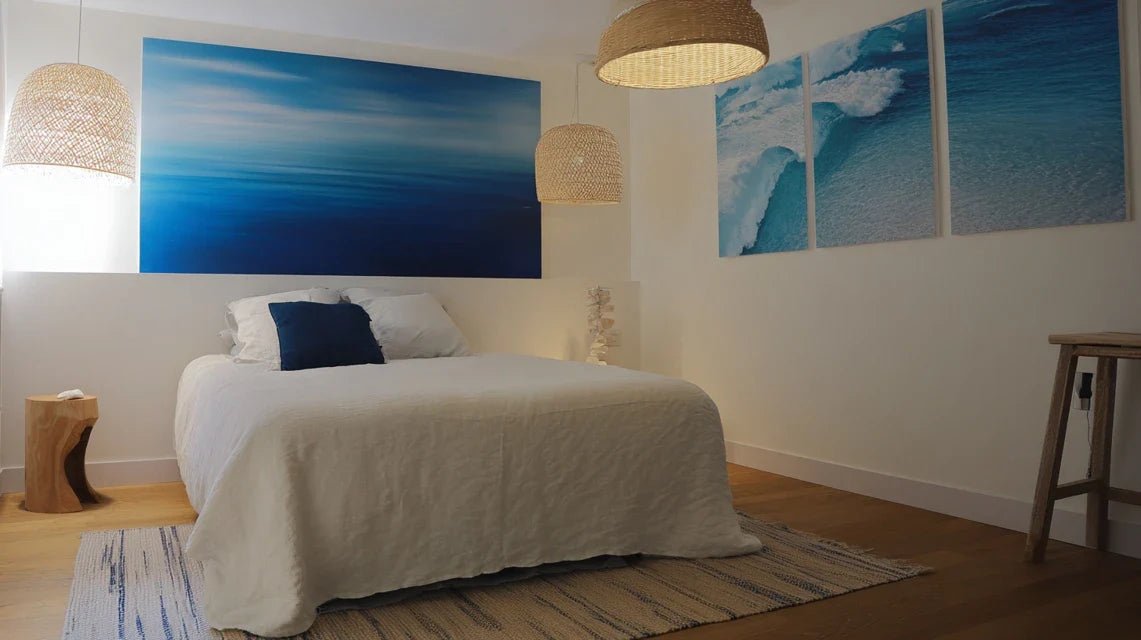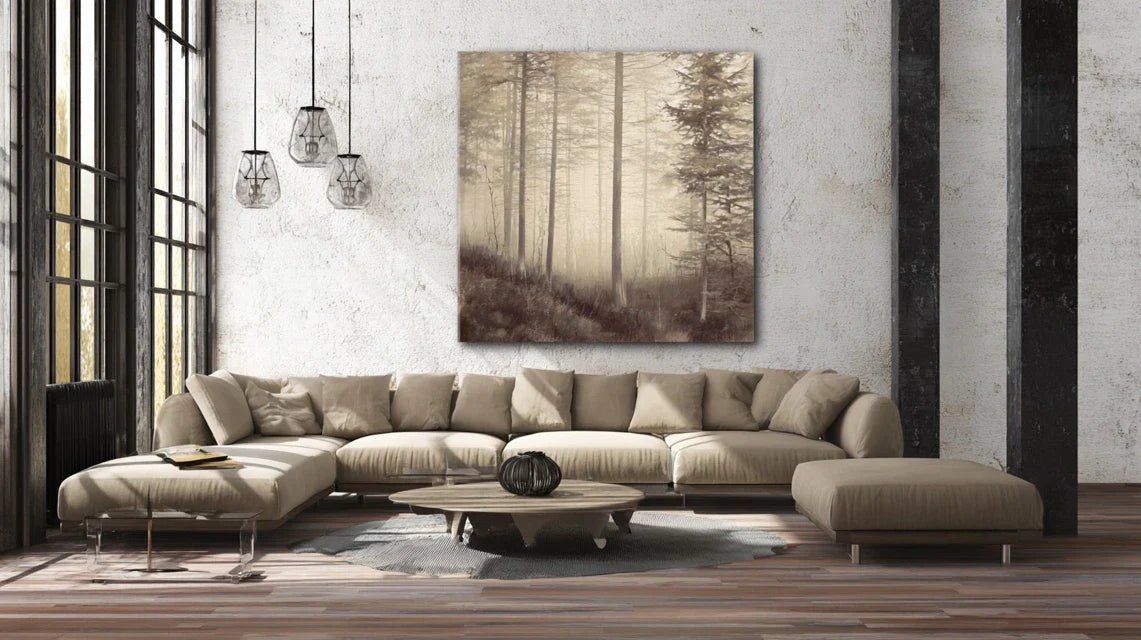
You come home after a tiring day, you push open the door to your living room and... nothing soothes you. You're reflected back the stress of the day by your white and cold walls instead of offering you that visual breath of fresh air you dream of.
Imagine that moment when, looking up, you could instantly escape to a lush forest, a majestic mountain or a golden plain that reconnects you with nature, even in the heart of the city.
You may have already tried some cheap posters or printed photos, but the result disappointed you: dull colors, flat rendering, impression of a "low-end" decoration that doesn't match your vision.
That's normal, and it's not your fault. The difference between a simple poster and a true landscape painting lies in the quality of the materials, the depth of colors and the ability to create that virtual window to serenity.
By the end of this article, you will know exactly how to choose and integrate landscape paintings that will transform your interior into a true visual well-being sanctuary, where every glance becomes a mini-regenerating escape.
Why does your mental wellbeing deserve natural landscapes on your walls?
In our era of hyperconnection and constant stress, your brain needs visual breaks to regenerate. Neuroscience proves it: contemplating natural landscapes, even in reproduction, decreases cortisol and activates the areas of the brain related to relaxation. It's like offering your eyes tired from screens an instant rejuvenation cure, available 24/7 in your living room.
🏠 Customer testimonial: Sarah, a Parisian executive, says: "Since I hung my series of three paintings depicting a forest-clearing-mountain sequence in my living room, my guests systematically ask me where I found this 'magic window'. I myself feel the difference: in the evening, instead of scrolling on my phone, I find myself contemplating my landscapes while drinking my tea."
💬 Conversation with a decor expert
The golden rule of interior landscapes: Choose scenes that evoke the times of day when you feel most serene. Your brain will automatically associate the view of this artwork with that state of well-being, creating a visual anchor for relaxation that you will feel in less than 30 seconds each time you look at it.
What really happens when your walls lack nature
Observe yourself in these situations: you pace around your living room without knowing why you feel restless, you have trouble relaxing even in your own home, or you experience a lack of inspiration and creativity in your living space.
This is not a coincidence: your nervous system reacts to the absence of soothing visual stimuli. Without natural elements to contemplate, your brain remains in "urban alert" mode even at home. The problem isn't you, but the visual environment that you haven't optimized yet.
It’s like trying to relax in a hospital waiting room: even if you want to, your visual environment doesn't help you. Your eyes instinctively seek natural visual resting points.
"Green" deprivation: an invisible but real stress
Contrary to what one might think, it’s not the quantity of decoration that counts, but its ability to connect your brain to natural rhythms. The majority of people accumulate decorative objects without creating this essential connection with the outdoors.
Imagine your gaze as a plant: it needs "green light" to flourish. Without this visual nourishment, it wilts, constantly searching for something that doesn't exist in your space.
Result: you experience unexplained eye fatigue, difficulty "disconnecting" mentally, and paradoxically, less desire to spend time in your own living room. The solution completely changes your relationship with your personal space.
🔍 Quick test: Sit in your living room and count how many elements evoke nature within your direct field of vision. If it's less than 3, your brain is working harder than it should to feel "at home".
The illusion of sufficient artificial lighting
Many think that good white LED lighting is enough to create a soothing atmosphere. In reality, your eye distinguishes more than 300 shades of green in nature, compared to only a few tones in standard artificial lighting.
It’s like feeding your vision with "empty calories": it illuminates, but doesn't nourish your nervous system. Your eyes remain "hungry" for this chromatic richness that only natural landscapes can offer.
D'où cette sensation de ne jamais être totalement détendu chez vous, malgré un mobilier confortable et un éclairage correct. Il manque cette dimension biophilique que votre cerveau primitif réclame instinctivement.
The trap of false "nature" solutions
Beware of artificial plants or pixelated images of nature printed on cheap canvas: your brain detects them as "fake" in milliseconds and refuses to connect with them emotionally.
You can verify this by observing your spontaneous reaction: in front of a well-reproduced landscape artwork, you inhale naturally more deeply. In front of the fake, you pass by without even realizing it.
This is why so many attempts to "green" interiors fail: they target the conscious eye but forget the primitive eye that, in turn, cannot be fooled.
3 signs your walls lack authentic nature:
- You avoid looking directly at your walls: Your brain subconsciously avoids "empty" visual stimuli that demand effort without soothing compensation
- Your guests sit with their backs to the walls: Instinctively, they prefer to face the central space rather than uninteresting surfaces
- You feel the need to "go outside for some fresh air" more often: Your nervous system compensates for the lack of natural stimulation indoors by an increased need for outdoors
The key: quality over quantity
The real difference lies in a painting's ability to create what is called the "window effect": this sensation that your wall opens onto a real landscape. This effect relies on three elements: the depth of field (foreground, midground, background clearly defined), the accuracy of natural colors (no artificial oversaturation), and the quality of the support which gives relief without disturbing reflections.
Smart buying rule: A single high-quality artwork will transform your daily well-being more than ten average decorations. Test by fixing the work for 30 seconds: if your breathing does not naturally slow down, it means that the work does not create the neurological connection sought.
| ❌ Common misconception | ✅ Scientific reality | 💡 Why it works | 🎯 Concrete benefit |
|---|---|---|---|
| You need a lot of green elements for a nature effect | A single well-chosen landscape is enough to create calm | The brain processes information quality, not quantity | Space and budget savings for greater impact |
| Nature photos have the same effect as paintings | The texture and relief of the support amplify the soothing effect | The eye perceives physical depth as more "real" | More intense and lasting feeling of escape |
| Any landscape is suitable if it's pretty | Each person reacts to specific types of landscapes | Connection with memories and personal preferences | Personalized well-being according to your emotional profile |
| The decorative effect is more important than the psychological effect | The impact on mood truly transforms your relationship with space | The brain associates space with felt emotions | Your home becomes a true regenerating refuge |
The foolproof method for creating your personalized visual oasis
Rassurez-vous : inutile d'avoir des connaissances en art ou en décoration pour réussir. This approach works like a recipe: just follow the steps in order to get a result that exceeds your expectations. In 3 simple steps, you will transform your wall into a window on your dream landscape, one that instantly soothes you with every glance.
🗺️ Overview of your transformation: Like a gardener who prepares the ground, plants in the right place and maintains his creation, you will first identify your personal "therapeutic landscape", then choose the optimal location and format, finally master the art of hanging for maximum effect. At each step, your space gains serenity and personality.
Step 1: Discovering your personal "landscape signature"
Starting with this introspection avoids the costly mistake of buying a "pretty" landscape that doesn't speak to you deeply. It's like building a house: emotional foundations determine whether you will truly feel at home. Once this step is complete, you will already feel the excitement of knowing exactly what you are looking for.
What you need for this exploration:
- A notebook or your phone: To note your spontaneous reactions without filtering them through logic. The goal is to capture your pure emotions when facing landscapes, not to make beautiful sketches. Opt for a small notebook that you can take everywhere rather than a large notebook that will stay on your desk.
- A series of varied visual references: Nature sites, travel magazines, Pinterest or Instagram from landscape artists. The principle is to expose your eye to as many types of landscapes as possible to identify what creates this "instant connection". Avoid online art galleries where colors are often distorted by screens.
- A 20-minute moment of calm: Without distractions, so that your brain can really process the emotions that each type of landscape provokes. It is this state of receptivity that reveals your authentic preferences, beyond trends or external influences.
Now let's move on to concrete practice:
How to reveal your deep preferences:
Test of the "3 breaths" : Facing each landscape, take 3 deep breaths while focusing on the image. Note whether your breathing naturally slows down (a positive sign) or remains tense. This test reveals the real effect of the landscape on your nervous system, beyond intellectual aesthetic appreciation. Do not try to understand why it works or not, just observe.
⏱️ Time : 2 minutes per landscape | ✅ Successful when : You feel a clear difference in relaxation between some landscapes and others | ⚠️ Attention : Do not choose with your head ("it's beautiful") but with your body (felt relaxation)
Classification by "moments of happiness" : Associate each landscape that soothes you with a positive personal memory (vacation, childhood, moment of joy). This emotional connection guarantees that the chosen painting will trigger those same positive sensations every day in your home.
⏱️ Time : 5 minutes of reflection | ✅ Successful when : You have identified 2-3 types of landscapes linked to your best memories | ⚠️ Attention : Avoid "impressive" landscapes without a personal emotional connection
Daily projection test : Imagine yourself returning tired and seeing this landscape on your wall. Which one immediately makes you want to settle comfortably? This is your most reliable indicator for a choice you will never regret.
⏱️ Time : 3 minutes of visualization per landscape | ✅ Successful when : One type of landscape clearly stands out as a "visual refuge" | ⚠️ Attention : Do not confuse "desire to travel there" and "desire to contemplate it daily"
✅ Validation of step 1 : You have identified your "family of landscapes" (forest, mountain, ocean, prairie...) and you know precisely why it soothes you. If you are still hesitating between two types, that's normal: step 2 will help you refine according to your space. Congratulations, you have avoided the mistake n°1 of 80% of buyers!
OUR RECOMMENDED PRODUCTS
Step 2: Optimize placement and format for maximum impact
Now that you know your ideal landscape, you are going to stage it so that it really transforms your daily life. This step is more technical but determines whether your painting becomes a simple decorative element or a real "therapeutic window". The snowball effect begins here: your gaze will naturally be drawn to this soothing area.
Measurement and planning tools :
- Measuring tape and spirit level: To measure precisely and avoid approximations that ruin the professional effect. A crooked picture attracts the eye negatively and creates subconscious tension instead of the desired soothing. Opt for a magnetic level that temporarily attaches to the nail.
- Photo application on your smartphone: To virtually test different formats and positions before making a final purchase. Photograph your wall, then overlay rectangles proportional to the sizes you are considering. This immediately reveals harmonious proportions according to your architecture.
- Mobile lighting (lamp or spotlight): To test the impact of light on your future location at different times of the day. Lighting completely transforms the effect of a landscape: too direct, it creates reflections; too weak, it dulls the colors. The ideal is indirect light that reveals without dazzling.
The "natural gaze" technique:
Mapping your visual paths: During a normal day, observe where your gaze naturally settles when you are in the room. Mark these "visual anchor points" with post-it notes. The picture should be placed on one of these natural routes, not in a dead zone that you never spontaneously look at.
⏱️ Time: 1 day of observation | ✅ Successful when: You have identified 2-3 "magnetic" zones for your eye | ⚠️ Attention: Do not choose the most "logical" location but the one you look at most often
Test of the "57 cm rule": The ideal height for your brain to process the picture as a "window" is 57 cm between the floor and the center of the work. This measurement corresponds to the average human gaze height and subconsciously creates this feeling of openness onto the exterior that you are looking for.
⏱️ Time: 5 minutes of measuring and marking | ✅ Successful when: You see the picture "naturally" without tilting your head up or down | ⚠️ Attention: Adjust according to your height if you are very tall or small
Proportionality with furniture: Your picture should be between 2/3 and 3/4 of the width of the furniture below (sofa, console...). Smaller, it appears lost; larger, it overwhelms the space. This proportion creates the visual balance that allows the brain to relax instead of subconsciously correcting imbalances.
⏱️ Time: 10 minutes of calculations and simulation | ✅ Successful when: The furniture + picture form a harmonious block | ⚠️ Attention: Measure the actual furniture, not the available wall space
Step 3: Master professional hanging for exceptional results
This final step transforms your choice and positioning into a daily visual experience. This is where the difference between "informed amateur" and "connoisseur" reveals itself: the technical details that make your landscape seem literally "alive" on your wall. Your surroundings will immediately notice this indefinable professional touch without being able to explain it.
High-end mounting hardware:
- Adjustable suspension system: Steel cables with adjustable hooks rather than fixed nails. This system allows for millimeter corrections after hanging and distributes the weight better to prevent sagging over time. Invest in quality: it's invisible but crucial for durability.
- Wall-type appropriate anchors: Molly for drywall, chemical anchor for concrete, wood screws for partition walls. A poor choice of fixing compromises safety and creates vibrations that alter the perception of stability of the artwork. Ask for advice in a specialized store according to your wall type.
- LED accent lighting: Adjustable spotlight with variable color temperature (2700K to 3000K) to reveal nuances without distorting colors. Lighting transforms a "pretty" painting into a "magical" painting that seems to have its own life depending on the time of day.
The "invisible" hanging technique:
Template paper method: Cut a piece of paper to the exact dimensions of the painting, mark the fixing points, position it on the wall and drill through the paper. This technique avoids measurement errors and missed holes that require patching and restarting. Professionals systematically use this method.
⏱️ Time: 15 minutes of preparation | ✅ Success when: The painting positions perfectly on the first try | ⚠️ Attention: Check that your template paper does not warp with humidity
Progressive lighting adjustment: Start with very soft lighting in the evening and gradually increase until you find the intensity that reveals all nuances without creating reflections. The goal: the painting should seem "lit from within" rather than lit from the outside.
⏱️ Time: 1 week of adjustments | ✅ Success when: The landscape seems to have its own luminous atmosphere | ⚠️ Attention: Avoid overly white lighting that "plasticizes" the natural effect
Stability test and finishing touches: Check that the painting does not move when touched lightly, that the cables are invisible from the front, and that no technical elements disrupt the illusion of a "natural window". These details make the difference between an amateur installation and a professional result.
⏱️ Time: 10 minutes of final checks | ✅ Success when: The installation seems "obvious" and natural | ⚠️ Attention: Do not neglect these finishing touches that condition the overall effect
Safe progression rule: Proceed to the next step only when you are fully satisfied with the previous one. It's better to take a week longer to make a good choice than to rush and regret it for years. Initial patience transforms into lasting daily satisfaction.
You now master the fundamentals, but the true connoisseur’s secrets lie in these details that even professional decorators don't always share. These refinements will make the difference between a "beautiful picture" and a truly transformative work of your space.
🎯 Secret of gallerists: The “maximum depth” effect is achieved by choosing landscapes with at least three distinct planes: sharp foreground (rocks, nearby trees), midground slightly blurred (hills, clearing), background very soft (distant mountains, sky). This trompe l'oeil technique creates the illusion of a true three-dimensional depth, transforming your wall into a convincing window.
💭 Question from an attentive reader
"I love the idea but I'm afraid of getting tired of a landscape that I see every day. How can I be sure my choice will remain inspiring over time?"
This concern is perfectly legitimate and shows that you are thinking carefully about your investment. In reality, it’s exactly the opposite that happens with a true natural landscape painting: the more you contemplate it, the more subtle details you discover that you hadn't noticed at first. It's like having a window onto a garden that changes according to the light and your moods. The trick is to choose a landscape with enough visual richness to nourish your gaze for years.
🔍 Anti-boredom test: Before making a final purchase, fix your eyes on the image of the chosen landscape for 2 full minutes. If your eye continues to discover elements (texture of bark, shades of green, play of shadows...), that's a good sign. A landscape "simple" at first glance but “rich” in exploration resists time.
The 5 mistakes that sabotage the “natural escape” effect
Attention, these mistakes are so common that even specialized stores don't always warn you about them. I share them to avoid these costly disappointments that I have observed in many well-intentioned customers.
- 🚫 Choosing a "photogenic" landscape rather than a soothing one: You are attracted by a spectacular sunset or a dramatic summit, but these “strong” images tire the eye on a daily basis. Prefer serenity to spectacle: your brain needs visual rest, not adrenaline. A soothing landscape remains inspiring longer than an
- 📏 Underestimating the necessary size: You choose too small out of fear of overdoing it, and the immersive effect disappears. A landscape should occupy enough visual space to create the "window effect". It's better to have a large, average-quality landscape than several excellent small landscapes competing for attention.
- 💡 Neglecting the room’s natural lighting: You place your landscape in an area with poor natural light, and it loses all its magic as daylight fades. Observe how the light changes in your room throughout a full day before deciding on the final location.
- 🖼️ Saving money on support quality: You opt for a low-end canvas print that quickly fades or sags with humidity. The support determines the durability of the effect: invest in a museum-quality rigid support that will preserve its colors and flatness for years.
- ⚖️ Forgetting harmony with existing decor: Your dream landscape clashes completely with the dominant colors of your room, creating visual tension instead of soothing. Take a photo of your room and virtually check the color harmony before making the final purchase.
🛡️ Safety checklist before purchasing: Does your landscape instantly soothe you? ✓ Do the colors harmonize with your existing decor? ✓ Is the size proportional to your wall and furniture? ✓ Does the location benefit from good natural lighting? ✓ If any answer is negative, rework this aspect before purchasing.
🎁 Special offer for readers
Because you took the time to inform yourself, enjoy 10% discount on your first order:
⏰ Valid 72 hours after reading • Applicable to all our products
❓ Answers to frequently asked questions about landscape wall art
The immediate effect is felt with the first glance (slowing of breathing), but the complete transformative impact unfolds over 2 to 3 weeks. Your brain needs that time to integrate this new "visual refuge" into its relaxation automatisms. To optimize: consciously look at your landscape for 30 seconds each morning, the positive association will strengthen more quickly.
Allow between €150 and €400 for a professional quality painting that will truly transform your daily life. Below €100, you risk disappointments (dull colors, fragile support). Above €500, you often pay for the artist's notoriety more than the therapeutic impact. The sweet spot is around €250 for a 70x100cm format in museum quality.
It’s counterintuitive, but a large landscape actually expands a small space en creating an "opening" towards the outside. The mistake would be to multiply small elements that fragment the space. Golden rule for small rooms: one large landscape on the main wall instead of several small scattered elements.
Absolutely! Use non-drilling mounting systems like high-strength adhesive hooks (up to 8kg) or tension rods for opposite walls. Elegant alternative: the design floor easel that transforms your artwork into a mobile sculpture. These solutions preserve your walls while creating the desired decorative effect.
Artistic stylization can even amplify the soothing effect because it avoids distracting details to focus on the essential emotional aspect of the landscape. Simple test: does the artwork make you want to "walk into" it mentally? If so, it doesn't matter whether it is photographic or stylized, the therapeutic effect will be present.
🌅 Your new life with your personal window on nature
In a few weeks, when you step through the door of your living room, your gaze will automatically settle on your chosen landscape and your breathing will instantly slow down. Your guests will notice this "particular atmosphere" in your interior without being able to explain it. You will feel that secret pride of having created a space that truly resembles you, that tells your need for nature and your taste for beautiful things.
Beyond decoration, you will have developed what I call the "decorative eye": this ability to analyze a space, identify what is missing for it to be truly soothing, and know how to remedy it with precision. This skill will transform your relationship with all your living spaces and impress those around you.
The hardest part was understanding the mechanism, now you know exactly what to do. Start today by identifying your landscape signature by observing your reactions to nature images. In 30 days, you will have created your own daily visual oasis that you will no longer be able to do without.
🚀 Your transformation starts now: Every major change in atmosphere begins with a conscious first look at your current space. You now have all the keys to create that visual escape you dreamed of, the one that will transform your "home" into a true personal sanctuary.