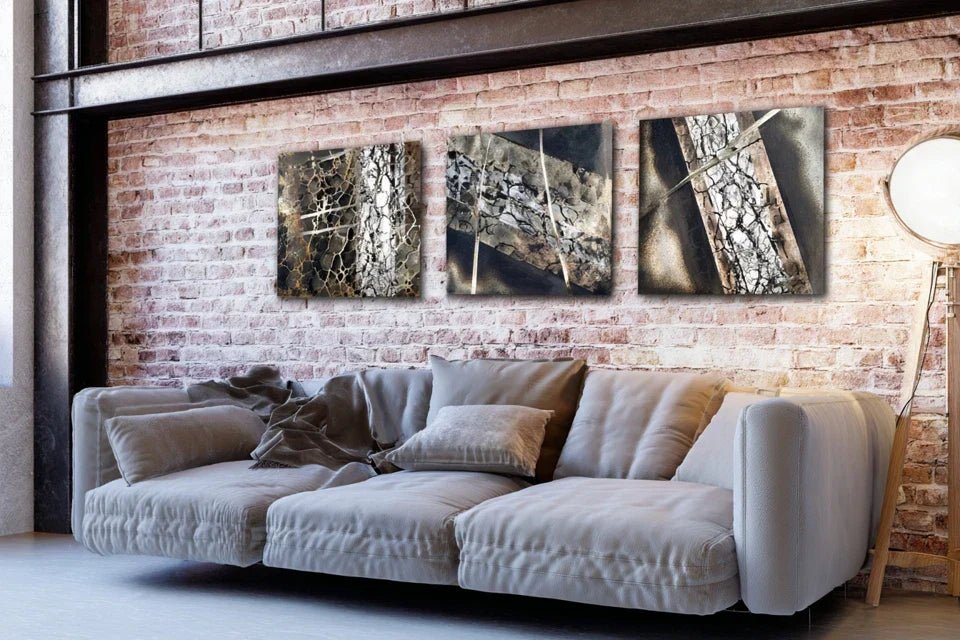
Are you looking at the walls of your living room and feeling that dull frustration: despite all your decor purchases, the overall look is sorely lacking in character. You've accumulated small objects, multiplied photo frames, bought those three little matching canvases on sale... but it doesn't work.
The space remains bland, impersonal, as if waiting for someone to breathe a true soul into it. Your guests pass by without stopping, your gaze slides over an environment that doesn’t really reflect you.
You've followed all the classic decor tips: harmonizing colors, multiplying points of interest, creating "themed corners." Result? A decorative clutter with no relief or distinctive personality.
It’s normal and it’s absolutely not your fault. The problem comes from a flawed approach: trying to say everything at once rather than daring to affirm one thing strongly.
By the end of this article, you will know exactly how to transform your interior with a single striking artwork and create that magnetic presence that makes all the difference in a successful minimalist decor.
Why one strong artwork is better than ten small decorations?
In our era of decorative overconsumption, we have lost sight of a fundamental truth: emotional impact comes from concentration, not dispersion. Imagine an orchestra where each musician played their own melody simultaneously – it’s exactly what happens in our cluttered interiors.
💡 Interior designer revelation: Sarah, a Parisian decorator, recounts having transformed a 45m² apartment simply by replacing fifteen small decorations with one powerful artwork of 120x80cm. "The owner called me crying with joy three days later – he felt truly at home for the first time in five years."
💬 Conversation with a decor expert
The golden rule of impactful decoration: One exceptional element creates more emotion than ten correct elements. This visual concentration allows your eye to rest, contemplate, and your soul to calm down. Observable result in 24h: your loved ones will immediately notice the transformation.
Understanding why your current decor doesn’t satisfy you
Do you recognize these three situations? Your gaze flits around without ever settling. You take photos of your interior, but they always seem "flat" on social media. Your guests compliment your decor politely, but without genuine enthusiasm in their voice.
The real issue is that your brain is desperately searching for a visual anchor and can't find one. Your current decor functions like permanent background music – present but invisible, reassuring but not memorable.
It’s like trying to follow a conversation in a crowded cafe: to many stimuli at once create cognitive fatigue that prevents you from fully appreciating anything.
The first hidden cause: the fear of empty space
Contrary to what we think, empty space isn't your enemy but your most valuable ally. The real revelation? The most beautiful interiors in the world use empty space as a frame to showcase their masterpieces.
Think of a luxury jewelry store window: they never display a hundred pieces of jewelry at once, but a single magnificently lit diamond on black velvet.
This fear of empty space drives you to fill every corner, diluting the impact of each element. The result: your interior becomes a "visual background noise" instead of a mastered symphony.
🔍 Revealing test: Take a photo of your main room and show it to a friend, asking them to describe what they see first. If they hesitate or list several elements, nothing dominates – the diagnosis is made!
The illusion of a "complete" decor
We have been conditioned to believe that a successful interior must be "complete",
meaning that every surface must carry something.
In reality, sophistication comes from rigorous selection, not accumulation
It’s like the difference between a powerful speech and incessant chatter:
the strength comes from what you choose to say, not everything you could say.
This belief keeps you in a cycle of compulsive purchases without ever reaching that deep satisfaction
that comes from an interior that truly reflects you.
Many fall into the trap of quick decorative solutions:
buying several small items rather than investing in a statement piece.
It’s like trying to make a gourmet dish with twenty average ingredients instead of three exceptional ones.
Consider your last decor purchase: was it an authentic crush or a "it will go well with the rest"?
This nuance makes all the difference between an interior that nourishes you and one that leaves you wanting.
The impact on your daily life is real: you come home without feeling that deep joy
that your own cocoon should provide.
The 3 warning signs of a scattered decor:
What really makes the difference is daring to embrace assumed singularity.
Like a signature fragrance that makes you recognizable,
a striking painting creates your unique decorative identity.
The more personal and assertive it is, the more memorable and soothing it is for yourself.
The authentic crush rule: If you hesitate for more than three seconds in front of a work, then it doesn't really suit you. The true crush is recognized by this immediate evidence that makes you say "that's exactly it!" Test by closing your eyes and opening them again: the emotion must be immediate.The "quick decor" trap
The epiphany: understanding the power of singularity
❌ Quantity approach
✅ Quality approach
💡 Why it changes everything
🎯 Immediate benefit
I buy what goes with the existing decor
I choose what overwhelms me
Emotion takes precedence over forced harmony
Authentic pleasure every day
I fill all available walls
I prioritize a signature wall
Empty space amplifies the visual impact
Rest for the eyes and mind
I collect nice little objects
I invest in a statement piece
One "wow" is better than ten "not bad"
Confident assumption of one's taste
I change often to renew myself
I choose for the long term and grow with it
Depth is born from repeated contemplation
Emotional stability of one's cocoon
The 3-step method for choosing your statement piece
Rassurez-vous, choisir LE tableau qui transformera votre intérieur n'est pas une science exacte mais un art accessible. C'est comme apprendre à reconnaître un bon vin : unce les bases comprises, votre instinct devient votre meilleur guide. The progression is simple: define your target emotion, explore the possibilities, then anchor your final choice.
🎯 Overall vision of your transformation: Step 1 - you identify the emotion you want to feel at home, Step 2 - you explore and prescreen according to your personal criteria, Step 3 - you test and validate your final crush. At each step, you gain clarity and confidence in your personal taste.
Step 1: Define your signature emotion
Starting with emotion rather than aesthetics is laying the right foundations for your choice. Comme un architecte dessine d'abord l'usage avant la façade, you must first clarify what you want to feel when you come home. This step will save you years of hesitation and regret.
The tools for emotional clarification
- Your personal inspiration journal: A simple notebook or photo folder on your phone where you collect everything that resonates with you – not just art, but also landscapes, atmospheres, and the colors of clothes you love. Avoid overly influential decor magazines; prioritize your spontaneous reactions. Quality is recognized when an image makes you look away from your screen to contemplate it again.
- The exercise of the ideal day: Visualize your perfect home routine precisely – in the morning with your coffee, in the evening while relaxing. Note the sensations you are seeking: tranquility, dynamism, inspiration, cocooning. This emotional mapping becomes your compass to avoid impulsive purchases that do not match your true nature.
- The test of opposites: Identify what you absolutely don't want to feel at home – stress, coldness, agitation, melancholy. This "negative" approach sometimes reveals your needs more clearly than a positive one. It significantly refines your selection criteria.
Now let's move on to concrete action to define your emotional profile.
Your emotional diagnosis in 15 minutes
Close your eyes and visualize your ideal living room: Sit comfortably and imagine yourself in your living room after a great day. How do you feel? What sensations dominate: serenity, creative energy, warm sophistication? This first intuition is often the most accurate because it comes from the heart, not the mind.
⏱️ Time: 5 minutes | ✅ Successful when: You can name 2-3 precise sensations without hesitation | ⚠️ Attention: Don't censor yourself for fear of "what will they think" – your interior should reflect you
List your 5 latest visual crushes: What has made you stop in the street, in a magazine, on social media in recent weeks? Look for the common point: is it the strength of the colors, the softness of the shapes, or the originality of the textures? This pattern reveals your natural style, the one that truly nourishes you.
⏱️ Time: 5 minutes | ✅ Successful when: You identify a common thread between your tastes | ⚠️ Attention: Distinguish what pleases you from what impresses you – only authentic pleasure counts
Determine your primary energy need: Should your interior stimulate you (bright colors, dynamic shapes) or soothe you (neutral tones, soft shapes)? Reflect on your current lifestyle and what you lack most. A stressed environment will need calm, an introspective personality will need stimulation.
⏱️ Time: 5 minutes | ✅ Successful when: You clearly know whether you want to "raise" or "lower" your energy level at home | ⚠️ Attention: Your needs can evolve with the seasons of your life – that's normal
✅ Step 1 Validation: You must be able to complete this sentence: "When I come home, I want to feel..." with 2-3 precise adjectives. If you are still unsure, take a few days to observe your emotional reactions in different places. This clarity is the key to the entire process – do not neglect it!
OUR RECOMMENDED PRODUCTS
Step 2: Explore and pre-select according to your criteria
Now that your emotional compass is calibrated, you can explore without getting lost. This is the difference between browsing a market with a precise list and wandering aimlessly: even discovery becomes more efficient. This step transforms the search from a chore into the pleasure of guided discovery.
Your personalized pre-selection criteria
- The optimal size criterion: For maximum impact, count 1/2 to 2/3 of the width of your main sofa, generally between 80cm and 120cm wide. This proportion creates the perfect balance between presence and harmony. Too small = lost in space, too large = overwhelming. Measure before you search to avoid disappointment.
- Intuitive color harmony: Forget strict matching rules. Your painting can pick up on 1-2 existing colors in your room OR introduce a completely new color that will become your signature. The important thing is that the whole ensemble gives you a feeling of correctness when you look at it. Trust your eye.
- The technique and support that speak to you: Oil painting for depth and richness, acrylic for modernity and pure colors, mixed techniques for originality. The medium also counts: stretched canvas for the classic, dibond for the contemporary, art paper for intimacy. Touch, feel – your tactile sensitivity is as important as visual.
Your effective exploration strategy
Create your shortlist of a maximum of 3-5 artworks: Browse no more than 2-3 specialized sites to avoid information overload. Immediately save what provokes an emotional reaction, even slight. Do not rationalize yet – let your instinct do the sorting. The goal is to create a bouquet of possibilities consistent with your emotional profile.
⏱️ Time: 45 minutes spread over 2-3 sessions | ✅ Success when: Each selected artwork makes you smile or move you | ⚠️ Attention: Stop as soon as you start comparing obsessively – it's a sign of saturation
Test compatibility with your daily life: For each preselected artwork, imagine it in three contexts: morning upon waking up, afternoon while working remotely, evening in relaxation mode. Does it retain its charm in all scenarios? An artwork that only supports one lighting or one mood will not be your ideal lifelong companion.
⏱️ Time: 10 minutes per artwork | ✅ Success when: The artwork feels "livable" in all your moods | ⚠️ Attention: An artwork that is too "perfect" can also be too intimidating for daily life
Validate quality and authenticity: Check the artist's signature, the quality of the support, and the storage conditions. For online art, request high-definition photos from multiple angles and lighting conditions. Don't hesitate to ask technical questions – a serious seller will appreciate your attention to detail.
⏱️ Time: 15 minutes per finalist artwork | ✅ Success when: You know the story of the artwork and its creator | ⚠️ Attention: The story should not overshadow your feelings – it's a plus, not the main criterion
🎯 Checkpoint step 2: Your final shortlist should only contain artworks whose precise emotional effect you can describe. If you say "it's pretty" without further detail, it's not quite there yet. Take the necessary time – it’s better to wait than to make a mistake.
This final step separates the amateur from the connoisseur: knowing how to validate your instinct with concrete tests. Like a chef who tastes his dish from all angles before serving it, you will test your favorite in all its dimensions. This is where absolute confidence in your choice is born.
The 3 definitive validation tests
The long-term projection test: Print the image of your favorite in A4 format, temporarily stick it on your main wall and live with it for a minimum of 48 hours. Does your gaze naturally settle on it? Does the image tire you out or reveal new details? This test eliminates 80% of "impulsive false ideas".
⏱️ Time: 2-3 days of observation | ✅ Success when: You want the real artwork after 48 hours of simulation | ⚠️ Attention: An A4 print does not do justice to the colors – focus on the composition and overall emotion
The benevolent outside look test: Show your choice to 2-3 trusted people, explaining what it represents for you. Their spontaneous reactions often reveal aspects that you were not aware of. Attention: you are looking for understanding, not approval. Your choice must be able to be explained and defended.
⏱️ Time: 30 minutes of conversation | ✅ Successful when: You talk about your artwork with passion and conviction | ⚠️ Attention: Don't let anyone discourage you from a true crush – but listen to rational arguments about quality
Validating emotional investment: Calculate the "cost per day of emotion": if your artwork makes you feel good for at least 5 years, divide its price by 1825 days. This calculation relativizes the investment and confirms the logic of choosing quality. An artwork worth €500 that nourishes you daily costs less than 30 cents a day of happiness.
⏱️ Time: 10 minutes of reflection | ✅ Successful when: The price/quality ratio seems consistent with your life priorities | ⚠️ Attention: Don't sacrifice quality to save €100 on a purchase intended to last for years