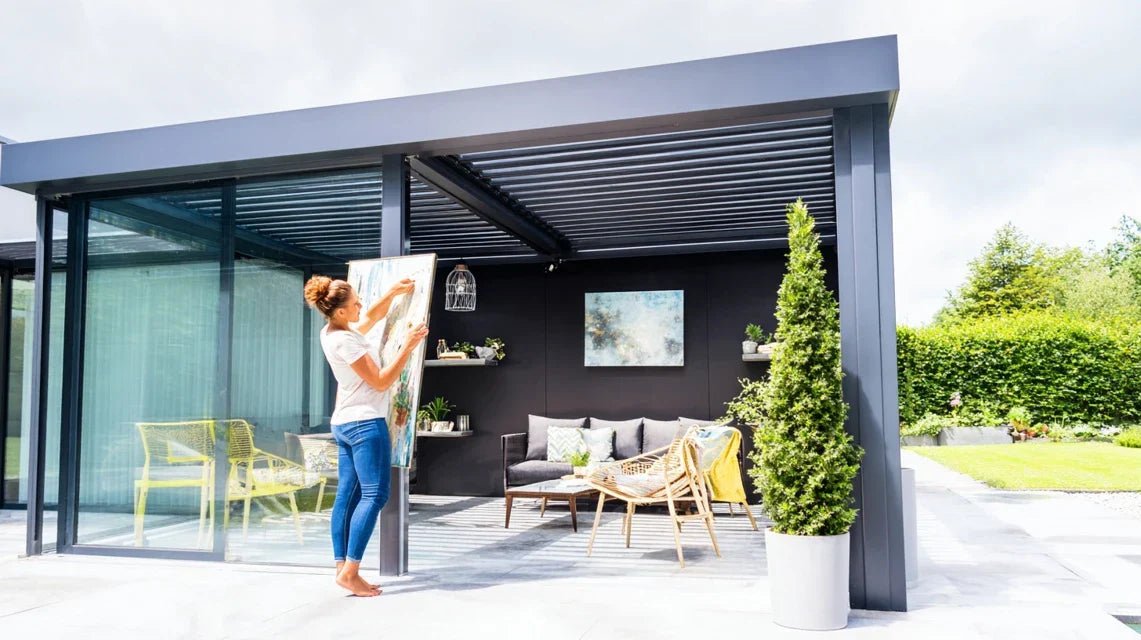
Composez votre galerie d'art

Des tableaux qui racontent votre histoire
Code d'initiation
ART10
10% offerts sur votre première acquisition
Découvrir la collection

Zen terrace decor: minimalist artworks for sheltered outdoor spaces

Décoration zen terrasse : tableaux minimalistes pour extérieur abrité
⏱️ Reading time: 8 minutes
You’ve just furnished your covered terrace with care, but something feels off. Despite your efforts, the space seems cold and impersonal, as if it lacks a soul – that peaceful and harmonious haven you had imagined.

The furniture is perfect, the plants are well-chosen, yet your gaze wanders into emptiness. This feeling of unfinished decor frustrates you, especially when you were already envisioning moments of absolute relaxation in your zen retreat.

You may have tried a few solutions: colorful cushions, lanterns, decorative objects found here and there. But nothing has created that authentic zen ambiance you were seeking. Instead, the space feels cluttered or disjointed.

This is normal, and it’s not a matter of your taste. True zen harmony isn't created by accumulating objects, but by the rightness of a few elements chosen with intention, especially outdoor-suitable wall art.

By the end of this article, you’ll know exactly how to choose and arrange minimalist artworks to transform your terrace into a true zen sanctuary, and you'll feel that serenity at first glance.

Why wall art is the missing element of your zen oasis?

Outdoor wall art isn’t just a decorative accessory: it’s the visual soul of your zen space. Without it, even the most beautiful terrace remains a decor without a story. Like a subtle fragrance that transforms a room, the right artwork instantly creates that emotional connection that makes you feel truly at home. If you wait, you risk spending months going around in circles, multiplying small purchases that never bring that sought-after zen coherence.

🏡 Customer testimonial: Sarah spent weeks searching for the perfect decor for her sunroom. Rattan furniture, tropical plants, string lights... Nothing worked. Until she hung a simple minimalist artwork with natural tones facing her sofa. “It was magical,” she says. “Suddenly, everything fell into place. The space finally had that serenity I was looking for.”

💬 Conversation with a decor expert

“I’m afraid an artwork on my terrace will be too... sophisticated? I want to keep a natural and relaxed feel.”
On the contrary! A minimalist artwork with natural tones reinforces that authenticity you're looking for. It’s like adding a sunset to a landscape: it enhances nature instead of distorting it. Zen art is inspired by nature to create perfect harmony.
“I’ve always been told not to put artwork on a terrace, that it's fragile and doesn't last outdoors.”
This rule dates back to an era when materials were less performant. Today, with UV-resistant supports and finishes adapted for sheltered spaces, a painting can perfectly enhance your terrace for years. It's the same evolution that outdoor fabrics have experienced: durable AND beautiful.

The secret of zen harmony: one strong artistic element is better than ten small decorative objects: This minimalist approach creates a soothing focal point that instantly unifies your space. You'll see the difference within the first 24 hours.

Understand why your terrace lacks this zen magic

Do you recognize these situations? Your gaze wanders without an anchor point when you sit outside. You feel that impression of "something too much or not enough" without being able to identify what. Your guests compliment the arrangement but you feel it lacks that personal signature that makes the difference.

What's happening is that your terrace suffers from the decorative blank page syndrome. All functional elements are there, but none tell your story or create that essential emotional connection to well-being. It’s not a design flaw; it’s simply the absence of a structuring artistic element.

Imagine your terrace as a melody: it has the rhythm (the furniture), the harmony (the colors), but it lacks that perfect note that transforms a sequence of chords into true musical emotion.

The first hidden cause: the illusion of "natural" decoration

Contrary to popular belief, a “natural” decoration does not mean absence of art. In reality, nature itself is the greatest artist: think of reflections on water, games of light and shadow, spontaneous compositions of foliage.

It's like believing that a Japanese zen garden is simply "wild": in reality, every stone, every curve is designed to create a perfect visual harmony. Likewise, your terrace needs that artistic element that echoes the surrounding natural beauty.

Without this artistic touch, your space remains in the “almost perfect” which unconsciously generates a slight tension instead of the sought-after serenity. Your approach will naturally evolve towards seeking that centerpiece that unifies everything.

🔍 Revealing test: Close your eyes on your terrace, then open them abruptly. Does your gaze settle naturally somewhere, or does it wander? If it's the latter case, you have just discovered why the space lacks this zen magic.

The second hidden cause: the myth of "empty sobriety"

Many confuse zen minimalism and total emptiness. In reality, zen aesthetics seeks the perfect balance between empty and full, silence and expression. A space that is too bare can paradoxically create anxiety instead of peace.

It's like the difference between an awkward silence and a serene one: it all lies in the quality of what structures that void. A well-chosen minimalist artwork becomes that "breath" that brings life to the visual silence of your terrace.

Without this artistic structuring, you feel this sense of being "too cold" or "too empty," which subconsciously pushes you to add decorative elements that paradoxically move away from the sought-after zen harmony.

The third hidden cause: overlooking vertical dimension

Almost all terrace arrangements focus on the horizontal plane: floor, furniture, plants. But zen harmony is born of three-dimensional balance. Walls remain "blank pages" that subconsciously create a visual imbalance.

Observe your space: you've probably thought about circulation on the floor, seating comfort, lighting. But have you structured the vertical visual landscape? That’s often where this feeling of incompleteness lies.

This neglect of verticality deprives you of that feeling of protective enclosure so characteristic of successful zen spaces, where every direction of the gaze finds a harmonious element.

3 signs your terrace needs wall art:

  • The "something extra" syndrome: You constantly seek that detail to "perfect" the atmosphere, a sign that the structuring element is missing
  • The "garden center catalog" effect: The space is beautiful but impersonal, as if it lacked your emotional signature
  • Subtle visual fatigue: After a few minutes, your gaze "detaches," finding no harmonious point of rest
The trigger element: the power of a zen focal point

What truly transforms a space into a zen refuge is the presence of a soothing focal point that acts as a "visual anchor." Like a lighthouse that guides the gaze without assaulting it, the right artwork instantly creates this feeling of organized serenity. You'll recognize it easily: as soon as you install it, you’ll feel that impression that “everything was meant for this,” as if the space had finally found its natural balance.

Golden rule of zen harmony: a perfectly balanced space attracts the gaze without holding it captive: Your artwork should create this feeling of "visual breathing" where the eye rests, relaxes, and then freely explores the whole. Test this by observing your instinctive reaction to different artworks.

❌ Common belief ✅ Zen reality 💡 Explanation 🎯 Practical benefit
"An artwork is too sophisticated for a terrace” Minimalist art reinforces natural authenticity Like a reflection on water sublimates a landscape Instant harmony without artifice
"You need to multiply small decorative objects” A single strong element unifies the entire space The principle of less is more characteristic of zen Immediate serenity and simplified maintenance
"Outdoor art doesn't last" Modern materials combine beauty and durability Technological evolution of resistant supports A lasting investment without constraints
"Minimalism is total emptiness" It’s the perfect balance between presence and sobriety Inspiration from traditional Zen philosophy Calmness without excessive austerity

The progressive method to create your perfect zen oasis

Rest assured: transforming your terrace into a true zen sanctuary doesn't require a huge budget or special skills. It’s a gradual process, like growing a Japanese garden: each step brings its satisfaction and naturally guides you to the next. In just 3 weeks, you will have created this space that instantly recharges you as soon as you set foot in it.

🗺️ Your zen roadmap: Step 1 - Analyze your space and define your ideal focal point (immediate satisfaction: clarity on your goal). Step 2 - Choose your artwork according to the rules of Zen harmony (pleasure: discovering THE artwork that speaks to you). Step 3 - Install and adjust for perfect balance (happiness: seeing your vision come true).

Step 1: Reveal the zen potential of your space

Starting with this analysis avoids costly mistakes and saves you valuable time. It's like drawing the foundations before building: this preparation guarantees a harmonious result. Once this step is complete, you will feel the satisfaction of "seeing clearly" in your project, and every subsequent decision will flow naturally.

What you need for this step:

  • A moment of calm (30 minutes): Choose a time when you can sit comfortably on your terrace, without distractions. Zen observation requires this quality of presence. Avoid peak traffic hours or daily stress.
  • Your smartphone (for photos): It will serve to capture different angles and lighting of your space. The eye quickly gets used to things, but a photo reveals details that you no longer see. Prefer several quick shots over carefully composed photos.
  • A notebook and pencil: To note your feelings and observations. Handwritten writing promotes this intimate connection with the space you are arranging. Choose a support that inspires you to write; it influences your creativity.

Now let’s move on to practice, step by step

How to reveal the strengths of your terrace:

Natural movement observation: Enter your terrace as you usually do, then sit in your favorite spot. Look around without forcing it, and note where your gaze naturally settles. These areas of attraction reveal potential focal points of your space.

⏱️ Time: 10 minutes | ✅ Successful when: You have identified 2-3 zones that "naturally" catch your eye | ⚠️ Attention: Do not try to analyze intellectually, let your instinct guide your observation

div>

Test different times: Observe your terrace at different times (morning, afternoon, early evening) to understand how natural light sculpts the space. Note which areas are illuminated or highlighted depending on the time. This information will be crucial for choosing the optimal location for your artwork.

⏱️ Time: 5 minutes x 3 moments | ✅ Successful when: You have a clear vision of the "privileged" zones by light | ⚠️ Attention: Avoid extreme weather days that distort the light analysis

Emotional mapping: Standing in the center of your terrace, slowly turn around and note your feelings for each direction. Which angles soothe you? Which create a slight tension? This emotional compass reveals where to place your art to maximize the zen effect.

⏱️ Time: 10 minutes | ✅ Successful when: You have identified your "maximum serenity zone" | ⚠️ Attention: Do not rationalize your feelings, note your spontaneous first impressions

✅ Validation of step 1: You must have a clear vision of your "golden triangle": your favorite position, the wall or zone that naturally attracts your eye, and the best lighting time. If any of these data are missing, repeat the concerned observation. Otherwise, congratulations: you have a solid foundation for choosing your perfect artwork!

OUR RECOMMENDED PRODUCTS

Step 2: Choose your artwork according to authentic zen codes

Now that you know your space, the choice of artwork becomes intuitive and joyful. You go from "blind search" mode to "immediate recognition" mode. This step is particularly rewarding because you will feel this "click" when you come across THE piece that perfectly matches your vision and your space.

Selection criteria for a successful zen artwork:

  • Natural color palette: Favor earth tones, beiges, muted greens, grayed blues, soft ochres. These shades naturally harmonize with the outdoor environment without creating a visual break. Avoid pure or acidic colors that disrupt zen serenity.
  • Minimalist composition: Look for works with clean lines, simple shapes, and plenty of empty space ("visual breathing”). The zen principle favors suggestion over demonstration. The work should leave room for your personal contemplation.
  • UV-resistant support: Verify that the artwork is specifically designed for sheltered outdoor spaces. Pigment inks and treated supports guarantee lasting beauty. This technical feature ensures the permanence of your aesthetic investment.

Zen selection process:

First impression test: When discovering an artwork, note your instinctive reaction within the first 3 seconds. Zen art should create an immediate feeling of calm or benevolent curiosity. If you feel tension or indifference, move on without forcing yourself.

⏱️ Time: 3 seconds per piece | ✅ Successful when: You feel a natural attraction, a visual "call" | ⚠️ Attention: Do not let practical considerations influence this initial emotional evaluation

In situ visualization: For artworks that have passed the emotional test, imagine them in your zen space. Close your eyes and project yourself contemplating this work from your favorite position. This visualization reveals a deep compatibility between the artwork and your world.

⏱️ Time: 2 minutes per selected artwork | ✅ Successful when: The visualization generates a feeling of anticipated well-being | ⚠️ Attention: If you have to "force" the visualization, it means that the harmony is not natural

Timelessness test: Ask yourself if you can still imagine admiring this artwork in 2-3 years. Zen art transcends fleeting trends to create lasting beauty. A truly zen work grows with you instead of becoming tiresome.

⏱️ Time: 1 minute of reflection | ✅ Successful when: You feel a deep connection, not just a crush | ⚠️ Attention: Beware of works that are too "trendy" and risk dating quickly

Step 3: Installation and perfect harmonization

This final step transforms your choice into a lived zen reality. This is the magical moment when your vision takes shape and you discover the real impact of your artwork on the atmosphere of the space. You will feel the deep satisfaction of seeing your terrace transform into a true personal refuge.

Material for perfect zen installation:

  • Suitable fixing system: Choose discreet but solid fixings, specifically designed for sheltered outdoor use. Zen elegance requires that the technique remains invisible. Avoid oversized systems that draw attention to themselves.
  • Spirit level: A perfectly horizontal placement ensures visual harmony. Even a slight misalignment can create a subconscious tension that undermines the desired zen effect. Technical precision supports aesthetic serenity.
  • Measuring tape: To respect the classic Zen proportions when positioning. The rule of the golden ratio and harmonious ratios are not just theoretical: they really influence your feeling towards the artwork.

Zen installation process:

Positioning at eye level when seated: Place the center of the painting at about 140-150 cm from the floor, which corresponds to your natural eye level when you are sitting on your terrace. This height creates an immediate and comfortable connection with the artwork, without visual effort.

⏱️ Time: 15 minutes | ✅ Successful when: Your gaze naturally finds the artwork without tilting your head up or down | ⚠️ Attention: Adjust according to your height and the height of your usual seats

Test of final visual balance: Once installed, sit in different places and observe the overall effect. The painting should create an anchor point without dominating the space. Zen harmony is born from this subtle balance between presence and discretion.

⏱️ Time: 10 minutes | ✅ Successful when: The space seems "complete" and peaceful from all angles | ⚠️ Attention: If a position reveals an imbalance, do not hesitate to adjust slightly

Zen progression rule: let the space “breathe” for 48h before any adjustment: Your eye needs this time to get used to the new harmony. Often, what seems "not quite right" on the first day finds its natural balance after this adaptation period. Patience and observation are the keys to Zen perfection.

You now master the fundamentals of outdoor Zen art. Let's discover some expert subtleties that will make the difference between a beautiful arrangement and a true personal sanctuary, those details that are immediately noticed by connoisseurs.

🎨 Pro secret - The "natural dialogue" effect: Position your painting to create a visual conversation with an existing natural element (plant, view, play of light). This ancestral technique of Zen design creates such a natural harmony that it seems obvious, even though it requires a trained eye to master.

🤔 Frequent question from our readers

"What if I make a mistake in my choice? I'm afraid of ruining the atmosphere I’ve already created..."

This concern is perfectly normal and reveals your sincere attachment to your space. In reality, choosing according to the progressive method that we have just seen considerably minimizes this risk. Moreover, authentic Zen art has this particular quality of integrating harmoniously even when it is not perfectly placed on the first try. The important thing is to start and adjust if necessary: the Zen instinct develops with practice, not with theory.

💡 Reassuring tip: Start by choosing a piece that truly speaks to you, even if you're not 100% sure about the placement. Once installed, live with it for a week. You’ll discover that your eye naturally finds the necessary small adjustments, and this experience will give you confidence for your future decor choices.

Avoid these mistakes that sabotage zen harmony

Even with the best intentions, some mistakes can compromise the desired zen effect. Knowing these classic pitfalls allows you to avoid them and preserve the serenity of your space from the first installation.

  • 🚫 The "wall collection" trap: Trying to create a gallery wall like indoors breaks the zen essence. The zen spirit favors contemplation of a unique work that lets the space breathe. Resist the urge to add: one perfect zen painting is better than three “almost perfect” paintings.
  • 🚫 The "favorite color" mistake: Choosing a painting for a color you like, without considering the overall harmony, often creates a visual disruption. In zen, emotion arises from the whole, not an isolated detail. Always test your choice by visualizing the overall effect.
  • 🚫 The “too small out of fear” misstep: Out of fear of doing too much, many choose formats that are too small and get lost in the exterior space. A zen painting should have a serene presence: neither overwhelming nor erased. Rely on the proportions of your identified focal zone in step 1.
  • 🚫 Neglecting protection: Forgetting the specifics of sheltered outdoor areas (humidity, temperature variations) by choosing an indoor painting. This technical error compromises durability and generates stress and disappointment. Invest in appropriate quality from the start.
  • 🚫 The "instant result" impatience: Wanting to judge the final effect immediately after installation, without allowing time for the eye to get used to it and for the space to “reveal” its new harmony. Zen art requires this contemplative pause to reveal all its beauty. Allow yourself this patience.

🛡️ Anti-error verification system: Before finalizing, check these 4 points: (1) Does the work create an immediate feeling of calm? (2) Does it integrate naturally without forcing your gaze? (3) Can you imagine it in your daily life 2 years from now? (4) Does it respect outdoor technical constraints? If one of the answers is negative, take the time to reconsider your choice.

🎨 Discover all our wall painting collections

🎁 Special readers offer

Because you took the time to inform yourself, enjoy 10% discount on your first order:

ART10

⏰ Valid 72h after reading • Applicable to all our products

❓ Frequently Asked Questions about Zen Art for Your Terrace

💰 What budget should you allocate for a quality zen artwork suitable for outdoors?

Allow between €80 and €300 for a minimalist outdoor quality artwork in standard format (60x40cm to 80x60cm). This price includes UV-resistant materials and finishes adapted. To optimize your budget, prioritize a medium size with a truly impactful work rather than a large format of average impact. Concrete example: Sarah invested €150 in a 70x50cm artwork with natural tones that completely transformed her 20m² conservatory.

⏰ How long does it take to see the zen effect after installation?

The impact is immediate for your personal feeling, but complete harmony reveals itself gradually over 7 to 10 days. Your eye gets used to it and discovers the subtleties of the work according to the hours and lighting. Do not judge definitively before this adaptation period. If after 10 days you do not feel this serenity, then the artwork does not correspond to your personal sensitivity.

🌧️ Does an artwork really resist outdoor conditions under shelter?

Absolutely, provided that you choose artworks specifically designed for sheltered outdoors. Modern pigment inks and anti-UV treated supports retain their colors for 5 to 8 years without visible alteration. Simply avoid exposure to heavy rain or permanent midday sun. A covered terrace, conservatory or pergola offer the ideal conditions for this durability.

🎨 How do you know if a minimalist style really suits you?

Observe your reaction to uncluttered spaces: do you feel calmed or anxious? If "magazine" interiors attract you but seem cold to live in, you are perfect for outdoor zen which combines purity and natural warmth. The ultimate test: look at photos of Japanese gardens. If they evoke serenity and inspiration in you, minimalist zen is made for you.

🏠 Can this approach be adapted to a small urban terrace?

It's even particularly effective! On a small space, the zen effect of a well-chosen artwork is amplified. Prioritize a proportionate format (40x30cm for 6-8m²) with tones that "enlarge" visually such as greyish blues or muted greens. Zen art excels at creating a feeling of space and escape, even in 5m² urban areas.

Your new zen reality awaits you

In a few weeks, when you settle on your terrace with your morning coffee or evening tea, everything will have changed. This gaze that wandered without finding rest will naturally focus on your zen artwork, instantly creating the bubble of serenity you dreamed of. Your guests will notice this particular atmosphere without necessarily understanding where it comes from, and you will feel the discreet pride of having created a space truly in your image.

Beyond simple decoration, you will have developed a zen eye that transforms your relationship with all your living spaces. This ability to perceive harmony, balance, and the accuracy of an arrangement will serve you in every future decor project. More than technical skills, you will have acquired this confidence in your personal taste which makes each choice more obvious and more accurate.

The hardest part - understanding the mechanisms of zen harmony - is now behind you. All that remains is to trust your instinct and enjoy choosing this artwork that will accompany you during your moments of daily relaxation. Your perfect zen terrace begins with this first step towards minimalist art that reflects you.

🌅 Your zen moment starts now: In a few minutes, you can start step 1 of analyzing your space. This half-hour of attentive observation will be the first step towards your zen transformation, and you will already feel that satisfaction of seeing clearly in your project. Your personal oasis is only 3 steps away.

Share

Read more

Protection tableau UV : éviter la décoloration par le soleil
Tableaux nature : connecter l'intérieur au paysage extérieur