


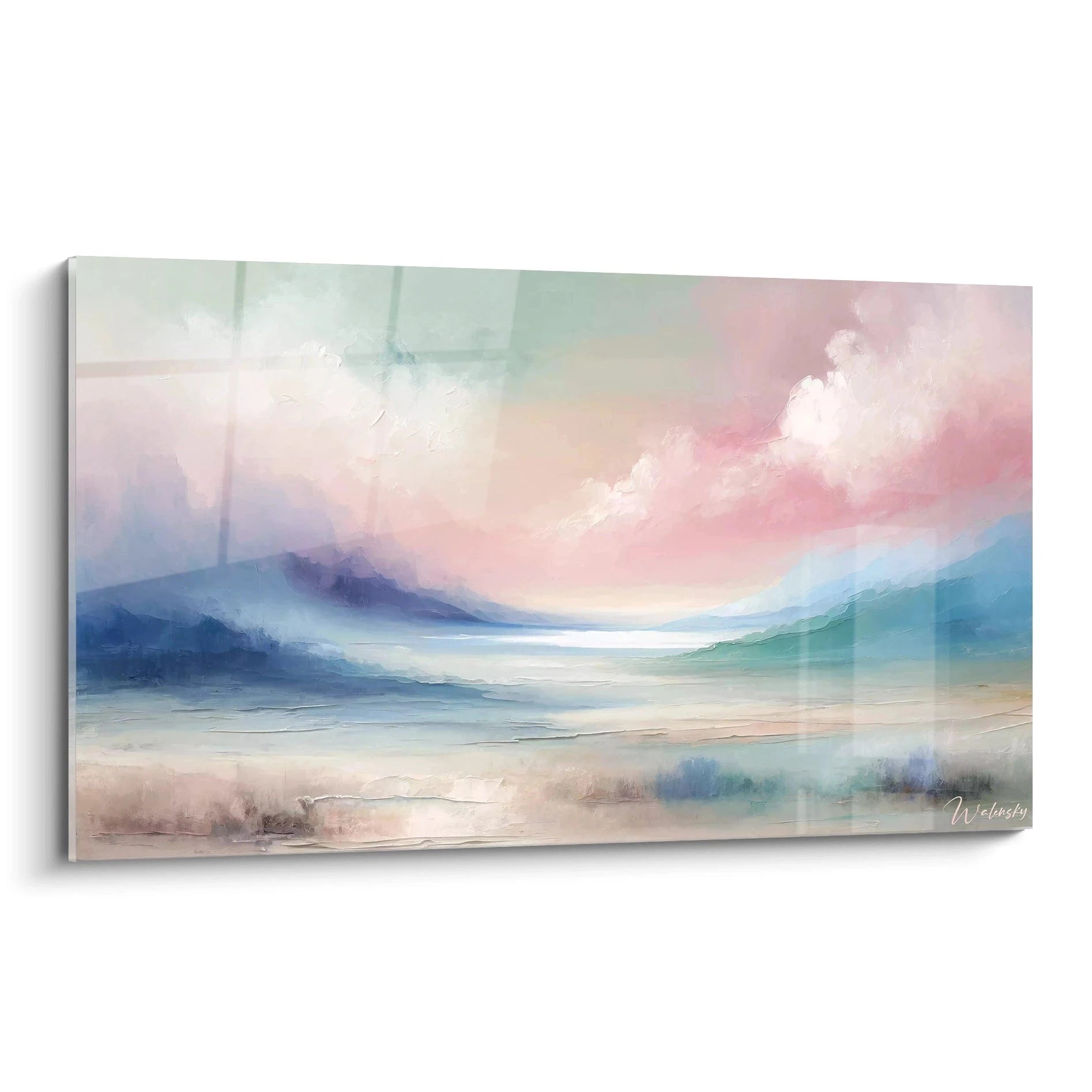

Artwork in an open kitchen during a reception: good idea?
October 11, 2025 · 14 min read · by Walensky
You've spent hours choosing the perfect artwork to enhance your open kitchen, and now you're agonizing over how to organize your first reception.
This artwork that moves you every morning risks suffering from cooking fumes, splashes or simply festive agitation? You can already imagine your guests scrutinizing your artistic choice while sipping their aperitifs.
You may have already tried temporary solutions: removing the painting before each event, protecting it with plastic wrap, or even considering moving it permanently. Result? Guaranteed frustration and a kitchen that loses its decorative soul.
It's perfectly normal to ask yourself these questions. The real reason for your hesitations? No one has ever explained to you how to reconcile art and conviviality in a modern living space.
By the end of this article, you will master the art of displaying your paintings with peace of mind during your receptions, transforming your open kitchen into a true living gallery where art and gastronomy flourish together.
Why your painting deserves its place of honor, even during your most beautiful evenings?
Removing your artwork at each reception is like hiding your personality when you entertain. Imagine a Michelin-starred chef who would hide his kitchen during service: unthinkable! Your painting tells your story, and your guests deserve to discover it in its natural environment.
🎨 Inspiring testimonial : Sophie, a Parisian interior architect, hesitated for a long time to leave her 120x80cm abstract painting in her kitchen during her monthly dinners with 12 guests. Today, this artwork systematically becomes the starting point of exciting conversations, creating a unique atmosphere that her guests love to rediscover.
Conversation with a decor expert
The golden rule of culinary art: A well-positioned painting withstands mishaps better than poorly maintained furniture. With a hanging height of more than 1.50m from the floor and 2 meters away from active cooking zones, your artwork remains beautiful for decades.

Let's truly understand what worries your painting (and you)
Do you feel this tension between protecting your artistic investment and fully enjoying your space? Do you scrutinize your artwork after every party, looking for the slightest sign of deterioration? Do you even hesitate to cook your favorite dishes for fear of splashes?
What you're experiencing is nothing unusual. In reality, the problem doesn’t come from your excessive caution, but from a lack of reliable information on the actual resistance of modern artistic supports to living environments.
It's like wanting to garden without knowing the seasons: the intention is excellent, but the knowledge is lacking to act serenely.
The real threat isn’t what you think
Contrary to popular belief, occasional humidity from a festive evening impacts your painting less than brutal heating temperature variations. Modern supports are designed to withstand normal domestic conditions.
Imagine your artwork as a good coat: it can handle occasional rain, but suffers more from being stored damp in a closed closet.
This revelation changes everything in your approach: instead of fearing every event, you can finally optimize the overall environment of your painting to protect it durably.
🧪 Revealing test: Observe your painting one winter morning after a night of heating, then after a festive evening: you will notice that temperature differences dry out the air more than the temporary steam from your pots.
The silent enemy: thermal shocks
Brutal temperature variations weaken supports much more than ambient humidity. A painting exposed alternately to direct sunlight and air conditioning ages prematurely.
It's exactly like your skin: it prefers constant hydration to repeated hot-cold aggressions.
Result? You stress for the wrong reasons while neglecting the real preservation factors. Once these mechanisms are understood, you effectively protect your investment.
The underestimated air circulation factor
Paradoxically, a painting "protected" in a corner without air circulation deteriorates faster than an artwork exposed in a controlled airflow. Stagnant air promotes the accumulation of residual humidity.
You can identify this phenomenon by observing the dead corners of your kitchen: they often accumulate more dust and humidity than passageways.
This discovery explains why some "well-protected" paintings age poorly, while others, intelligently exposed, cross the years without difficulty.
🎯 The 3 signals of an optimal location:
- Natural air circulation: You feel a slight movement of air near the wall, a sign of healthy atmosphere renewal
- Stable temperature: The area remains cool even during cooking, protected from direct heat sources
- Indirect lighting: Your artwork is visible without annoying reflections, even with festive lighting turned on
The trigger effect: creative confidence
What really makes the difference is your assurance in your decorative choices. When you master best practices, you radiate a confidence that transforms the atmosphere of your gatherings. Your guests feel this serenity and appreciate your artistic universe all the more.
The rule of dynamic balance: A well-positioned painting participates in the climatic balance of your space rather than being subjected to it. Observe whether your artwork seems "in its place" even during culinary excitement.
| ❌ Limiting belief | ✅ Technical reality | 💡 Explanation | 🎯 Practical benefit |
|---|---|---|---|
| Cooking steam inevitably damages my painting | Occasional steam naturally dissipates | Modern supports resist normal humidity variations | You cook freely without constant stress |
| You have to choose between art and conviviality | Art enriches your guests' experience | A refined environment stimulates conversations and creativity | Your gatherings become memorable and personal |
| Artwork of value has no place in the kitchen | Location matters more than the function of the room | Protection = hanging technique + judicious location choice | You showcase your collection in your living spaces |
| A reception = multiplied risks for the artwork | A one-off event has less impact than daily wear and tear | Damage comes from time and poor conditions, not occasions | You organize your parties with peace of mind |

The method of three circles to protect and enhance your painting
Rassurez-vous, protecting your artwork while preserving the soul of your gatherings follows a simple and progressive logic. Like creating a harmonious garden, we will first prepare the ground, then plant in the right place, and finally intelligently maintain. The result? An open kitchen where art and gastronomy coexist naturally.
🎯 Your action plan in 3 circles: Circle of safety (optimal location), circle of protection (professional hanging), circle of enhancement (aesthetic integration). Each circle reinforces the others for a lasting and elegant result.
Circle 1: Create your artistic safe zone
Starting by defining the ideal location is like choosing the foundations of a house: everything else depends on it. This step will give you immediate relief because you eliminate 80% of potential risks from the start.
Essential measuring tools
- Measuring tape of at least 3 meters: To accurately measure safety distances from heat sources, steam and frequently used areas. Opt for a locking measuring tape to work alone. A measuring tape that is too short would cause you to neglect essential angle measurements. 60cm spirit level: Essential for perfectly horizontal hanging that resists vibrations from household appliances. Visual stability reinforces the harmonious integration of the artwork. A smaller level would lack precision on large canvases. Wall stud detector: Secures hanging by identifying solid anchor points, particularly crucial in modern often hollow partition walls. The solidity of the fixing preserves your investment over time.
Let's move on to mapping your space now:
Identify your optimal zone
Trace the safety perimeter: Measure 2 meters from your cooktop and 1.5 meters from the sink in all directions. These distances create a protective bubble against splashes and concentrated vapors. Temporarily mark these areas with masking tape on the floor.
⏱️ Time: 15 minutes | ✅ Successful when: You clearly visualize the restricted and authorized zones | ⚠️ Attention: Don't forget diagonal projections when using pots and pans
Test airflow: Turn on your extractor fan at normal speed and observe the movement of a paper tissue near the candidate locations. The air should circulate without creating turbulence that would vibrate your painting. A gentle circulation guarantees a stable environment.
⏱️ Time: 10 minutes | ✅ Successful when: The tissue moves slightly without jerks | ⚠️ Attention: Avoid direct flows from the extractor fan that could dry out certain supports
Check lighting at different times: Observe your candidate wall in the morning, midday and evening with different lights on. Your painting should remain visible without annoying reflections even with festive lighting. This check avoids unpleasant surprises during your receptions.
⏱️ Time: 5 minutes x 3 moments | ✅ Successful when: No reflection masks the artwork | ⚠️ Attention: Adjustable spotlights can create variable reflections depending on their position
✨ Validation of your ideal zone: Your location is optimal when you can hold a normal conversation next to it without raising your voice, even with the extractor fan running. If you feel a sensation of heat or humidity extending your hand towards the wall, move the location an additional 50cm.
— Our selection


OUR RECOMMENDED PRODUCTS
Circle 2: Mastering Professional Hanging
Now that your safety zone is defined, hanging becomes your technical shield. This step transforms your assurance: no more anxious checks after each kitchen use, but total peace of mind.
Professional Hanging Hardware
- Special heavy-duty expansion anchors: Support up to 50kg and resist vibrations from appliances. Look for the "anti-vibration" mention on the packaging. Standard anchors will loosen over time in an active environment like a kitchen.
- Picture hooks with anti-detachment safety: A double hanging system that prevents accidental lifting of the artwork during air movements. Visualize a hook with a small top barrier. This security avoids falls due to drafts created by opening doors and windows simultaneously.
- Galvanized steel cable: More resistant than traditional wire to ambient humidity and repeated micro-tensions. The plastic sheathing protects against oxidation in an environment where air circulates with culinary moisture.
Secure Hanging Technique
Drill at strong points: Use your stud finder to locate wall studs or identify solid masonry. Drill slightly at a downward angle (5° inclination) so that gravity works with your hanging, not against it. This carpenter's technique avoids progressive slippage.
⏱️ Time: 20 minutes | ✅ Successful when: The anchors are perfectly flush with the wall | ⚠️ Attention: First test on a sample of inconspicuous wall to validate your technique
Install double security: Secure two hanging points spaced 70% of the width of your artwork. Test each point with a 5kg weight for 10 minutes before proceeding with the final hanging. This preliminary check avoids unpleasant surprises and definitively reassures.
⏱️ Time: 15 minutes | ✅ Successful when: No sagging is visible after load test | ⚠️ Attention: Strictly adhere to the test time, materials may yield in a delayed manner
Circle 3: Enhancing Aesthetic Integration
The final step transforms your technical hanging into a true staging. Here, you become curator of your own space, creating that perfect harmony that your guests will immediately notice without being able to explain.
The Art of Contextualized Enhancement
Create a visual dialogue: Position your artwork at eye level (1.60m from the floor to the center of the work) and align it with an existing architectural element: countertop, shelf or window. This visual coherence naturally anchors the work in space. The eye instantly perceives harmony.
⏱️ Time: 10 minutes | ✅ Successful when: The alignment becomes natural in your peripheral vision | ⚠️ Attention: Check the alignment from several viewing angles of your open kitchen
Orchestrate ambient lighting: Install discreet LED lighting (adjustable spotlights or strip) that reveals your artwork without overwhelming it. The ideal intensity? You should be able to comfortably read a book 50cm from the work. This warm light creates a flattering intimacy during your receptions.
⏱️ Time: 25 minutes | ✅ Successful when: The artwork radiates without shadows | ⚠️ Attention: Avoid overly cool LEDs that distort the colors of your painting
The principle of progressive evolution: Your installation reaches maturity after 2-3 receptions. Don't hesitate to refine the lighting or hanging angle according to your observations. Perfection is born of intelligent adjustment.
You now master the fundamentals of domestic culinary art. Let's discover the subtleties that distinguish a novice installation from a connoisseur's hanging, those details that make all the difference during your most beautiful evenings.
🔮 Collector's secret: Create a "life notebook" of your painting by photographing the artwork under different seasonal lighting conditions. This documentation reveals the subtle evolution of colors and allows you to continuously optimize its presentation according to the seasons and your events.
Question from a passionate reader
"Can I really leave my masterpiece while I prepare a festive meal for 15 people?"
This concern is perfectly legitimate when you invest in a valuable work. The truth? Your painting will withstand a festive evening more easily than a week of intense heating in winter. Works of art are designed to accompany life, not to be put under glass. Start with a more intimate reception (6-8 people) to gain confidence, then gradually increase. You'll see that the warm atmosphere will sublimate your work.
💡 Confidence test: Organize an aperitif of 2h with your kindest loved ones. Observe the natural interaction between your guests and your painting: you will discover how art enriches your moments of sharing.
— You may also like


Pitfalls to avoid to preserve your decorative serenity
Even with the best intentions, some common mistakes can compromise your installation. I prefer to tell you about them now to avoid these pitfalls that are perfectly avoidable with a little vigilance.
- Underestimate the cumulative effect of micro-vibrations: Placing your painting above the dishwasher seems harmless, but repeated cycles create vibrations that fatigue the hanging. Prefer a wall perpendicular to large appliances. This mistake affects 70% of domestic installations, so it is very common!
- 🌡️ Ignoring seasonal temperature variations: A perfect location in summer can become problematic in winter if heating creates drafts. Test your location over a full cycle of seasons before considering the installation as permanent.
- 💧 Confusing protection and overprotection: Installing a protective plexiglass seems logical but often creates annoying reflections and traps moisture. Your painting breathes better bare in a good location than stifled in a bad one.
- 🎯 Neglecting the evolution of your culinary habits: You cook little at present? Anticipate the evolution of your practices. A location that suits simple dishes could be exposed if you develop your passion for elaborate cuisine.
- 👥 Forgetting your guests' perspective: Your painting pleases you from your usual position, but your guests discover it from other angles. Test visibility from all points in your open-plan kitchen, especially the dining area.
🎯 Your monthly checklist: Check the horizontality of the hanging, verify the absence of condensation behind the artwork, test the solidity of a slight frame movement, observe the condition of the cable or hanging system. Monitor these warning signs: persistent condensation, progressive sagging, abnormal vibrations during appliance use.
— In the same vein


Your specific questions about domestic culinary art
A professional hanging costs between 80€ and 150€ depending on the complexity of your wall. It's worth it from the first year if you own a work of art worth over 500€. To optimize: group several hangings during the same intervention, and ask for a demonstration of techniques for your future acquisitions.
Allow yourself 3 weeks after installation for your artwork to "acclimate" and for you to get used to it. This period allows you to observe the behavior of your painting during your normal daily cooking. You will approach your first reception with a natural and legitimate confidence.
This concern naturally diminishes with positive experience. Document the condition of your artwork with monthly photos: you will objectively see its stability over time. Join collector groups who share reassuring experiences. Anxiety often arises from isolation when facing the unknown.
Your open-plan kitchen, a new artistic territory
In a few weeks, you contemplate your open-plan kitchen transformed into a true living gallery. Your guests can't help but compliment this perfect harmony between art and conviviality. Your artwork naturally dialogues with the culinary effervescence, creating that unique atmosphere that only true lovers of art and gastronomy know how to appreciate.
Beyond decoration, you have acquired expertise in domestic conservation which transforms your relationship with art. This confidence radiates in all your decorative choices: you finally dare to express your personality without compromise.
The hardest part was understanding the real issues and demystifying imaginary constraints. Now, photograph your ideal location and get your professional hanging equipment. Your first successful installation will open the way to a collection that grows serenely.
🚀 Your next step: The art of living is cultivated through informed action. Your open-plan kitchen awaits to reveal its full artistic potential. Start today: decorative excellence begins with a first mastered hanging!

Explore our collections


