⏱️ Reading time: 8 minutes
You've just acquired this
perfectly functional Airbnb property, with its pristine white walls and modern furniture.
Yet, something feels off. Your first guests leave polite but lukewarm reviews, mentioning a
"lack of soul" or a
"cold atmosphere".
You look at the photos of your listing and feel that impersonal chill radiating from every room.
The spaces are clean, well-arranged, but they resemble more of a waiting room than a welcoming home.
You've probably tried adding some colorful cushions, green plants, or scented candles.
But despite these efforts, the overall impression remains that of an anonymous passing place rather than a warm refuge.
This is perfectly normal and it’s absolutely not your fault.
The real reason for this failure lies in the fact that these small decorative touches only create a superficial visual impact, without truly transforming the emotion felt in the space.
By the end of this article, you will know exactly how to transform the atmosphere of your Airbnb thanks to a single strategic element: wall art. You'll be able to visualize your guests feeling immediately at home upon arrival.
Why is wall art becoming the secret weapon of Airbnb hosts who are thriving?
In 2025, competition among Airbnb owners intensifies dramatically.
Travelers no longer settle for a clean bed and an equipped kitchen. They seek an emotional experience that justifies paying more than a standard hotel.
It's exactly like the difference between eating in a cafeteria and dining in a restaurant with a carefully curated ambiance: the food may be similar, but the experience changes everything.
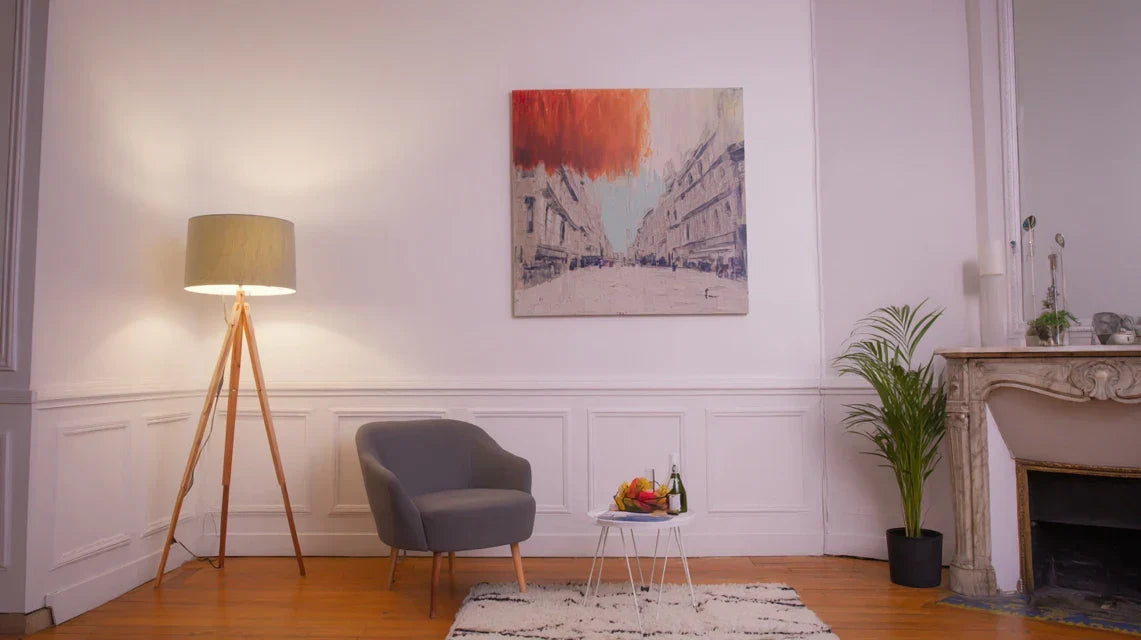
📸 Real testimonial: Marie, owner of a Parisian studio, saw her bookings stagnate despite a prime location. After hanging a single abstract painting in warm tones above the sofa, her reviews radically changed. The words "cozy", “welcoming” and “character” appeared in 80% of subsequent reviews.
💬 Conversation with a decor expert
"I don't know anything about art, I’m afraid of choosing something too personal that won’t appeal to my guests..."
That’s exactly the opposite! A neutral and “one-size-fits-all” painting will create no emotion. Think about your favorite restaurant: what marks you is its
unique personality, not its ability to please everyone. Your guests are looking for an authentic experience, not another aseptic space.
"I've always been told that in short-term rentals, you should avoid fragile or expensive decorative elements..."
This rule dates back to an era when paintings were mainly framed under glass. Today, modern supports like aluminum or canvas offer exceptional strength while maintaining a high-end finish. It's stronger than a mirror and infinitely more impactful.
Why does your Airbnb feel so impersonal?
Do you recognize these situations: your guests take photos of the view or amenities, but never of the overall ambiance?
They spend more time in local cafes than in your accommodation? Their comments mention cleanliness and functionality but never "charm" or "character”?
What's really happening is that your space suffers from what professionals call “blank canvas syndrome”.
Your brain finds no emotional anchor and automatically interprets the environment as temporary and impersonal.
It’s like walking into a modernized hospital room: everything is technically perfect, but your body can't relax because nothing signals "home" to your subconscious.
The first hidden cause: lack of an “emotional focal point”
Contrary to what most owners think, the problem isn’t a lack of decoration, but the absence of an element that tells a story.
Pillows and plants create physical comfort, but only art can create an instant emotional connection.
Imagine your living room as a conversation: the furniture are the practical words, but the painting is the intonation that gives meaning to the whole thing.
Without it, the conversation remains functional but soulless.
The impact is immediately felt in the attitude of your guests: they go from “temporary users” to “temporary residents”.
This nuance radically changes their relationship with the space and their desire to recommend it.
🔍 Quick test: Take a photo of your main living room. If your gaze isn't drawn to any specific element within the first 3 seconds, that’s exactly what your guests feel when they enter.
The second cause: the illusion of “safe neutrality”
Many owners believe that a neutral decor avoids disappointments. In reality, extreme neutrality creates unconscious anxiety because it doesn't allow the brain to "categorize" the environment.
It’s like wearing a beige suit to make a good impression: technically correct, but which doesn’t create any positive memory.
Your guests forget your accommodation as soon as they leave.
This approach leads to repeated cancellations and spontaneous recommendations, as your Airbnb doesn't create a distinct memory that inspires guests to return.
The third cause: the trap of "decoration by accumulation"
Faced with this coldness, the natural instinct is to multiply small decorative elements. But this strategy creates visual noise that fatigues the eye without creating an emotional impact.
You can easily spot it: if you count more than 8 decorative items in your main room, you are probably in this situation.
Your guests will describe the space as "cluttered" or "overcrowded" rather than "cozy".
This translates into shorter stays and a tendency for your guests to spend more time outside than inside your accommodation.
3 telltale signs:
- Your guests never mention the atmosphere in their reviews: This means that your space doesn't create any memorable emotion, either positive or negative
- Spontaneous photos from your guests always show the same angles: Reveals that only one area of your accommodation is photogenic, the rest being visually "empty"
- Your ratings remain stuck between 4.3 and 4.6: Indicates functional satisfaction without enthusiasm, typical of spaces technically correct but emotionally flat
The trigger that changes everything
The real key is to create an "instant emotional moment" as soon as you enter the main room.
Like a lever, a single well-chosen artwork can transform the perception of the entire space because it instantly gives a visual identity that the brain can "read" and appreciate.
You'll recognize it when your guests start spontaneously taking selfies in your living room.
The 10-second rule: If a visitor doesn't feel a positive emotion within the first 10 seconds, your space will remain "functional" in their mind. Test it by observing the reaction of friends who discover your accommodation for the first time.
| ❌ Space without wall art |
✅ Space with artwork |
💡 Mechanism |
🎯 Concrete benefit |
| Feeling of "waiting room" |
Impression of "home" |
The brain identifies a home |
Guests more relaxed upon arrival |
| Reviews mentioning functionality |
Reviews evoking the atmosphere |
Emotional connection created |
Higher ratings and enthusiastic comments |
| Technical photos of the accommodation |
Spontaneous "lifestyle" photos |
Space becomes photogenic |
Free promotion on social media |
| Stays focused on the outside |
Quality time in the accommodation |
Reassuring environment created |
High satisfaction and repeat bookings |
The progressive method to transform your Airbnb in 3 steps
Rassurez-vous, cette transformation ne nécessite ni budget important ni compétences artistiques particulières.
Comme pour cuisiner un plat réussi, il suffit de suivre les bonnes étapes dans le bon ordre.
Étape 1 : choisir l'emplacement stratégique, Étape 2 : sélectionner le bon format et style, Étape 3 : optimiser l'accrochage et l'éclairage.
Chaque étape apporte un résultat visible immédiat et prépare naturellement la suivante.
🗺️ Vue d'ensemble de la transformation : Nous allons procéder comme un architecte d'intérieur professionnel : d'abord identifier le "mur vedette" qui aura le maximum d'impact, puis choisir l'œuvre qui racontera la bonne histoire, enfin l'installer pour créer un effet "magazine de déco". Résultat visible dès la première étape.
Étape 1 : Identifier votre "mur de première impression"
Cette étape est cruciale car elle détermine l'impact de toute votre démarche.
Comme pour planter un arbre qui deviendra le point focal de votre jardin, le choix de l'emplacement conditionne tout le reste.
Une fois cette étape terminée, vous ressentirez déjà une satisfaction anticipée en visualisant le résultat final.
Ce dont vous avez besoin pour cette étape
-
Votre smartphone en mode appareil photo : Il vous servira à prendre des photos depuis l'angle d'entrée principal de chaque pièce. Activez la grille de composition pour mieux visualiser l'équilibre. Évitez les applications avec filtres qui faussent la perception réelle des couleurs et de la luminosité.
-
Un mètre ruban ou une application de mesure : Pour vérifier les dimensions disponibles sur chaque mur candidat. L'outil de mesure intégré iOS/Android fonctionne parfaitement pour cette application. Les dimensions précises détermineront le format optimal du tableau.
-
Un carnet ou l'application Notes : Pour noter vos observations sur l'éclairage naturel à différents moments de la journée. Observez particulièrement les variations entre matin, après-midi et soirée car elles influencent la perception des couleurs.
Passons maintenant à la pratique
Comment procéder concrètement
Photographiez depuis l'entrée de chaque pièce : Placez-vous exactement où vos invités posent leur premier regard en entrant. Prenez 3 photos : vue d'ensemble, mur de gauche, mur de droite. Cette perspective révèle les murs naturellement "mis en scène" par l'architecture. C'est plus simple qu'il n'y paraît.
⏱️ Temps : 15 minutes | ✅ Réussi quand : Vous identifiez clairement quel mur attire naturellement le regard | ⚠️ Attention : Ne choisissez pas un mur face à une fenêtre forte, car le contre-jour nuira à la lisibilité de l'œuvre
Test the "first impression" rule: Enter each room as if you were discovering it for the first time. Count mentally "1, 2, 3" and note what element spontaneously catches your eye. If it's a blank wall, that's your ideal location. This technique replicates exactly the perception of your future guests.
⏱️ Time: 10 minutes | ✅ Successful when: You identify the wall that naturally "calls" for a decorative element | ⚠️ Attention: Be wary of your visual habits if you already know the space well
Check technical constraints: Measure the available wall surface taking into account sockets, switches and passages. Note the ceiling height and possible viewing distance. These measurements will determine the ideal proportions of your future artwork without risking the "stamp" or "overwhelming" effect.
⏱️ Time: 10 minutes | ✅ Successful when: You know precisely the available and optimal space | ⚠️ Attention: Don't forget the space needed around the artwork (at least 20cm on each side)
✓ Verification of step 1: You have identified a wall that naturally attracts the eye from the entrance, with enough space to accommodate a proportionate work, and benefiting from favorable lighting. If you are still hesitating between two walls, choose the one visible from the most different angles. The next step will be much easier.