

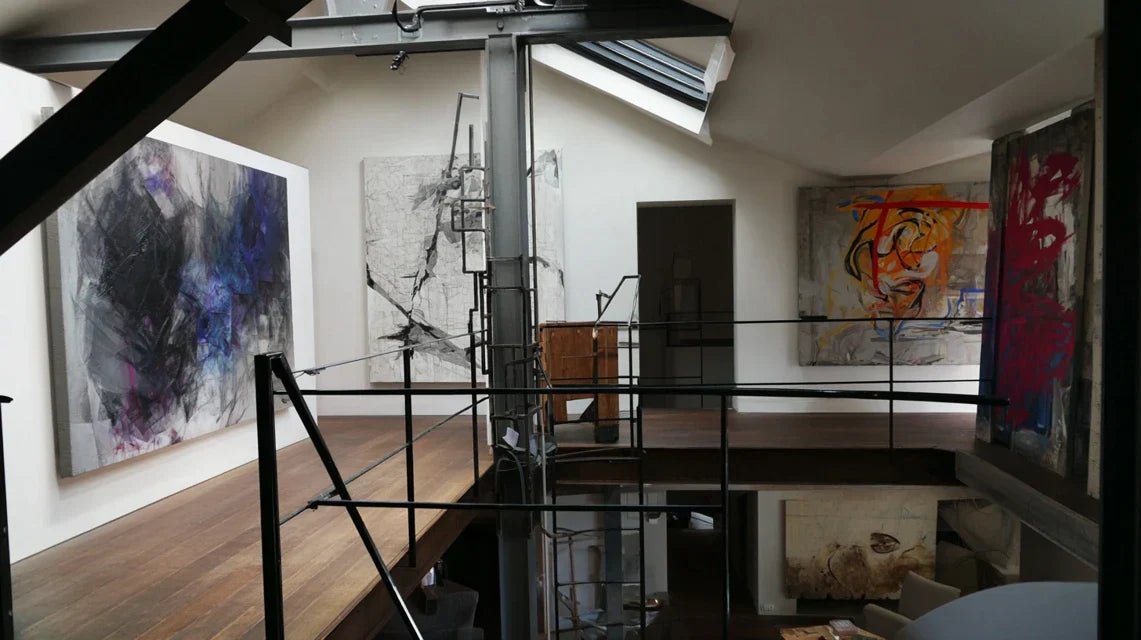
You’ve just moved into that magnificent loft with soaring ceilings you've always dreamed of, but your paintings seem lost, like postage stamps glued to a giant wall. This frustrating feeling of your decor being swallowed by the immensity of the space overwhelms you every time you look up.
The impressive silence of these vertiginous volumes amplifies your doubt: those artworks that seemed perfect in your old apartment now appear derisory against this imposing height. You feel this strange impression that your decor floats in the void, without anchor or coherence.
You've probably tried to hang your paintings higher, or add a few more. But the result remains disappointing: the space still feels unbalanced and cold, as if your artworks refused to dialogue with this exceptional architecture.
This difficulty is perfectly normal and does not reflect your artistic tastes at all. The problem is that traditional decorating rules no longer apply in these spaces with out-of-the-ordinary proportions. Standard hanging techniques create a disproportion effect that detracts from your finest pieces.
By the end of this article, you will master the techniques specific to double height spaces and transform this architectural challenge into a true decorative asset, creating a private gallery worthy of the finest New York lofts.
Why is your wall decor so crucial in a double-height space?
In a loft or mezzanine, your walls are no longer simple decorative supports but become the protagonists of your interior architecture. Ignoring this reality now means accepting to live in a space that will forever remain cold and impersonal, like an empty shell that doesn't resemble you. It also means missing out on the unique opportunity to create an exceptional place that will impress all your guests.
🏛️ Architectural testimonial: Sarah, an interior architect, remembers a client who had bought a sublime Parisian loft with 6 meters under the ceiling. After six months, he admitted to feeling crushed by the void despite the beauty of the space. Three large paintings and a rethought hanging were enough to transform this feeling of discomfort into absolute pride in his interior.
💬 Conversation with a decor expert
The golden rule for double height spaces: Your paintings should occupy the vertical space like windows onto your artistic universe. Once this approach is adopted, your loft regains its soul and character in less than a week.
Finally understand why your paintings seem "lost" in your loft
If you feel this frustration of seeing your works swallowed by the immensity, if your guests don't even notice your carefully chosen collection, or if you avoid looking up so much that this void above makes you uncomfortable, you are not responsible for this situation.
The real problem lies in a mismatch of proportions that our brain interprets as an imbalance. Your space has changed architectural category, but your decorative approach hasn't followed this scale mutation.
Imagine wearing delicate jewelry on a wedding dress with a long train: even the most beautiful, they would disappear in the amplitude of the garment. That’s exactly what happens to your paintings in this vertical theater that your living room has become.
The first hidden cause: the illusion of the "right height"
Contrary to popular belief, respecting the traditional height in a double-height space creates an effect of "visual belt" that dramatically cuts your wall into two disconnected zones. Your gaze remains prisoner of the lower part, completely ignoring the majesty of your ceiling.
It's like trying to contemplate a sunset while keeping your eyes fixed on the horizon: you miss out on the grandeur of the spectacle. In your loft, this approach transforms your exceptional space into a simple elevated living room.
This perceptual error deprives you of the feeling of grandeur and prestige that your interior should provide. Moreover, it creates an emotional dissonance between the architectural investment and the felt result.
🔍 Instant verification test: Look at your main wall and blink quickly. If your gaze naturally stops halfway without being drawn upwards, it's that your paintings create this "invisible visual barrier" which limits your space.
Many think that adding more paintings will solve the scale problem. In reality, multiplying small works horizontally creates an even more pronounced "postage stamp effect" and turns your wall into a chaotic bulletin board.
It's like trying to fill a cathedral by installing dollhouse furniture: the more you put in, the more glaring the scale mismatch becomes. Your wall needs powerful presences, not a scattered collection.
This strategy visually exhausts you and turns your relaxation space into an overstimulating environment. Paradoxically, you get the opposite effect of what is sought: instead of a feeling of fullness, you create decorative chaos.
The third hidden cause: ignorance of the "vertical line of force"
Few people notice that double-height spaces have natural "visual highways" that guide the eye upwards. Ignoring these lines of force is placing your paintings against the architectural energy of the space.
You can spot these lines by observing where your gaze naturally goes: protruding angles, exposed beams, play of shadows created by natural lighting. These are your hidden allies to create a decoration that amplifies the beauty of your architecture.
When your paintings oppose these natural forces, you feel a subtle discomfort without understanding why. Your eye constantly battles between what it wants to see (the vertical momentum) and what you offer it (a horizontal decoration).
3 signs that your decor ignores these natural forces:
- You instinctively avoid looking at the ceiling: Your brain flees the visual dissonance created by this opposition between architecture and decoration
- Your guests focus on the furniture on the floor: They subconsciously compensate for the vertical decorative void by over-focusing on low elements
- The space seems smaller than it is: The gaze blocked horizontally artificially compresses the perception of volume
The trigger element: revealing architectural scale
The real click happens when you understand that your loft is no longer a "living room with a high ceiling" but an "architectural space" that deserves a museum-like approach. This realization changes everything: your paintings become installations that dialogue with the architecture, not simple decorations that are subjected to it. Once this mental transition has been made, every choice of hanging becomes obvious and natural.
The rule of mental transformation: Think "private gallery" rather than "decorated living room". This single change in perspective instantly makes you perceive the right proportions and ideal locations.
| ❌ Traditional living room approach | ✅ Architectural gallery approach | 💡 Why it changes everything | 🎯 Immediate benefit |
|---|---|---|---|
| Paintings at a fixed height of 1m60 | Evolving hanging from 1m80 to 2m50 | Respects the vertical dynamic | Instant feeling of elegance |
| Multiplication of small works | Selection of monumental pieces | Creates a strong visual presence | Maximum decorative impact |
| Uniform distribution on the wall | Composition in ascending movement | Accompanies the architectural momentum | Natural harmony with the space |
| Indirect general lighting | Spots directed at each work | Theatrizes the presentation | Maximum valuation of the collection |
The progressive method to succeed in your hanging in double height space
Now that you understand the hidden mechanisms, transforming your loft becomes a logical and rewarding process. Like an architect who draws plans before building, we will proceed in structured steps to create your private gallery. In each phase, you will see your space gain coherence and prestige, until you obtain this loft worthy of decoration magazines.
🏗️ Overview of your transformation: We will first analyze your architecture to identify its strengths (step 1), then select and size your works according to these discoveries (step 2), and finally orchestrate a theatrical hanging that reveals the full potential of your space (step 3). Each step brings you closer to that feeling of absolute pride when you contemplate your transformed interior.
Step 1: Decipher the strengths of your space (the invisible foundation)
This first step is crucial because it reveals the hidden "superpowers" of your architecture. Like a diviner who detects underground water, you will identify the guidelines that will make your paintings revealers of beauty rather than simple ornaments. Once this mapping is complete, you will feel that deep satisfaction of finally understanding your space.
Architectural detection tools
- A camera or smartphone: To capture the shadow plays at different times of the day and reveal invisible lines of force to the naked eye. Prefer black and white mode which accentuates structural contrasts. Avoid flash, which erases these precious architectural nuances.
- A 5-meter minimum tape measure: To measure not only height but above all the relative proportions between the width and height of each wall panel. Quality is recognized by its rigidity: a tape that bends will distort your measurements and therefore your perception of proportions.
- Colored post-its: To temporarily mark visual anchor points and test different compositions before final hanging. Choose colors contrasting with your walls for a clear visualization of your future impact areas.
Let's move on to exploring your decorative territory
Architectural discovery protocol
Photograph your space from all angles: Take a panoramic photo from each corner of the room, then vertical framing of each main wall. These images will reveal the guidelines that your eye does not consciously perceive but that your brain uses to visually organize space. This step completely demystifies the apparent complexity of your loft.
⏱️ Time: 15 minutes | ✅ Successful when: You clearly distinguish the "dynamic" areas (corners, beams) and "soothing" (flat surfaces) on your photos | ⚠️ Attention: Don't just photograph facing the walls, angles often reveal the most spectacular perspectives
Measure the golden proportions of your space: Calculate the height/width ratio of your main walls. A wall 6m high and 4m wide has a ratio of 1.5 which calls for elongated works. This simple math determines the decorative genetics of your space and avoids format errors.
⏱️ Time: 10 minutes | ✅ Successful when: You know the ratio of your 3 main walls | ⚠️ Attention: Include protruding elements (beams, ducts) in your measurements, they influence the overall perception
Identify your visual "power zones": Stand in the center of the room and note where your gaze naturally goes. These spontaneous attraction areas are your premium locations for master works. Mark them with your post-its to create your decorative battle plan.
⏱️ Time: 5 minutes | ✅ Successful when: You have identified 2-3 magnetic zones per main wall | ⚠️ Attention: Perform this test at different times to see how natural light modifies these attraction areas
🎯 Validation of your analysis: You must now view your loft as a visual journey with stages and highlights, rather than just a surface to decorate. If you feel this new clarity on the organization of your space, you are ready to choose your artworks. In case of doubt, repeat the photo exercise: architecture never lies!
OUR RECOMMENDED PRODUCTS
Step 2: Select and size your strategic artworks
With your architectural map in hand, you enter the most exciting phase: transforming your discoveries into powerful artistic choices. This step takes you from the status of an amateur decorator to that of a informed curator. Each decision becomes strategic and you feel the adrenaline rush of the collector composing their gallery.
Your premium selection criteria
- The proportion calculator (architectural rule of thirds): Your main artworks should occupy at least 1/3 of the available height. In a space 4.5m high, aim for paintings minimum 150cm to create a legitimate visual presence. Smaller formats automatically relegate your works to the rank of negligible accessories.
- Amplified chromatic consistency: In a large volume, colors visually "dilute". Choose artworks with more marked contrasts than in a classic living room. A painting with soft tones that fascinates up close can completely disappear at observation distance in your loft.
- The series or statement piece effect: Opt for either a monumental artwork which becomes the absolute focal point, or a series of 3 coordinated pieces that create an ascending visual rhythm. The in-between never works in these exceptional volumes.
The professional selection method
Apply the "decorative zoom" rule: Test your current artworks by stepping back at least 4 meters. What remains impactful at this distance will survive in your loft, the rest should be relocated or replaced. This ruthless but necessary selection avoids costly mistakes of decorative insignificance.
⏱️ Time: 20 minutes | ✅ Successful when: You clearly distinguish your "loft artworks" from your "living room artworks" | ⚠️ Warning: Don't get emotionally attached, the visual impact takes precedence over personal affection in these spaces
Calculate your optimal impact zones: For each identified location, determine the ideal size according to the formula: wall height ÷ 3 = minimum artwork height. This mathematical approach guarantees perfect proportionality and eliminates haphazard approximations that create imbalance.
⏱️ Time: 15 minutes | ✅ Successful when: You have precise dimensions for 3-4 strategic locations | ⚠️ Warning: Err on the side of large rather than just right, a slightly too large artwork impresses, an artwork that is too small will always disappoint
This final step transforms your loft into a true total work of art. You are no longer hanging paintings, you are creating an immersive experience that reveals the grandeur of your space. This is where you feel that intense pride of the creator seeing their vision come to life, and where your guests discover an interior worthy of the most beautiful architectural achievements.
The museum hanging technique
Create your upward force line: Start with the most imposing artwork at 6ft 7in from the floor (center of the artwork), then organize the others in a visual staircase that guides the eye upwards. This progression creates a dynamic that amplifies the sensation of height rather than suffering it.
⏱️ Time: 45 minutes | ✅ Successful when: Your gaze naturally follows an upward curve from one artwork to another | ⚠️ Warning: Mark with pencil before drilling, height errors are fatal to harmony in these volumes
Install gallery lighting: Each artwork deserves its own directional spotlight that detaches it from the wall and creates depth. This theatricalization transforms your collection into a permanent exhibition and justifies the grandeur of your architecture.
⏱️ Time: 30 minutes per artwork | ✅ Successful when: Each painting stands out from the wall with a sculptural presence | ⚠️ Warning: Avoid reflections on the glass which cancel out all the staging effect
The rule of harmonious progression: Each step should give you a increasing satisfaction. If you feel resistance or doubt, it's a signal to return to the previous step and consolidate your foundations before continuing.
You now master the fundamentals of double-height wall hanging. These techniques give you a considerable advantage over 95% of loft owners who simply adapt their traditional living room habits. Here are the expert subtleties that will make your interior a reference.
🎭 Master technique: Create "visual dialogues" between works on opposite walls. Place a passionate red artwork facing a work with complementary tones: your guests will discover these secret correspondences as they circulate, transforming your loft into an art discovery trail. This museum-level technique creates a narrative depth that only true connoisseurs master.
🤔 Frequent question from our readers
"I'm afraid that large paintings cost a fortune... How can I do it when I have a tight budget?"
This concern is perfectly legitimate and shows that you are thinking practically about your project. The solution is not to sacrifice visual impact but to rethink your acquisition strategy. A single large-format artwork will have infinitely more impact than five small artworks costing the same total price. Moreover, high-end reproductions on noble supports now offer exceptional rendering at a fraction of the price of an original work. The important thing is the wall presence, not necessarily authenticity to begin your transformation.
💡 Budget-friendly strategy: Start with a single statement artwork that already transforms your perception of space, then gradually add the other pieces. You will see that this first transformation completely changes your relationship to your interior and justifies the following investments.
The pitfalls to absolutely avoid in your loft project
Before embarking on this transformation, I want to warn you against the common mistakes that can compromise your entire project. These pitfalls are predictable and perfectly avoidable when you know them, but they have already ruined many beautiful loft projects.
- 🚫 The "gallery wall" horizontal error: It is tempting to create an alignment of several works at the same height to "fill" the space. This approach creates a decorative frieze effect that visually crushes your ceiling and transforms your loft into an elevated hallway. Instead, prioritize asymmetrical compositions that follow the verticality of your architecture.
- 🚫 The trap of hanging too low out of habit: Your eye accustomed to standard apartments will push you to hang at 1m60 from the floor. In a loft, this height creates a blaring decorative void above and gives the impression that your paintings "fall" to the floor. Dare to go up to 2m50 to regain the natural visual balance of your space. 🚫 The illusion of security with small formats: Many people choose modest works out of fear of "making a mistake". In a double-height volume, these formats create a "rice grain" effect that makes your artistic investments completely invisible. This excessive caution ultimately costs you more because you multiply purchases without achieving any impact.
- 🚫 Neglecting directional lighting: Relying on general lighting to reveal your works is a fatal mistake. Without dedicated spotlights, even the most beautiful paintings blend into the wall and lose their sculptural presence. This economy of means completely cancels out the investment in artwork.
- 🚫 Forgetting the "breathing room" between artworks: Some people saturate their walls with enthusiasm, without leaving any visual rest space. This over-decoration turns your loft into an organized flea market and deprives you of the feeling of grandeur that characterizes these exceptional spaces.
🛡️ Your decorative safety checklist: Before each hanging, check that your main works occupy at least 1/3 of the available height, that you have provided specific lighting for each one, that your composition guides the eye upwards rather than horizontally, and that you keep visual silence zones between your groups of artworks. These four points are your safeguards against costly mistakes.
🎁 Special readers offer
Because you took the time to inform yourself, enjoy 10% discount on your first order:
⏰ Valid 72h after reading • Applicable to all our products
Your essential questions about wall art in double-height spaces
For optimal impact, count €200 to €800 per main artwork whether you choose high-end reproductions or original works. With 3-4 strategic pieces plus dedicated lighting (€150 per spotlight), a budget of €1500 to €3000 radically transforms your space. Spread over 6 months, starting with the masterwork that sets the tone for your decoration.
Hanging up to 2.5m remains accessible with a stable stepladder and the right fixings. For heavy works (over 5kg), prioritize metal molly anchors in plasterboard or chemical anchors in concrete. The real difficulty is not technical but conceptual: daring these unusual heights requires trusting mathematical proportions rather than your visual habits.
Absolutely! Even with 3.5m, you already benefit from an exceptional volume that requires a specific approach. Simply adapt the proportions: aim for works of at least 120cm and hang the center 2m from the floor. The effect of grandeur and elegance will be immediate, even on this more modest height than New York lofts.
Not at all! What's important is the presence and the quality of contrasts, not the artistic style. A large format classic portrait or a romantic landscape can create a fascinating contrast with the contemporary architecture of the loft. This boldness in mixing eras often reveals a more affirmed decorative personality than the "safe" choice of all-modern.
LEDs now offer excellent color rendering (CRI>90) while consuming little energy. Prefer a temperature of 3000K to 4000K that respects the original colors without creating a cold atmosphere. The advantage of LEDs: you can easily create lighting scenarios with dimmers to adapt the ambiance according to the time of day.
Your loft transformed: when architecture meets your artistic universe
In a few weeks, when you cross the threshold of your loft, you will feel that surge of pride that comes from exceptional interiors. Your guests will instinctively stop to contemplate this private gallery where each work dialogues with the architecture so naturally that it seems to have always been there. This feeling of absolute mastery of your space will definitely replace the former frustration of a poorly tamed volume.
More than a simple decorative transformation, you will have acquired this rare skill of knowing how to reveal the hidden potential of exceptional spaces. This expertise will serve you in all your future development projects and give you the quiet assurance of those who understand the secret rules of architectural harmony.
The most difficult part was understanding these invisible mechanisms that govern the balance of volumes. Now that this knowledge is yours, all you have to do is make the first move: measure the height of your main wall and calculate the dimensions of your future masterpiece. Your loft only awaits this first decision to reveal its true personality.
🚀 Your transformation begins now: Every great loft that impresses you today started with the same gesture you are about to make: dare to use the right proportions. Your space deserves this ambition, and you now have all the keys to successfully realize it.


