Displaying a work of art or hanging a heavy picture requires particular attention to the maximum load that your wall hooks can support.
Whether it's a large canvas, a decorative mirror or a shelf loaded with items, knowing the weight limit and the strength of your fixings is essential to avoid any accidents. Our technical guide reveals everything you need to know about the load capacity of different fixing systems, breaking tests and advice for safely installing heavy objects.Understanding Maximum Load Capacity of Wall Hooks
The maximum load capacity of a wall hook represents the maximum weight it can support without risk of failure. This value is determined by several technical factors that directly influence the safety of your wall installations, especially when hanging valuable artwork or paintings.
- The manufacturing material of the hook (steel, aluminum, brass) The quality and type of hardware providedThe nature of the wall on which the fixing is installedThe installation technique and angle of fixation
- Simple aluminum rails: up to 30 kg per meter Reinforced professional rails: up to 50 kg per meterModular multi-point systems: up to 100 kg per complete installationInfluence of wall type on load capacity
- Static load test: Measures the ability of the hook to support a constant weight over time
- Dynamic load test: Evaluates resistance to movement or vibration
- Pull-out test: Determines the force required to completely pull the fixing out of the wall
- Theoretical maximum load: Maximum value measured in laboratory conditions
- Recommended load: Generally 60-70% of the theoretical maximum load
- Excessive humidity: Can weaken certain fixing materials and the wall itself
- Regular vibrations: Gradually decrease the holding power of the fixings
- Weigh your complete artwork : Include the frame, glass and all elements (use a precision scale)
- Add a safety factor : Multiply the weight obtained by 1.5 to obtain the minimum required load
- Identify your wall type : Concrete, brick, plaster, wood (directly influences effective capacity)
- Evaluate environmental conditions : Humidity, vibrations, exposure to drafts
- Select your fixing : Choose a model whose maximum load exceeds your calculation
- Consider the distribution of attachment points : Multiply the fixing points for very heavy objects
- Check compatibility with your hanging system : Ensure that the artwork and hook are compatible
- Visible deformation of the hook: Indicates a load close to the breaking limit
- Cracks around the anchor point: Sign that the wall is beginning to yield under pressure
- Progressive movement of the fixing: Suggests slow tearing of the support
- Abnormal tilt of the painting: May indicate partial system failure
- Creaking noises during vibrations: Warning sound often preceding a rupture
- Preliminary installation
- Empty test
- Test with progressive load
- Prolonged holding test
- Vibration resistance test
- Final visual inspection
Important safety factor: Manufacturers generally indicate a maximum load lower than the actual breaking load, with a safety coefficient of approximately 1.5 to 3 times. For example, a hook rated for 10 kg could theoretically support between 15 and 30 kg, but this margin is essential for your safety.
Different Types of Fixings and Their Resistance
Single nail hooks
These classic hooks are among the most common on the market. Their load capacity generally varies between 2 and 15 kg depending on their size and design. The main advantage of this type of fixing is its ease of installation, but be careful: its resistance is highly dependent on the nature of the wall.
Tip to increase resistance: For a heavy painting weighing more than 10 kg, it is preferable to install two nail hooks distributing the load rather than a single larger hook. This technique increases overall safety and distributes stress better on the wall.
Fixings with dowels offer superior resistance, capable of supporting between 15 and 45 kg depending on the model and type of dowel. These systems are particularly recommended for concrete, brick or block walls, where they reach their maximum capacity. Their installation requires more precision but guarantees remarkable stability for heavy artworks.
Specialized suspension rails
Professional rail systems represent the optimal solution for very heavy works, with a capacity exceeding 50 kg per hanging point. These devices distribute the load over a larger wall surface, significantly increasing the safety threshold of the fixings.
The nature of the wall support plays a decisive role in the actual capacity of your fixing. A hook rated for 20 kg could only support 10 kg on a plasterboard partition, but reach its full capacity on a concrete wall. It is therefore essential to adapt your choice to the type of wall in your interior.
| Wall type | Relative capacityRecommended fixingTypical max. load|||
|---|---|---|---|
| Concrete/solid brick | 100%Expansion dowel20-50 kg|||
| Hollow brick | 70-80% | Special hollow wall anchor | 15-35 kg |
| Drywall | 40-50% | Molly/special drywall anchor | 8-20 kg |
| Solid wood | 90% | Direct wood screw | 18-45 kg |
Rupture and Safety Limits Tests
Resistance test methodology
Manufacturers submit their wall hooks to rigorous tests to determine their maximum load. These tests simulate real-world usage conditions and precisely measure the breaking point of the fixings under different types of stress.
Interpretation of announced values
Maximum loads indicated by manufacturers generally include a significant safety margin. For optimal installation, it is recommended not to exceed 70% of the announced maximum load, creating a buffer zone that compensates for possible variations in the quality of the wall or the installation.
Factors reducing load capacity
Several elements can significantly reduce the effective resistance of your wall fixings, compromising the safety of your artwork or heavy pictures.
Critical safety threshold: For any work of art or picture whose value is important, we systematically recommend choosing a fixing with an announced capacity of at least twice the actual weight of the object to be suspended. This precaution ensures a comfortable safety margin and prevents costly accidents.
OUR RECOMMENDED PRODUCTS
Discover our selection of products specially chosen for you. Click on the images to learn more.

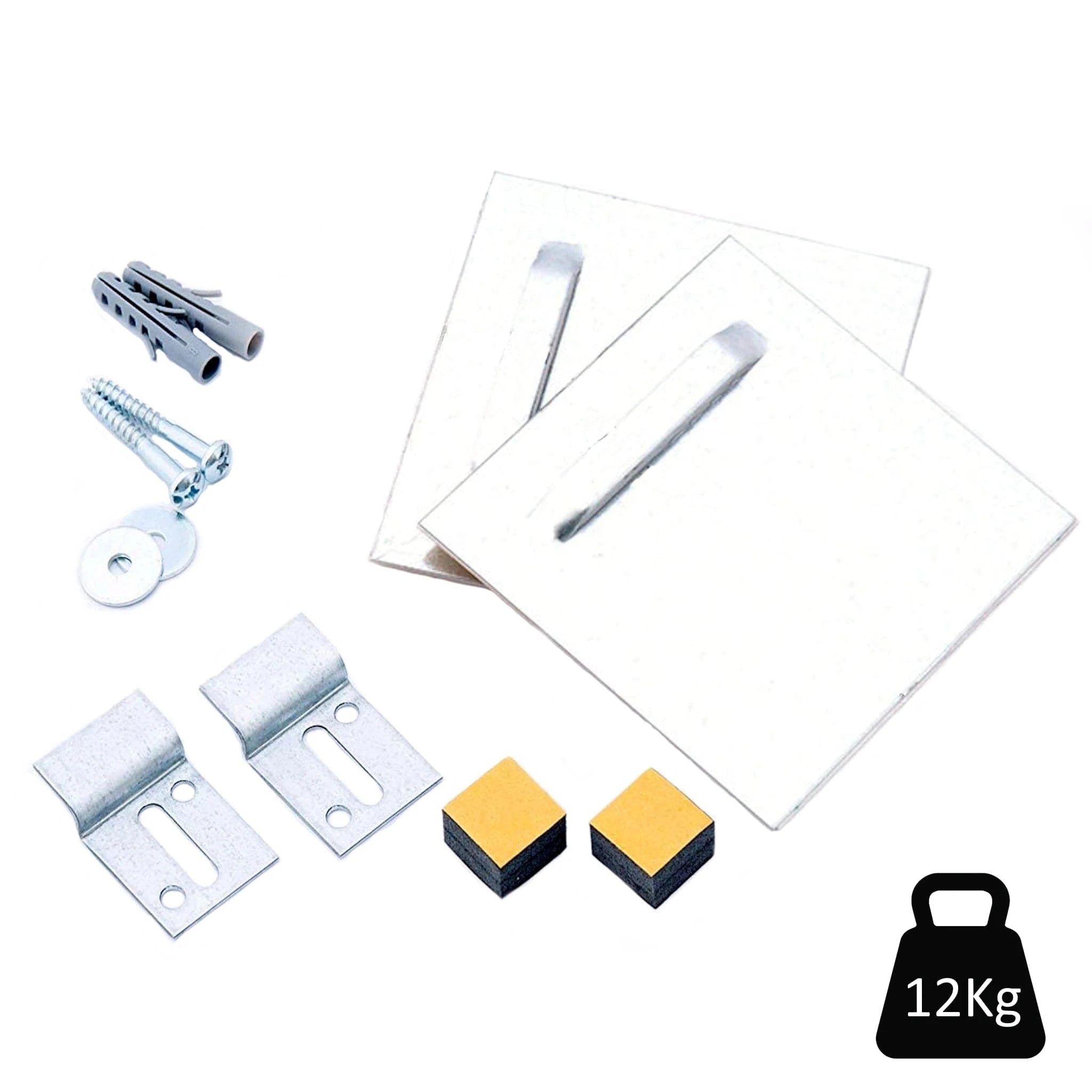
Wall mounting hooks 12kg max - complete set
39.99 €
|
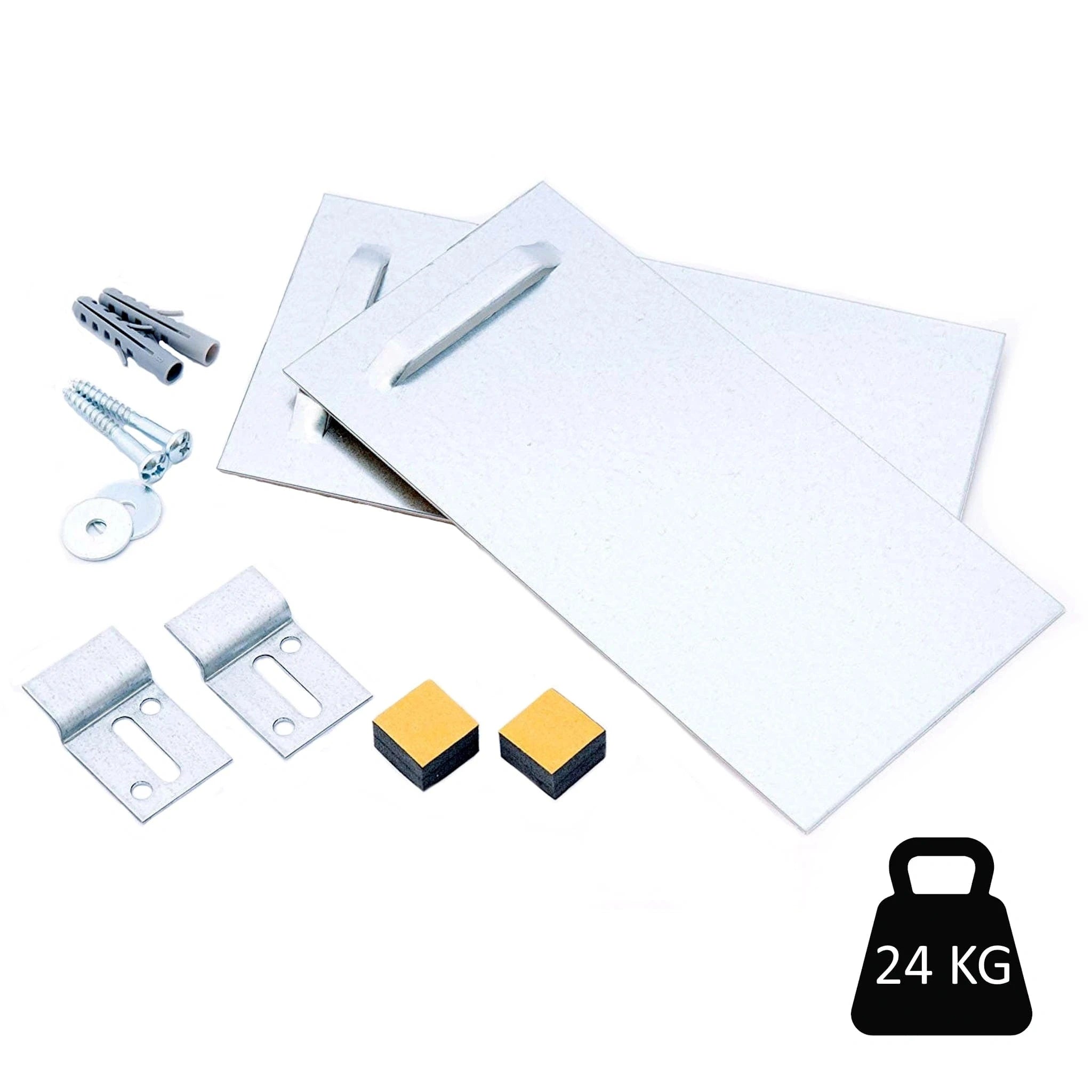
Crochets de fixation mural 24kg max - kit complet
49,99 €
|
Why choose our products : All our wall hooks are made with high quality materials to guarantee exceptional durability and robustness. Easy and quick installation without special tools.
Practical Guide to Calculating Maximum Load Capacity
To correctly secure your paintings and works of art, follow this precise calculation methodology that will help you determine the necessary capacity for your wall hooks.
Double weight technique for valuable artworks : For works of great value, professionals recommend temporarily testing the fixing with a weight equivalent to twice the actual weight of the artwork for 24 hours before installing the original. This additional precaution guarantees the reliability of the fixing system on your specific wall.
Optimal Installation to Maximize Resistance
The theoretical capacity of a wall hook can only be achieved if the installation complies with certain technical rules. Here's how to optimize your fixing to achieve the advertised maximum load.
Wall preparation and location selection
Before any installation, carefully inspect the hooking surface for any structural weaknesses. For drywall walls, locate the studs with a detector to anchor your heavy fixings directly into them, instantly doubling their load capacity.
Specific installation techniques by fixing type
Each fixing system requires a specific approach to develop its full load capacity. Expansion anchors, for example, must be inserted into a hole perfectly suited to their diameter, neither too large (risk of rotation) nor too narrow (incomplete insertion).
Post-installation Verification
After installing your fixing, test its solidity by gradually applying an increasing load until the weight intended for your painting or artwork is reached. Observe any signs of weakness such as slight movement of the hook or deformation of the surrounding wall.
Signs of Exceeding Maximum Capacity
The Essential Steps to Test the Resistance of Your Fixings
To guarantee the safety of your installations, particularly for valuable works, follow this professional test protocol before permanently hanging your painting or artwork.
Frequently Asked Questions about the Capacity of Wall Hooks
Use a precision scale by placing the complete artwork on it. For very large pieces, you can use two scales placed under each end and add the values. Do not forget to include the weight of the glass, the frame and any other decorative elements in your final calculation.
The values shown generally correspond to tests carried out under optimal conditions on concrete walls. For maximum safety, reduce this value by 30 to 50% depending on your wall type, especially for drywall which offers much lower resistance.
Absolutely. Distributing the load across multiple anchor points is a professional technique that significantly increases safety. For artworks weighing over 15 kg, always use at least two fixing points, ideally spaced at least 30 cm apart to optimize force distribution.
To maximize the load on this type of fragile support, locate the metal or wood studs using a detector and anchor your fixings directly into them. If that's not possible, use special drywall expansion anchors or umbrella plugs which distribute the load behind the panel, multiplying the capacity by 2 or 3 compared to a standard plug.
Conclusion: Secure Your Artwork with Suitable Fixings
Knowing the maximum load capacity of your wall hooks is a determining factor for the safety of your artwork and valuable paintings. Beyond the simple indications from manufacturers, it's an entire science that combines the type of wall, the installation technique, and the specifics of each fixing.
To guarantee a durable installation without risk of falling, always prioritize the quality of the fixing systems and do not hesitate to invest in professional solutions for your most valuable or heaviest pieces. The price difference is minimal compared to the value of your artworks and the peace of mind provided.
Finally, remember that the actual capacity of a wall hook depends as much on its own quality as on its correct installation and the support on which it is fixed. By following the technical advice in this guide, you will maximize the resistance of your fixings and effectively protect your paintings and decorative objects for years to come.