You are facing your blank, empty walls, feeling that frustration of not knowing where to start creating the warm atmosphere you dream of.
This feeling of intimidation when faced with galleries, the fear of making the wrong choice, the worry of spending on something you won't like in six months... You may have already tried some impulsive purchases that are now gathering dust in a closet.
You’ve tried inexpensive reproductions, followed advice from general decor magazines, but nothing seems to create that unique and personal atmosphere you truly seek.
That's perfectly normal! The real reason for these failures isn't your lack of taste, but the absence of a progressive method to develop your artistic eye and build a coherent collection.
💡 By the end of this article, you will master a structured approach to starting your wall art collection, discover how to choose your first paintings without stress, and transform your spaces into true aesthetic havens that reflect who you are.
Why creating your wall art collection NOW can transform your daily life?
Each day spent in an impersonal interior subtly erodes your well-being. Imagine coming home after a difficult day and instantly feeling that peace that comes from works of art chosen with love. It's like the difference between sleeping in a hotel room and in your personal cocoon.
🎨 Testimonial : Sophie, a Parisian executive, transformed her 35m² studio by gradually installing three abstract paintings in ochre tones. "I didn't expect the impact to be so strong," she confides. “My guests don’t recognize the place anymore, and I myself enjoy spending my evenings at home rather than fleeing this cold space.”
💬 Conversation with a decor expert
A wall art collection is built like a garden : each work finds its place naturally when you respect a logical progression. Visible results in 3 weeks, complete transformation in 3 months.
What’s really happening behind your hesitations (it's not what you think)
Do you recognize these situations? You wander around a gallery without daring to ask questions, you hesitate for weeks in front of an artwork online, or you only buy "safe" reproductions out of fear of making a mistake.
These behaviors don't reveal a lack of artistic taste, but simply the absence of a structured decision-making system. Your brain protects you from error by paralyzing you, exactly as someone who has never cooked avoids inviting people to dinner.
The good news? Once the methodological foundations are acquired, choosing becomes intuitive and enjoyable.
💡 First hidden cause: You confuse "love at first sight" and "impulsive purchase"
Contrary to popular belief, a true artistic crush is recognized by its lasting power, not by the emotional intensity of the moment. Authentic art creates an attraction that grows, like a good wine that reveals itself.
It's like the difference between physical attraction and true love: one disappears as soon as you look away, the other pleasantly haunts your thoughts for days.
This confusion either makes you give up on artworks that truly suit you (out of excessive caution) or accumulate purchases that you quickly get tired of. Understanding this difference transforms your approach as a collector.
🔍 Immediate validation test: Look at an artwork that attracts you, then look away for 30 seconds. If you feel the irresistible urge to look at it again, that's a real signal. If you forget about it, move on.
🎯 Second hidden cause: You are looking for THE perfect piece instead of building a collection
The classic mistake is to want to find immediately the painting that will change everything. In reality, magic happens through the harmonious accumulation of several elements that respond to each other.
It's exactly like creating a perfume: a single note, even exceptional, never creates emotion. It is the accords between top, heart and base notes that create the unique signature.
This search for immediate perfection makes you miss interesting artworks that would take on their full meaning in a dialogue with other pieces acquired later.
🧩 Third hidden cause: You underestimate the impact of hanging and lighting
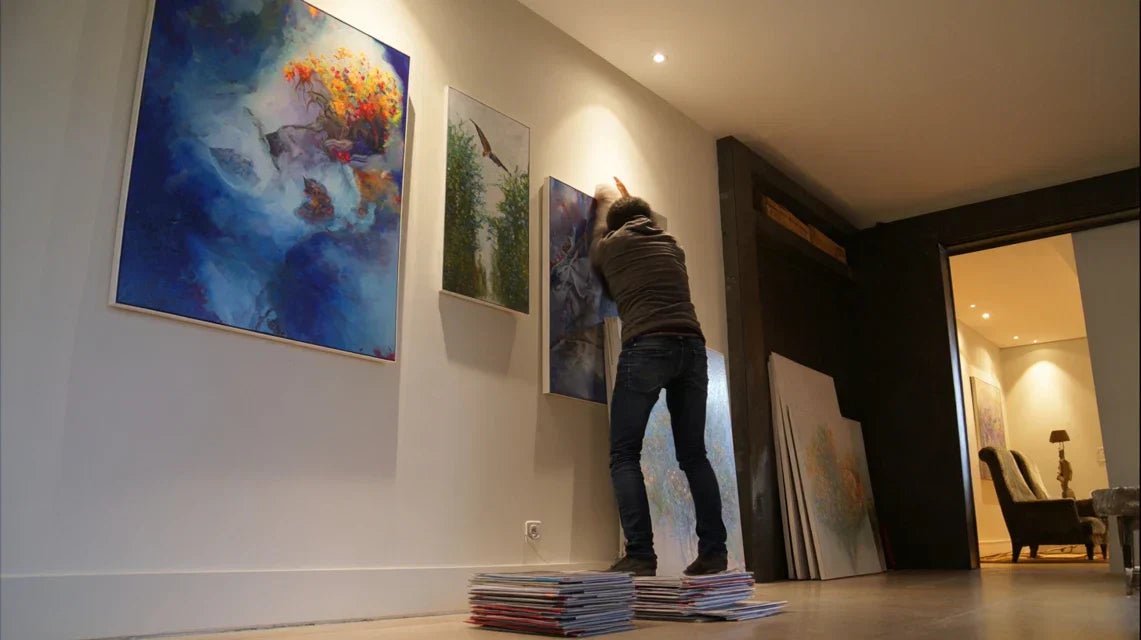
Even the most beautiful painting in the world looks dull if it is poorly presented. Marc, an antique dealer for 20 years, says: "I have seen crusts transformed into masterpieces by appropriate lighting, and magnificent canvases ruined by a bad placement."
Spot these clues at home: paintings that seem "extinguished" despite their beauty, artworks that appear too small or too large for their location, colors that seem faded when they were vibrant in store.
This neglect of staging makes you doubt your artistic choices, while the problem lies in the technical presentation, not in the artwork itself.
🔍 5 signs of a successful presentation:
- The artwork naturally attracts the eye: It becomes a focal point effortlessly, like a visual magnet
- Colors appear richer in the evening: Good lighting reveals hidden nuances during the day
- The scale seems obvious: Neither too imposing nor lost, the artwork finds its proper proportion in the space
- It creates spontaneous conversations: Visitors notice it and comment on it naturally
- You rediscover it regularly: Even after months, it continues to surprise you with new details
⚡ The trigger factor: Your first purchase determines the entire collection
Your first acquisition acts as the DNA of your future collection. It subconsciously establishes your criteria for color, style, format and budget. This is the artistic domino effect: well chosen, it opens up infinite possibilities; missed, it locks you into a path that doesn't suit you. Identify it by observing which artworks your eyes are naturally drawn to in a gallery.
Golden rule for the first purchase: Choose a work that truly moves you, even if it is outside your decorative comfort zone. Your artistic instinct is more reliable than your aesthetic habits. Check it by experiencing this emotion for a few days before buying.
| ❌ "Decoration" approach | ✅ "Collection" approach | 💡 Key difference | 🎯 Long term benefit |
|---|---|---|---|
| I'm looking for something that goes with my sofa | I'm looking for a work that touches me personally | Emotion takes precedence over decorative harmony | Unique collection that evolves with you |
| I buy everything at once to "finish" the decor | I build up gradually according to my discoveries | Patience allows for refinement of taste | Each acquisition becomes more relevant |
| I prefer safe and recognized values | I dare to emerging artists who speak to me | Authenticity counts more than notoriety | Possibility of discoveries before everyone else |
| I want everything to be perfectly matched | I accept contrasts and unexpected dialogues | Harmony is born from mastered diversity | Living interior that tells your story |
The progressive method to build your collection without stress
Rest assured, building a wall art collection is like cultivating a garden: you start by preparing the ground, planting some main species, then enriching it over the seasons. No rush, just a natural progression that leads you towards a harmonious and personal ensemble where each work finds its obvious place.
🎯 Overview of your progress: Three simple steps: first define your personal style (discovery), then acquire your first structuring works (foundation), finally enrich and refine your collection (flourishing). Each step brings you satisfaction and confidence to approach the next.
🛠️ Your Exploration Tools
🎨 Practical Application of Discovery
Visit 3 different artistic venues: Alternate between a contemporary gallery, a classical museum and an artist's studio. This diversity reveals your preferences by contrast. In each venue, note your first emotional impression before analyzing technically. Your instinct is more revealing than your intellect.
⏱️ Time: 2 hours per venue over 3 weeks | ✅ Success when: You identify 2-3 styles that create a strong emotion | ⚠️ Attention: Don't try to "understand" intellectually, let your senses guide your notesTest your reaction over time: Photograph 10 works that mark you, then revisit these images after a week. Those that continue to move you reveal your true artistic sensitivity. It's the ultimate test of authenticity of your attraction.
⏱️ Time: 30 minutes of shooting + 15 minutes of analysis one week later | ✅ Success when: 3-4 images retain their power of attraction | ⚠️ Attention: Resist the urge to rationalize your emotions, note them rawAnalyze your constants: Identify common points between your favorites: recurring colors, techniques, formats, subjects. These patterns reveal your personal artistic DNA, your unconscious aesthetic signature that will guide all your future choices.
⏱️ Time: 1 hour of quiet analysis | ✅ Success when: You can describe your style in 3 keywords | ⚠️ Attention: Look for emotional patterns, not just visual ones✅ Step 1 Validation: You should be able to explain in 2 sentences what attracts you to art, have identified 2-3 preferred styles, and feel less anxiety about artworks. If you are still hesitating, extend this exploration phase by a week. The following steps will be much smoother.
OUR RECOMMENDED PRODUCTS
🏗️ Step 2: Acquiring Your First Structural Works
You are now moving from the status of amateur to that of beginner collector. This step is more exciting because you are finally realizing your discoveries. The snowball effect begins: each acquisition refines your taste and facilitates subsequent choices.
💰 Budget and Purchasing Strategy
- First artwork: 200-500€: Sufficient budget for quality without being paralyzing. Prioritize the original even modest over a luxury reproduction. A real oil painting at €300 teaches you more than a fine art print at €150. Authenticity educates your eye.
- Preferred support: Canvas or wood panel to start. These traditional supports age well and are easy to hang. Paper, even of good quality, remains fragile for beginners. You learn the gestures of handling and conservation.
- Starting format: 40x60cm or 50x70cm, present enough without dominating the space. It is the equivalent of the "reference format" that gives you the scale to judge other sizes. Smaller, the impact is timid; larger, the error is expensive.
🎯 Progressive Acquisition Strategy
First acquisition: the test artwork: Choose within your identified style, but dare to take a small risk (color, technique). This work tests your ability to live with your choices. Buy it in a place where you can return for advice.
⏱️ Time: 2-3 visits before purchase | ✅ Successful when: You install it and do not regret it after a week | ⚠️ Attention: Avoid over-analyzing, trust your first emotional reaction
Experiment with hanging: Test 3-4 different locations before permanently fixing. Observe the artwork at different times of the day. Natural lighting reveals aspects invisible in store. Take the time for this crucial technical step.
⏱️ Time: 3 days of observation | ✅ Successful when: The location seems obvious and the artwork "lives" well | ⚠️ Attention: Beware of reflections and direct lighting that distort colors
Second purchase: create a dialogue: Look for a work that "responds" to the first without copying it. Even artist with different technique, or even technique with different style. This visual conversation is the basis of any coherent collection.
⏱️ Time: 2-3 months after the first purchase | ✅ Successful when: The two works enhance each other | ⚠️ Attention: Resist the temptation to create a "perfect" match, prefer complementarity
🎭 Step 3: Develop your collector's expertise
You now master the fundamentals of collecting. This step distinguishes you from the occasional enthusiast: you develop an expert eye, anticipate the evolution of your collection, and create a set that really tells your personal story.
🔍 Technical and aesthetic mastery
Deepen your knowledge of an artistic movement: Choose the style that attracts you most and study its history, its masters, its contemporary evolutions. This specialized expertise gives you a head start in identifying emerging talents and understanding prices.
⏱️ Time: 3-6 months of deepening | ✅ Successful when: You recognize influences and can explain why a work pleases you | ⚠️ Attention: Keep an open mind, expertise should not confine you
Meet living artists: Visit workshops, attend vernissages, participate in meetings. These direct exchanges transform your understanding of art and create privileged acquisition opportunities before the artist is "discovered".
⏱️ Time: 1 event per month | ✅ Successful when: You maintain relationships with 2-3 artists | ⚠️ Attention: Buy based on artistic conviction, not personal sympathy
Plan the evolution of your collection: Define a direction for 2-3 years: deepening a style, opening to other techniques, seeking chromatic consistency. This overall vision guides your future acquisitions and avoids dispersion.
⏱️ Time: Continuous reflection over 6 months | ✅ Successful when: Each new acquisition fits into your global project | ⚠️ Attention: Stay flexible, your taste may evolve
Rule of progression for the collector: Move on to the next step when you naturally anticipate the effect of a work in your interior, that you feel less stress before a purchase, and that you start to educate those around you about your artistic choices. Patience and regularity are better than haste and a large budget.
Now that you master the method, here are the insider subtleties that distinguish the informed collector from the enthusiast. These tips give you an edge and allow you to create a truly distinctive collection.
🎯 Pro tip - The "third look" rule: A truly remarkable artwork reveals new details with each in-depth observation. First look: emotional impact. Second: composition and technique. Third: hidden subtleties and nuances. If it withstands this test, it's a lasting investment that will continue to surprise you for years.
💭 "How long does it take to build a real collection?"
"I wonder if it's going to take me years to have something coherent at home..."
I understand this impatience! In reality, the impact is felt with the first well-chosen artwork, just like a beautiful lamp transforms the ambiance of a room. The magic of a collection comes from the quality of the pieces and their dialogue, not their number. Marie-Claire, a teacher, created a striking atmosphere with only two blue abstract canvases in her living room in 6 months. Focus on the emotion each addition brings you rather than a quantitative goal.
✨ Immediate action: Identify the space in your home that inspires you most (often the place where you spend the most time relaxing) and imagine your first artwork there. You will immediately feel the transformative effect possible.
⚠️ Common pitfalls that ruin a budding collection
After supporting hundreds of beginner collectors, I have identified recurring mistakes that spoil the experience and the result. The good news? They are all avoidable when you know them in advance.
- 🛒 Buying in lots or series: The "3 matching paintings" offer seems reassuring but limits your artistic development. Each artwork should be a thoughtful individual choice. It's tempting because it avoids the anxiety of choice, but you end up with a soulless decorative set, like a menu imposed at a restaurant. Prefer to build gradually. 📏 Underestimating the importance of dimensions: A painting too small in a large space seems lost, too big it overwhelms the atmosphere. Always measure and visualize before buying. The classic mistake: choosing in a store where the artwork appears perfect in a small exhibition space. At home, proportions can totally change the effect. 💡 Neglecting appropriate lighting: Even a masterpiece is dull under a harsh fluorescent light. Invest in artwork lighting from your first purchase. Many think it's a luxury, but it’s like buying a beautiful book and reading it by candlelight: you miss the essential. 🎭 Copying the style of a collection seen elsewhere: Instagram is full of seductive collections, but reproducing someone else's will distance you from your personality. Draw inspiration from the method, not the result. Your collection should tell your story, not that of an influencer. Otherwise, you live in a magazine set, not at home. The desire to quickly build up your collection. But art is digested slowly. Each work deserves time to reveal its personality in your space. Rushing is like wanting to be friends with someone on the first meeting: artificial and unsustainable.
🎁 Special offer for readers
Because you took the time to inform yourself, enjoy
❓ Your questions as a beginner collector
Absolutely! The most beautiful collections play on harmonious contrasts. The important thing is a common thread: a color palette, a shared emotion, a preferred technique, or simply your personal sensitivity. David Bowie brilliantly mixed classical and contemporary art, creating a unique and coherent ensemble.
🌟 Your transformation into an accomplished collector
In three months, you will return home with a smile as you discover your walls. Your guests will immediately notice this unique and warm atmosphere that you have created. You will feel the particular pride of living surrounded by carefully chosen works that tell your story and evolve with your sensitivity.
Beyond decoration, you will have developed a personal artistic eye which enriches all your other aesthetic choices. This newly acquired confidence radiates in your way of dressing, arranging your space, choosing your travel destinations. Art educates the eye to all the beauty of the world.
The hardest part was understanding the method, you now have it. Your first step? Visit a gallery this week with your new perspective. You will be surprised at how much your perception has already changed just by reading this article!
🚀 Your artistic adventure begins now: Every great collector started with a first moved look at a work. Yours may be waiting around the corner. Trust yourself, your artistic sensitivity is unique and precious!