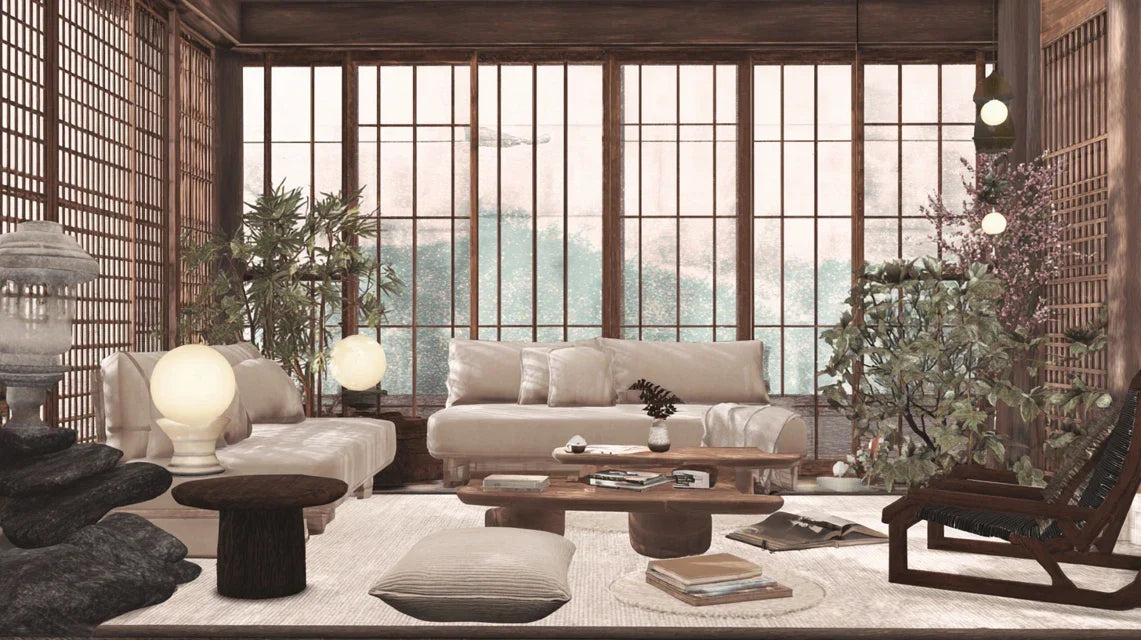
You've just finished decorating your living room, proud of the result, but something feels off. Despite your carefully chosen furniture and harmonious colors, the overall look desperately lacks soul and personality.
The bare walls send back a cold echo, that feeling of incompleteness that constantly reminds you that your decor is lacking character. You feel this dull frustration of living in a space that feels more like a catalog than a true home.
You've probably tried some solutions: a mirror here, a shelf there, maybe even a hastily chosen painting. But it doesn’t work, the sought-after harmony still eludes you, and you wonder why your efforts aren't giving the expected result.
That's perfectly normal! The problem isn't with your aesthetic sense, but simply that you haven't yet discovered the secret of Japandi style - this magical fusion between Japanese refinement and Scandinavian warmth that instantly transforms any space.
By the end of this article, you will perfectly master the art of creating an authentic Japandi atmosphere with adapted wall art, and you'll finally be able to transform your interior into a zen and cozy sanctuary that truly reflects you.
Why is Japandi revolutionizing interior decoration in 2025?
The Japandi style is literally exploding this year because it meets a deep need of our time: to find serenity in a hyperconnected world. It's like discovering the perfect recipe that combines the soothing simplicity of Japanese zen with the warm softness of Scandinavian hygge. If you wait any longer, you risk missing out on this decorative wave that is already transforming millions of homes around the world.
🏡 Authentic testimonial: Sarah, a Parisian interior architect, recounts: "I visited an apartment belonging to a client who had tried Japandi alone. Beautiful light wood furniture, natural textiles... but the bare walls created a striking coldness. By adding three paintings with clean lines in earthy tones, the space literally came alive. She cried tears of joy discovering the transformation."
💬 Conversation with a decor expert
The golden rule of Japandi: Wall art doesn't decorate a space, it reveals it. Just like a chef adds the final spice that transforms an ordinary dish into an unforgettable culinary experience, the right painting in a Japandi interior instantly creates that sought-after feeling of "home."
Do you recognize yourself in these decor warning signs?
Your living room feels like a sterile waiting room, your guests don't know where to put their eyes when they enter, and you yourself avoid spending time in certain well-arranged rooms. These symptoms reveal a classic imbalance between functionality and emotion in your decoration.
What’s really happening is that your space lacks visual anchors - those elements that naturally capture the eye and create a soothing hierarchy in the room. It's not your fault: we have been taught to prioritize minimalism, but without being told how to avoid coldness.
Imagine your interior as a melody: without the right accent notes (wall art), even the most beautiful harmony remains flat and lifeless.
First revelation: Minimalism doesn't mean empty
Contrary to what magazines convey, true Japanese minimalism always incorporates contemplative elements. Zen monks don’t meditate in empty rooms but face works of art chosen for their soothing power. The difference between empty and minimalist is the presence of an artistic soul.
It's exactly like the difference between a neglected garden and a zen garden: even with three times fewer elements, the zen garden provides infinitely more well-being thanks to the quality and placement of each component.
This revelation completely changes your approach: you’re no longer afraid to add art, you understand that it's even essential to achieve that sought-after serenity.
🔍 Quick test: Look at your main room and count how many elements naturally attract your gaze. If it’s less than 3, your space lacks visual anchors - add a painting and observe the instant difference!
Second revelation: Neutral colors need depth
Beige, off-white, taupe gray... These shades form the perfect base of Japandi, but they create a feeling of flatness if they are not enhanced by deeper nuances. That's why your current decor may seem dull despite its sophistication.
Think of a pastry: even the most beautiful vanilla cake needs a layer of chocolate or red berries to reveal all its flavor. Your neutral walls are that perfect base waiting for its revealing element.
Wall art in earthy tones, ocher, or sage green plays exactly this role: it visually anchors your palette while preserving the overall harmony.
Third revelation: Texture counts as much as color
Here's the secret factor that 90% of decorations neglect: texture contrast. A successful Japandi interior subtly plays on the opposition between smooth and rough surfaces, matte and satin finishes.
You can check this at home: run your hand over your different surfaces. If everything is smooth and uniform, it lacks that tactile richness that makes a space feel alive and engaging.
That's why textured canvas artworks or mixed media techniques instantly bring that missing dimension to your decoration.
The 3 signals that never lie:
- Your guests are looking for a place to sit: Your space lacks visual hierarchy, like a theater scene without directional lighting
- You avoid taking photos from certain angles: Your eye instinctively detects "dead" zones that lack visual interest
- The atmosphere changes radically depending on the lighting: Sign that your decoration depends too much on external light and lacks autonomous structuring elements
The trigger factor: Art as an emotional balancing point
Here's what really makes the difference: Japandi wall art doesn't decorate, it balances. Like a subtle counterweight that stabilizes your entire composition. Once you understand this principle, you never see your interior the same way again. You intuitively identify where to place this balancing point so that the whole room finds its natural breath.
The rule of harmony triangle: In any successful Japandi space, you must be able to trace an imaginary triangle between three elements: your natural focal point (window, fireplace), your main seating area, and your wall art. This triangle creates the perfect balance.
| ❌ Classic decor belief | ✅ Japandi reality | 💡 Why it works | 🎯 Perceived benefit |
|---|---|---|---|
| The more empty, the more zen | Emptiness needs contemplation points | The human eye naturally seeks landmarks | Immediate feeling of active serenity |
| Neutral colors are enough | Neutrals reveal their beauty by contrast | Principle of light and shadow in painting | Visual richness without clutter |
| Art must match perfectly | Art must create a harmonious tension | Creative dialogue between elements | Living space that evolves with the light |
| A pure style without mixing | Balanced fusion of two philosophies | Complementarity of opposites | Unique and timeless personality |
The 3-step method to master Japandi wall art
Rest assured, creating the perfect Japandi atmosphere is simpler than it seems. It's like learning a family recipe: once you know the ingredients and the order of preparation, the result becomes endlessly reproducible. We will progress together, from preparing your space to creating your personalized gallery wall, through choosing the masterwork that sets the tone for all your decor.
🗺️ Your artistic roadmap: Step 1 - Prepare the ground (identify your walls and palette), Step 2 - Choose your masterpiece (the one that defines the atmosphere), Step 3 - Create overall harmony (balance the whole). At each step, you will see your space gradually transform into a personal sanctuary.
Step 1: Prepare your decorative canvas
Starting by analyzing your existing space is laying the solid foundations of your future transformation. Like a painter who carefully prepares their canvas before the first brushstroke, this step determines the success of the entire project. Once completed, you will feel that deep satisfaction of finally mastering your environment.
🎨 Your Japandi analysis tools
- A color chart of natural tones: Precisely identify your dominant colors (beige linen, off-white, pearl gray). You will find it in any hardware store, look for "earth" or "mineral" ranges. Quality is recognized by the subtlety of nuances - avoid versions that are too bright which clash with the Japandi spirit.
- A meter and a sketchbook: To note dimensions and create your wall plan. The principle: visualize before acting, like professional interior architects. A small-format notebook is enough, the important thing is to keep track of your thoughts and measurements.
- Your smartphone in photo mode: Capture your space under different lighting conditions to identify areas of shadow and light. It's your ally for detecting wall art opportunities that your accustomed eye no longer notices.
Now, let's move on to concrete action:
🔍 Diagnosis of your space
Map your strategic walls: Photograph each wall of your main room at different times of the day. The goal is to identify which walls benefit from the best natural light and which naturally create visual resting zones. These are your premium locations for wall art.
⏱️ Time: 30 minutes | ✅ Success when: You have identified 2-3 locations that naturally "call" to the eye | ⚠️ Attention: Avoid walls facing windows (backlight) - a mistake that tarnishes even the most beautiful works
Analyze your existing palette: Note in your notebook the 3-4 dominant colors of your space (walls, main furniture, textiles). Compare them with your color chart to precisely identify your base tones. This step reveals the missing colors that will bring the desired depth.
⏱️ Time: 20 minutes | ✅ Successful when: You can name your colors precisely with the vocabulary of the color chart | ⚠️ Attention: Do not underestimate the impact of moldings and baseboards - they influence the entire palette
Define your privacy zones: Observe where you naturally settle to read, relax, or entertain. These areas need soothing and contemplative art. Mark them on your sketch as they will determine the type of works to prioritize.
⏱️ Time: 15 minutes of observation | ✅ Successful when: You have identified 1-2 well-being zones and their specific visual needs | ⚠️ Attention: Distinguish between passageways (dynamic art) and resting areas (contemplative art)
✅ Validation of step 1: Your space has no secrets for you, you know its light assets and colorimetric needs. You feel the excitement of already seeing your future decoration taking shape. If some points remain unclear, repeat an observation session at a different time of day - the light often reveals unsuspected details.
RECOMMENDED PRODUCTS
Step 2: Select your signature artwork
You are now ready to choose the masterpiece that will define the soul of your decoration. This step is more rewarding as you begin to see your vision taking shape concretely. This is where the magic happens: a single well-chosen work instantly transforms the energy of the entire room.
🎯 Authentic Japandi Selection Criteria
- Harmonious format and proportions: For a main wall, aim for a minimum width of 60-80cm. The work should occupy about 2/3 of the width of your sofa or main piece of furniture. This proportion creates the perfect visual balance without crushing or disproportion.
- Earth and plant palette: Prioritize ochres, sands, sage greens, soft terracotta. These colors naturally dialogue with the light woods and natural textiles of Japandi. Avoid saturated colors that break the sought-after meditative harmony.
- Authentic techniques and textures: Textured canvases, mixed media, wood engravings, watercolors on handmade paper. The materiality of the work should evoke craftsmanship and authenticity, core values of Japandi.
🎨 Expert Selection Process
Emotional resonance test: When faced with a work that attracts you, close your eyes for 10 seconds then look at it again. Your first sensation should be serenity, not excitement. Japandi favors lasting emotions over fleeting crushes.
⏱️ Time: 2-3 minutes per piece | ✅ Successful when: The artwork instantly soothes you and makes you want to contemplate it for a long time | ⚠️ Warning: Beware of artworks that are too "perfect" - Japandi values imperfect beauty (wabi-sabi)
In situ validation: If possible, request a digital preview or use augmented reality applications to visualize the artwork in your space. This step eliminates 80% of post-purchase disappointments.
⏱️ Time: 15 minutes of testing | ✅ Successful when: The artwork integrates naturally without dominating or disappearing | ⚠️ Warning: Artificial lighting can distort colors - test under your usual lighting
Step 3: Orchestrate overall harmony
With your signature piece chosen, you reach the level of mastery that distinguishes a thoughtful decoration from a simple assemblage. This final step reveals your personality while respecting the codes of Japandi. You create a coherent ensemble that you will be proud of for years to come.
🎼 Composition of your artistic set
Balanced trio principle: If you want multiple artworks, respect the rule of 3 different formats: one large (your signature), one medium (dialogue), one small (accent). Arrange them according to the triangle rule to create a natural visual path.
⏱️ Time: 45 minutes of setup | ✅ Successful when: Your eye naturally moves from one artwork to another without effort | ⚠️ Warning: Respect a minimum of 15-20cm between each artwork to preserve visual breathing space
Integration with your decorative objects: Create subtle echoes between your artworks and your textiles, ceramics, plants. A cushion that picks up a shade from your painting, a plant that dialogues with the greens of the artwork... These details reveal your decorative refinement.
⏱️ Time: 30 minutes of adjustments | ✅ Successful when: The whole seems to have always been there | ⚠️ Warning: Avoid exact matching - prioritize subtle echoes over literal associations
The rule of natural progression: You can move on to the next step when your space immediately gives you a feeling of well-being when entering it. Your eye naturally finds resting points and your mind relaxes automatically. Take the necessary time for each step - haste is the enemy of Japandi.
You now master the fundamentals of Japandi applied to wall art. Here are the expert subtleties that will make your interior a reference that your guests will not forget.
💎 Master decorator's tip: The "false backlight" technique - place a discreet LED lighting behind your main artwork to create a subtle halo in the evening. This trick used in high-end galleries transforms your painting into a true luminous focal point, creating an incomparable cozy atmosphere.
🤔 Reader's Passionate Question
"I love the concept but I'm afraid it will be too 'trendy' and that I'll quickly get tired of it..."
Your questioning reveals admirable decorative wisdom! This hesitation is natural when you have already experienced disappointments with fleeting styles. But here’s why Japandi fundamentally differs: it draws on two millennial traditions, not a passing fad. It's like worrying about getting tired of wood, stone or natural light - impossible because these elements respond to deep human needs. Moreover, Japandi evolves with you: you can modify the color accents via textiles or objects, while retaining your timeless artistic base.
🔄 Durability Test: Look for photos of Japandi interiors dating back 5-10 years on Pinterest. You will notice that they have aged remarkably well, unlike fleeting trends. This is your guarantee of lasting aesthetic appeal.
⚠️ The 5 Pitfalls That Sabotage Your Japandi Decor
Allow me to protect you from common mistakes that I regularly observe, even among experienced decorators. These errors are understandable because they seem logical at first glance, but they subtly destroy the Japandi harmony.
- 🎨 Choosing artworks that are too perfect or symmetrical: The Western mindset pushes us towards geometric perfection, but Japandi celebrates imperfect beauty (wabi-sabi). A watercolor with natural bleeds or an engraving with slightly irregular lines will bring infinitely more authenticity than a perfectly calibrated reproduction. This "imperfection" creates the sought-after emotional connection. 🖼️ Hanging too high out of habit: The classic rule “eye at 5’3” (1m60) does not apply to Japandi! Here, we prefer hanging at eye level when seated, i.e., 4’7”-4’9” (1m40-1m45). Why? Because Japandi art is contemplated in serenity, not passed quickly. This 6-inch difference completely transforms your relationship with the artwork. 🎭 Multiplying artistic styles: The desire to show one's artistic culture leads to mixing abstract, figurative, photo... Mistake! Japandi requires strict stylistic consistency. It’s better to have three minimalist watercolors than a watercolor + a photo + a collage, even if each is beautiful individually. 🔆 Neglecting specific lighting: Relying solely on general lighting kills the impact of your artworks. Each painting deserves its dedicated lighting, even discreet. A simple adjustable spotlight or a wall sconce reveals details invisible under general lighting and creates that precious, cozy atmosphere. 💰 Skimping on framing: A low-quality frame instantly devalues even the most remarkable artwork. In the Japandi spirit, the frame is an integral part of the work - it must be made of natural materials (raw wood, bamboo) and visibly handcrafted.
🎁 Special offer for readers
Because you took the time to inform yourself, enjoy
❓ Your most frequently asked questions about Japandi wall art
🌸 Your new decorative chapter begins now
In a few weeks, you will return home with that magical feeling of finding your personal sanctuary. Your walls will finally tell your story, this quest for harmony between simplicity and refinement that characterizes you. Your guests will immediately feel this particular serenity that emanates from successful Japandi interiors, and you will discover the unique pleasure of living in a space that truly resembles you.
Beyond the aesthetic transformation, you will have acquired this artistic sensitivity that enriches everyday life. You will instinctively know how to create soothing atmospheres, balance spaces, and above all, connect with this philosophy of simple beauty that positively influences your overall well-being. This new skill will follow you in all your future decorative projects.
The hardest part was understanding the mechanics of Japandi - now that it's done, your first move can be as simple as browsing a collection of artworks while keeping your new knowledge in mind. Trust your instinct refined by this reading, and embark on this beautiful decorative adventure that will permanently transform your relationship with your interior.
🚀 Your moment of transformation: You now have all the keys to create the Japandi interior of your dreams. This perfect harmony between zen and cozy awaits your action to reveal all its magic in your daily life.