

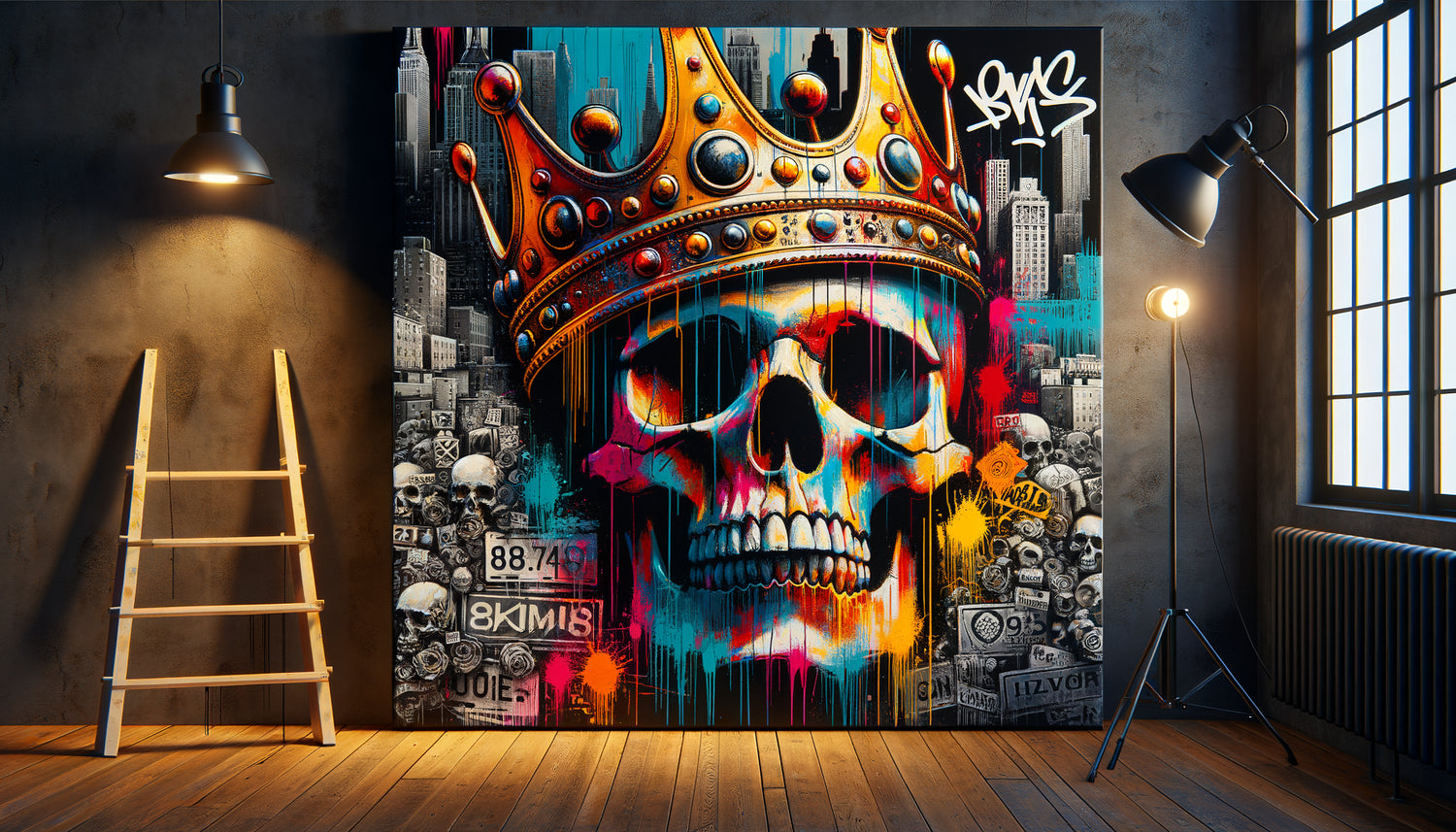
This February morning in 2019, I remember walking through the doors of a Christie's auction house in Manhattan. A Basquiat had just reached $110 million. Around me were seasoned collectors, gallery owners in three-piece suits, and that electric tension characteristic of major art transactions. For fifteen years, I have been accompanying investors in their acquisitions of New York street art new, and one certainty prevails: this market tolerates no approximations. Between reckless speculation and golden opportunities, the line is thin.
Here's what investing in New York tableaux street art new-yorkais brings: a growing heritage value backed by American cultural history, remarkable liquidity on the secondary market, and the opportunity to own works that transform an interior into a contemporary manifesto.
You have probably already been seduced by the raw energy of a piece of street art, this visual urgency that electrifies walls. But faced with the abundance of offers – from silkscreens at €500 to originals at six-figure prices – how do you distinguish a fleeting infatuation from a lasting investment? How do you avoid worthless reproductions while building a coherent collection?
Rest assured: investing in New York street art does not require a degree in art history or a hedge fund manager's portfolio. It simply requires understanding the codes of an exciting market, knowing which artists matter, and adopting a rigorous methodology. I am going to share with you the criteria that I use daily to guide my clients towards judicious acquisitions.
The pillars of the market: why New York remains the epicenter
New York is not just another city in the world of street art – it's the original laboratory where everything took shape. In the 70s and 80s, the New York subway became the democratic canvas for an entire generation. Jean-Michel Basquiat, Keith Haring, Futura 2000: these names are not just signatures; they are temporal markers that have redefined the boundaries between urban art and institutional market.
This historical legitimacy confers an undeniable premium on New York works. A painting by KAWS, an artist who started by diverting advertising posters in Manhattan phone booths, is now negotiated between $50,000 and several million depending on the format and period. This escalation is not accidental: it reflects the progressive museum recognition (MoMA, Brooklyn Museum) and the appetite of Asian collectors for these iconic pieces.
The New York market also boasts exceptional traceability. Established galleries like Deitch Projects or the defunct Fun Gallery have created solid archives. For investors, this documentation is crucial: a certificate of authenticity issued by a reputable gallery can multiply an artwork's value by three or four.
Key artists: where to place your capital
Let's start with the obvious: Jean-Michel Basquiat represents the absolute pinnacle, but with works rarely starting below a million dollars, he remains inaccessible to most collectors. His influence, however, permeates the entire market. Look for artists who engage with his legacy: Futura, whose gestural abstractions extend Basquiat's energy, still offers original works between 15,000 and 80,000 euros.
KAWS (Brian Donnelly) represents the safest investment of the past decade. His Companions – these characters with X-shaped eyes – have achieved worldwide recognition. However, be careful: prioritize original paintings or silkscreen prints in very limited editions (less than 50 copies). Mass reproductions, although appealing, offer only limited appreciation potential.
Shepard Fairey (Obey Giant) represents another solid pillar. The author of the Hope poster for Obama's campaign enjoys rare widespread notoriety. His works blending visual propaganda and social critique are sold between 5,000 and 150,000 euros. For a judicious investment, aim for original pieces on wood or metal rather than silkscreens on paper.
Don't forget Swoon (Caledonia Curry), whose cut-out portraits bring a rare feminine sensibility to this male-dominated world. Her works regularly increase in value (+40% over five years) while remaining accessible: count 8,000 to 40,000 euros for an authentic piece.

Decoding authenticity: your anti-deception shield
I've seen too many enthusiastic investors acquire worthless reproductions not to insist on this point. The New York street art market is full of traps for the uninitiated. Here’s my systematic verification protocol.
First reflex: demand complete provenance. Where does the artwork come from? Who initially sold it? An unbroken chain of documentation from the artist's studio to you is non-negotiable. Serious galleries spontaneously provide this information. Its absence should trigger a red alert.
Second safeguard: the authenticity certificate. Not just a printed paper, but an official document issued by the artist, their studio, or a recognized gallery. For KAWS, for example, check that the certificate bears the stamp of his studio or an official partner gallery. Contact these entities directly if in doubt – they generally respond within 48 hours.
Third criterion: edition. A silkscreen numbered 12/150 is worth infinitely less than a 5/25. The rule of thumb: below 100 copies, you enter a credible investment territory. Beyond 300, you are essentially buying decoration. For unique works (original paintings), request a photo of the artist in their studio with the work visible – most studios document their production.
Strategic formats: size and heritage value
A dimension often overlooked: format drastically influences appreciation potential. Very large pieces (over 200x150 cm) appeal to institutional collectors but limit liquidity – few private buyers have the necessary space. Conversely, small formats (less than 60x40 cm) offer financial accessibility but less wall presence.
The optimal format for investment is between 100x100 cm and 150x120 cm. These dimensions suit contemporary interiors while displaying a strong presence. A 120x100 cm KAWS will be resold more easily and quickly than a 300x200 cm format, even if the latter seems more spectacular.
Regarding techniques, prioritize as follows: original paintings (acrylic, spray paint, mixed media) at the top, followed by works on wood or metal (supports prized for their urban authenticity), then limited edition silkscreens (less than 50 copies), and finally signed digital prints (essentially decorative value).

Emerging trends: new names to watch
If you have a limited budget (5,000 to 15,000 euros) but want to bet on significant growth potential, explore emerging artists from the Lower East Side and Bushwick. Misha Tyutyunik, whose psychedelic portraits fuse urban art and pop culture, is seeing his prices rise steadily. His original pieces still hover around 8,000 euros – an accessible entry point.
Faith47, although South African, has established her reputation in Brooklyn. Her contemplative works, between abstraction and figuration, attract a wealthy clientele seeking sophistication. Expect 12,000 to 35,000 euros for an original canvas. Her market remains stable with positive medium-term prospects.
Another option: Vhils (Alexandre Farto), a wall sculptor turned painter. His portraits carved into the material convey a unique approach. Although Portuguese, his New York presence (regular exhibitions in Manhattan) positions him as an emerging value. Necessary budget: 15,000 to 50,000 euros.
Acquisition strategy: timing and preferred channels
Where to buy? Established galleries offer security and expertise but practice substantial margins (40-60%). In return, you benefit from expert advice and a solid guarantee of authenticity. For a significant first investment, this channel remains recommended.
Auction sales (Christie's, Sotheby's, Phillips) present total price transparency but require reactivity and composure. Set yourself a ceiling before the session and respect it. I have seen bidders carried away by emotion paying 30% above the high estimate – rarely a good deal.
Contemporary art fairs (Armory Show, Frieze New York) constitute a fertile hunting ground. Galleries often offer unpublished works there at slightly negotiable prices. Prioritize VIP first days if you have access – the best pieces sell quickly.
Regarding timing, a simple rule: buy during the summer (June-August) when the market slows down, and ideally sell in November-December, a period of high activity preceding the holidays and end-of-year tax deductions.
Ready to transform your interior into a New York gallery?
Discover our exclusive collection of Street art paintings that combine urban aesthetics and heritage potential, carefully selected for their authenticity and visual impact.
Preservation: protecting your investment
One last crucial point: a poorly preserved artwork quickly loses its value. Aerosol paintings, particularly sensitive to UV rays, must be protected by museum-quality anti-UV glass. Cost: 300 to 800 euros depending on the format, but essential to preserve pigments.
Maintain a stable temperature between 18 and 22°C with humidity of 45-55%. Sudden thermal variations (proximity to radiators, excessive air conditioning) cause cracking and peeling of pictorial layers. Also avoid direct exposure to sunlight – even behind a protective window, UV rays gradually degrade the works.
For serious collectors, subscribe to a specialized fine arts insurance. Standard home policies rarely cover the actual value of artworks. Expect 0.5 to 1.5% of the insured value annually – a negligible cost compared to the capital protected.
Investing in New York street art is engaging with the living history of contemporary art. Imagine the moment you hang this unique piece in your living room, where each visitor will stop, captivated by the raw energy that pulsates from the streets of the Bronx or Brooklyn. You don't simply own a work – you hold a fragment of American urban culture, a window open onto an era that revolutionized our relationship with art.
Start modestly if necessary, but start today. The market doesn't wait for the undecided. An authentic Shepard Fairey screen print, a small Futura format, a Bushwick emerging piece: each acquisition is a step towards a coherent collection and intelligent heritage diversification. In ten years, you will be glad that you dared to take the plunge when others were still hesitating.
FAQ: Your essential questions
What is the minimum budget to consider when investing in New York street art?
To acquire an authentic work with real investment potential, allow a minimum of 3,000 to 5,000 euros. At this level, you can access limited edition screen prints by established artists or original works by promising emerging artists. Below 2,000 euros, you mainly enter the territory of decorative reproductions, which are certainly aesthetic but have no significant appreciation potential. For major pieces by KAWS, Shepard Fairey or Futura, the entry ticket is more in the range of 15,000 to 50,000 euros. My advice: it's better to acquire one quality piece every two years than a dozen reproductions with no heritage value. Patience and selectivity are your best allies in this demanding market.
How to verify that a street art painting is authentic before purchasing?
Authenticity verification rests on three non-negotiable pillars. Firstly, demand documented provenance: the complete history of the artwork since its creation, including gallery invoices, exhibition catalogs, or previous sales certificates. Secondly, an official certificate of authenticity issued by the artist, their studio, or a recognized gallery must accompany the work without fail. Contact the issuer of the certificate directly to confirm its validity – a simple email is usually sufficient. Thirdly, examine the physical characteristics: handwritten signature of the artist (not printed), consistent numbering for editions, quality of paper or canvas. For significant purchases (over 10,000 euros), do not hesitate to call in an independent expert who will charge 200-500 euros for a complete appraisal – a negligible investment compared to the risk of acquiring a forgery. Finally, be wary of abnormally low prices: a piece sold 30% below market value usually hides an authenticity or provenance problem.
Do New York street art paintings represent a safer investment than other urban art styles?
Yes, for three structural reasons. Firstly, historical legitimacy: New York is the documented cradle of the movement, with solid archives dating back to the 70s. This traceability reassures collectors and institutions, creating stable demand. Secondly, institutional recognition: major New York artists are represented in the permanent collections of MoMA, the Whitney Museum, or the Brooklyn Museum – a validation that perpetuates their value. Finally, market liquidity: a KAWS or a Shepard Fairey can be easily resold within a few weeks via international auction circuits, unlike less well-known regional artists. That said, diversifying geographically remains relevant – London street art (Banksy obviously, but also Ben Eine) or Parisian (JR, Invader) also offers solid opportunities. The key lies in the documented notoriety of the artist, their museum exhibition and the depth of their secondary market. New York simply accumulates these advantages more systematically than other urban scenes.


