I spent ten years transforming drab open spaces into vibrant studios for digital agencies, tech startups, and creative collectives. In every project, the same request arose: “We want something urban, bold, that reflects our DNA.” And each time, a carefully chosen street art transformed the atmosphere. Yet, faced with the explosion of this artistic movement – from Banksy’s monumental murals to Futura 2000’s explosive typography – many creative directors remain paralyzed in front of their blank walls.
Here's what a street art brings to a creative office: a strong visual identity that stimulates innovation, an emotional charge that nourishes team motivation, and a cultural message that impresses clients and partners. Three dimensions rarely found in a single decorative work.
The classic frustration? Hesitating between a “favorite” piece that’s too personal and a generic, soulless artwork. Fearing the stylistic misstep that turns your space into a disconnected urban art showroom. Or worse: investing in a reproduction that loses all credibility with your discerning visitors.
Good news: street art offers a diversity of styles, formats, and messages that allows you to create an authentic work environment. You don't need to be an experienced collector. It’s enough to understand a few essential codes to transform your office into an inspiring space where creativity and professionalism coexist naturally.
The energy of the wall: understanding the psychological impact of street art at work
In the Paris agency of an audiovisual production company, I installed a large format representing an explosion of abstract colors in a wild graffiti style. The creative director called me back three months later: “Brainstorming sessions have changed tone. More spontaneous, less inhibited.” It's no coincidence.
Street art inherently conveys values of freedom, controlled transgression, and innovation. These visual codes communicate directly with the creative subconscious. Unlike classical art that imposes a detached contemplation, urban art creates proximity, familiarity that desacralizes the workspace.
For a creative office, this particular energy becomes a catalyst. It sends a clear signal: here, we value boldness, we celebrate originality, we reject standardization. Your collaborators subconsciously integrate permission to break free from conventions. Your clients instantly grasp your differentiating positioning.
But be careful about consistency. A hyper-aggressive street art in a strategy consulting firm could create cognitive dissonance. The artwork should amplify your identity, not contradict it. Contemporary street art fortunately offers a sufficiently wide spectrum to adapt to all degrees of boldness.
From wild graffiti to neo-pop: identify the movement that speaks your language
Street art is not monolithic. I've seen too many disappointed buyers who thought “urban art” and ended up with an aesthetic that didn’t suit them. Let's decode the major families.
Typographic graffiti: for verb purists
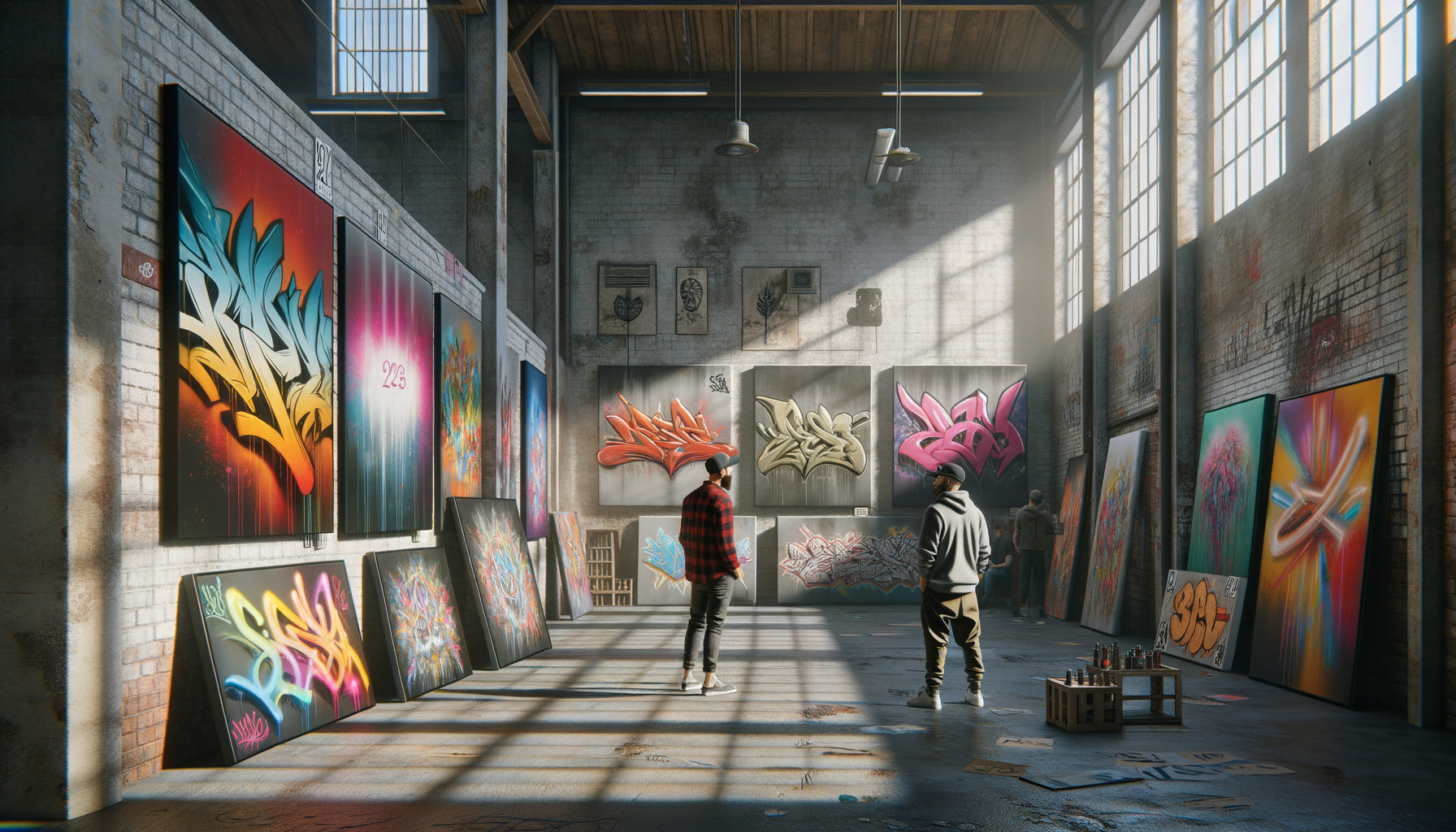
Complex lettering, urban calligraphy, depth games. If your creative office revolves around writing – editorial agency, naming studio, publishing house – this family naturally resonates. The compositions of intertwined letters create a visual dynamism that celebrates the power of language. Favor wall art with controlled colors (no more than three shades) to avoid visual saturation in a concentration environment.
Narrative stencil: for storytellers
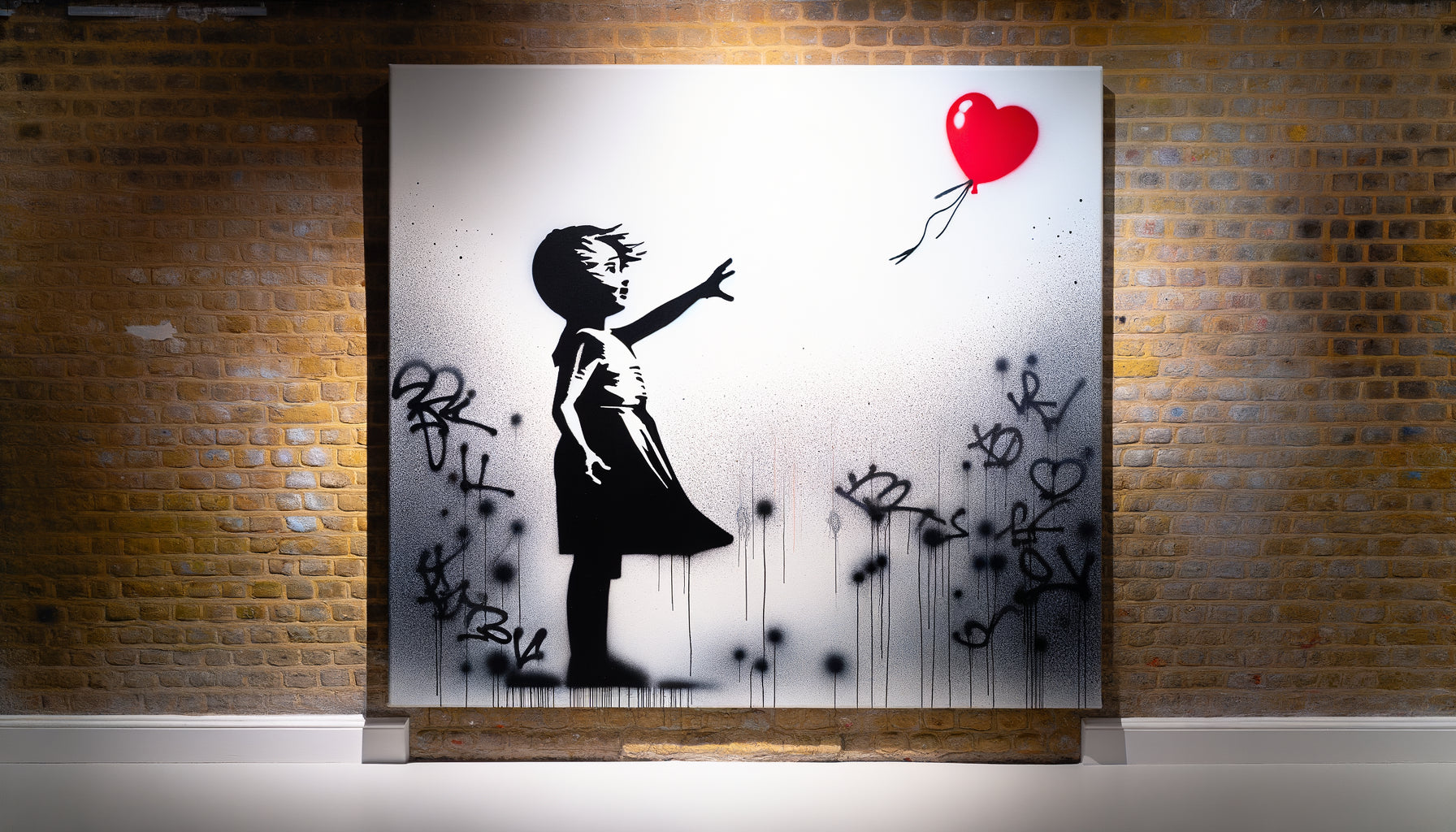
Heir to Banksy and Blek le Rat, this movement tells stories in a single image. Perfect for communication agencies, content creation studios or design thinking firms. These works naturally generate conversations. A visitor stops, decodes the message, smiles. Your wall art becomes the starting point of discussions that humanize your professional relationships.
Urban abstraction: for tech innovators
Runs, drippings, gestural superimpositions. If your business navigates in abstraction – data science, AI, fintech – this aesthetic creates a metaphorical resonance. Indefinite forms evoke mastered complexity, organized chaos. I have equipped several tech coworking spaces with this type of work: they age remarkably well and adapt to changes in layout.
Iconic neo-pop: for consumer brands
Colorful reinterpretations of cultural icons, playful diversions. Ideal for marketing agencies, video game studios, event companies. These wall art

The three technical criteria that change everything
Beyond style, concrete parameters determine the success of your choice. Neglect them and your artistic favorite will become a source of daily frustration.
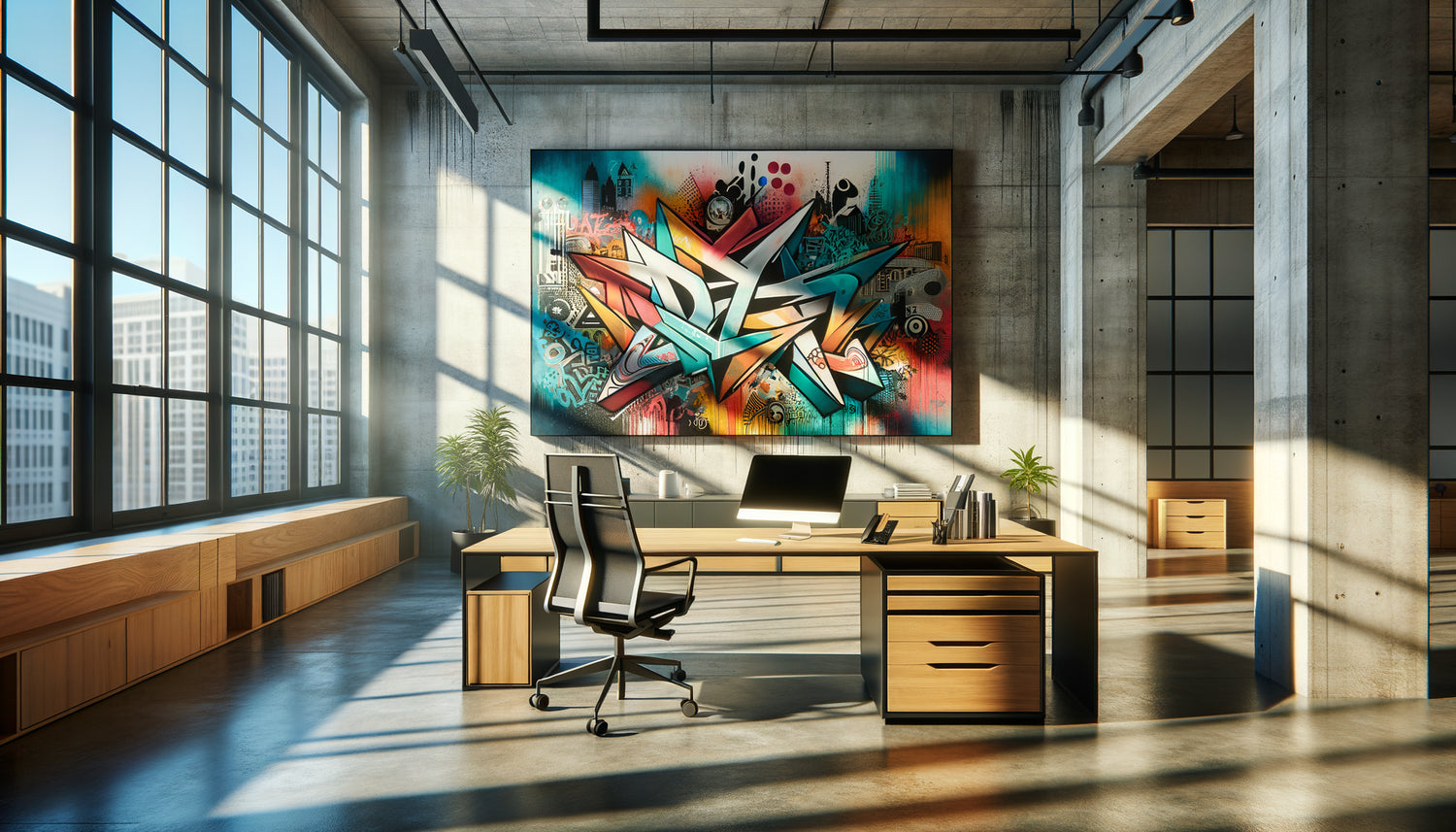
Proportional dimension. Classic mistake: undersizing. In a creative office with ceilings of 2.80 m and walls of 4 linear meters, a street art painting of 60x80 cm visually disappears. Empirical rule: the artwork should occupy between 60 and 75% of the width of the main wall. For maximum impact without overwhelming, aim for at least 120x160 cm in a standard meeting room. Large format street art creates an immersion that fully justifies the investment.
The support and finish. Stretched canvas, aluminum dibond, plexiglass, wood. Each material dialogues differently with architecture. In an industrial loft with exposed beams, prioritize raw supports (wood, metal) for stylistic consistency. In a refined office with contemporary lines, plexiglass brings depth and modernity. I have a weakness for aluminum dibond: lightness, durability, vibrant color rendering. Perfect for street art paintings strong> with saturated tones.
Lighting and hanging. Street art thrives on contrasts and vibrant colors. A poorly lit location kills 50% of its impact. Analyze the natural exposure of your wall: if it is low, provide dedicated lighting (adjustable LED spotlights, 3000K temperature). Regarding height, the center of the artwork should be at 1.55-1.65 m from the floor – a natural eye level, a frequent position in dynamic creative spaces.
When the painting becomes a manifesto: matching artwork and corporate culture
The decisive moment of my support always comes with this question: “What does this work say about us?” A street art painting in a creative office is never neutral. It embodies values, projects an ambition, reveals a posture.
I worked with a social design agency that wanted to affirm its societal commitment. We selected a triptych representing the evolution of a popular neighborhood, created by an urban artist involved in participatory projects. The work told their story as much as their vision. Every client presentation started in front of these street art paintings, creating an emotional connection from the start.
Conversely, a hyper-growth fintech startup sought to temper the cold image of its sector. We opted for humanized street art characters, almost poetic, which softened the tech environment without denying their innovation DNA. The contrast precisely created the desired message: “We master technological complexity while keeping humans at the center.”
Ask yourself these essential questions before purchasing: Will this work represent me in five years? Will it withstand changes in positioning? Does it generate an emotion universal enough to unite a diverse team? A good street art painting for a creative office must be assertive enough to mark the minds, open enough to allow multiple readings.

Original, limited edition or reproduction: decoding the value without snobbery
A sensitive subject in the street art world. Let's be clear: for an office, authenticity counts, but museum-quality perfection is not the goal. Your priority: visual impact + budget consistency + cultural message.
Unique originals are justified if you have the budget (from €2000) and are looking for a radical differentiating element. Advantage: certificate of authenticity, heritage valuation, premium storytelling. Disadvantage: risk of theft/damage in a passageway area, psychological pressure on teams (“be careful not to damage the work”).
Limited edition numbered prints (editions of 50-300) offer the best impact/investment ratio for a creative office. Accessible price (€300-€1200), impeccable quality, artist's signature, traceability. This is my systematic advice for equipping a meeting room or client space. Street art paintings in limited edition retain sufficient scarcity to nourish your image without the pressure of the unique original.
High-quality reproductions have their place in circulation areas or individual workstations, provided you assume the status. Never fake certificates, never pretend to be an original. Total transparency. Then invest in print quality (Giclée, resistant pigments) and high-end support. A beautiful assumed reproduction is always better than a dubious pseudo-limited edition.
The trap of trends: building an evolving collection
Street art moves fast. The emerging artists of today are forgotten in three years, while others explode. How to avoid the “office stuck in 2024” effect?
My method: build through temporal layers. Don't bet everything on the same style or period. In a mature creative office, I systematically compose: 60% of works with timeless codes (gestural abstraction, classic typography reinterpreted, universal iconography) + 40% of contemporary pieces that capture the spirit of the times.
This proportion allows to regularly refresh the atmosphere by replacing only the contemporary elements, without upsetting everything. Your street art paintings remain fundamental, creating continuity and a stable identity. Current touches evolve, proving your active cultural awareness.
Another strategy: prioritize artists with a consistent approach rather than explosive trends. I have observed for fifteen years that creators who develop a personal visual language, even less publicized, produce works that age better than spectacular marketing stunts. For a creative office that projects itself in the long term, it is a safer investment.
Your office deserves a work that tells your boldness
Discover our exclusive collection of Street art paintings that transform workspaces into inspiring visual manifestos.
From white wall to living space: visualize the transformation
Imagine your next client meeting. You welcome them into your conference room. Their gaze immediately rests on this street art painting that occupies the main wall. No need for long speeches about your innovative approach: the work speaks for you. It instantly creates a cultural connection, reassures of your modernity, legitimizes your creative expertise.
Now visualize your teams during a brainstorming session that's stalled. The eyes turn to this bold urban composition. It silently reminds you that you have built this structure on controlled risk-taking, on the rejection of preformatted solutions. Energy is unlocked.
Choosing a street art painting suitable for a creative office is not a matter of decoration. It's a strategic act that materializes your company culture, nourishes daily inspiration and builds your professional image. Start by clarifying your real identity – not the fantasized one. Then find the work that amplifies it naturally. The rest will follow: the right dimensions, the appropriate support, the optimal positioning.
Your white wall is waiting to tell your story. The right street art painting will write it in colors, gestures and emotions. You just have to dare to take the step.
FAQ: Your questions about street art paintings in creative offices
What budget should you allocate for a quality street art painting for an office?
For a professional space, I recommend budgeting between €400 and €1500 for a museum-quality limited edition artwork, approximately 100x150 cm in size. This is the sweet spot that guarantees visual impact, certified authenticity, and durability. Below €300, you enter basic reproductions which can detract from your image. Above €2000, you access unique original works – relevant if the work becomes a central element of your corporate storytelling. Think cultural investment rather than decor expense: a good street art painting appreciates over time, unlike furniture which depreciates. For a first acquisition, aim for €800-€1000 on a masterpiece rather than multiplying small formats without character. Your meeting room deserves this ambition.
How do you know if a street art style really matches your company's identity?
Failproof method that I apply: gather three collaborators of different profiles (not just creatives) in front of several visuals of street art paintings. Ask them spontaneously: “What’s the connection to our business?” If all three identify a coherent connection, even nuanced, you're on the right track. If the answers diverge completely or remain vague, the work is too personal or disconnected. Another test: imagine this artwork on your website or LinkedIn. Do you fully embrace it? Green light. Do you feel a mismatch? Keep searching. Street art offers a wide enough palette to find your exact resonance. Never force yourself towards a style just because it’s trendy. The authenticity perceived by your customers depends on your own conviction. A street art painting that is slightly less daring but perfectly assumed will always outperform a spectacular piece that makes you uncomfortable.
Should you prioritize a local or international artist for a creative office?
Excellent question that goes beyond geographical aspects. A local artist offers powerful storytelling benefits: you support the cultural scene of your territory, you can sometimes meet the creator (a special moment to share with your teams), and you create connections with your ecosystem. For an office rooted in a defined urban community, this is consistent. However, if your activity is international or digital without a strong territorial anchor, a globally recognized artist more legitimately validates your scope. My recommendation: mix. Your street art painting can be signed by an emerging international name that affirms your global culture, complemented by secondary pieces from local artists who prove your territorial commitment. This balanced strategy avoids the "ivory tower disconnected" aspect as well as the "limited localism" trap. The essential remains artistic quality and emotional resonance, regardless of the creator's geographical origin.