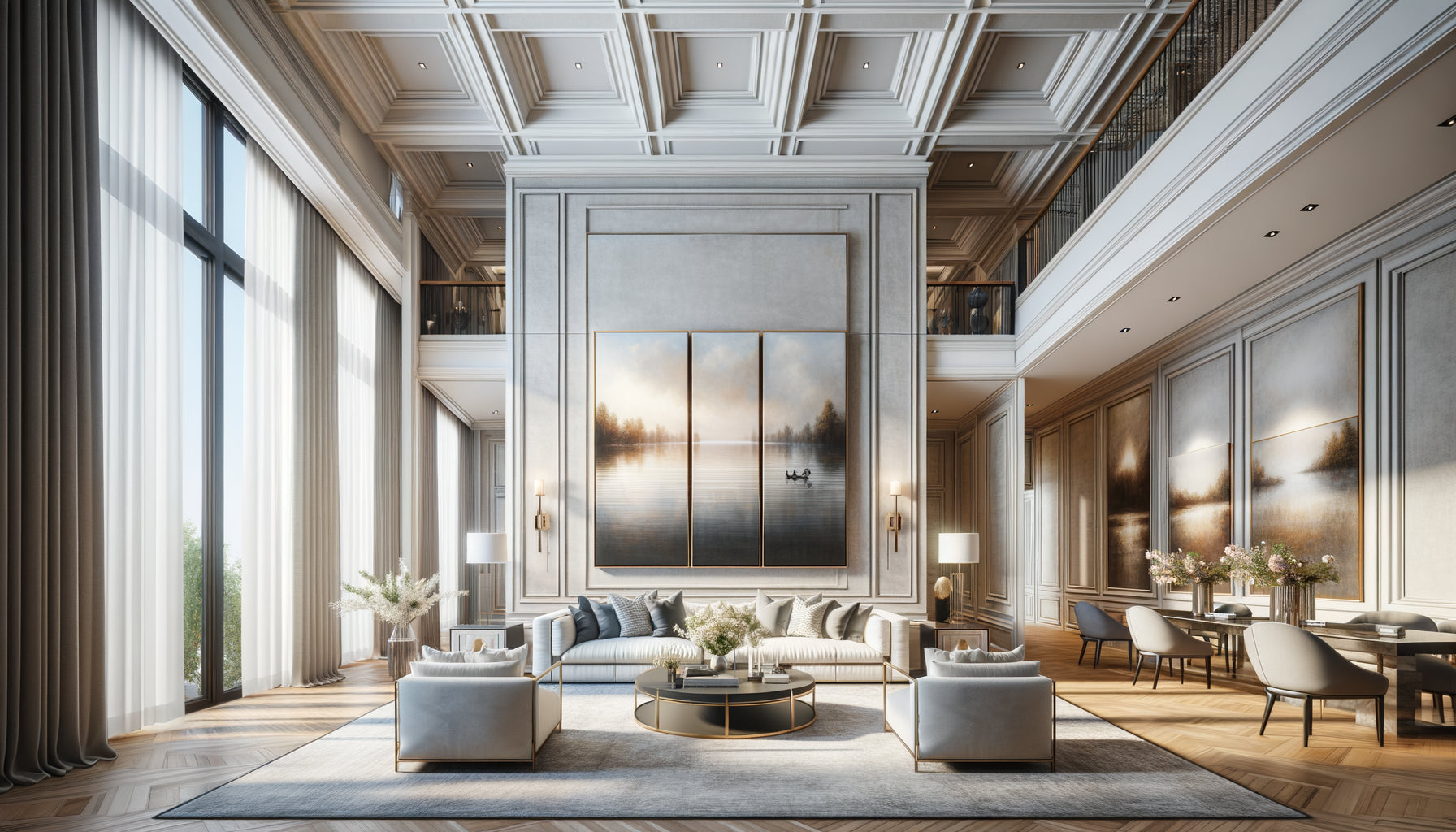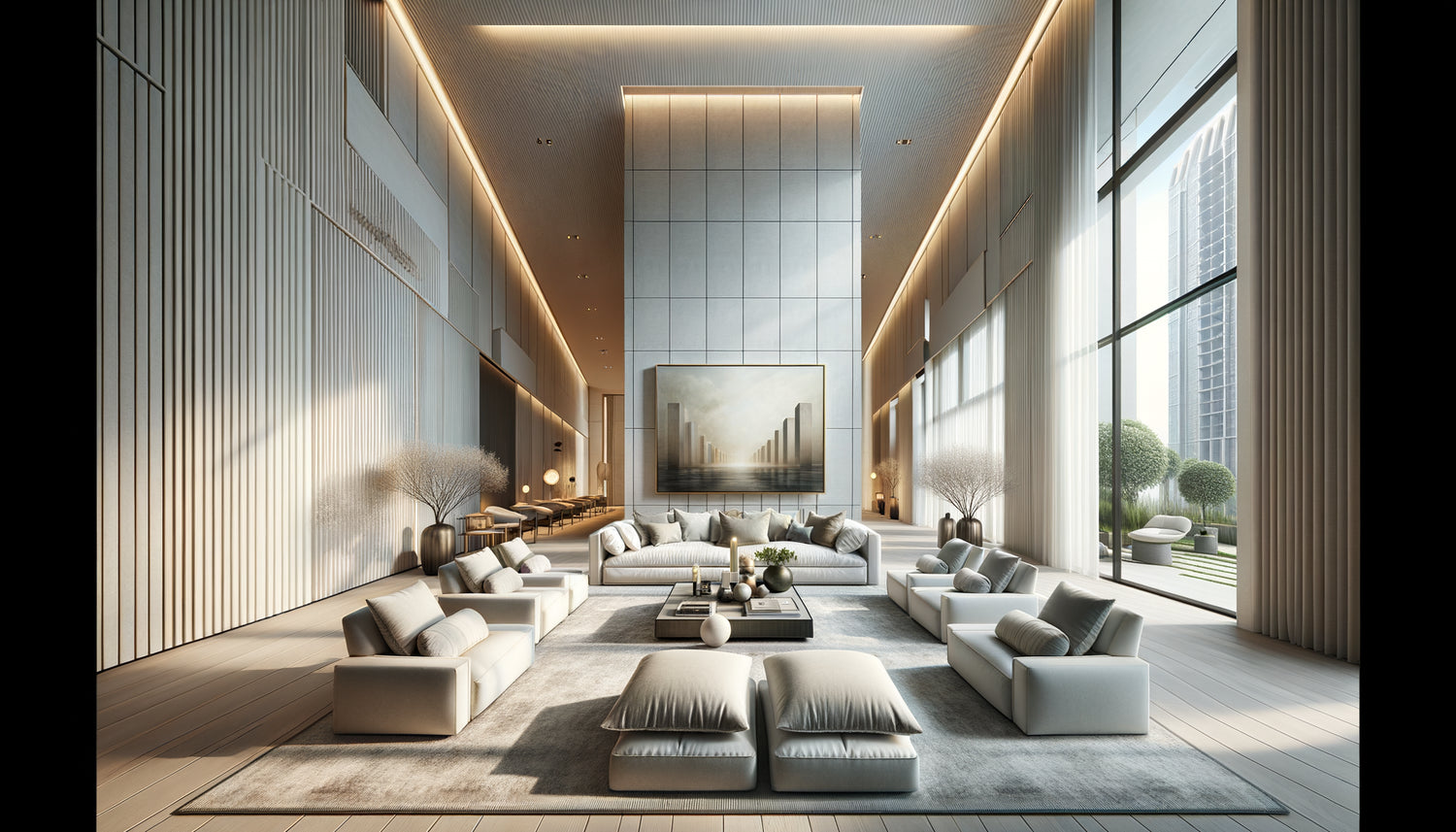
The first time I accompanied a client to their Parisian loft with four-meter cathedral ceilings, I was struck by this paradox: a magnificent volume that nevertheless felt cold, almost intimidating. The space breathed, certainly, but it desperately lacked soul. That's when I realized that choosing an artwork for a living room with high ceilings is not a matter of chance, but of a true visual strategy.
Here's what a perfectly chosen artwork brings to your living room with generous volumes: it creates a visual anchor that humanizes the space, it structures the height by guiding the eye, and it transforms an impressive volume into a cozy cocoon. Three benefits that radically change the atmosphere of your room.
You've probably already felt this frustration: buying a piece you love only to realize, once hung, that it gets completely lost in the immensity of your wall. Or worse, that it accentuates the feeling of emptiness rather than filling it. I’ve seen this disappointment so many times that it pushed me to develop a methodical approach.
Rest assured: with the right guidelines, choosing an artwork for a living room with high ceilings becomes a creative pleasure rather than a puzzle. I'm going to share the principles that have transformed hundreds of vertiginous spaces into true havens of style. From rules of proportion to staging tips, you will have all the keys to make your ceiling height a majestic asset.
The golden rule of proportions: when size becomes your ally
In a living room with high ceilings, the biggest mistake is to undersize the artwork. I developed a simple rule after years of experimentation: for a ceiling exceeding 3.20 meters, your artwork must occupy at least one-third of the width of the main wall. On a 4-meter wall, this means a work of art at least 130 centimeters wide.
Why this proportion? Because an artwork for a living room with high ceilings must engage in dialogue with the volume, not disappear in its shadow. The human eye naturally seeks reference points in large spaces. A piece that is too small creates cognitive dissonance: the brain immediately perceives the imbalance.
For ceilings reaching 4 meters or more, I even recommend formats exceeding 150 centimeters in width or height. Panoramic horizontal formats work particularly well to visually lower the height and create an anchoring effect. Conversely, vertical formats sublimate the majesty of your volumes.
A trick that I use systematically: before buying, cut kraft paper to the planned dimensions and tape it to the wall. Live with it for a few days. This simulation immediately reveals whether the proportions harmonize with your architecture.
The art of strategic hanging to tame verticality
The hanging height of an artwork for a living room with high ceilings defies conventional rules. Forget the famous museum rule (center of the work at 1.60 meters from the floor): it produces a ridiculous effect in generous volumes, leaving meters of empty space above the work.
My approach prioritizes three strategic zones depending on the desired effect. Enhanced median placement positions the center of the artwork between 5.9 and 6.6 feet from the floor, creating a visual balance while maintaining an intimate connection with the living room's occupants. This height works wonderfully for low sofas and conversational arrangements.
For bolder compositions, ascending placement positions the painting noticeably higher, sometimes with the bottom of the artwork at 6.6 feet from the floor. This spectacular technique draws the eye upwards, celebrating the verticality of your architecture. I reserve this for strong graphic works or abstract compositions with vibrant colors that remain legible from a distance.
Finally, the wall composition technique transforms the entire height into a personal gallery. Several paintings of varying sizes create an ascending visual rhythm, like an artistic constellation that naturally guides the eye from floor to ceiling. This approach requires more planning but produces a striking effect in a living room with a high ceiling.

When the painting's style meets the architecture of volumes
Not all artistic styles dialogue with the same ease in relation to majestic heights. I have noticed that abstract works with broad brushstrokes deploy beautifully in these contexts. Energetic brushstrokes, color flows, dynamic compositions create a movement that naturally fills the space.
Panoramic landscapes constitute another category particularly well suited. A mountain scene, a stretch of sea, a misty forest: these subjects possess their own verticality or horizontality which resonates with your architecture. A painting for a living room with a high ceiling representing a landscape creates an imaginary window that opens the space rather than closing it.
For lovers of figurative art, large-format portraits produce a striking theatrical impact. A face 120 centimeters high becomes a presence, almost an inhabitant of your living room. This boldness works particularly well in contemporary interiors with clean lines.
I often guide my clients towards polyptychs or triptychs: several panels forming a unique work. This fragmentation allows to cover a large wall surface while creating a visual rhythm that lightens the massiveness of a single large painting. The space between the panels becomes an element of composition itself.
The color palette: when color sculpts the space
In a living room with high ceilings, the choice of colors in a painting radically influences the perception of volume. Cool and light shades – sky blues, aquamarine greens, pearl grays – accentuate the feeling of space and height. They are perfectly suited if you want to celebrate this verticality, create an airy and luminous atmosphere.
Conversely, warm and deep tones – earthy reds, burnt ochres, midnight blues – visually bring walls closer and psychologically lower the ceiling. A large painting with warm hues creates a cocoon effect in a space that might seem too vast. This strategy works wonderfully in living rooms where you are looking for intimacy despite generous volumes.
Strong contrasts constitute a third path: a painting for a living room with high ceilings combining deep black and bright white, or juxtaposing vivid complementary colors, becomes a powerful focal point that instantly anchors the gaze. This graphic approach is particularly suitable for contemporary or industrial interiors.
Never forget to analyze the natural light in your living room. A north-facing wall will benefit from warm and luminous colors that compensate for the coolness of the natural lighting. A south-facing wall bathed in sunshine can accommodate cooler tones without appearing austere.

The balance of furniture: creating a dialogue between the high and the low
A painting for a living room with high ceilings never lives alone. It constantly dialogues with your furniture, and this visual exchange determines the harmony of the whole. The first rule: create a visual connection between the artwork and an anchor piece of furniture – sofa, console, fireplace – located just below or nearby.
When hanging a painting above a sofa in a living room with high ceilings, ideally leave 30 to 40 centimeters between the backrest and the bottom of the frame. This breathing space creates a visual unity while avoiding the “stuck” effect that would minimize the presence of the artwork.
For compositions without furniture directly below, I often introduce intermediate vertical elements: an architectural plant (a ficus lyrata, an indoor olive tree), a sculpture on a pedestal, or a designer floor lamp. These objects create a soft transition between the floor and the hanging artwork, naturally guiding the eye in its ascent.
The technique of decorative layering also works remarkably well: in front of the wall displaying your artwork, arrange several elements with progressive heights – a coffee table, a raised pouf, a side table, a medium-sized plant. This stratification creates a visual pyramid that enhances the work at the top of the composition.
Lighting and highlighting: revealing the magic after dark
A painting for a living room with high ceilings deserves dedicated lighting that transforms it into a true scenic installation once night falls. Generous ceilings offer the advantage of allowing spectacular light installations without visually cluttering the space.
Track spotlights are my favorite solution: flexible, discreet during the day, they allow precise adjustment of the angle of illumination. For a large-format painting, I recommend two spotlights positioned at 30° on either side of the work, creating uniform lighting without parasitic reflections.
Picture lights traditionally attached directly above the frame produce an elegant gallery effect. Choose proportionally sized models: for a 150 centimeter artwork, a 60 to 80 centimeter light maintains visual balance. LED versions avoid any heat harmful to the paint.
A more contemporary technique: indirect LED lighting concealed behind the frame. These bands create a luminous halo that visually detaches the work from the wall, giving it an almost floating presence particularly striking in living rooms with cathedral ceilings. The effect becomes truly architectural.
Ready to transform your living room into an exceptional gallery?
Discover our exclusive collection of wall art for Living Room that will sublimate your high ceilings with style and character.
Concrete inspirations for every interior style
For a contemporary living room with clean lines and 3.50 meter ceilings, I recommend a large horizontal minimalist abstract work: 200 x 100 centimeters in concrete gray, off-white tones and touches of gold. Hung 1.90 meters from the floor above a low anthracite sofa, it creates a perfect balance between sophistication and softness.
In an industrial loft with vertiginous volumes of 4.50 meters, the wall art for living room with high ceiling ideal adopts a powerful graphic approach: a vertical triptych composition in black and white, each panel measuring 80 x 180 centimeters. Arranged with 20 centimeters apart, they create a visual colonnade that celebrates the height while structuring the exposed brick wall.
For a reinvented classic interior, I suggest a large romantic landscape: a misty forest scene or a twilight seascape in a restrained gold frame. Format 180 x 120 centimeters, hung between 2 and 2.20 meters from the floor, creating an imaginary window that beautifully dialogues with the moldings and old parquet flooring.
The Scandinavian style with high ceilings calls for light compositions: several small botanical paintings or watercolors arranged in an asymmetrical constellation across the entire height of the wall. This organic approach maintains Nordic clarity while humanizing generous volumes with fragmented and airy artistic presence.
Visualize your transformation
Imagine yourself in a few weeks, comfortably settled on your sofa. Your gaze naturally rises to this work that you have carefully chosen. It no longer floats lost on a wall that is too large. It inhabits the space. It dialogues with the changing light throughout the hours. It anchors your living room in an atmosphere that finally resembles you.
Your guests cross the threshold and their gaze is immediately captured by this artistic presence which transforms your impressive volume into a sophisticated display case. It's no longer “a large living room,” it’s your living room, with its unique character, its soul revealed by this perfectly proportioned painting.
Start today by measuring your main wall. Note the ceiling height, available width, and viewing distance. These numbers are your compass. Then let yourself be guided by your aesthetic intuition, keeping in mind the principles of proportion and balance that we have explored. The ideal painting for your living room with a high ceiling exists: it awaits your gaze to reveal all its magic.
Frequently Asked Questions
What is the minimum size for a painting in a living room with a ceiling height of 3.50 meters?
For a ceiling height of 3.50 meters, aim for a minimum 120 centimeters in the main dimension of your painting. This is the threshold where the work begins to dialogue harmoniously with the volume without getting lost. If your main wall measures 4 meters wide, a format of 150 x 100 centimeters will create an even more satisfying balance. Don't be afraid to go big: in generous volumes, the boldness of proportions is often more harmonious than timidity. Also consider multiple compositions – three paintings of 80 x 80 centimeters aligned horizontally cover 240 centimeters and produce a considerable visual impact while pleasantly fragmenting the wall space.
Should I choose a vertical or horizontal format to enhance the height?
Both options work beautifully, but with opposite effects that need to be understood to choose consciously. A vertical format (e.g., 100 x 150 centimeters) amplifies and celebrates the verticality of your living room with a high ceiling. It draws the eye upwards, creating an impression of majesty and elevation. This option is particularly suitable if you like the cathedral effect and want to emphasize it. Conversely, a horizontal panoramic format (180 x 100 centimeters) visually lowers the perception of the ceiling, creating a feeling of anchoring and stability. This solution softens overly imposing volumes and creates a more cozy atmosphere. My advice: if your living room already seems warm despite the height, dare to go vertical; if it seems too vast or cold, prefer the reassuring horizontal.
How to prevent the painting from appearing lost on a very large wall?
The feeling of « loss » often comes from a visual isolation of the painting. Even perfectly sized, it can seem to float without connection to the rest of the decor. My three-step strategy: first, create an anchor furniture by positioning a sofa, console or low bookcase directly below the artwork or in close proximity. Then, add vertical transition elements – architectural plants, designer floor lamps, sculptures – that create a dialogue between the floor and the painting. Finally, don't hesitate to paint the wall a different color or create an architectural frame with moldings: this delimited background prevents the artwork from dissolving into the white immensity. For the most daring, panoramic wallpaper behind the painting creates a spectacular gallery effect that completely transforms the perception of space in your living room with a high ceiling.