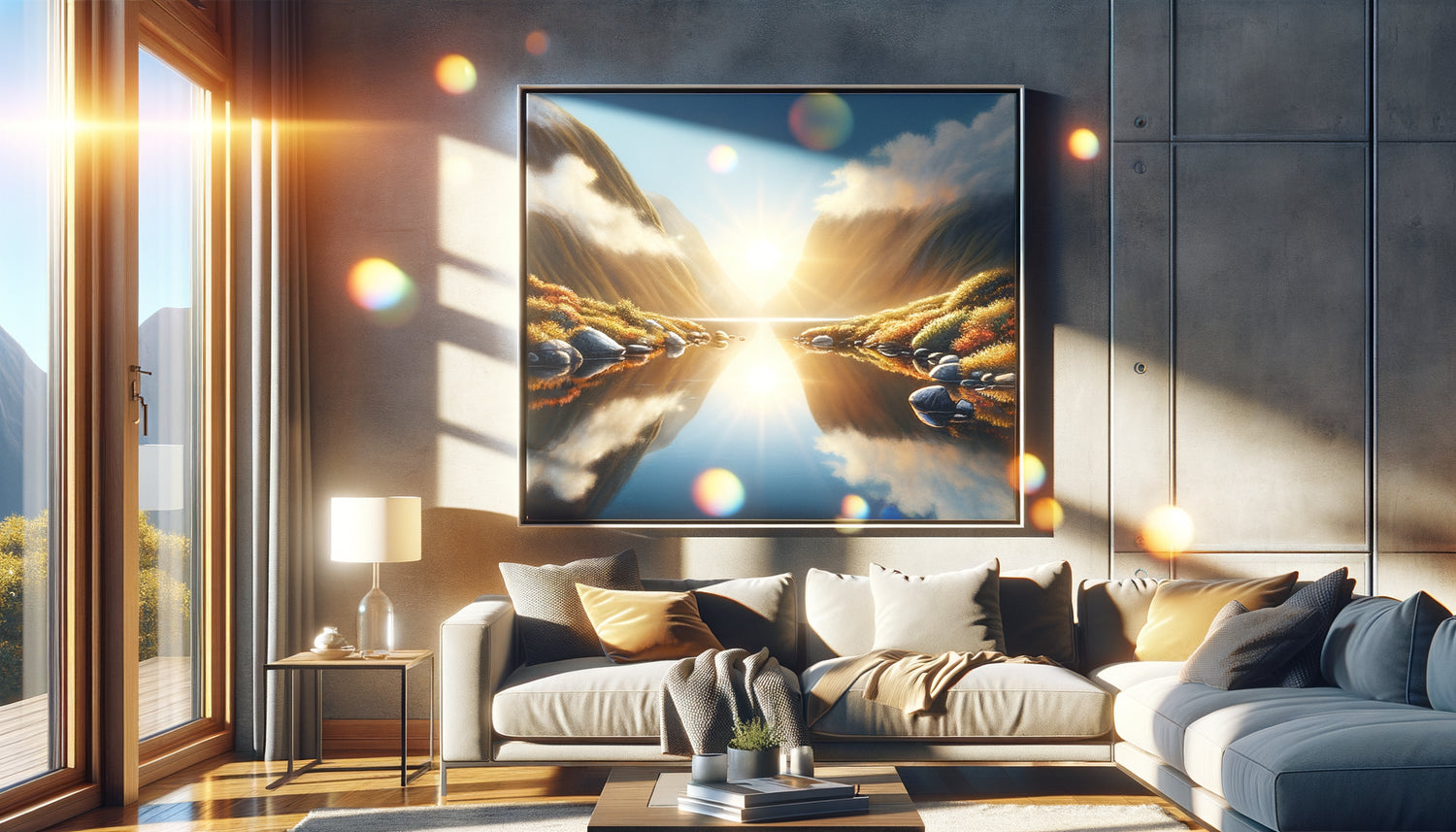
That morning, while installing a new canvas in the library of a Parisian apartment flooded with light, I watched my client’s face fall. Her magnificent abstract landscape, acquired at auction, was literally disappearing under a dazzling white veil. The sunlight was transforming her investment into an impenetrable mirror. I have witnessed this scene dozens of times in twenty years as a hanging advisor for galleries and private collectors.
Here's what a reflection-free installation brings to your bright living room: perfect visibility of your works at any time, optimal enhancement of your collection, and visual comfort that transforms every glance at your walls into a moment of pure pleasure.
You have invested in a work you love, chosen the ideal location in your light-filled living room, but here's the problem: it’s impossible to contemplate it without squinting. Reflections transform your painting into an unreadable shiny surface, especially at times when the brightness is most beautiful. This daily frustration spoils the pleasure that your decoration should bring you.
Rest assured: this problem affects all art lovers who prioritize bright spaces. There are elegant, often unknown solutions that preserve both the beauty of your interior and the readability of your works. None requires sacrificing your brightness or moving your paintings to darker areas.
I am going to share with you the professional techniques that I apply daily for my clients, from the novice collector to the seasoned gallerist. Simple adjustments that will transform your visual experience.
The rule of angles: understanding where reflections really come from
In my consulting workshop, I always explain this fundamental principle: a reflection is never a matter of chance. It obeys a simple physical law that every professional hanger knows by heart: the angle of incidence equals the angle of reflection. In concrete terms, if light strikes your painting at 45 degrees from the window, it bounces back exactly at the same angle towards your eyes.
This understanding changes everything. Rather than considering reflections as a fatality in a bright living room, you realize that they depend on three controllable variables: the position of the light source, the location of the painting, and your usual point of observation (usually your sofa).
I have developed a simple method to identify the problematic area. Position yourself where you usually contemplate your painting. Ask someone to hold a mirror in the place of the artwork. What you see in that mirror is exactly what will create reflections on your painted surface. A window? A luminaire? You have just identified your enemy.
Strategic inclination: the secret of museums
Pay close attention during your next museum visit: paintings are never perfectly vertical. They tilt slightly forward, usually between 5 and 15 degrees. This subtle inclination, invisible to the untrained eye, directs reflections downwards rather than towards the viewer.
To recreate this professional technique at home, the system is remarkably simple. Place two small adhesive wedges (available at hardware stores) behind the top of your frame. Start with a modest 5-degree tilt. Step back, observe from your sofa, and adjust gradually. The effect is often spectacular: the reflection that spoiled your contemplation disappears as if by magic.
However, be careful with heavy or large-format paintings. Inclination requires reinforced hanging system. I've seen too many canvases fall because the owner underestimated the effect of imbalance. For artworks weighing more than 5 kilos, consult a professional installer.
Mastering natural light without sacrificing brightness
The paradox of bright living rooms still fascinates me: we desperately seek natural light, then struggle against its undesirable effects. The solution is never to darken, but to filter intelligently.
Sheers are your first line of defense. Unlike blackout curtains that kill brightness, a quality sheer diffuses direct light while preserving the overall clarity of your room. I consistently guide my clients towards technical fabrics specifically designed for this function: semi-transparent linen, tightly woven cotton, or microfiber sheers.
Timing also matters. If your painting receives direct sunlight between 3 p.m. and 5 p.m., a simple adjustment to your habits can change everything. Partially close the sheer during this critical window, then fully reopen it. This dynamic management of natural light requires initial discipline but quickly becomes an automatic habit.
Perpendicular positioning: avoiding the line of fire
Golden rule that I apply in 90% of my installations: never place a painting facing a direct light source. If your window is south-facing and your sofa faces north, hang your artworks on east or west walls. Natural light will illuminate the painting laterally without creating a reflection towards your viewing point.
This perpendicular configuration radically transforms the visual experience. The painting captures ambient brightness without suffering the direct onslaught of rays. Colors remain vibrant, nuances visible, textures readable. It's the difference between looking at a phone screen in full sun and in the shade: same device, totally different experience.
For living rooms where this perpendicularity is impossible (windows on multiple walls, panoramic bay windows), consider mobile wall mounts. These self-supporting structures allow you to create artificial walls exactly where the lighting geometry requires it. A more expensive solution, certainly, but one that definitively solves the problem in complex spaces.

Anti-reflective glass: investment or gimmick?
This question consistently comes up during my consultations. Anti-reflective glass, also called museum glass, divides collectors. Some consider it a revolution, others a superfluous luxury. After testing dozens of references on hundreds of installations, my position is nuanced.
Anti-reflective glass works through surface treatment: microscopic layers eliminate up to 99% of light reflections. The result is striking, almost unsettling. You get the impression that the painting floats directly on the wall, without protection. Transparency is absolute, even in direct sunlight.
But this technological miracle comes at a price: expect between 150 and 400 euros depending on the format, which is often more expensive than the frame itself. For a work of great sentimental or financial value, the investment is fully justified. For an 80 euro decorative reproduction, the calculation becomes less obvious.
Affordable alternatives that really work
If museum glass exceeds your budget, matte glass is an excellent compromise. Less effective (it reduces about 60 to 70% of reflections), it costs three times less and is quite sufficient in most domestic situations. Its slightly frosted appearance can even add an interesting texture to some contemporary works.
For tight budgets, consider anti-reflective spray. These specialized products are applied directly to existing glass and modestly but noticeably reduce reflections. Efficiency limited to 30-40%, but for 15 to 25 euros, it may be enough to make a painting readable again in a moderately bright living room.
Last option that I often recommend: the complete absence of glazing. On modern canvases protected by multiple layers of varnish, glass is often just an aesthetic convention. Without it, no reflection is physically possible. Just make sure your work is properly varnished and that you don't touch it directly (skin oils gradually degrade the paint).
Artificial lighting: creating ideal conditions
When natural light is a problem, take control with artificial lighting. This is my preferred method for serious collectors: rather than being at the mercy of the sun, we create a stable, controllable, optimized luminous environment.
Adjustable LED spotlights on rails are the professional solution par excellence. Mounted to the ceiling 1.5 meters in front of the artwork, tilted downwards at a 30-degree angle, they generate uniform lighting that enhances the work without creating hot spots or reflections towards the viewer. Color temperature is extremely important: prioritize 3000K (warm white) for classic paintings, 4000K (neutral white) for contemporary art.
Specialized picture wall lights offer an elegant alternative. Mounted directly above the frame, they create a pool of directed light. However, be careful about the heat generated: some halogen models can damage the paint over time. Modern LEDs eliminate this risk while consuming 90% less energy.
The technique of dominant ambient lighting
A less well-known but remarkably effective strategy is to increase the general lighting in your living room to drown out reflections in a homogeneous brightness. When the entire room is bathed in uniform light from 500 to 700 lux, point reflections become much less annoying because the contrast decreases.
This approach requires a holistic reflection on your domestic lighting. Multiply the sources: dimmable floor lamps, indirect wall lights, LED strips behind furniture. The goal is to create multiple layers of light that overlap and balance each other. Your artwork is no longer a focal point assaulted by direct light, but an element harmoniously integrated into a coherent luminous environment.
A significant investment indeed (allow 500 to 1500 euros to rework the complete lighting of a living room), but which radically transforms the overall ambiance of your room, far beyond the simple question of reflections on paintings.
Your living room deserves artworks perfectly visible, whatever the time of day
Discover our exclusive collection of wall art for Living room that will enhance your walls without ever disappearing under reflections.

Transform your bright living room into a personal gallery
Imagine: you come home in the late afternoon, that golden hour when natural light is at its peak. You settle on your sofa with a cup in hand, and your gaze naturally falls on your favorite painting. This time, no white veil hides the colors. The nuances are present, the details visible, the emotion intact. Exactly as you imagined it the day you acquired it.
This daily visual comfort, this ability to contemplate your works in all lighting conditions, is not a luxury reserved for professional galleries. It's the result of simple and thoughtful choices: an adjusted hanging angle, a well-chosen voile, discreet additional lighting.
Start with a single work, the one that frustrates you the most. Apply the tilting technique this week. Observe the difference. Then proceed methodically to the other paintings in your collection. In a month, your bright living room will have become what it should always have been: a perfect showcase for your artistic favorites.
Frequently Asked Questions
Are all types of paintings affected by reflections?
Absolutely, but not in the same way. Paintings under glass (watercolors, engravings, framed photographs) are the most vulnerable because the glass reflects light directly like a mirror. Oil or acrylic paints with varnish also create reflections, but generally less pronounced as the surface is slightly textured. Matte canvases without varnish are the least problematic, but be careful: without protection, they accumulate dust and degrade more quickly. If you are starting your collection and your living room is very bright, prioritize works on matte canvas or invest immediately in a frame with anti-reflective glass. This will avoid daily frustrations and subsequent reframing costs. The nature of the pictorial surface directly influences your anti-reflection strategy.
Can reflections damage my painting over time?
This is an excellent question that few people ask. Reflections themselves do not damage the artwork, but they often reveal a more serious problem: direct exposure to UV rays. If you see intense reflections at certain times of day, it means your painting is likely receiving direct sunlight. UV rays degrade pigments over time, particularly reds and blues which irreversibly fade. By resolving your reflection issue with filtering curtains or repositioning, you simultaneously protect the longevity of your collection. It's doubly beneficial. For valuable artworks, invest in anti-UV glass (often combined with an anti-reflection function) that blocks 99% of harmful radiation. Your painting will retain its vibrant colors for decades while remaining perfectly visible in your bright living room.
Can we solve the problem of reflections without drilling additional holes in the walls?
Absolutely, and it's often my first recommendation for renters or those who hesitate to drill multiple holes. The simplest solution is to tilt the existing painting with repositionable adhesive pads, which requires no new drilling. You can also play solely on textiles (filtering curtains, drapes) and mobile accent lighting (adjustable floor lamps, standing spotlights). Freestanding wall mounts are another zero-hole option: these independent metal structures allow you to hang your paintings exactly where the light is least problematic, without touching the walls. Finally, the most radical but also the most reversible solution: temporarily change the painting's wall according to the seasons. In summer, when the sun is high and intense, move it to a wall perpendicular to the windows. In winter, when the lighting is softer, put it back in its ideal location. This seasonal rotation also protects your artworks from prolonged light exposure in the same place.