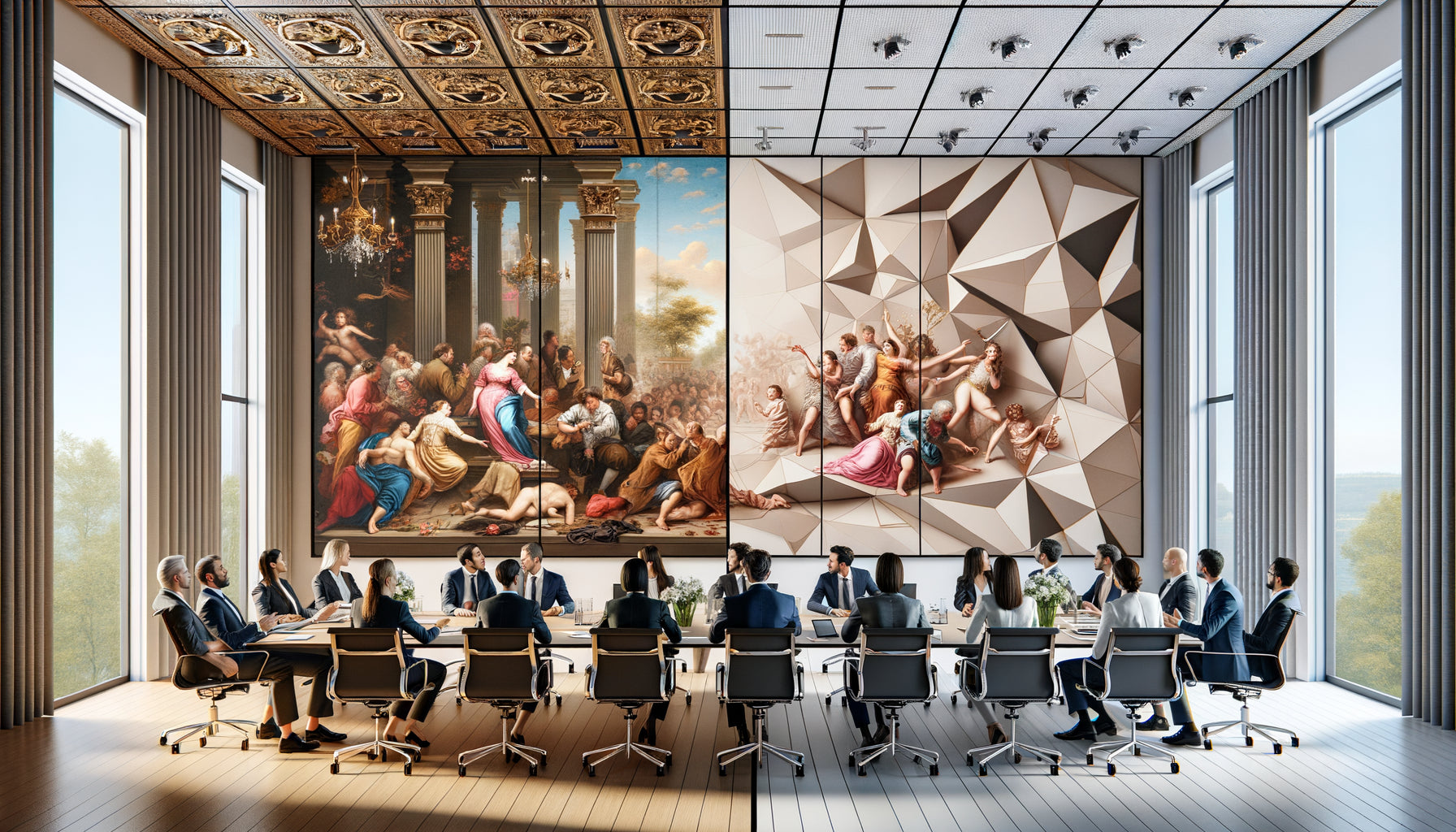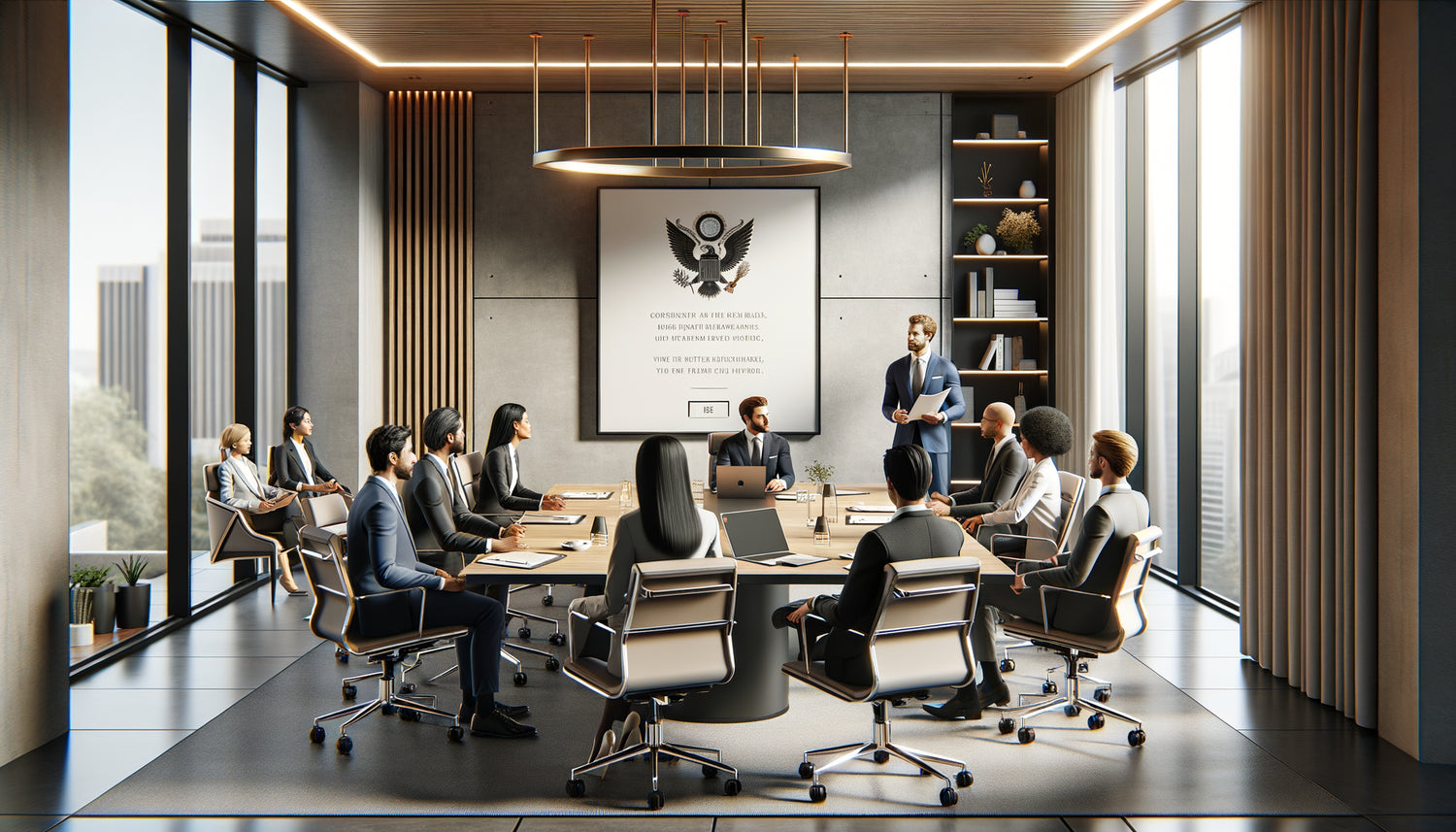
The meeting room door closes. Twelve pairs of eyes turn to the projection screen. The air is heavy, almost electric. In a few seconds, you will animate this strategic meeting that must unlock the project bogged down for three weeks. Then, something unexpected happens: your sales director's gaze lingers on the side wall, where stands this new artwork with its quote in gold lettering. A slight smile. A posture straightens. The energy has changed.
Here is what inspiring quotation artworks bring to team meetings: they create a positive emotional anchor that reduces collective anxiety, they establish a psychological framework conducive to creativity, and they act as visual reminders of shared values that realign priorities when discussions go astray.
You've probably already felt this frustration: meetings going around in circles, collaborators mentally absent, that diffuse feeling that despite the perfect agenda and impeccable slides, something is missing to truly unite the group. You invest in management training, animation techniques, but the atmosphere remains sometimes heavy, especially during difficult discussions.
Rest assured: the solution does not lie solely in your animation skills. The physical environment of your meeting rooms plays a much more decisive role than we imagine on collective dynamics. And among all the levers at your disposal, quotation artworks are one of the most underestimated tools for professional space design.
I will show you exactly how and why these decorative elements subtly but profoundly transform the quality of your team exchanges, based on what I concretely observe in companies that integrate them intelligently.
The invisible power of permanent visual messages
Unlike what is said during a meeting - words that evaporate as soon as they are spoken - a quotation artwork remains. It silently occupies the visual space, imprinting itself in everyone's peripheral memory even before the session begins. When Sophie, marketing manager at a Parisian scale-up, arrives fifteen minutes early, she consults her notes while sipping her coffee. Her gaze naturally scans the room and stops for a few seconds on this inspiring artwork proclaiming 'Creativity is born from the courage to offer the imperfect'. Without even realizing it, she has absorbed a message that will color her mental disposition.
This phenomenon of cognitive priming has been documented by social psychology for decades. Our brains constantly process environmental stimuli, even those we do not consciously pay attention to. A motivating message strategically positioned in a meeting room acts as a discreet programmer of our mental states. It does not obviously replace inspiring leadership or a clear vision, but it prepares the emotional ground on which your words will fall.
The mirrored effect of displayed values
Quote art also functions as identity mirrors. When a team gathers under a message proclaiming 'Excellence is the sum of our small attentions', it’s not just decorative. It's a tangible reminder of what the group exists for, a common reference point when egos clash or priorities diverge. Marc, director of a Lyon-based communication agency, confided that he deliberately installed three motivational art pieces in his main meeting room after a period of internal tensions. 'During a tense disagreement over a client strategy, someone literally pointed to the artwork and said: 'We're forgetting that'. It broke the escalation.'
This ability to re-anchor a discussion in shared values may be the most valuable asset of inspiring messages displayed. They don’t take sides in conflicts, but they elevate the debate. They gently remind you that you are not there to be right individually, but to succeed collectively.
How quotes concretely change the atmosphere of meetings
Observe the typical dynamics of a crisis meeting. Anxiety rises. Shoulders tense. Eyes dart away. In this state, the reptilian brain takes over: our superior cognitive abilities - creativity, systemic thinking, collaboration - are drastically reduced. We switch to survival mode, and meetings become sterile exercises in territorial protection.
A well-chosen artwork with a quote acts as a pattern interrupt. Imagine this message displayed facing participants: 'Every problem carries within it the germ of its solution'. This simple sentence cognitively reframes the situation. The problem is no longer a threat, but a challenge containing its own resolution. This micro-reframing, repeated meeting after meeting, gradually installs a different psychological culture in this space.
The psychology of colors and typography
The effectiveness of an inspiring artwork doesn’t depend solely on the textual message. The color palette, the typographic choice, the visual composition play a decisive role. Warm hues (ochres, terracotta, golds) create an enveloping atmosphere that promotes cohesion. Deep blues and elegant grays establish an atmosphere of serious reflection, ideal for strategic meetings. A handwritten typography humanizes the space, while architectural lettering reinforces the professional dimension.
Julie, an interior architect specializing in workspaces, systematically selects motivational artworks based on the identity of each company. 'For a tech startup, I prefer bold messages with dynamic graphic compositions. For a law firm, more classic quotes in understated frames. The mismatch between the message and the company's identity creates a counterproductive dissonance.'

Three fatal mistakes in choosing quotes
Not all artwork with quotes are created equal. Some choices, despite the best intentions, produce the opposite effect of what is sought. First mistake: overly generic or banal quotes. 'Together, anything is possible' or 'Believe in your dreams' at best generate indifference, at worst cynicism. Your employees are not fooled. A hollow message displayed on a wall remains a hollow message, just more visible.
Second trap: the inadequacy between the message and the lived reality. Displaying 'Failure is our best teacher' in a corporate culture that sanctions the slightest mistake creates a toxic dissonance. The motivational artwork then becomes a permanent reminder of organizational hypocrisy. Demotivating effect guaranteed.
Third error: overload. Multiplying inspiring artworks in the same space dilutes their impact to the point of creating visual noise. A single powerful message, perfectly positioned, surpasses ten scattered phrases. The golden rule: one artwork per wall maximum, placed within the natural field of vision of seated participants.
The long gaze test
Here's how to evaluate the relevance of a quote before displaying it: read it carefully, then ask yourself if you would be proud to defend this principle in front of your team during a difficult discussion. If the answer is yes, this inspiring message has its place on your wall. If you feel even slight discomfort, abandon it. Perceived authenticity makes all the difference between a decorative element that unites and an object that irritates.
The quotes that truly transform team dynamics
After observing dozens of professional environments, certain types of messages stand out for their measurable effectiveness on the quality of interactions. Process-oriented quotes rather than result-oriented ones work remarkably well. 'Progress is measured in questions asked, not answers found' repositions a team towards exploration rather than immediate performance. This opens up the mental space needed for innovation.
Messages that normalize vulnerability also create profound transformations. 'Courage begins when you say 'I don't know'' explicitly allows the expression of doubts, reducing this exhausting dance where everyone pretends to master everything. In meetings following the installation of such motivational wall art, uncomfortable silences are more easily filled with constructive confessions.
Finally, quotes that celebrate interdependence strengthen cohesion. 'Your success amplifies mine' or 'We are the sum of our mutual contributions' directly counter internal competitive dynamics. These messages do not eliminate competition - sometimes necessary - but they recontextualize it within a collective framework.
Adapting the message to the company's moment
Strategic intelligence consists of evolving your inspirational wall art according to the phases that the organization goes through. During a period of rapid growth: messages about rigor and consolidation. During a difficult transformation: quotes about resilience and adaptation. When launching an ambitious project: words about boldness and experimentation. This rotation creates a sense of narrative coherence between the physical environment and the collective experience.

Strategic placement makes all the difference
A wall art with quote poorly positioned loses 80% of its effectiveness. The optimal location depends on your spatial configuration, but some universal principles apply. Ideally, the message should be visible from the seats of participants without requiring significant head rotation. The wall facing the entrance door is generally the best choice: it visually welcomes arrivals and remains in the peripheral field of vision during interactions.
Absolutely avoid placing a motivational artwork behind the usual position of the speaker. This forces participants to focus on that area, creating attentional confusion: should they look at the presenter or the message? Height also matters. The center of the artwork should be between 145 and 160 cm from the floor, corresponding to the eye level of a seated person.
Lighting is the most neglected factor. A inspiring artwork plunged into shadow or drowned in backlighting loses all its power. Provide indirect lighting that highlights the message without creating annoying reflections. Some companies even install subtle directional spotlights that emphasize the importance given to these elements.
Ready to transform the energy of your team meetings?
Discover our exclusive collection of wall art for Meeting Room that combines refined design and powerful messages, designed to create inspiring collaboration spaces.
Beyond decoration: creating a consistent visual culture
The most effective inspiring artworks integrate into a global approach of intentional space design. They dialogue with the other visual elements of the room: the quality of the furniture, the spatial organization, the presence or absence of plants, natural light. This aesthetic and symbolic coherence creates what could be called a 'semantic atmosphere' - an environment that constantly communicates aligned signals.
Thomas, organizational transformation consultant, systematically integrates the visual dimension into his interventions. 'I have seen teams block for months on relational problems, then quickly unlock after a complete redesign of their main meeting room, including three motivational artworks collectively chosen. It wasn't magic - it was the tangible signal that something was really changing, that old dynamics belonged to the past.'
This symbolic dimension of environmental change should not be underestimated. Modifying the physical space makes an abstract commitment to evolve visible and real. The displayed quotes then become markers of this collective intention, silent witnesses of a culture under construction.
Involve the team in choosing the messages
Maximum engagement is achieved when team members participate in the selection of inspiring artworks. Organize a short session where everyone proposes a quote that personally inspires them, then vote collectively. This process generates three benefits: it creates conversation around shared values, it ensures the message resonates authentically, and it installs a sense of shared ownership of the space.
Some companies go even further by implementing a semi-annual rotation. Every six months, an inspiring artwork changes, chosen by a different team member who briefly explains their choice during a meeting. This practice maintains perceptual freshness - our brains get used to constant stimuli - and it offers a recurring opportunity to reaffirm or readjust collective priorities.
Measuring the real impact on your meetings
How do you know if your artwork with quotes really make a difference? A few simple indicators can be used to evaluate their effectiveness. The first signal is the frequency of explicit references. If, during your discussions, participants begin to spontaneously quote the displayed message, it means that it has penetrated the conversational culture of the group. The second marker is the meeting start-up time. An inspiring environment generally reduces the social warm-up phase, with participants entering more quickly into a collaborative mindset.
The third indicator, more subtle: the evolution of language used. If your inspiring artwork focuses on innovation and experimentation, observe whether the vocabulary of participants evolves towards more exploratory terms rather than defensive ones. The fourth signal is the quality of silences. In toxic meetings, silences are heavy and anxious. In well-designed spaces with appropriate motivational messages, silences become reflective and fertile.
Of course, these transformations never result solely from artworks. They amplify and reinforce positive dynamics that you build through your leadership and management practices. But ignoring this environmental dimension is to neglect a accessible and remarkably effective lever.
What if you transformed your next meeting?
Imagine your next strategic meeting. You enter the redecorated room. The inspiring artwork that you have carefully chosen dominates the main wall, its warm colors immediately creating a different atmosphere. Your team members arrive gradually, and you notice these micro-changes: a smile when reading the quote, a more open posture, informal exchanges slightly more positive before the official start.
The meeting begins. Discussions follow one another. At a critical moment, when tension threatens to rise on a disagreement, you feel that the energy remains constructive. The message displayed on the wall has said nothing, intervened in nothing, and yet its silent presence contributed to maintaining the psychological framework necessary for collective intelligence.
You won’t miraculously transform your meetings with a single decorative element. But you will create an environment that supports your intentions, materializes your values, and gently but constantly reminds everyone why they are there together, seeking solutions rather than defending positions.
The simplest and most powerful action you can take this week: gather your team, even for fifteen minutes, and ask them which quote would inspire them during difficult collective moments. Then offer that quote a place of honor in your meeting space. Observe. Listen. And see how this small environmental change opens up unforeseen possibilities.
Frequently Asked Questions
Do quote art pieces really work or is it just aesthetics?
This is the legitimate question that every pragmatic manager asks. The nuanced answer is: yes, they do work, but not as an isolated miracle solution. An inspiring artwork acts through accumulation and consistency. Its effect is not measured during a single meeting, but over several weeks of repeated exposure. The psychology of priming demonstrates that our brains constantly process environmental messages, even unconsciously. These messages influence our mental dispositions, our interpretive frameworks, and therefore our behaviors. However, this influence remains subtle and works optimally when it aligns with an authentically aligned management culture. An motivating artwork in a toxic environment changes nothing; the same artwork in a context of sincere efforts towards greater collaboration significantly amplifies those efforts. Consider it as a catalyst rather than a primary cause of transformation.
How do I choose the right quote for my specific team?
The optimal choice of a quote artwork rests on three fundamental criteria. First, alignment with your current challenges: if your team struggles to innovate due to fear of failure, prioritize messages that normalize experimentation. If interdepartmental collaboration is stalled, opt for quotes about collective intelligence. Second, emotional resonance: the message should trigger a slight click, an 'yes, exactly!' internal response in your collaborators. To test this, share three options during a meeting and observe spontaneous reactions. Third, durability: choose a quote deep enough to remain relevant for several months, but clear enough to be immediately understandable. Avoid metaphors that are too obscure and require explanation - an inspiring message speaks directly to intuition. And don’t hesitate to involve your team in the final choice: their adherence multiplies the impact of the selected message.
Should you regularly change wall art or keep the same message?
This question touches on a delicate balance between familiarity and freshness. Our brain has a remarkable ability to adapt: we gradually cease to consciously perceive constant stimuli. After three to six months, your inspiring wall art may become 'invisible' cognitively, blending into the background. This suggests regular renewal. However, there is also value in constancy: a message that remains present over time becomes more deeply rooted in collective memory and becomes a stable cultural reference. The optimal solution? Keep your main motivating wall art - the one that embodies your core value - permanently, but add a second rotating location that changes every quarter according to seasonal priorities. This approach combines anchoring and renewal. An elegant alternative: keep the same location but change the frame or colors periodically, creating renewed familiarity. The key is to avoid both overwhelming change which creates confusion, and total fixity which leads to indifference.