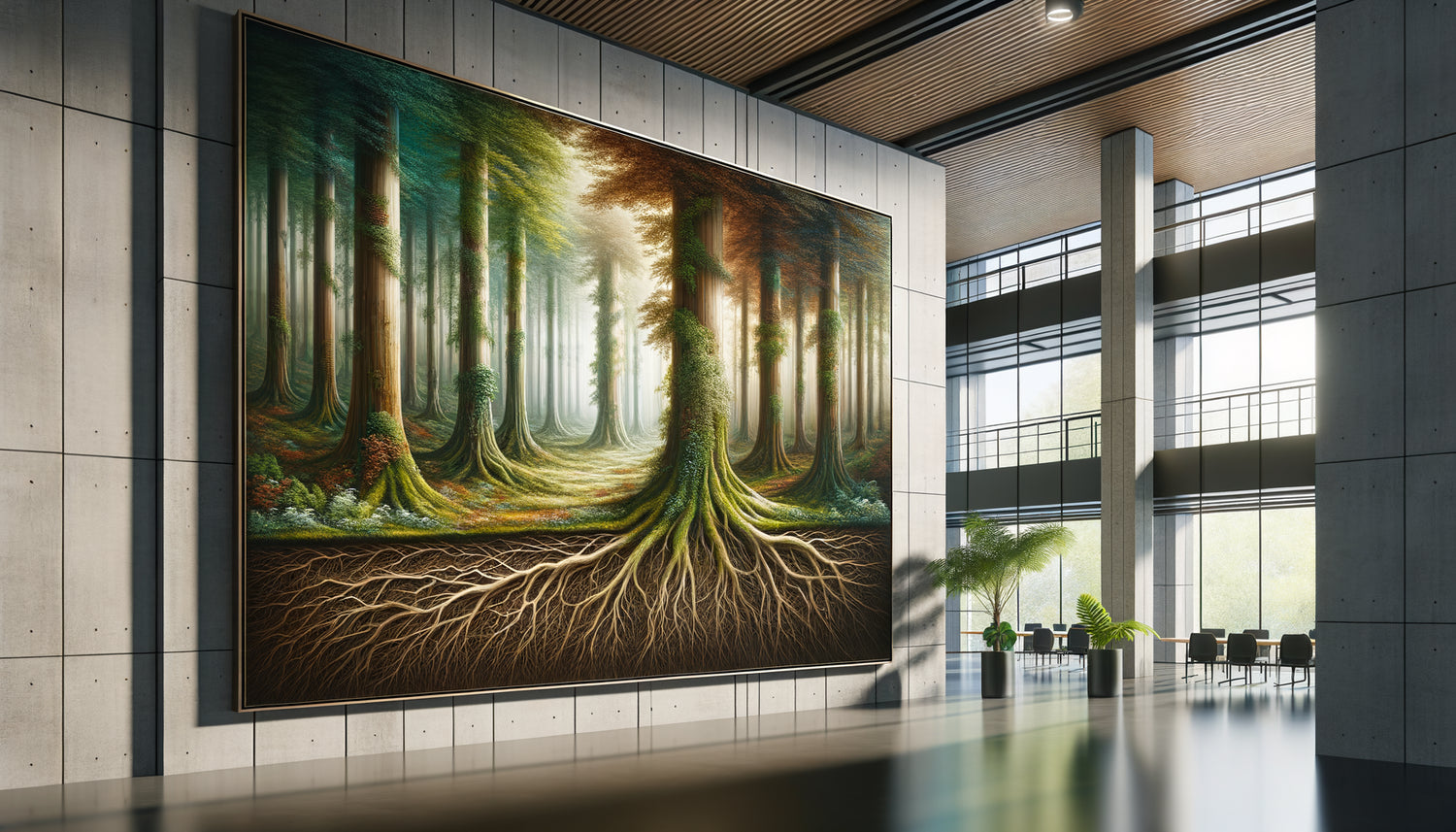
I recently accompanied the leader of a rapidly expanding startup. Her office, ultramodern but cold, reflected the constant urgency of her days. She confided in me her exhaustion: "I want my teams to feel connected, not like cogs." Observing the space, I immediately thought of these forest paintings that now adorn the headquarters of Europe's most innovative companies. Three months later, she sent me this photo: her team gathered in front of a monumental sequoia forest, smiles on their faces.
Here's what a forest painting brings to your business ecosystem: a visual metaphor for organic growth that inspires collaboration and resilience, a natural anchor that reduces stress by 23% according to the University of Melbourne, and a symbol of sustainable development that strengthens your brand identity.
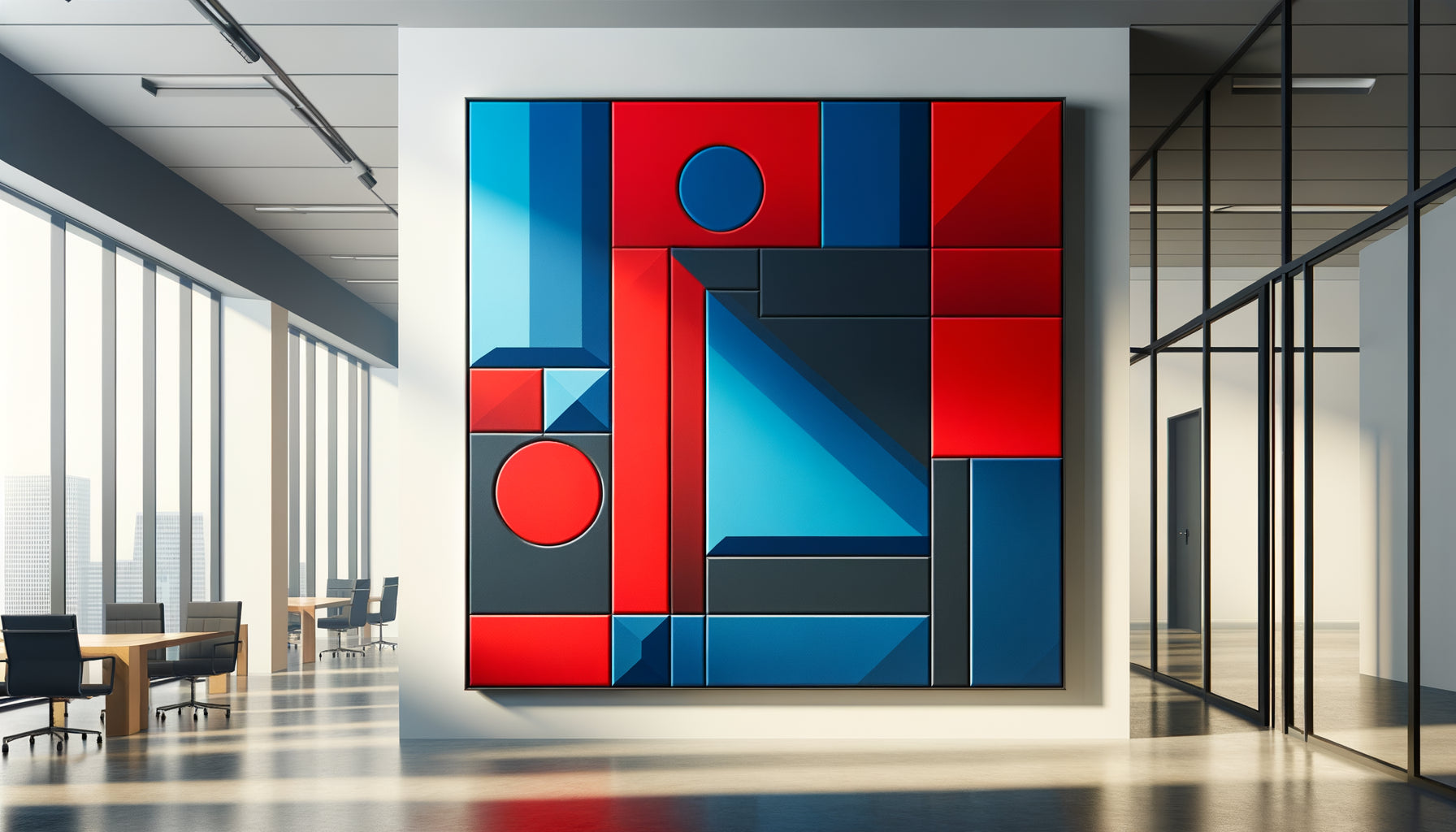
Too many companies decorate their spaces with soulless geometric abstractions or motivational slogans that ring hollow. The result? Disconnected employees, a corporate culture difficult to embody, talents seeking meaning elsewhere. Yet, the solution has been before our eyes for millennia: the forest as a model of living organization.
Whether you lead an SME in transformation or coordinate hybrid teams, you can transform your professional environment into an inspiring ecosystem. Without a colossal budget or architectural revolution. Simply by understanding why forest paintings resonate so deeply with contemporary organizational challenges.
When the canopy meets the org chart
In a mature forest, no tree grows alone. Century-old oaks share their nutrients with young saplings via an invisible root network. Pioneer birches prepare the ground for more demanding species. This organic growth follows no five-year plan but produces ecosystems of extraordinary resilience.
It's exactly this paradigm that modern organizations are seeking. The time has passed for rigid pyramidal structures. High-performing companies cultivate business ecosystems where information circulates horizontally, where mentors naturally transmit, and where each talent finds its ecological niche.
A forest painting in a meeting room is not just a decorative element. It's a silent manifesto that daily reminds of this philosophy. When you negotiate a partnership in front of a beech forest, the subliminal message is powerful: we believe in lasting alliances, not dominance reports.
The invisible roots of collaboration
Scientists have discovered the “wood wide web” – this mycorrhizal network that connects trees to each other. A mother tree can nourish up to 47 young plants simultaneously. She detects their needs and adjusts her carbon transfers accordingly.
This metaphor fascinates management experts for a reason: it perfectly illustrates organic leadership. In your company too, invisible connections count more than the official organizational chart. Informal mentorships, cross-functional collaborations, coffee machine conversations – that's where true organic growth takes place.
A painting depicting a forest with its superimposed vegetation layers materializes this complexity. The canopy that captures the light, the shrubs that create habitat, the litter that nourishes the soil – each level has its role in the corporate ecosystem. Your salespeople may be the visible canopy, but without the IT groundwork, nothing works.
Collective intelligence in action
I installed a series of forest paintings at a consulting firm going through a difficult merger. Two corporate cultures clashing. The HR manager organized a workshop in front of these visuals: "Observe this mixed forest. Conifers and deciduous trees don't compete with each other, they create a richer ecosystem." Six months later, this metaphor had become their common language for managing diversity.

Resilience as organizational DNA
A forest that has experienced a fire regrows more diverse. A felled tree becomes the habitat of hundreds of species. This ability to transform crisis into opportunity defines ecological resilience – and should define your company.
The most powerful forest paintings show this temporal dimension. A clearing where light pierces after a storm. Dead trunks colonized by mushrooms. These images normalize failure as an integral part of organic growth. They remind us that disruptions are not bugs, but features of the system.
In a volatile economic world, this symbolism speaks directly to your teams. The painting becomes a psychological anchor during restructurings. "We are this forest after the storm: temporarily weakened, but in full regeneration." This type of visual storytelling reinforces cohesion much better than a corporate email.
Why tech startups adopt forests
A fascinating paradox: the most technologically advanced companies are those that invest heavily in forest imagery. I visited the offices of a French unicorn – monumental forest paintings in every open space, while they develop artificial intelligence.
Their CEO explained to me: "Our engineers spend 10 hours a day in pure abstraction. Algorithms, data, cloud architectures – nothing tangible. These forests reconnect them to the real world, to the living, to the organic complexity that inspires our machine learning models."
This trend reveals something profound about our era. The more immaterial our work becomes, the more we need natural anchors. Forest paintings offer this sensory compensation. They create a soothing counterpoint to permanent hyper-connectivity.
Biomimicry as a culture of innovation
Forests embody 385 million years of incremental innovation. No R&D department can rival this track record. By displaying forest paintings, you subtly suggest that inspiration can come from the living, not just competitors.
This philosophy of biomimicry transforms brainstorms. "How would a forest solve this logistical problem?" becomes a legitimate question. The corporate ecosystem is enriched with new metaphors: cross-pollination of ideas, unexplored niches, strategic symbioses.

Choosing your forest according to your corporate culture
Not all forests communicate the same message. A Scandinavian boreal forest evokes Nordic rigor, sobriety, and sustainability. A tropical jungle speaks of explosive diversity, creative abundance, and rapid growth. A temperate autumn forest celebrates cyclical transformation.
In my consultations, I always analyze the company's development phase. A series A startup might prefer a young, dynamic forest, with slender trees growing vertically – a perfect metaphor for their scaling. A century-old company reinventing itself will identify more with an old forest that is regenerating.
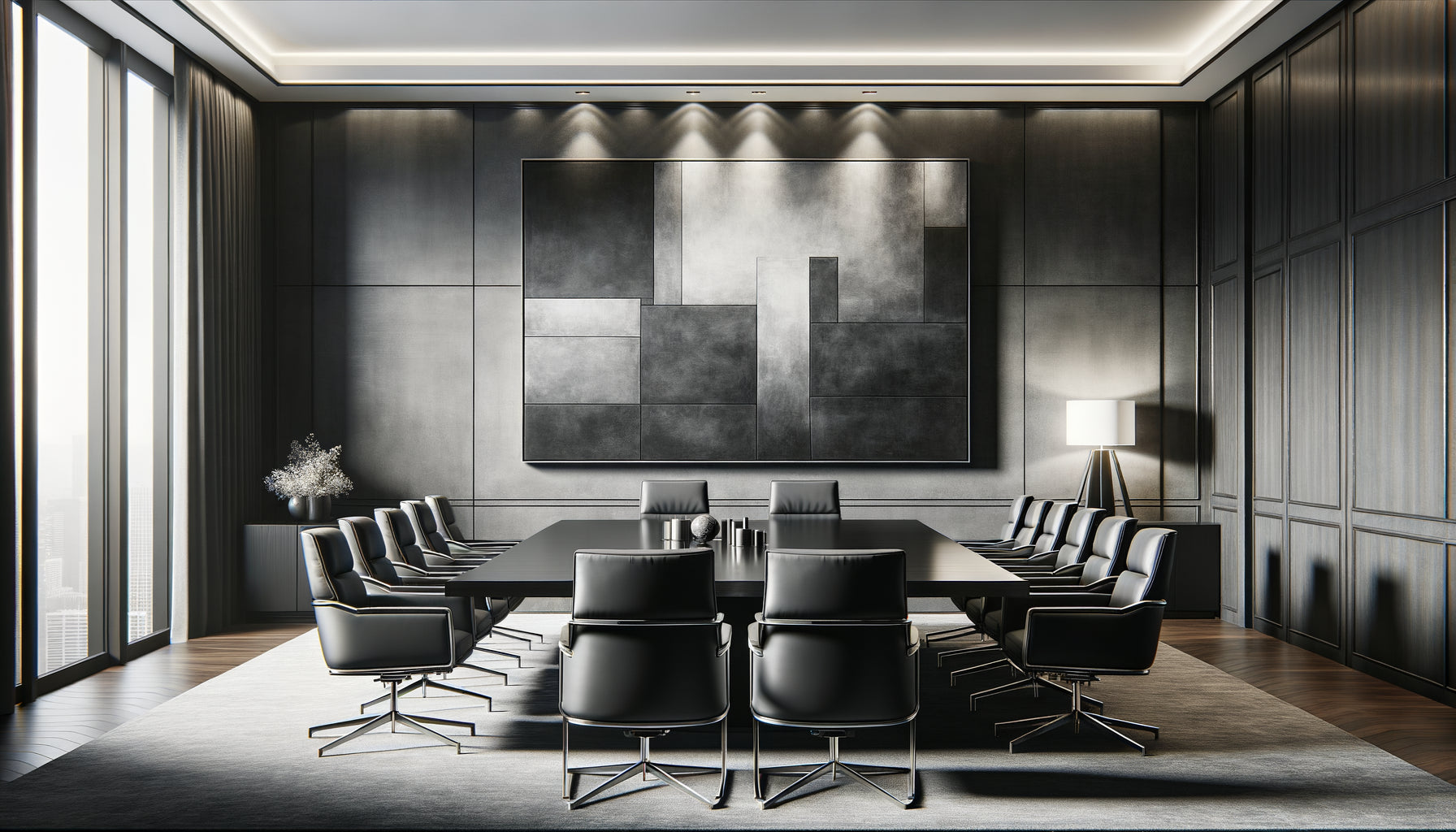
Black and white forest paintings convey timeless elegance, ideal for the luxury or strategic consulting sectors. Color-saturated forests are suitable for creative agencies and lifestyle brands. The color palette becomes an identity language.
The scale as a leadership tool
A detail I consistently observe: the human presence in the forest artwork. A small character at the foot of giant sequoias radically changes the narrative. It recalls humility in the face of something greater than oneself – a valuable antidote to entrepreneurial hubris. Without human presence, the forest becomes an abstract ideal, almost intimidating.
The size of the artwork also matters enormously. A monumental format (2m x 1.5m) in an entrance hall affirms: “Nature is our main reference.” Medium formats (80cm x 60cm) in individual offices function as contemplative windows, visual breaths.
Beyond the symbol: measurable benefits
Let's pause the poetry to talk about data. The University of Queensland measured the impact of natural visuals in a professional environment. Striking results: 15% increase in declared well-being, 23% reduction in stress markers, 18% improvement in creativity on standardized tests.
Forest artworks produce what is called the “window effect” – the same cognitive benefits as a real view of nature, accessible even in an open space without windows. For companies in city centers, this is a valuable compensation.
I documented a particularly compelling case at a call center. Critical turnover, sick leave increasing. After installing large forest artworks in break areas, turnover fell by 31% in eight months. Employees spontaneously mentioned these “recharging” spaces in internal surveys.
The organic growth of a company goes hand in hand with talent retention. If an artwork can help reduce burnout, its ROI far exceeds its acquisition cost.
Ready to transform your professional environment into an inspiring ecosystem?
Discover our exclusive collection of art for Meeting Rooms that embodies organic growth and strengthens your company culture.
Cultivating your inner forest
Imagine in six months. Your new recruit crosses the threshold of your company. Their gaze stops on this forest artwork majestic in the hall. Even before the first meeting, they intuitively perceive your values: patient growth, assumed interdependence, organic resilience. They already see themselves as a young tree finding its place in your canopy.
Forest wall art doesn't just decorate your walls. It seeds a living, breathing, evolving corporate culture. It daily reminds that the most effective business ecosystem isn’t the fastest, but the most adaptive. Not the most dominant, but the most symbiotic.
Start modestly if you wish. A single painting in your main meeting room. Observe how it subtly changes dynamics. How conversations calm down. How natural metaphors invite themselves into your strategies. How your team begins to think of itself as a living organism rather than a machine.
Organic growth isn't decreed. It is cultivated, day after day, with patience and attention. Just like a forest.
Frequently asked questions about forest paintings in business
Does a forest painting suit all industries?
Absolutely, and that's precisely what makes this symbolism so powerful. I have installed forest paintings in traditional law firms as well as biotechnology startups. The forest speaks a universal language: that of growth, interdependence and sustainability. In the financial sector, it tempers the image of greed with a responsible dimension. In tech, it humanizes innovation. In industry, it recalls the importance of ecosystems. Simply adapt the painting style to your visual identity: minimalist and graphic for modern sectors, realistic and detailed for more classic environments. The key is authenticity: choose a forest that truly resonates with your values, not the one that seems most trendy.
How to integrate a forest painting without greenwashing?
Crucial question, because your employees immediately detect the inconsistency. A forest painting becomes greenwashing if your practices contradict the symbol. The solution? Accompany the visual with concrete actions, even modest ones. Launch a paper reduction program. Establish « forest meetings » by walking outside when possible. Sponsor a few hectares of real forest with your team. It's not the scale that matters, but the consistency. During installation, organize a collective moment where you explain why you chose this painting, what values it embodies for you, and invite your teams to take ownership of this metaphor. An authentic forest painting then becomes the starting point of a cultural transformation, not just a simple marketing facade. Your clients and employees will appreciate this sincere approach.
Where to position a forest painting to maximize its symbolic impact?
The location radically transforms the scope of the message. In an entrance hall, your forest painting becomes a statement of intent visible to all – clients, partners, candidates. It says: “Here is our philosophy even before we talk business.” In a strategic meeting room, it subtly influences important decisions, reminding you of the long-term vision when short-term pressure rises. In an open space, position it facing the workstations to offer this “window on nature” that reduces stress. Avoid passageways where no one really stops. Prioritize break areas where your employees can contemplate the painting while relaxing. A trick I often use: create a small green corner under the painting (a few potted plants), reinforcing the connection with nature. This coherent staging amplifies the biophilic effect and physically anchors the metaphor of the corporate ecosystem in your space.