The abstract watercolor you hung near the sink has lost its vibrancy in just a few weeks. The corners of your favorite lithograph are starting to warp. I observe this scene far too often during my interventions: beautiful works sacrificed on the altar of humidity, due to a lack of adequate ventilation.
Here's what proper ventilation brings to your bathroom artwork: durable protection against excessive moisture, preservation of pigments and support, and the ability to create a true aesthetic sanctuary without compromising your artistic investments.
The frustration is understandable. You've carefully decorated this room, chosen every decorative element, yet this technical issue of ventilation seems to undermine all your efforts. Should you give up on displaying art in this intimate space where you spend precious moments?
Rest assured: solutions exist, tested and approved by decades of museum conservation adapted to domestic environments. With the right ventilation parameters, your bathroom can accommodate artwork while guaranteeing its longevity.
In this article, you will discover the critical humidity thresholds to respect, efficient ventilation systems, and how to create a protective microclimate around your favorite artworks.
The fatal triangle: humidity, stagnation, and condensation
After a hot shower, the air in your bathroom can reach 90% relative humidity. It is precisely within this zone that the irreversible degradation of artistic materials begins. The fibers of paper expand, the canvas relaxes, pigments migrate.
The real enemy isn't punctual humidity, but its persistence. When saturated air stagnates around a painting, condensation forms on cold surfaces: the frame, the protective glass, or even the canvas itself. This liquid water becomes a vector for mold and brownish foxing stains.
I have measured in poorly ventilated bathrooms humidity levels exceeding 75% for more than 8 consecutive hours after a simple morning shower. At this level, even works framed under glass are not safe: moisture seeps in by capillary action along the edges.
Thresholds to absolutely respect
To preserve your paintings, aim for a relative humidity between 45% and 60% normally, with peaks never exceeding 70% for more than two hours. These values correspond to the preventive conservation standards used in regional museums.
The ideal temperature is between 18°C and 22°C, with stability being essential: sudden variations cause expansion-contraction cycles that crack pictorial layers and delaminate assemblies.
VMC, extractor or natural ventilation: decoding the options
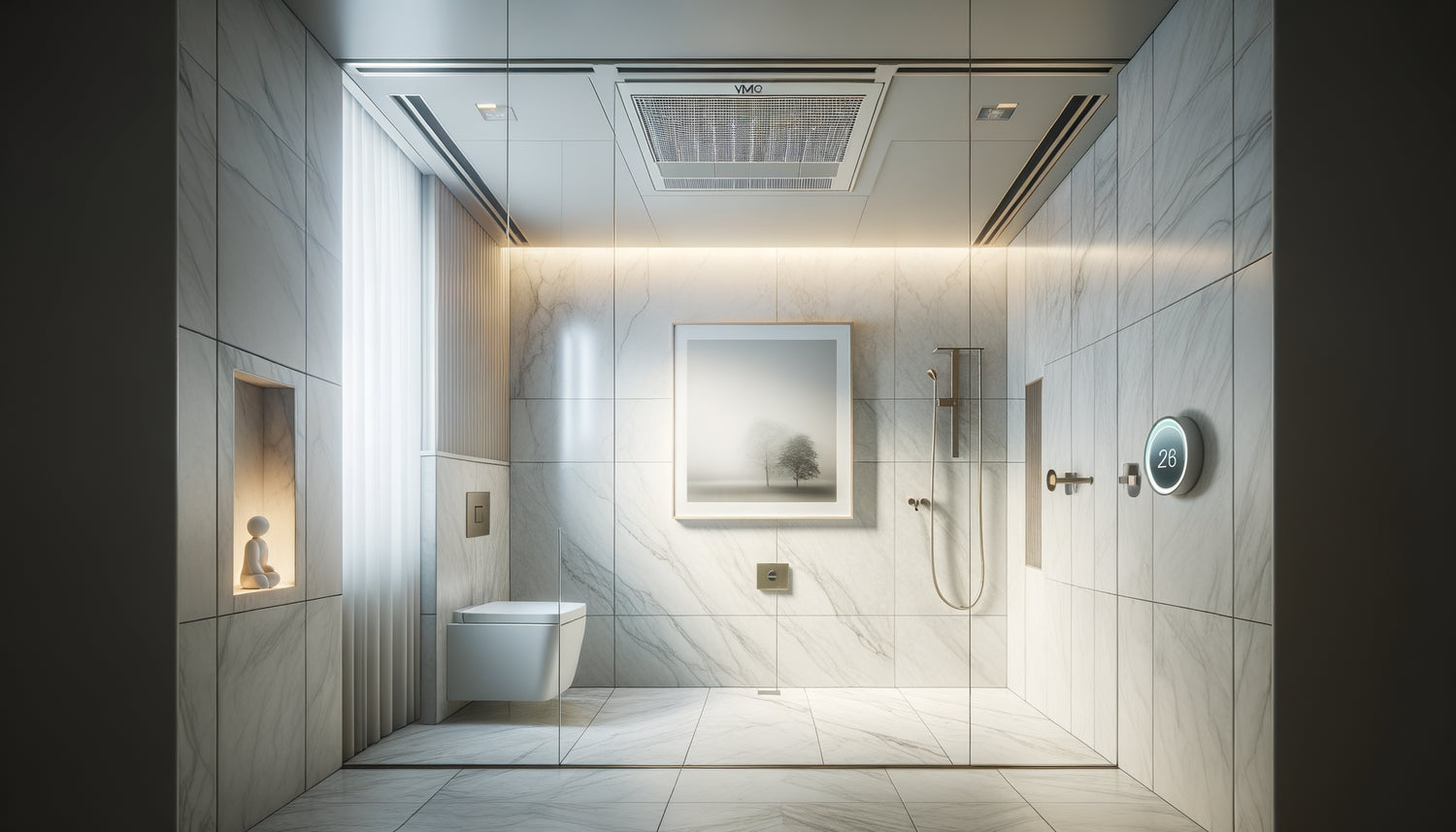
The humidity-sensitive VMC represents the most sophisticated solution for a bathroom welcoming wall art. This system automatically adjusts its flow rate based on detected humidity, creating a stable environment without jolts. Its continuous extraction maintains a constant air renewal, avoiding stagnant pockets of moisture.
In my recommendations, I emphasize a minimum flow rate of 30 m³/h in permanent extraction, with peaks at 90-120 m³/h during periods of heavy use. This capacity allows for the rapid evacuation of water vapor before it settles on surfaces.
The spot extractor: an essential complement
Even with a high-performance VMC, I observe better results when an additional air extractor is triggered during and after showering. Ideally, it should run for 20 to 30 minutes after the hot water has been used, allowing all excess humidity to be completely evacuated.
Prioritize models equipped with an integrated humidity sensor that activates automatically. This automation guarantees constant protection, even if you forget to turn it on manually.
Natural ventilation through a window or skylight remains valuable as a complement, particularly after prolonged baths or showers. Opening the window for 10 minutes creates a complete air renewal that chases away the last traces of vapor. However, be careful of direct drafts on wall art: they can cause thermal shock.

Strategic placement: where to hang your artwork
The location of your wall art conditions its survival as much as the ventilation itself. The critical zone extends within a radius of 1.50 meters around the shower or bathtub, where water splashes and vapor concentration are maximal.
Prioritize walls opposite the water points, ideally near the door or on the wall adjacent to the window. These locations benefit from better air circulation and reduced exposure to direct humidity.
Absolutely avoid uninsulated exterior walls: their lower temperature favors condensation on any attached surface. If your bathroom only has walls facing outwards, ensure adequate thermal insulation or install a small local heating system.
The ideal height to minimize risks
Hang your artworks at eye level or slightly above, never within the first 60 centimeters from the floor where residual humidity accumulates. This elevation also keeps them out of reach of accidental splashes.
Leave a space of 3 to 5 centimeters between the artwork and the wall using spacers or appropriate hanging systems. This air gap promotes circulation and avoids trapped condensation zones.
Invisible shields: suitable protections and frames
The choice of frame constitutes a determining physical barrier. Opt for frames with anti-reflective UV treated glass and an acid-free neutral cardboard mat. This configuration partially isolates the artwork from the ambient atmosphere while allowing micro-ventilation along the edges.
The seals on the back of the frame deserve particular attention. A kraft paper glued continuously creates a buffer volume that slows down sudden hygrometric changes. However, ensure to leave tiny openings to avoid an internal greenhouse effect.
For works on canvas or paintings without glass, I recommend applying a suitable protective varnish: acrylic for watercolors and gouache, resinous for oils. This additional layer repels surface humidity and facilitates the cleaning of any deposits.
Materials to favor or avoid
Some supports resist humidity remarkably well in a ventilated bathroom: prints on dibond (composite aluminum), photographs under plexiglass, or acrylic paintings on primed canvas.
Conversely, unprotected watercolors, pastels, antique engravings on verge paper and mixed media incorporating organic elements (vegetal, textile) remain vulnerable even with optimal ventilation. Reserve these treasures for rooms with a more stable climate.

Monitor and adjust: the tools of the informed collector
Investing in a digital hygrometer-thermometer transforms your approach to preservation. Discreetly placed in the bathroom, this device (20 to 50 euros) records humidity and temperature variations over several weeks.
Connected models offer smartphone alerts when critical thresholds are exceeded. This monitoring allows you to adjust ventilation parameters or usage habits before damage appears.
Examine your paintings monthly: warping of the paper, appearance of stains, peeling pictorial layers, mold in the corners of the frame. These early signs indicate a hygrometric imbalance that must be corrected immediately.
Simple daily actions that make a difference
Beyond technical installation, a few simple habits multiply the effectiveness of your ventilation system. Activate ventilation 5 minutes before showering to create an anticipated airflow. Wipe tiled surfaces after use to reduce residual evaporation.
Keep the door slightly open after passing through to promote air circulation with the rest of the living space. If your bathroom is windowless, this connection with other rooms becomes vital for atmospheric renewal.
Transform your bathroom into a protected art gallery
Discover our exclusive collection of wall art for Bathroom that combines moisture resistance and refined aesthetics, specially selected to enhance your wellness space.
When technology meets aesthetics
Imagine this morning scene: you enter your bathroom bathed in natural light, your gaze rests on this Japanese lithograph that has accompanied you for years. The colors are intact, the paper remains perfectly taut. The extractor quietly starts while you prepare your shower.
This harmony between preservation and aesthetic pleasure is not an inaccessible luxury. It results simply from properly sized ventilation and a thoughtful placement of your works.
Current technologies make these systems silent, economical and remarkably reliable. A hygroregulated VMC consumes less than 15 euros of electricity per year, a negligible investment compared to the sentimental and financial value of your paintings.
Start by measuring the current humidity level in your bathroom for a week. If values regularly exceed 65%, prioritize optimizing your ventilation before hanging any valuable artwork. If parameters are already acceptable, you can gradually compose your intimate gallery, carefully monitoring during the first few weeks.
Your bathroom deserves to be a space of beauty as much as functionality. With controlled ventilation, it becomes that sanctuary where art accompanies your daily rituals without ever suffering.
Frequently Asked Questions About Ventilation and Artwork Preservation
Can I hang a painting in a bathroom without an extractor fan?
It is technically possible, but strongly discouraged for valuable artworks. Without mechanical ventilation, you will need to compensate with intensive natural ventilation: window open for at least 15 minutes after each hot water use, door kept slightly ajar the rest of the time. In this case, prioritize reproductions on resistant supports such as aluminum or plexiglass rather than original works. A punctual extractor remains an acceptable minimum solution if it operates for at least 30 minutes after each shower. In all cases, install a hygrometer to monitor that humidity does not stagnate above 65%. If your bathroom is windowless and without ventilation, I honestly advise you to forgo traditional paintings in favor of waterproof decorative elements: artistic wall ceramics, resin sculptures or adapted plant installations.
How long should I leave the ventilation running after a shower?
The optimal duration is between 20 and 30 minutes after the end of your shower, time necessary for excessive humidity to be completely evacuated and for the relative humidity rate to drop below 60%. This duration varies according to several factors: the temperature of your shower (the hotter it is, the more steam it generates), the volume of your bathroom (small spaces saturate quickly), and the power of your ventilation system. Hygroregulated VMC systems automatically manage this duration by adjusting their extraction speed until an acceptable humidity level is reached. If you use a manual extractor, program it with a timer so you don't have to think about it. In particularly humid or poorly insulated bathrooms, extend up to 45 minutes. Investing in a hygrometer will allow you to precisely refine this timing according to your specific configuration and usage habits.
What types of paintings best resist the humidity of a bathroom?
Impressions on non-porous supports are largely dominant in terms of resistance: aluminium dibond, plexiglass, expanded PVC or forex. These materials are completely impermeable and do not react to hygrometric variations. Next come acrylic or oil paintings on canvas prepared with a modern acrylic primer, provided they are protected by an appropriate varnish and framed correctly. Photographs under glass with neutral matting withstand well a controlled environment between 45 and 65% humidity. Contemporary engravings on treated paper also resist if the framing is airtight. Conversely, absolutely avoid unprotected watercolors, pastels, mixed media incorporating papier-mâché or textile elements, and old works on vellum paper without restoration. Unprimed canvases and tempera paintings are also vulnerable. In case of doubt, always prioritize safety: a beautiful resistant reproduction is better than an original work degraded by unsuitable conditions.