

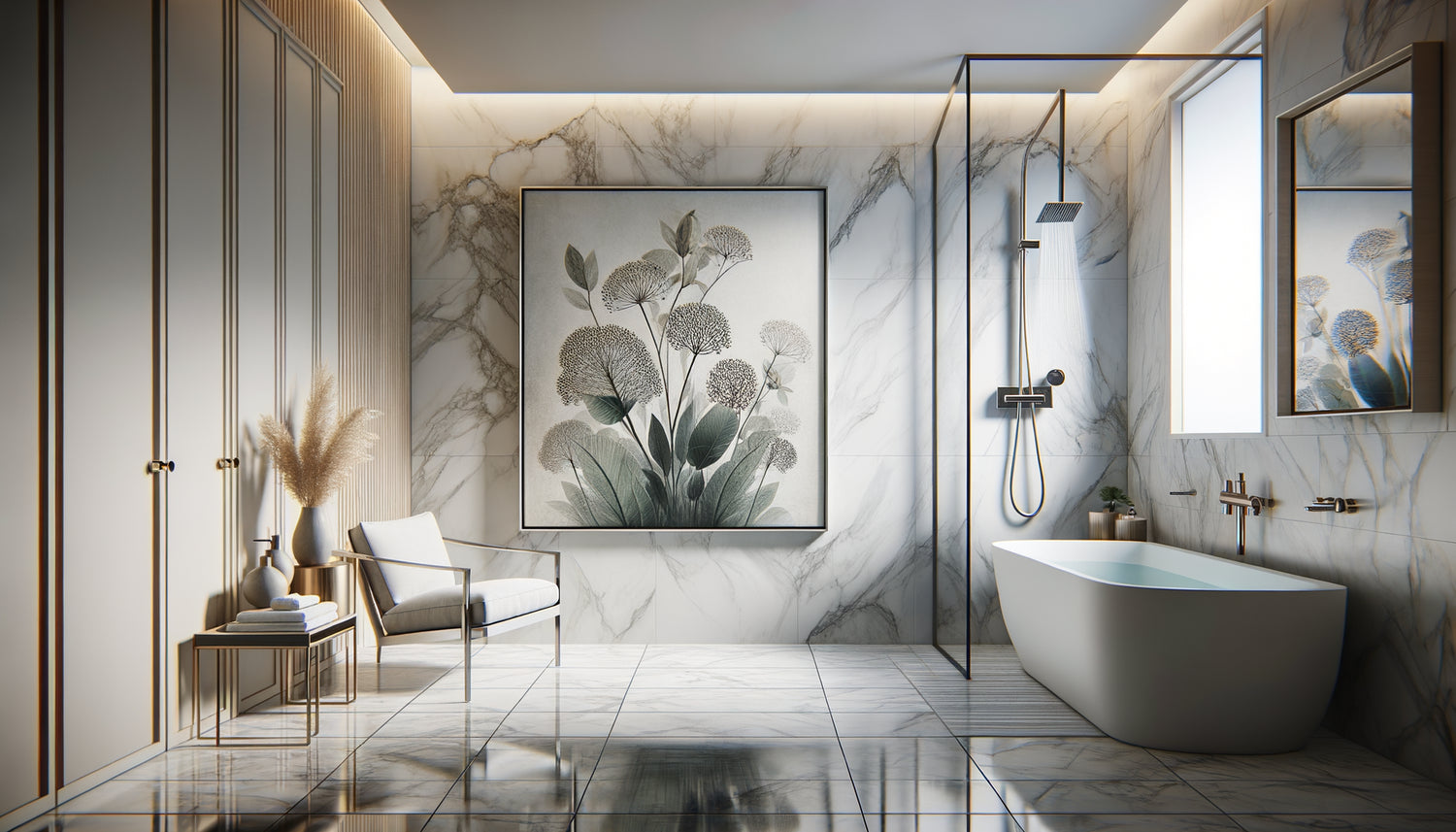
The first time I hung a lithograph above a bathtub was in a Parisian apartment in the 9th arrondissement. Six months later, the paper was warped, the colors had turned yellow, and I bitterly discovered that not all artworks are designed to withstand the humid atmosphere of a bathroom. This mistake taught me a fundamental lesson: transforming your bathroom into an intimate gallery requires choosing suitable artwork capable of resisting steam, temperature variations, and ambient humidity.
Here's what a well-chosen bathroom artwork brings: a sophisticated atmosphere that transforms the utilitarian space into a personal sanctuary, guaranteed resistance to moisture thanks to the right materials, and artistic expression that extends your decor to this often-neglected room.
Many people give up decorating their bathrooms for fear of damaging their artworks. They imagine mold, rusted frames, soaked canvases. Yet, with the right knowledge about resistant materials and suitable formats, your bathroom can accommodate true works of art without any risk. I'm going to reveal how to select artwork that defies humidity while enhancing your wellness space.
Materials that defy humidity: choosing without compromise
The fatal mistake is to apply the same selection criteria for a living room to the bathroom. Traditional canvas and paper artworks are the first enemies of moisture. Paper absorbs water vapor, warps, and promotes mold growth. Even varnished canvas eventually sags with cycles of humidification and drying.
Aluminum prints on aluminum represent the most resilient solution I have tested. The metallic support is naturally impermeable, and the inks are fixed by thermal sublimation, creating a perfect fusion between the image and the metal. No risk of peeling, no possible infiltration. The visual rendering is striking, with vibrant colors and remarkable depth.
Tableaux on plexiglass or acrylic glass offer an elegant alternative. The smooth, non-porous surface naturally repels moisture. I particularly appreciate prints under acrylic, where the image is printed on the back of a transparent plate: the depth created gives the artwork an almost three-dimensional dimension, perfect for contemporary atmospheres.
Expanded PVC and composite materials are also excellent supports. Initially used for outdoor signage, these materials are designed to withstand the elements. Their adaptation to decorative paintings has opened up new possibilities for humid spaces. Lightweight, resistant, they are easy to install and require no special maintenance.
Frames and finishes: the invisible armor against steam
A moisture-resistant artwork also requires a frame suitable for the bathroom environment. Solid wood frames that are not treated should be absolutely avoided: they swell, warp, and can even develop mold in the joints.
My first choice is aluminum or stainless steel frames. They are inherently rustproof and retain their impeccable appearance even after years of exposure to steam. Their clean style harmonizes perfectly with modern faucets and metal accessories.
For those who prefer the warmth of wood, opt for treated composite wood or lacquered MDF frames. The protective layer prevents moisture absorption. I have seen excellent results with white or black lacquered frames, whose glossy finish adds a sophisticated touch while repelling water.
The frameless artwork option completely eliminates this problem. Prints on aluminum or plexiglass can be mounted directly to the wall with invisible fixings, creating a very contemporary floating effect. This minimalist solution emphasizes the artwork itself.
Essential protective treatments
Even with the right materials, additional protection can significantly extend the life of your artworks. Anti-UV and hydrophobic varnishes create an invisible barrier against moisture. Some high-end prints already incorporate this treatment, so check when purchasing.

Where to place your artworks: the strategy of humidity zones
Not all areas of your bathroom have the same level of exposure to moisture. Understanding this mapping allows you to position your artworks intelligently to maximize their longevity.
The red zone corresponds to the space immediately adjacent to the shower or bathtub. This is the area of direct water projection and intense steam. Even the most resistant artworks will be subjected to significant constraints in this area. If you absolutely want to decorate this area, prioritize aluminum or plexiglass exclusively, without any wood or paper elements.
The orange zone encompasses the perimeter one meter from the water source. Humidity is high but there is no direct contact. This is the ideal location for resistant artworks: prints on aluminum, plexiglass, PVC. I have installed magnificent botanical compositions in this area for several clients, with spectacular results.
The green zone refers to walls opposite the water source, near the door or above vanity units away from the shower. Humidity is moderate here. You can allow for a wider variety of supports, while maintaining vigilance regarding material quality and protective treatments.
A practical tip: install effective ventilation. A high-performance VMC system or regularly airing out the room significantly reduces ambient humidity, creating a healthier environment for your artwork as well as yourself.
What visual universes to sublimate your bathroom
Beyond technical resistance, the aesthetic choice of your artworks radically transforms the atmosphere of your bathroom. This intimate room deserves particular attention in the selection of visuals.
Aquatic and botanical themes create a natural coherence with the function of the room. Photographs of waves, water droplets, seabeds bring a poetic dimension. Representations of tropical plants, lush foliage, delicate flowers evoke a natural spa, a forest bath.
Abstract compositions in soothing tones – deep blues, turquoise greens, sandy beiges, pearl grays – create a zen atmosphere conducive to relaxation. Fluid and organic shapes resonate with the omnipresent water element in the bathroom.
For lovers of originality, minimalist graphic works in black and white create a striking contrast with often light-colored tiled surfaces. Inspirational typography, clean line drawing, architectural photography bring contemporary sophistication.
Do not forget the impact of size and composition. A large artwork becomes a centerpiece that structures the space. A composition of several small formats creates a dynamic gallery wall. In a small bathroom, a vertical format visually lengthens the space, while a horizontal format widens it.
Harmony with your color palette
Your artworks must dialogue with the existing colors: tiles, furniture, bath linen. A tone-on-tone approach creates an enveloping and coherent atmosphere. A touch of contrasting color in the artwork energizes the whole and attracts the eye. Analyze your current palette before choosing.

Minimal maintenance for lasting beauty
One of the major advantages of tableaux designed for bathrooms is their ease of maintenance. Unlike traditional artworks that require delicate dusting, these durable supports can be easily cleaned.
For aluminum and plexiglass prints, a slightly damp microfiber cloth is sufficient. Wipe them regularly to remove water splashes and limescale marks. Avoid abrasive products that could scratch the surface; if necessary, use a mild glass cleaner.
The metal frames are cleaned with the same cloth. Check the fixings occasionally, especially if your bathroom experiences significant temperature and humidity variations: materials expand and contract, which may slightly loosen the attachments.
A monthly visual inspection allows you to detect any problems early on. Look for signs of water infiltration behind the artwork, oxidation marks on metal fixings, or a beginning of peeling. These issues are easily resolved if caught in time.
Transform your bathroom into a private gallery
Discover our exclusive collection of bathroom wall art that combines exceptional moisture resistance with refined aesthetics.
Mistakes to Absolutely Avoid
After years of advising on decoration projects, I have identified the recurring pitfalls that compromise the longevity of bathroom artworks.
The first mistake is to underestimate the actual humidity of your space. Even a seemingly dry bathroom generates significant residual moisture. Do not rely on the absence of visible condensation: water vapor spreads everywhere, penetrates porous materials, and accumulates gradually.
Next, neglecting ventilation turns your bathroom into an incubator of problems. Without air renewal, humidity stagnates, intensifies, and attacks all materials. Before investing in artworks, ensure functional ventilation.
The use of inappropriate fixings is another pitfall. Simple nails in a damp wall corrode quickly. Opt for fasteners suitable for the support (drywall, tile, concrete) and stainless steel or resistant plastic fixings.
Finally, avoid hanging works with significant sentimental or financial value. Even with all precautions, a bathroom remains a constrained environment. Reserve your precious pieces for more lenient spaces, and select for the bathroom artworks specifically designed for this purpose.
Visualize Your Personal Sanctuary
Imagine stepping into your bathroom tomorrow morning. Instead of bare, cold walls, your gaze falls upon a soothing botanical composition, monstera leaves with delicate veins printed on brushed aluminum. Natural light dances across the metallic surface. The familiar space has become an aesthetic refuge, a moment of beauty stolen from everyday life.
This transformation requires only an informed choice : durable materials, a strategic location, and visuals that resonate with your sensibility. Your bathroom deserves the same decorative attention as your other rooms. By respecting technical constraints, you create a space where functionality and beauty coexist harmoniously.
Start by assessing your humidity zones, measuring your available wall spaces, and defining the atmosphere you want to create. Every bathroom has artistic potential waiting for your eye to reveal it.
Frequently Asked Questions About Bathroom Wall Art
Can I Really Hang a Wall Art Above My Bathtub?
Yes, provided you choose a wall art specifically designed to withstand humidity. Exclusively opt for prints on aluminum or plexiglass in this area with high exposure. These non-porous materials naturally repel water and steam. Also ensure that the wall art is securely attached with stainless steel fixings, at a distance of at least 60 cm above the waterline to limit direct splashes. If your bathtub generates a lot of steam during prolonged hot baths, install effective ventilation and regularly wipe away any droplets that may form on the wall art. With these precautions, your artwork will retain its impeccable appearance for years.
Are Canvas Wall Arts Totally Excluded for a Bathroom?
Traditional canvases stretched on wooden frames are indeed not recommended in bathrooms, even well-ventilated ones. The fabric absorbs moisture, sags, encourages the development of mold, and colors eventually fade. However, there are interesting alternatives: some manufacturers offer canvas effect prints on synthetic supports that reproduce the texture and visual rendering of a canvas while offering the resistance of an impermeable composite material. These solutions allow you to retain the warm aesthetic of canvas without the technical drawbacks. If you absolutely want an authentic canvas, reserve it for a secondary bathroom with permanent ventilation, and position it away from any water or steam source.
How Can I Tell If a Wall Art Is Suitable for a Bathroom Before Buying It?
Always check the manufacturer's or seller’s specifications. A wall art piece designed for humid environments should clearly state this characteristic with terms like moisture resistant, suitable for bathroom, or outdoor use. Examine the support: if it is aluminum, PVC, plexiglass, or glass, that’s a great sign. Consider the frame if there is one: is it metal, treated composite, or lacquered wood? Be wary of wall art pieces whose descriptions are vague about materials. Don't hesitate to contact the seller directly for technical details. Specialty stores in humid environment decoration generally offer collections entirely dedicated, which greatly simplifies your search and guarantees you products tested and approved for this specific use.


