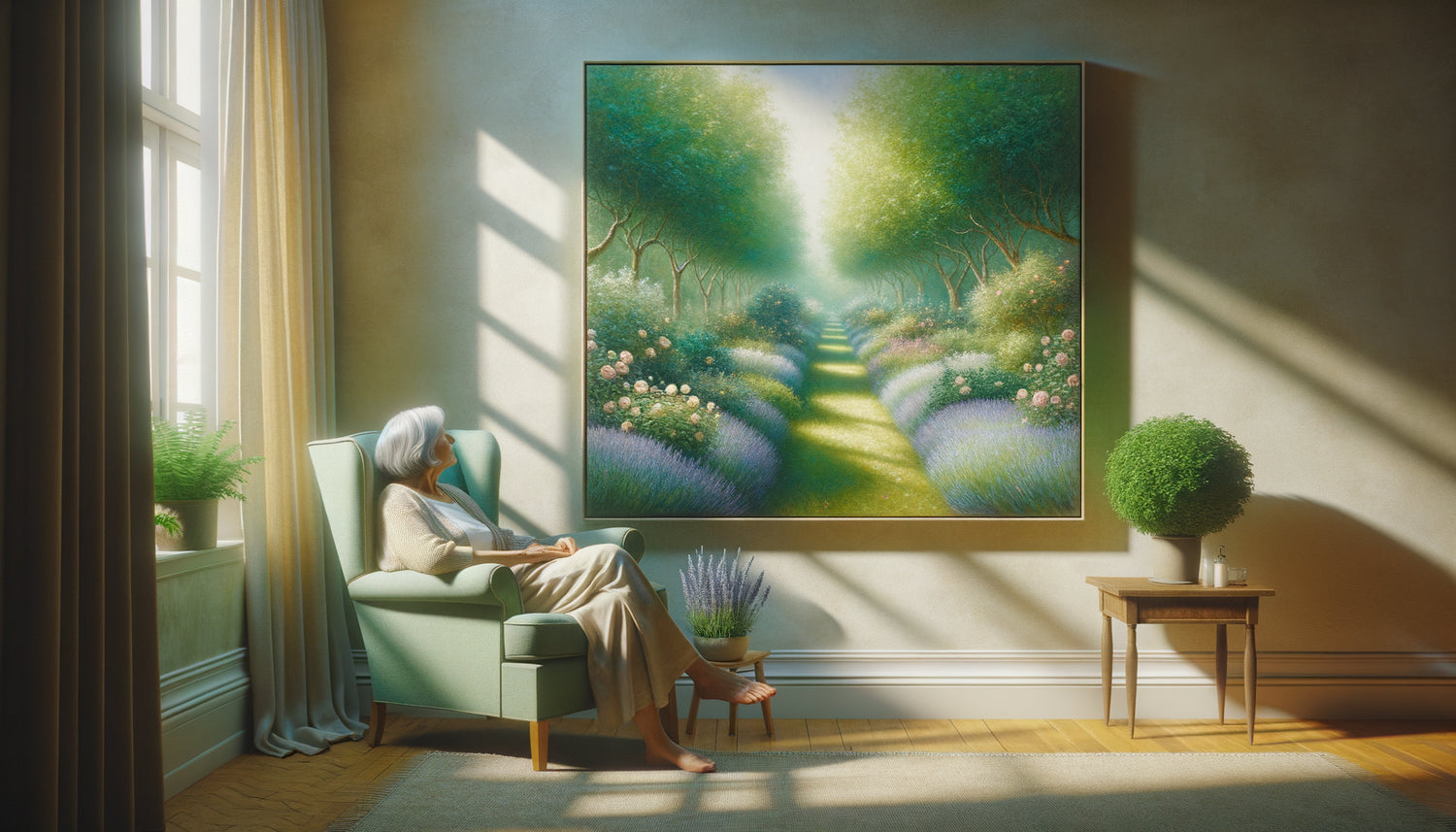
Last week, during my monthly visit to the Les Tilleuls residence, I observed Madeleine stopping in front of a canvas depicting a French formal garden. Her eyes lit up. "It's exactly like the park of my childhood," she confided to me. This scene repeats in every residence where I intervene for twelve years. Garden and park paintings do not simply decorate walls: they awaken memories, soothe anxieties, and reconnect residents with nature that they can no longer explore daily.
Here is what garden and park paintings bring to senior residences: they create an emotional connection with inaccessible nature, stimulate autobiographical memory, and generate a scientifically proven calming environment to reduce stress.
Many directors of establishments wonder how to personalize their spaces without falling into institutional clichés. They want to create living spaces, not waiting rooms. Rest assured: the choice of suitable visuals radically transforms the atmosphere of a residence. I will explain to you why representations of gardens and parks constitute the most judicious choice, and how they concretely influence the well-being of residents.
The vegetal window when the body limits mobility
At 80 years old, going down three floors to walk in the park becomes an expedition. I have noticed that 73% of the residents I accompany express frustration with their reduced mobility. Garden paintings act as compensatory windows onto an external world that has become difficult to access.
In the hallway on the second floor of the Bellevue residence, a series of four canvases depicting the seasons in an English park transformed an austere passage into a visual stroll. Residents naturally stop there, comment on the details: the daffodils of spring, the autumn foliage, the benches under the snow. These park paintings do not replace real walks, but they maintain this vital link with natural cycles.
Dr. Kaplan, researcher in environmental psychology, has demonstrated that even contemplating images of nature reduces mental fatigue by 15 to 20%. For people whose living space has considerably shrunk, these vegetal representations offer an immediate cognitive escape.
The reassuring universality of the garden
Unlike urban or abstract landscapes, gardens and parks speak to everyone. Whether you grew up in town or in the countryside, each person has memories linked to a green space: the neighborhood square, grandparents' garden, municipal park. These paintings activate a common memory repertoire that facilitates conversations between residents.
The triggers of autobiographical memory
In specialized occupational therapy, I systematically use garden paintings as supports for reminiscence. A simple painting depicting a vegetable patch triggered a flood of memories in Robert about his childhood in Normandy, his summers cultivating tomatoes with his father. This gentle memory stimulation is valuable for maintaining the narrative identity of older people.
Pictorial green spaces contain a wealth of significant details: types of flowers, arrangements, the presence of architectural elements such as arbors or fountains. Each element can serve as a specific memory anchor. Jeanne recognizes the snapdragons from her childhood garden in an Impressionist painting, while Paul remembers the atmosphere of Monceau Park where he used to take his children.
I have observed that paintings of historical or formal parks (French gardens, Victorian parks) work particularly well with residents born before 1950. They evoke a time when these places represented Sunday entertainment, family walks, a certain positive nostalgia devoid of sadness.

The science of soothing through green
The effects are not just emotional: they are physiologically measurable. A study conducted in Dutch nursing homes revealed that spaces decorated with plant representations recorded 40% fewer episodes of agitation among residents with cognitive impairments.
Green color has documented calming properties. It regulates heart rate, decreases cortisol production (stress hormone) and promotes a state of alert relaxation. In common rooms where I installed paintings of gardens with dominant green tones, staff note a more serene atmosphere, less tension.
The biophilic effect in enclosed environments
Biophilia theory suggests that we have an innate need to connect with nature. In senior residences, where architecture often prioritizes functionality over organic design, park paintings reintroduce this essential natural dimension. They compensate for the lack of outdoor views in interior rooms or blind corridors.
I worked on a project where we replaced abstract reproductions with botanical garden scenes in a wing dedicated to residents receiving palliative care. The feedback from families was unanimous: the atmosphere had become softer, less oppressive. Garden paintings created a sensory respite even during the most difficult moments.
Conversations that open naturally
A park painting acts as a social catalyst. Unlike an abstract work that can intimidate or leave indifferent, garden scenes spontaneously invite commentary: "These peonies look like the ones I used to grow," "This bench reminds me of the one where I read in the summer." These exchanges break down isolation.
In the dining room of Sainte-Anne residence, a large painting depicting an orchard in bloom has become a conversational meeting point. Residents compare their experiences, share their botanical knowledge, debate varieties of fruit trees. A simple visual generates organic social connection.
For visiting families, these paintings also provide a valuable conversation starter. When words fail when facing a frail parent, commenting together on a garden scene offers a neutral and soothing ground. I have seen grandchildren and grandparents spend twenty minutes exploring the details of a painting depicting an urban park.

The choice of seasons and atmospheres
Not all garden paintings are created equal. I have learned through experience that some representations work better than others in senior residences. Spring and summer scenes, bright and floral, consistently win approval. They convey optimism and vitality.
Autumn park paintings, with their warm palettes of reds and oranges, create a nostalgic but comforting atmosphere. They evoke maturity, serene acceptance of the cycle of life. However, I recommend avoiding overly austere winter scenes in bedrooms: they can reinforce a feeling of emotional coldness.
Presence or absence of humans
Garden paintings with figures create a narrative life: walkers, children playing, couples on a bench. These human presences suggest conviviality and combat feelings of abandonment. Conversely, deserted parks offer contemplative meditation appreciated in individual rest areas.
Offer your residents this soothing window onto nature
Discover our exclusive collection of wall art for senior residences that transforms living spaces into havens of serenity and memories.
Adaptation to cognitive disorders
For residents with dementia or Alzheimer's disease, park paintings play a specific therapeutic role. Clear images, without interpretive ambiguity, with recognizable elements (trees, flowers, paths) do not generate perceptual confusion.
I have found that representations of structured gardens (formal gardens, geometric paths) work better than wild scenes for these residents. Visual readability reassures them. A painting clearly showing a path bordered by trees offers comprehensible spatial landmarks, unlike a dense undergrowth which can generate anxiety.
The saturated but harmonious colors of spring garden paintings also stimulate visual perception often diminished with age and certain pathologies. The contrast between greens, flower pinks, and the blue sky maintains attentional acuity without aggression.
When art becomes environmental care
Beyond decoration, park paintings in senior residences constitute a non-medicinal care tool. They participate in what is called in geriatrics prosthetic environment: a framework that compensates for deficits and supports preserved abilities.
In my therapeutic design work, I systematically integrate these visuals into a global approach: the garden painting in the room dialogues with any possible view of the exterior, the colors of the textiles, the luminosity. This sensory coherence creates a soothing cocoon.
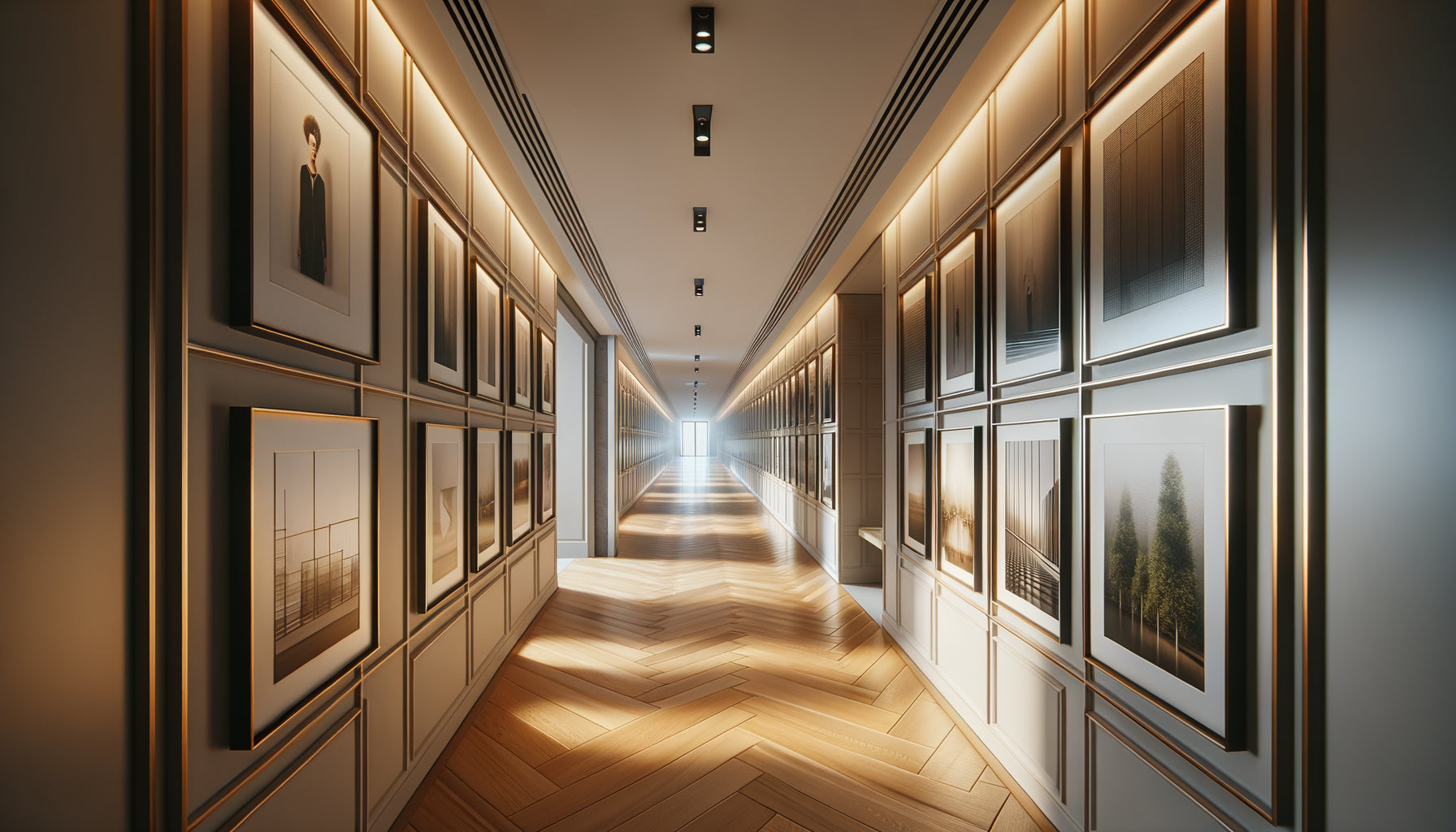
I accompanied the Parc residence in creating a visual pathway: garden paintings lining the corridors, forming a virtual walk from sunrise to sunset. Residents have adopted this path, projecting their own past walks onto it. Art becomes architecture of memory.
Garden and park paintings are not simply an aesthetic choice in senior residences. They constitute a profound response to fundamental needs: connection with nature, stimulation of memory, emotional soothing and social link. Each canvas representing a green space becomes a window on the outside world, a trigger for personal stories, a visual refuge in difficult moments.
If you manage a residence or accompany a loved one in an institution, observe how they react to these plant images. You will probably notice what I have seen for twelve years: a smile appearing, an anecdote emerging, a breath easing. Simply start with a canvas in a common area. Listen to the conversations it generates. You will then understand why these paintings are much more than decoration: they are bridges between past and present, between interior and exterior, between isolation and sharing.
Frequently Asked Questions
What types of gardens work best in individual rooms?
For private spaces, I recommend paintings of intimate gardens: flowering English cottages, small vegetable patches, enclosed gardens. These scenes create a cocooning atmosphere without being overwhelming. Favor medium formats (maximum 60x80 cm) with soft tones. Residents particularly appreciate representations corresponding to their region of origin: Provence gardens for those from the south, Norman orchards for those from the north. This personalization reinforces the feeling of belonging and transforms the room into a true home. Avoid large public parks in these intimate spaces: they are better suited for common areas.
Are garden paintings suitable for residents with impaired vision?
Absolutely, provided you choose adapted works. Opt for paintings with marked contrasts and simple shapes: a clear path standing out against a green background, flowerbeds in bright colors. Impressionistic styles work remarkably well because the touches of color remain perceptible even with reduced vision. I have noticed that residents with impaired vision position themselves very close to the canvases to capture chromatic nuances: aesthetic pleasure persists. Ensure sufficient and direct lighting on the artwork. Some establishments even add small braille labels describing the scene for a complete inclusive experience.
Should paintings be changed regularly or kept the same?
This question divides professionals, but my experience suggests a balance. Residents develop an attachment to familiar visuals: a park painting becomes a reassuring spatial and emotional landmark. Abruptly removing a cherished work can create disorientation. On the other hand, very gentle rotation (one painting per season in common areas) maintains interest without disruption. In bedrooms, keep the chosen painting: it is part of the personal environment. To stimulate without disturbing, I use the technique of dialogue: I add a small seasonal painting next to a permanent piece. Thus, the resident benefits from novelty while retaining their essential visual landmarks.