


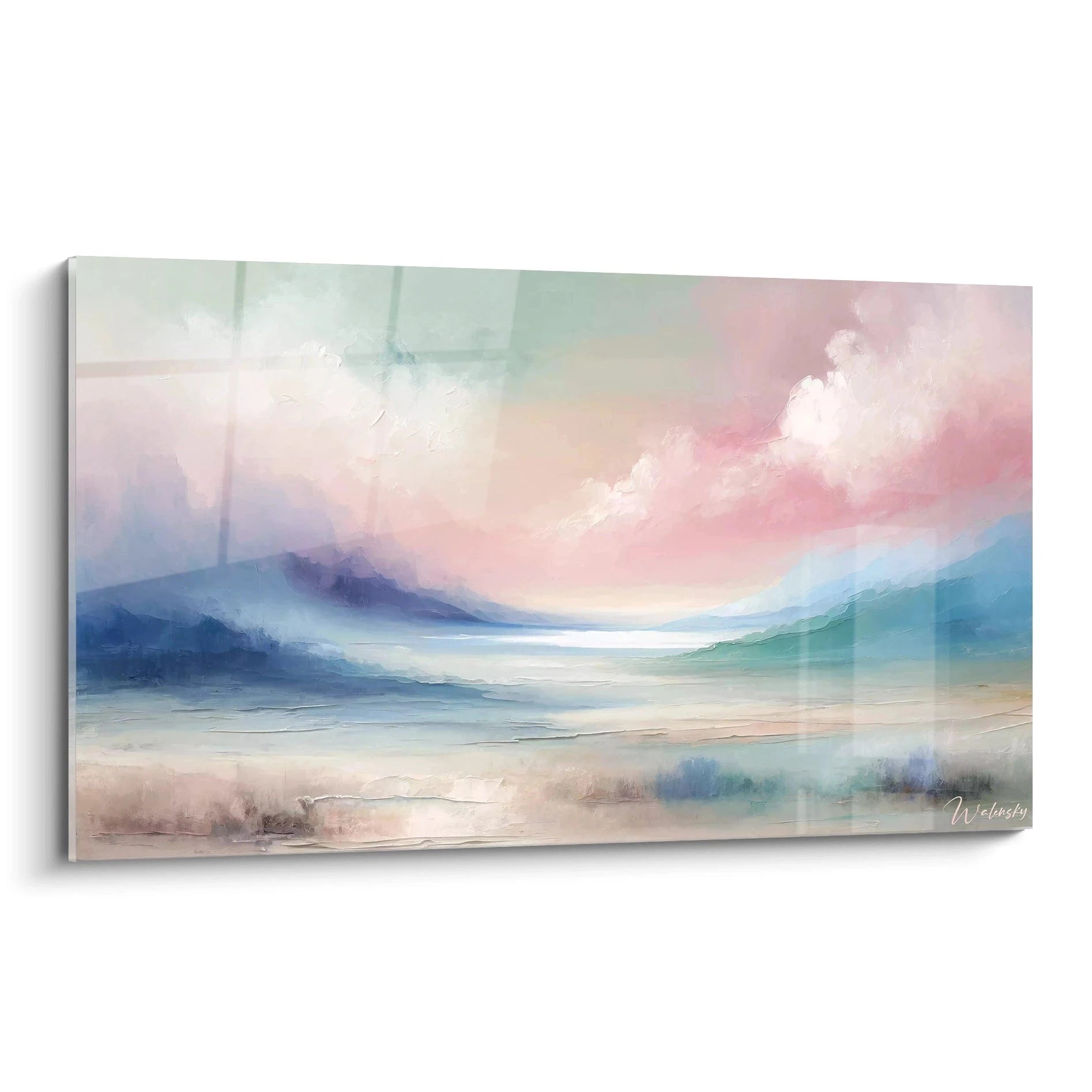

How Do Large-Format Wall Artworks Create Visual Landmarks?
October 30, 2025 · 9 min read · by Walensky
I remember this Parisian industrial loft, 180 square meters of dizzying volumes and white walls as far as the eye could see. A raw beauty, certainly, but the gaze got lost in it like in a desert. The owner confessed to feeling a strange malaise: “I feel like I’m floating in my own apartment.” Then we installed a monumental abstract canvas of 2.50 meters facing the entrance. Instantly, the space found its anchor. This large format became the beating heart of the place, the visual compass that transformed chaos into harmony.
Here's what large-format paintings bring to your interiors: they structure the space by creating magnetic points of attention, they orchestrate the movement of the gaze with a natural authority, and they establish a visual hierarchy that soothes our perception. In a world saturated with stimuli, these works become reassuring beacons.
You may have felt this in your own space: that diffuse feeling that something is missing, that the gaze wanders without ever settling. You accumulate small frames, decorative objects, but the effect remains scattered, cacophonous. It's frustrating, this inability to create a consistent atmosphere despite all your efforts.
Rest assured: you don’t need to redo your entire decor. Large formats have this unique ability to instantly reorganize the reading of a space. I will reveal to you how these monumental works become the silent architects of your interior, transforming visual chaos into mastered balance.
The anchoring effect: when the gaze finally finds its harbor
In the psychology of spatial perception, our brain constantly seeks visual reference points to understand and memorize an environment. It is an ancestral survival reflex: quickly identify the dominant elements of a landscape in order to orient oneself. A large-format painting precisely activates this primary mechanism.
I accompanied a Brussels gallery during its complete redesign. Visitors walked through the rooms without stopping, overwhelmed by the profusion of medium-sized works. We redistributed the collection by installing monumental formats at each strategic threshold. The result was spectacular: the visit time increased by 40%, and the routes became more fluid. Large formats created visual stations, natural pauses where the gaze could finally rest before setting off to explore.
In your living room, this principle applies with the same effectiveness. A large painting placed above the sofa or facing the entrance immediately becomes the focal point that structures the entire room. The other decorative elements naturally find their place in this hierarchy, like satellites orbiting a planet. The space ceases to be an addition of objects to become a coherent composition.
The invisible geometry: how to structure without partitioning
Large-format wall art act as immaterial walls that define zones without enclosing them. This is particularly valuable in open contemporary spaces where kitchens, dining rooms and living rooms merge into a single volume.
An interior architect with whom I collaborate regularly consistently uses this technique: he positions monumental works to signal functional transitions. A large-scale abstract diptych marks the end of the dining area and announces the relaxation space. No physical partition, yet the reading of the space is clear.
This visual structuring relies on a simple principle: our eye traces invisible lines between the dominant elements of a room. A large format on the wall automatically creates an axis, a direction that guides circulation. Place a second one on a perpendicular wall, and you mentally draw an angle, a spatial delimitation. Your brain interprets these visual cues as soft boundaries that organize space without fragmenting it.
The monumental rule of thirds
To maximize the structuring effect, I systematically apply the rule of thirds adapted to large formats. The artwork should ideally occupy between one third and two fifths of the width of the wall. Below, it floats without conviction. Beyond, it overwhelms. This proportion creates an affirmed presence that naturally becomes a visual anchor point without aggressively dominating.
In a bedroom 4 meters wide, opt for a work from 140 to 160 centimeters. This format asserts its presence while allowing the architecture to breathe. The eye immediately identifies this major landmark, then explores the rest of the room with this mental compass in mind.

Our favourite
Golden Buddha Painting with Closed Eyes - Golden Serenity - Abstract Face Edition
233,90€
Discover this artworkThe orchestration of movement: creating intentional visual journeys
A well-designed interior tells a story through an orchestrated visual journey. Large-format wall art are the chapters of this spatial narrative, the highlights that punctuate the storytelling.
I recently worked on a master's house where the main hallway was 15 meters long. An oppressive tunnel that owners quickly crossed, avoiding eye contact. We installed three large formats spaced strategically: the first visible from the entrance, creating an invitation; the second halfway through, offering a pause; the third announcing arrival in the living area. This dreaded hallway became a contemplative walk where the gaze bounces from landmark to landmark.
This technique of visual cueing transforms the perception of distances and proportions. A large space no longer appears empty but rhythmic. A small space doesn't seem cramped but articulated. Monumental landmarks create a breath, a cadence that makes the spatial experience more comfortable.
Strategic height to guide the gaze
The vertical placement of your large format artwork determines the direction of the visual flow. Hung at eye level (approximately 145-160 cm in the center), it creates a horizontal landmark that soothes and stabilizes. Positioned higher, it raises the gaze and gives an impression of verticality, valuable for compensating for low ceilings. Lower, in a staircase for example, it accompanies the descent and secures movement.
In a living room with a fireplace, I avoid placing the large format above the mantelpiece if it is very ornate. It's better to install the monumental work on the adjacent wall, creating a secondary focal point that balances without competing. Two visual landmarks of equal intensity cancel each other out; a dominant and a satellite create a harmonious dynamic.
— Our selection


The emotional dimension: landmarks that tell an identity
Beyond their structuring function, large format artworks embody the soul of a place. They don't just organize space; they characterize it. A large abstract format with muted tones evokes contemplative sobriety. An exuberant figurative canvas of imposing dimensions affirms an extroverted personality.
I remember a couple who were hesitating between several monumental artworks for their cathedral-like living room. All the artworks functioned technically as landmarks, but only one provoked that emotional spark, that feeling of « coming home ». It is this intimate resonance that transforms a simple visual landmark into an affective anchor.
Your guests may never consciously verbalize the presence of the large format, but their brain will record it as the identity marker of your space. In six months, when they think about your interior, it is this monumental work that will emerge first in their memory. It will have become the memorial landmark of your universe.

— You may also like


The mistakes that turn a landmark into a visual obstacle
Not all large formats automatically create effective landmarks. Some common mistakes sabotage their structuring potential.
The error of the saturated wall: surrounding your monumental painting with a constellation of small frames. The eye doesn't know where to land, the focal point is diluted in visual noise. A large format requires empty space around it to fully shine. Allow at least 30 centimeters of free space on each side.
The error of the unsuitable format: a painting that is too small on a wall that is too large creates a timid effect, an hesitant landmark that lacks authority. Conversely, a disproportionate work crushes the space and generates visual tension. The large format must be ambitious without being tyrannical.
The error of neglected lighting: a monumental painting in the dark loses 70% of its impact as a visual landmark. The eye is naturally drawn to illuminated areas. Directional lighting or a discreet spotlight transforms your large format into a magnetic beacon, especially in the evening when ambient light decreases.
The trap of multiplying strong points
I often observe this temptation: since a large format works admirably, why not multiply it? Beware of the overload syndrome. Three monumental paintings in a 30 square meter living room create an exhausting visual competition. Landmarks are hierarchical: one dominant, secondary ones more discreet. This perceptual pyramid soothes our cognitive system which hates indecision.
In generous spaces, prefer a single XXL format rather than several large ones. A 3-meter wide canvas has a cathedral presence that no accumulation can reproduce. It becomes THE absolute landmark, the north star of your interior.
Your space deserves its visual north star
Discover our exclusive collection of wall art for senior residences that transforms each room into a harmonious and structured universe.

In the same vein
Echoes of Ancient Rocks Wall Art - Abstract Edition
233,90€
Discover this artwork →Transform your perspective on space
Large format wall artworks don’t just decorate your walls: they rewrite the grammar of your space. They transform confusion into clarity, passage into destination, indifference into emotion. These visual landmarks exert a gentle authority that guides without constraining, structures without rigidifying.
In three months, when you walk through your reorganized living room around its large format, you may no longer remember the former diffuse malaise. You will simply think: “This space reflects me”. This is the silent power of monumental landmarks – they eventually disappear from our consciousness to become the very essence of our daily lives.
Start by identifying the wall that most appeals to you when entering your home. That's where your visual landmark awaits to come alive. You don’t need to revolutionize your entire interior immediately: a single large format artwork, judiciously chosen and positioned, can rewrite the whole story of your space. The rest will follow naturally, gravitating around this new visual sun you have installed.
Frequently Asked Questions
What is the minimum size for a painting to create a true visual landmark?
The effective minimum dimension depends on your space, but I generally recommend not going below 100 centimeters in the shortest dimension. For a standard living room of 20-25 square meters, aim for a minimum of 120 x 80 cm. The goal is that the artwork is visible and identifiable upon entering the room, even in peripheral vision. A simple test: step back 3 meters. If the painting disappears into the background or seems shy, it's too small to serve as a structuring landmark. Remember that color and contrast also play a role: a canvas with vibrant tones can create a focal point with slightly smaller dimensions than a soft monochrome work which will require more surface area to assert itself as a visual landmark.
Can we create landmarks with several medium paintings rather than one large one?
Technically yes, but with a crucial nuance: the ensemble must be perceived as a cohesive unit, not as a scattered collection. The gallery wall technique works when frames are close together (a maximum of 5-10 cm apart) and form a compact rectangle or square that reads as a single visual block. In this case, the whole becomes the focal point, not each artwork individually. However, I find that this approach requires a trained eye to succeed in balancing. A single large format offers a more immediate and powerful solution: it has a natural authority that no accumulation can truly reproduce. If you are hesitating, start with the unique large format. You can always add satellites later.
How to choose between horizontal and vertical format to structure the space?
The horizontal format (landscape) visually widens the space and creates a sense of horizontal amplitude, perfect above a sofa or console. It invites the eye to scan the room laterally, accentuating its width. The vertical format (portrait), on the contrary, raises the gaze and gives an impression of height, valuable in rooms with low ceilings or narrow spaces such as corridors and stairwells. My practical advice: observe your bare wall. If it seems too wide and low, opt for a vertical format that will compensate. If it looks narrow and high, choose the horizontal one to balance it. In a well-proportioned square space, simply follow your emotional intuition – both formats will work effectively as focal points, it is your personal resonance with the artwork that will make the difference.
Explore our collections


