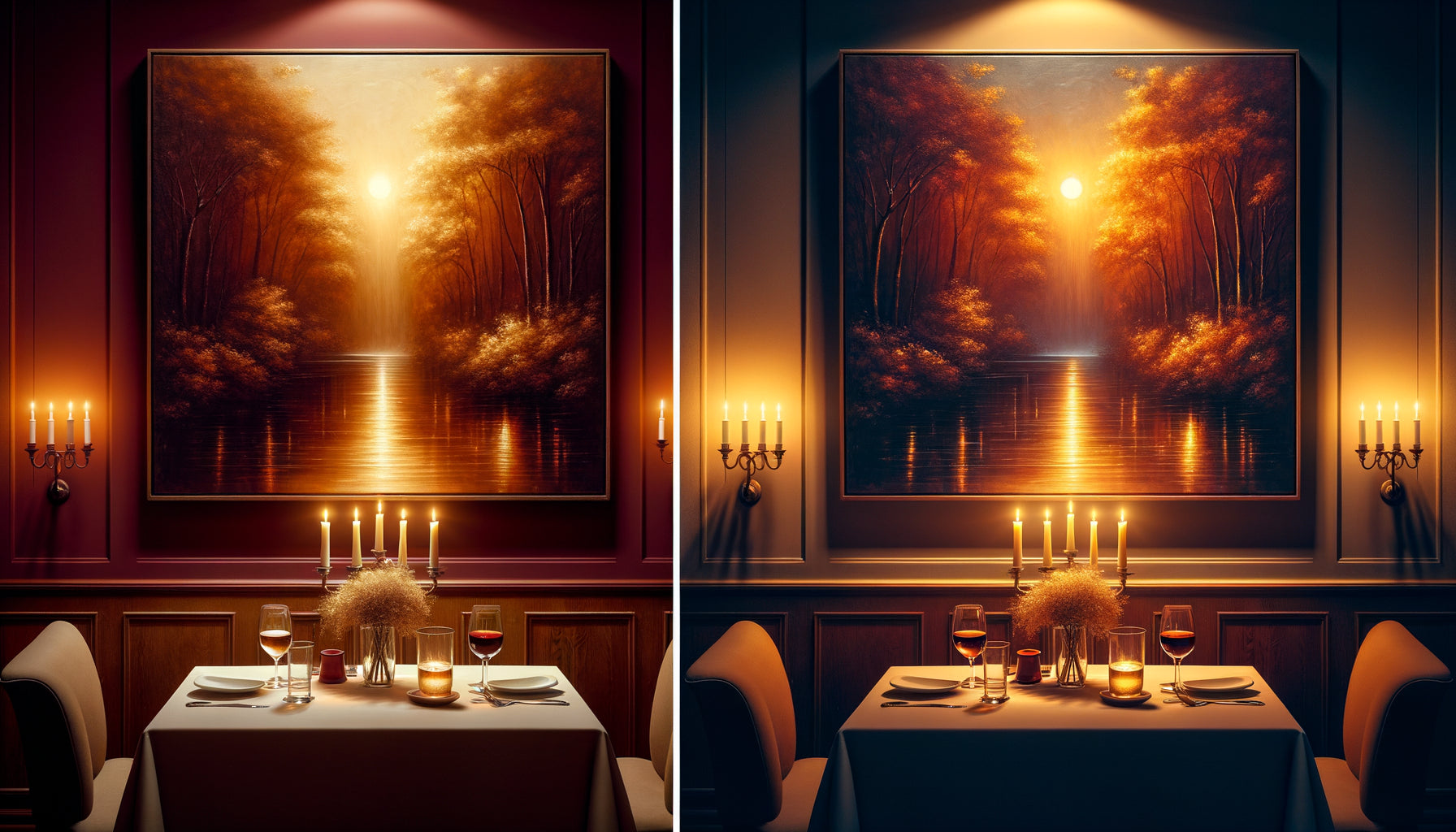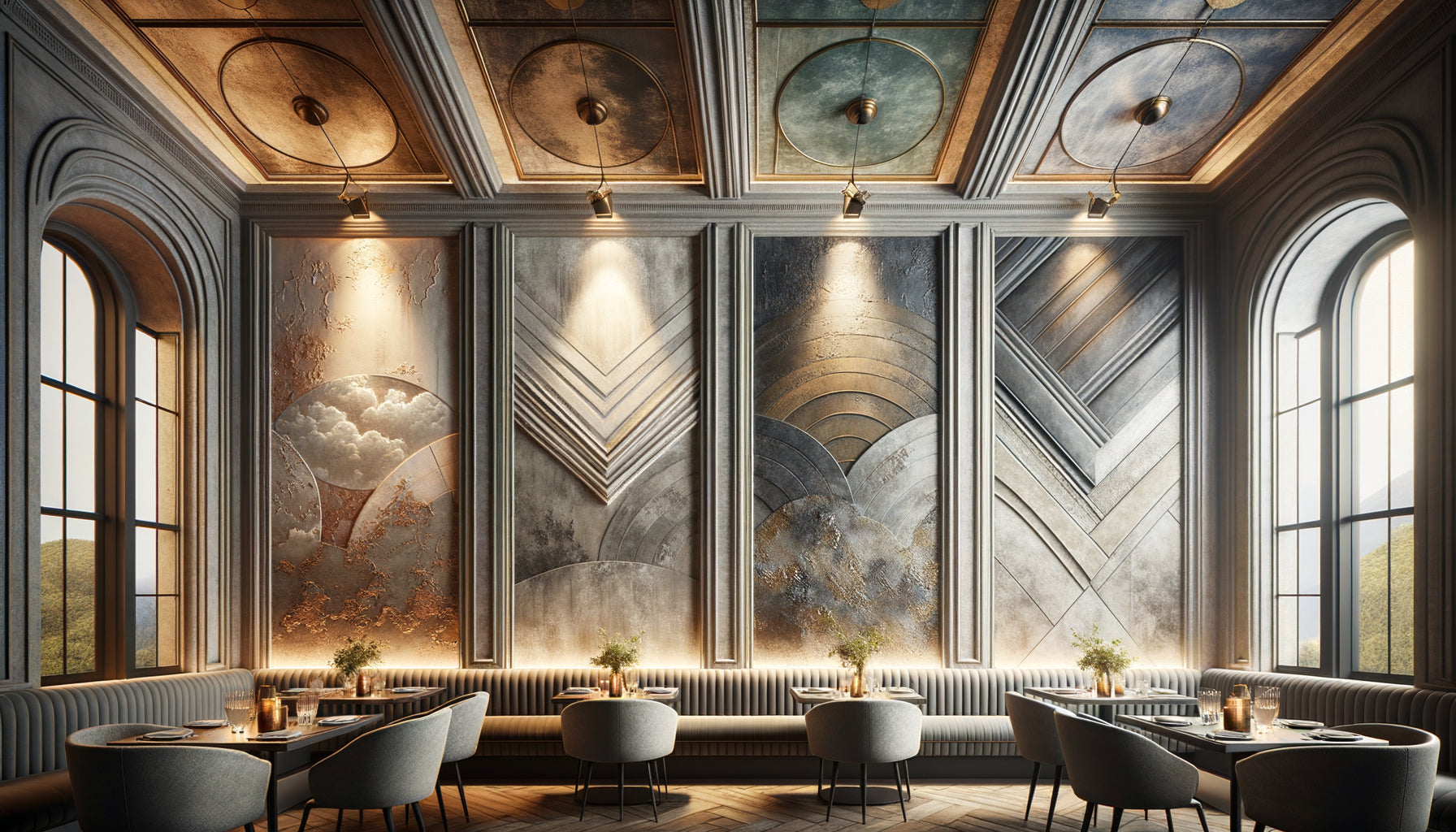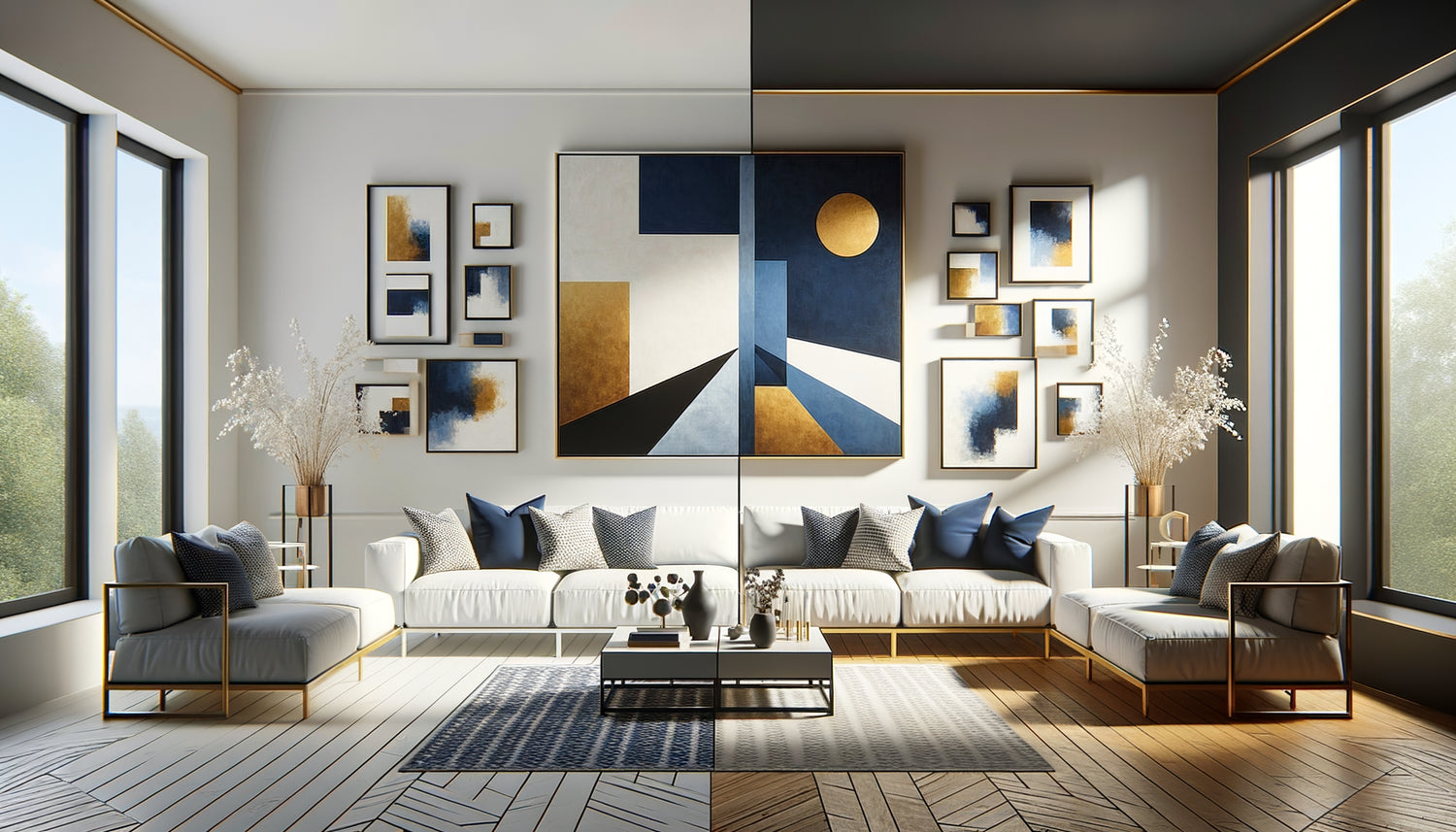
I spent twelve years designing window displays for the largest department stores in Europe. My profession? To capture attention in three seconds flat on a busy street. And I discovered an immutable law: the human eye is programmed to focus on large surfaces before scanning the details. I have applied this truth to hundreds of projects, and it works just as masterfully in our interiors. An XXL painting on a main wall doesn't just attract « a little more » attention than a composition of small formats: it magnetizes it instantly.
Here’s what an XXL painting brings: an immediate presence that structures the space, a powerful focal point that directs the gaze, and an impression of luxury and decorative confidence that transforms an ordinary room into a memorable place.
You've probably experienced this frustration: you accumulate frames, you arrange them carefully, you step back... and the whole thing remains bland, scattered, almost invisible. As if your walls were swallowing your efforts. Meanwhile, you visit interiors where a single painting imposes its presence, creates an instant atmosphere, gives the impression that every choice has been considered.
Rest assured: this is not a question of budget or « innate good taste ». It's a matter of understanding visual and architectural mechanisms. And I’m going to pass that understanding on to you now.
The tyranny of the first glance: how our brain scans a space
During my training in visual merchandising, we were taught the Z-eye path: the eye enters a space, instinctively sweeps from left to right, then descends diagonally. This movement lasts between two and four seconds. During this microscopic time frame, our brain seeks an anchor point – something imposing enough to justify its attention.
An XXL painting on a main wall wins this battle before it even begins. Its generous surface intercepts the gaze like a lighthouse in the fog. A composition of small formats, however carefully arranged, requires additional cognitive effort: the eye must first identify that it is a coherent ensemble, then decode the relationship between the elements. This extra mental work creates friction – and in the world of interior design, friction kills impact.
I measured this phenomenon during an installation for a watch shop in Zurich. We had two identical walls: one with nine 30x40 cm frames arranged in perfect grid, the other with a single 180x120 cm visual. With an eye-tracking system, we found that the XXL painting captured attention 3.7 times faster and held the gaze 2.4 times longer. The numbers don't lie.
The scale effect: when size creates emotion
There is a psychological dimension rarely mentioned: the size of a work directly influences the emotional intensity it generates. An XXL format doesn’t just show « bigger » – it creates an immersive experience that short-circuits our critical distance.
Think of cathedrals, Renaissance frescoes, IMAX screens. Gigantism is never accidental: it aims to overwhelm us, to place us in a posture of reception rather than analysis. In a living room, a painting of 150x100 cm or more produces exactly this effect. It doesn't decorate your wall: it occupies your field of vision, dialogues with your body, redimension the perception of the entire room.
A composition of small formats, even extremely successful, remains in the register of applied decoration. It adds to the space. An XXL painting, on the other hand, redefines the space. It becomes the reason for being of the wall, or even of the room. I have seen entire apartments designed around a single monumental work – and the effect is always striking.
The principle of dominant visual mass
In space design, we talk about visual hierarchy. In any environment, some elements must dominate to create a clear reading. Without hierarchy, the eye wanders aimlessly – and the space appears confused, anxiety-inducing. An XXL painting instantly establishes this hierarchy. It says: 'Start with me, then explore the rest.'
A composition of small formats, even sophisticated, creates a horizontal hierarchy: all elements are equal, competing for attention. Result? None really win. It's democratic, certainly, but visually exhausting. The gaze jumps from frame to frame without ever finding rest.

The architectural question: fill the space or structure it
During a project for an industrial loft in Berlin, the client absolutely wanted to "dress" a 5-meter long brick wall. His first idea? A collection of twelve small paintings. On paper, this seemed logical: multiply the works to cover the surface.
But here's the trap: multiplying small formats on a large wall doesn't fill the space, it fragments it. Each frame creates a small visual island. The whole looks like a decorative archipelago – perhaps pretty, but fragmented, without architectural strength. The wall itself disappears under the visual noise.
We eventually opted for an XXL diptych of 200x150 cm each, spaced 40 cm apart. The effect was radical: the wall regained its monumentality while being inhabited. The XXL painting respected the architecture instead of fighting it. It created a dialogue between raw material and image, between emptiness and fullness.
This lesson applies to all primary walls: a living room with a wall of 3-4 meters, a bedroom with the headboard clear, a generous hallway. These spaces call for a proportional response. An XXL format recognizes this scale and responds with confidence.
The luxury of simplicity: why less can feel infinitely more
There's something deeply counterintuitive about our approach to decorating: we often think that more objects = more visual richness. Exactly the opposite happens. The most impressive interiors I’ve designed were always those where we had the courage to subtract rather than add.
An XXL artwork embodies this luxury of simplicity. It asserts: “I only need this.” This decorative confidence is instantly striking. It evokes art galleries, minimalist penthouses, five-star hotel lobbies – places where every element is chosen for its maximum impact.
A composition of small formats, despite all its qualities, can betray hesitation: the fear of emptiness, progressive accumulation, a lack of overall vision. Even if it's perfectly executed, it remains an additive response. The XXL artwork is a subtractive response: a single gesture, total, assumed.
The cognitive economy of your space
Our interiors either tire us out or replenish us depending on their cognitive load. Too much visual stimuli exhausts the brain which constantly has to process information. An XXL artwork reduces this load: it's a single, clear piece of information that your nervous system can grasp at a glance and then integrate as a soothing background.
I worked with an interior architect specializing in neuroarchitecture who measured cortisol levels (stress hormone) in different environments. Her research consistently showed that spaces with a dominant focal point generated less stress than those with multiple visual elements of equal importance.

The photographic advantage: the Instagram era rewards readability
Let's face it: we live in an age where our interiors are photographed, shared, and judged in a fraction of a second on a smartphone screen. This reality is not superficial – it reflects our contemporary way of perceiving and evaluating spaces.
An XXL artwork is naturally photogenic. It instantly creates what photographers call a "strong subject": something that anchors the image and gives it an immediate sense of reading. Look at interiors that perform well on social media: almost all feature a dominant element, often a large-scale work of art.
A composition of small formats is difficult to photograph. It requires the right angle, the right distance, often several shots to be understood. On a 6-inch screen, it becomes unreadable and transforms into an abstract pattern. The XXL artwork, on the other hand, transcends all media: it impresses in reality, it impresses in photos, it impresses in miniature.
Ready to transform your main wall into a true visual statement?
Discover our exclusive collection of wall art for Restaurants that captivate the eye and structure space with a majestic presence.
How to choose and install your XXL artwork for maximum impact
Now that you understand why an XXL format surpasses a multiple composition, let's talk about concrete strategy. Not all XXL artworks are created equal, and their installation follows specific rules that I have refined over hundreds of projects.
First, the rule of thirds: your XXL artwork should cover approximately 60-75% of the width of your main piece of furniture (sofa, bed, console). Below that, it appears timid. Beyond that, it stifles. This proportion creates a natural visual balance that satisfies our innate sense of harmony.
Next, the height: the center of the artwork should be 145-155 cm from the floor, which corresponds to the eye level of a standing person. This height ensures that the work naturally integrates into your field of vision without forcing your gaze up or down. In a dining room where you are seated, lower this height by 10-15 cm.
Regarding the subject matter: prioritize simple compositions with a clear focal point. Works that are too detailed lose their impact at large scale – they become illustrated wallpaper. Geometric abstracts, clean landscapes, monumental portraits, architectural photographs work beautifully in XXL because they possess this clarity of reading that amplifies the size effect.
The technical mistakes that sabotage installation
I've seen too many beautiful XXL artworks ruined by avoidable installation errors. The first mistake is undersizing the hanging system. A 120x80 cm artwork can weigh 8-15 kilos. Always use anchors suitable for the type of wall and check the maximum load. An artwork that tilts or, worse, falls, instantly cancels out all the desired effect.
Second mistake: neglecting lighting. An XXL artwork deserves dedicated lighting – either a rail with an adjustable spotlight placed 50 cm above, or integrated ceiling lighting. Tangential light creates relief, intensifies colors, transforms your work into a museum installation. Without proper lighting, even the most beautiful XXL painting loses 50% of its impact in the evening.
Visualize the final transformation
Imagine this moment: you cross the threshold of your living room after the installation. Your gaze is immediately captured by this XXL format that now inhabits your main wall. The entire space seems reorganized around this new presence. Your guests enter and instinctively slow down, captivated before even taking off their coats.
This isn't decoration – it's spatial transformation. Your main wall is no longer a problem to be solved with an accumulation of small formats, but an opportunity seized with confidence. You have created a focal point that structures, impresses and soothes simultaneously.
Start by accurately measuring your main wall. Photograph it. Mentally visualize this XXL format that inhabits it. Then take action: choose a work that really speaks to you, not the one that « will go well with the sofa ». Decorative boldness always pays off, especially on a large scale.
Frequently Asked Questions
Could an XXL painting overwhelm a small space?
This is the most common fear, and yet totally unfounded. An XXL painting in a small space creates exactly the opposite effect: it visually expands the room by creating perspective. Your eye, drawn to the large surface, forgets the physical limits of the wall. I have installed 150x100 cm formats in studios of 25 m² with spectacular results: the room suddenly seemed intentionally designed around this work, therefore more thoughtful, less imposed. The only rule: leave at least 20 cm of free space around the painting so it can « breathe ». In a small space, a well-chosen large painting always surpasses five small formats that visually fragment already limited walls.
What budget should you allocate for a quality XXL painting?
The range varies enormously depending on the medium and technique. A museum-quality canvas print costs between €150 and €400 for a 120x80 cm format, which remains accessible. Original artworks start around €800 and can rise to several thousand. But here's the economic argument I always present: a single XXL artwork often costs less than a composition of six framed small formats. Count 80-120€ per quality frame with mat, mounting and glass, and you quickly reach €600 for an ensemble that will have less visual impact. My advice: always prioritize a single high-quality XXL format rather than several medium small formats. The investment is similar, but the decorative effect is incomparable. Also consider longevity: a large format transcends trends and moves better.
How to integrate an XXL artwork when you already have a lot of wall decoration?
This is the time to show decorative courage: less is exponentially more. If you want the impact of an XXL artwork, you must give it the space it deserves. Specifically: remove everything around your main wall. Those three small frames, that decorative shelf, that mirror – put them away temporarily. Install your XXL format alone on this now clear wall. Live with this configuration for a week. I bet you won't put the old elements back. The classic mistake is to want to "add" a large format to a wall that is already loaded – guaranteed result: visual cacophony. The XXL artwork is not one element more, it is a statement that replaces everything else. If your collection of decorative objects is dear to you, create a secondary gallery wall for them in a hallway or bedroom. But free up your main wall for this strong gesture that will transform your entire room.