Silence permeates these places in a particular way. In a chapel or place of contemplation, each visual element becomes meaningful, each color murmurs an intention. I spent twelve years supporting religious communities, healthcare facilities and memorial sites in the design of their sacred spaces. And I understood one essential thing: tableaux ne décorent pas ces lieux, ils les habitent.
Here's what good paintings bring to a chapel or place of contemplation: ils créent une atmosphère propice à l'introspection, ils offrent un point d'ancrage visuel pour l'apaisement, and ils respectent la diversité des chemins spirituels. Too often, we hesitate between traditional religious iconography and total abstraction, fearing either imposing or emptying the space of all substance. This tension is natural. Rest assured: there are artistic paths that honor the sacred without imprisoning, that invite contemplation without prescribing. In the lines that follow, I share the principles that guide my choices when selecting works for these very special spaces.
L'art qui invite au silence intérieur
In a chapel, the painting should never shout. I have seen too many places of contemplation cluttered with overloaded religious images, where the eye finds no rest. La première qualité d'un tableau pour une salle de recueillement est sa capacité à créer du silence visuel. This does not mean absence of presence, but rather a gentle presence that does not impose its rhythm.
Purified compositions work remarkably well. Think of the color planes of monochromes, minimalist landscapes where earth and sky meet in a soothing horizon line. I installed in a hospital chapel a large painting simply depicting a twilight sky, those shades of deep blue progressing to mauve. Visitors confided in me that they found an invitation to breathe, to lay down their burden.
La palette chromatique du recueillement
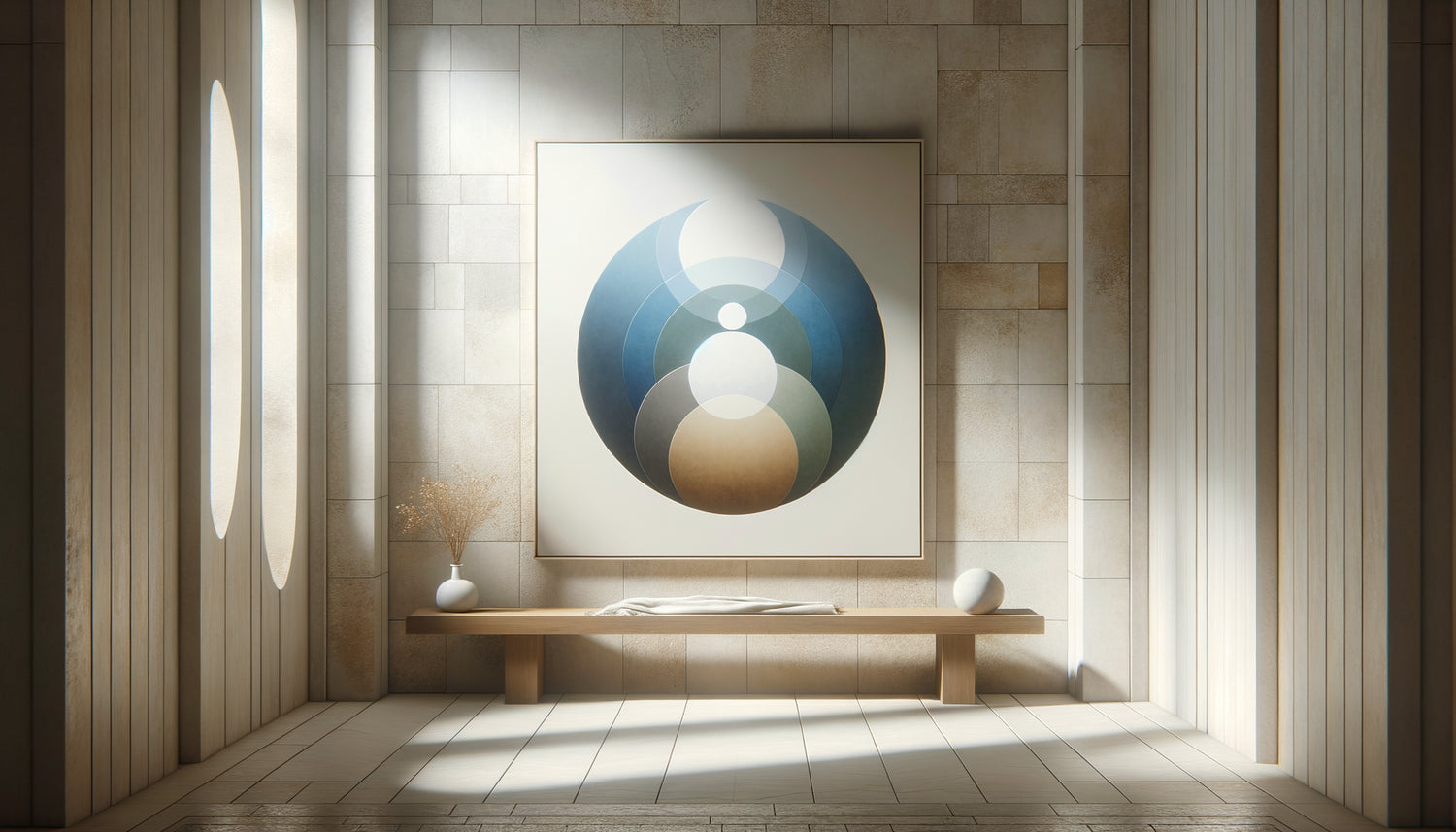
Colors speak directly to our nervous system. For a place of contemplation, prioritize tons sourds et profonds: deep blues, darkened emerald greens, earthy ochres, pearl grays. These shades naturally create an atmosphere conducive to introspection. I systematically avoid bright reds, vibrant yellows or contrasts that stimulate rather than soothe.
Cream white, lunar beige, stone nuances can also constitute the essence of a painting for chapel. These non-colors leave mental space free, allow everyone to project their own spiritual quest without the work imposing an overly marked emotional direction.
Entre figuration et abstraction : trouver l'équilibre universel
The question consistently arises: should there be explicit religious symbols in a contemporary chapel? My answer has become more refined over the course of projects. The most powerful paintings for a place of contemplation are those that suggest rather than assert. They open interpretive doors instead of closing meaning.
Contemplative abstraction offers this precious freedom. A painting where light seems to emanate from layers of glazes, where forms evoke without naming, allows each person to find their own resonance. The believer may see a divine presence in it, the agnostic an invitation to secular meditation, the bereaved a space to welcome their pain.
That said, some figurative representations work wonderfully well, provided they carry a contemplative quality. For a memorial place, I selected a painting simply depicting open hands, without faces, without identifiable religious context. This universal image of giving, welcoming or prayer speaks to all sensibilities.
Symbols of nature as a common language
Nature constitutes a universal spiritual vocabulary. A painting depicting a centuries-old tree, mountains in the mist, the water of a still lake, a forest enveloped in morning light: these images resonate with something fundamental within us, regardless of our beliefs.
In a care home chapel, I installed a series of three paintings showing the same landscape at different times of day. This suggestion of cycle, passage of time, change in permanence, offered residents a soothing mirror of their own journey. Families reported that their loved ones enjoyed contemplating these images during difficult moments.

Dimensions and placement: a modern sacred geometry
A painting that is too large overwhelms, one that is too small gets lost. For a place of contemplation, I apply the rule of single focal point. It is better to have a single beautiful-sized work, placed facing the entrance or above the prayer space, than several small scattered images that fragment attention.
The ideal dimensions obviously depend on the volume, but for a medium-sized chapel (20 to 40 m²), I recommend formats between 80x120 cm and 120x180 cm. This scale allows the painting to have a structuring presence without authoritatively dominating the space.
The placement height deserves particular attention. The center of the artwork should be slightly below eye level when seated, facilitating contemplation for those who pray or meditate while sitting. I generally install the center of the work between 120 and 140 cm from the floor.
Lighting as Spiritual Revelation
A painting for a chapel should be illuminated with delicacy. Natural light remains ideal, but if you must use artificial lighting, opt for indirect spotlights with warm temperature (2700-3000K) that avoid reflections while subtly revealing the nuances of the work. The goal is not to dramatically stage the painting, but to allow it to breathe in the space.
Materiality and Authenticity: Choosing Works That Last
In a place of contemplation, the material quality of the painting deeply matters. These spaces call for authenticity, permanence, and the seriousness of artistic commitment. Prioritize original paintings or very high-quality art reproductions on canvas rather than framed paper prints.
Traditional techniques – oil on canvas, thick acrylic, mixed media with texture – bring a depth and richness that digital reproduction, however sophisticated, struggles to match. When light catches the reliefs of a true painting, when layers of glazes create this almost architectural depth, the painting truly becomes a companion for contemplation.
If the budget does not allow for the acquisition of original works, turn to giclée reproductions on canvas, with 100-year guaranteed pigment inks, mounted on wooden frames. Absolutely avoid glossy prints or overly ornate frames that betray the contemplative vocation of the place.

Respecting Spiritual Diversity in Universality
Our societies have become mosaics of beliefs. A contemporary chapel, particularly in a healthcare facility, senior residence, or memorial place, welcomes people with infinitely varied spiritual journeys. The challenge is to choose paintings that honor this diversity without falling into bland neutrality.
Over the years, I have developed a sensitivity to what I call transcendent visual archetypes: light, path, threshold, verticality, flight, water, breath. These motifs resonate with great spiritual traditions without belonging exclusively to any one. A painting depicting golden light streaming through clouds will evoke Christian transcendence for some, Buddhist enlightenment for others, or simply the comforting beauty of nature for still others.
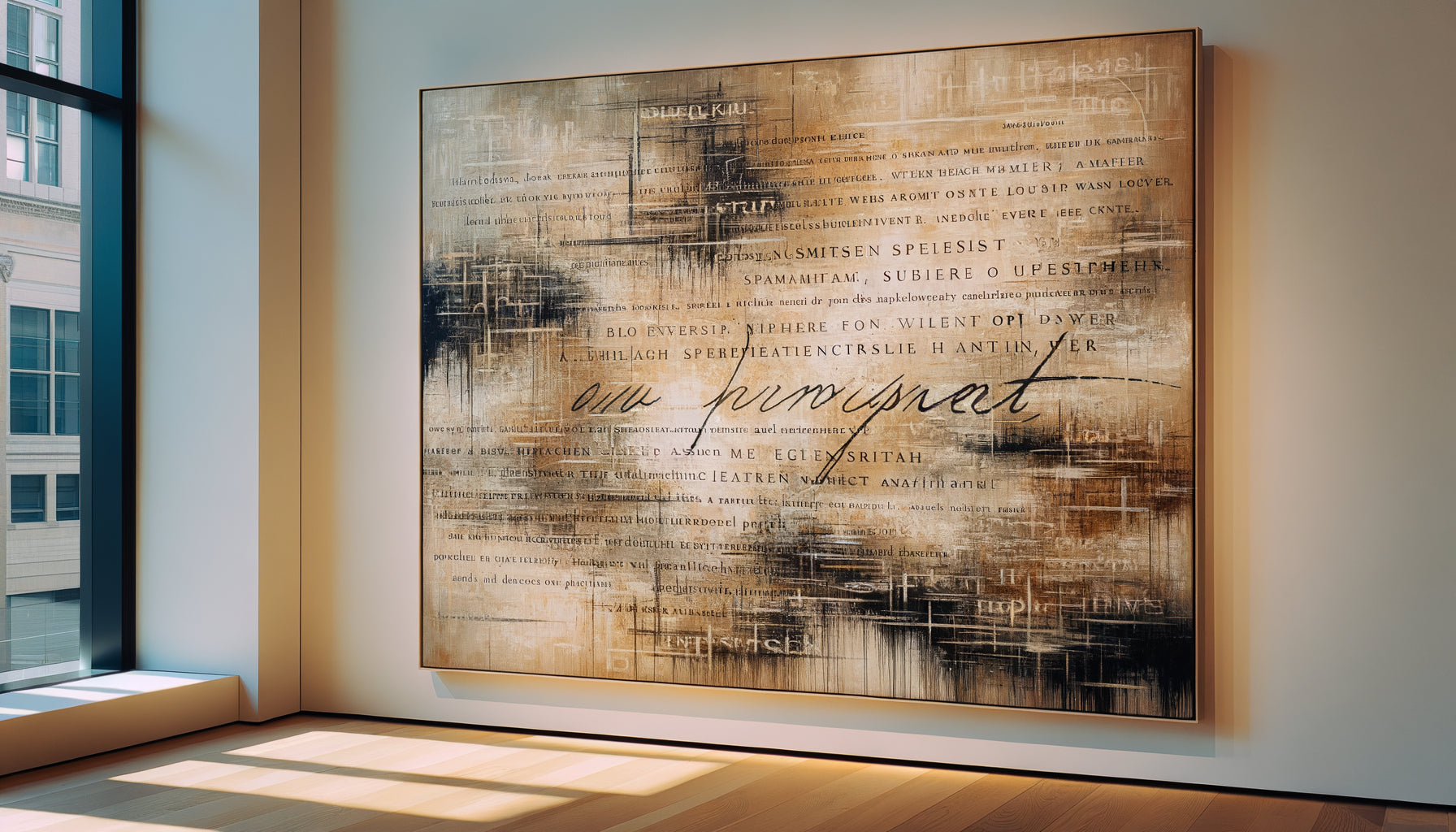
This approach requires finesse in selection. It is about avoiding overly explicit symbols (crosses, figures of saints, religious calligraphy) while refusing total emptiness that would strip the space of all spiritual substance. The painting for a modern contemplation room walks this thin line between presence and openness.
Some artists and movements to explore
Certain artists have particularly developed this visual language of interiority. Without imposing a unique style, I invite you to discover: the monochromes of Yves Klein, whose IKB blue possesses an incomparable meditative depth; the luminous landscapes of William Turner, where matter and light merge; the lyrical abstraction of painters such as Zao Wou-Ki, who combines East and West in atmospheric compositions.
More contemporary artists working on translucent light, superimpositions of colored veils, mineral textures or landscapes reduced to their geometric essence offer fertile avenues for dressing a chapel with justness.
Create an authentic space of peace
Discover our exclusive collection of wall art for senior residences that transform your contemplation spaces into true havens of serenity.
When the painting becomes a silent companion
After twelve years of designing these spaces, I realized that the best paintings for chapels are those that you don't immediately notice, but which you can no longer do without. They do not impose themselves during the first visit, but after a few minutes of presence, they become the natural anchor of the gaze and mind.
These are works that evolve with daylight, revealing different nuances depending on the time. These are compositions that support hundreds of contemplations without ever exhausting their mystery. These are images that accompany both joyful prayer and mourning, daily meditation and moments of crisis.
Choosing a painting for a place of contemplation is ultimately selecting a silent companion that will welcome the joys and sorrows, the questions and silences of all those who cross this threshold. This responsibility deserves time, reflection, and above all listening to what the space itself whispers when you stand in silence.
Visit the empty chapel at different times. Observe how the light moves, where it lingers. Imagine yourself in contemplation facing the main wall. What visual presence would support you without distracting you? What image would invite you to set aside your agitation? It is in this patient listening that the right choice is born, one that will faithfully serve the soul of the place for years.
Frequently Asked Questions
Can multiple paintings be installed in a small chapel?
It's an understandable temptation, but one I encourage you to avoid. A small chapel or place of contemplation (less than 20 m²) calls for visual unity rather than multiplication. A single quality painting, well placed, will create a much more conducive atmosphere for contemplation than several works that fragment attention. If you absolutely want multiple visuals, opt for a triptych or diptych, i.e., a work originally designed to be viewed in multiple panels. This approach maintains unity while creating a visual rhythm. The exception concerns chapels with separate spaces (nave and choir, for example), where you can create a dialogue between two complementary works, but never competing ones.
Should religious or secular artists be prioritized?
The spirituality of a work does not depend on the creator's confession at all. Some of the most profoundly meditative paintings I have installed in chapels were created by agnostic artists or from non-Christian spiritual traditions. What matters is the intrinsic contemplative quality of the work, its ability to open an inner space rather than its alignment with a doctrine. An abstract landscape created by an artist without religious affiliation can infinitely better serve contemplation than a conventional pious image. Focus on what the painting evokes in you when you contemplate it in silence, on its color palette, on its composition. Rothko, who created some of the most spiritual works of the 20th century, said he wanted to provoke quasi-religious experiences without ever subscribing to a denominational tradition. This is the spirit that should guide your choice: the ability of the work to create a spiritual opening, regardless of the creator's biography.
How to maintain a painting in a place of contemplation?
Chapels and places of contemplation often present particular conditions: variations in temperature when heating is only activated for services, sometimes high humidity levels, intense natural light depending on orientation. To protect your artwork, first make sure to avoid direct sunlight, which irreversibly discolors pigments. If stained glass windows or windows direct sunlight towards the location of the painting at certain times, install curtains or reorient the work. As for cleaning, extreme gentleness is required: a very light dusting with a soft duster once or twice a year is more than sufficient. Never use cleaning products, even mild ones, directly on the canvas. If the artwork requires deeper cleaning, entrust it to a restorer. Finally, monitor the appearance of mold if the place is humid, and do not hesitate to invest in a discreet dehumidifier if necessary. A well-maintained painting will last through the decades while retaining all its evocative power.