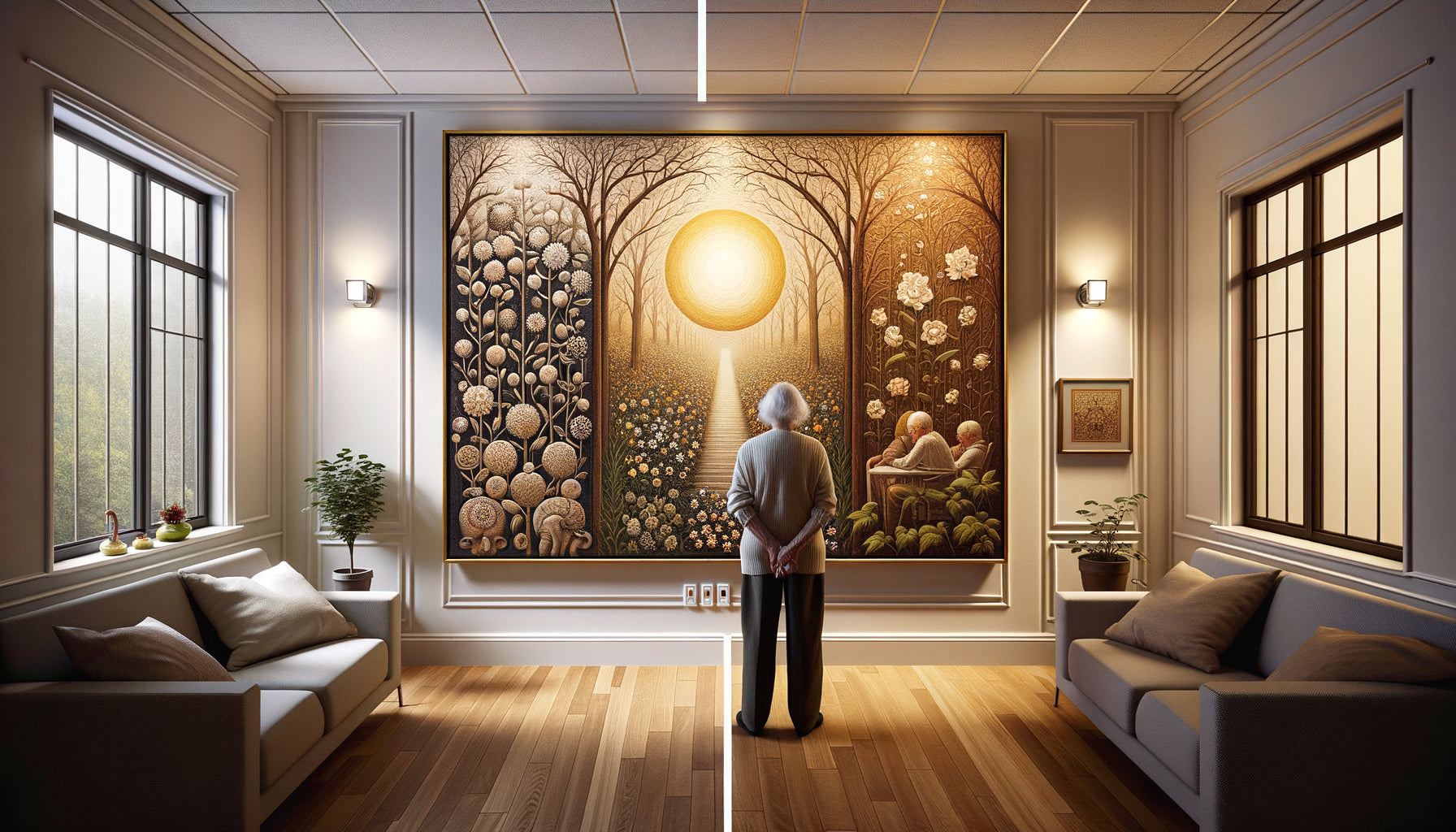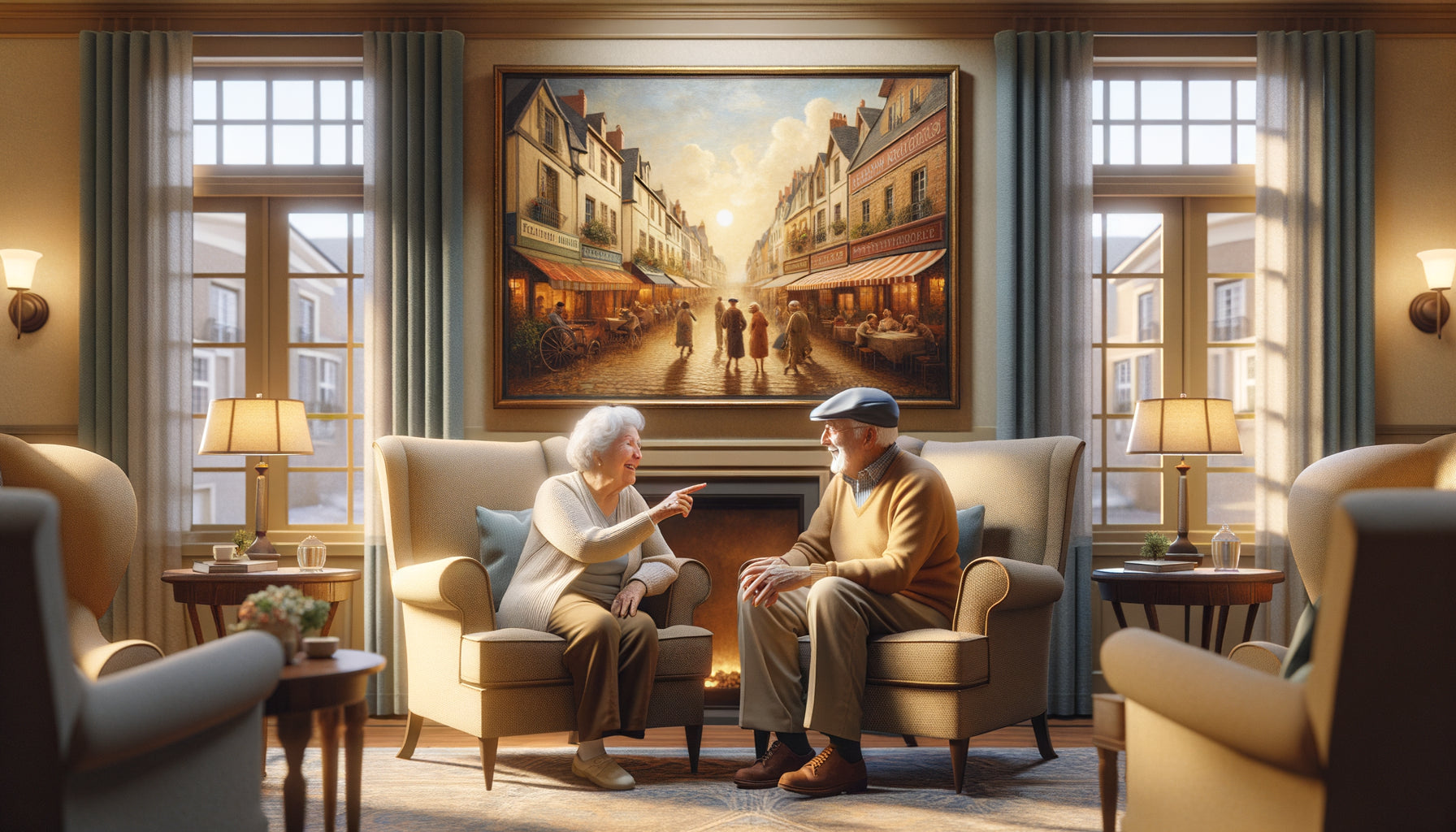
I recently transformed the common area of a senior residence near Toulouse. The director contacted me after investing in a beautiful collection of Provence watercolors. Her observation was bitter: "No one notices them. With the current lighting, they seem dull, as if they didn't really exist." In three weeks, we transformed this makeshift gallery into a true luminous showcase. Residents now stopped, commented on the nuances, rediscovered invisible details. The light had awakened the soul of these works.
Here's what adapted lighting for paintings in senior residences brings: it reveals the chromatic richness of the artworks without dazzling sensitive eyes, creates stimulating points of interest in common living areas, and transforms corridors into true soothing art galleries.
Too often, the artworks hung in these places of life are drowned under uniform neon lights or left in the gloom. The result? Magnificent canvases that go unnoticed, wasted cultural investments, and above all, missed opportunities to create moments of daily wonder for residents. Yet, the solution exists: it lies in the judicious choice of lighting specifically designed to enhance art while respecting the particular visual needs of a senior audience.
I will guide you through the lighting techniques that I systematically use to sublimate paintings in these very special environments, where visual comfort and aesthetics must coexist harmoniously.
Light that respects: understanding specific visual needs
Lighting for paintings in senior residences cannot ignore a physiological reality: with age, the pupil dilates less effectively, the lens yellows slightly, and sensitivity to glare increases considerably. These natural transformations require a radically different lighting approach than that of a classic museum.
During a project in Bordeaux, I installed LED spotlights with variable intensity with a color temperature of 3000K – this warm golden hue that envelops without aggression. The contrast was striking: where fluorescent tubes created blinding reflections on the protective glasses, this softer light revealed the pigments with remarkable accuracy. A visually impaired resident confided in me that she could finally distinguish the details of a still life that she had only glimpsed before.
The ideal luminous intensity is between 150 and 300 lux for paintings in senior residences – intense enough to reveal the details, but never aggressive. This technical measurement translates concretely into light that guides the gaze without tiring it, allowing prolonged contemplation even for the most sensitive eyes.
The lighting angle: the secret of professionals
A detail changes everything: the projection angle of the light. I systematically install my light sources with a 30-degree inclination relative to the artwork. This magical angulation eliminates distracting reflections while sculpting the reliefs of the painting. On an Impressionist canvas with generous impasto, this grazing lighting makes shadows dance and reveals the artist's gesture – a tactile dimension that invariably fascinates residents.
Lighting technologies: practical decryption for each situation
After fifteen years of illuminating works in various contexts, I have identified three systems particularly suitable for senior residences, each responding to specific architectural configurations.
Rails with adjustable spotlights are my preferred solution for multifunctional common areas. In a residence in Lyon, we equipped the main living room with a discreet rail running along the ceiling. Each 7W LED spotlight can be individually reoriented, adapting to seasonal rotations of temporary exhibitions. Flexibility is total, maintenance minimal, and electricity consumption negligible – a decisive argument for managers keen to control costs.
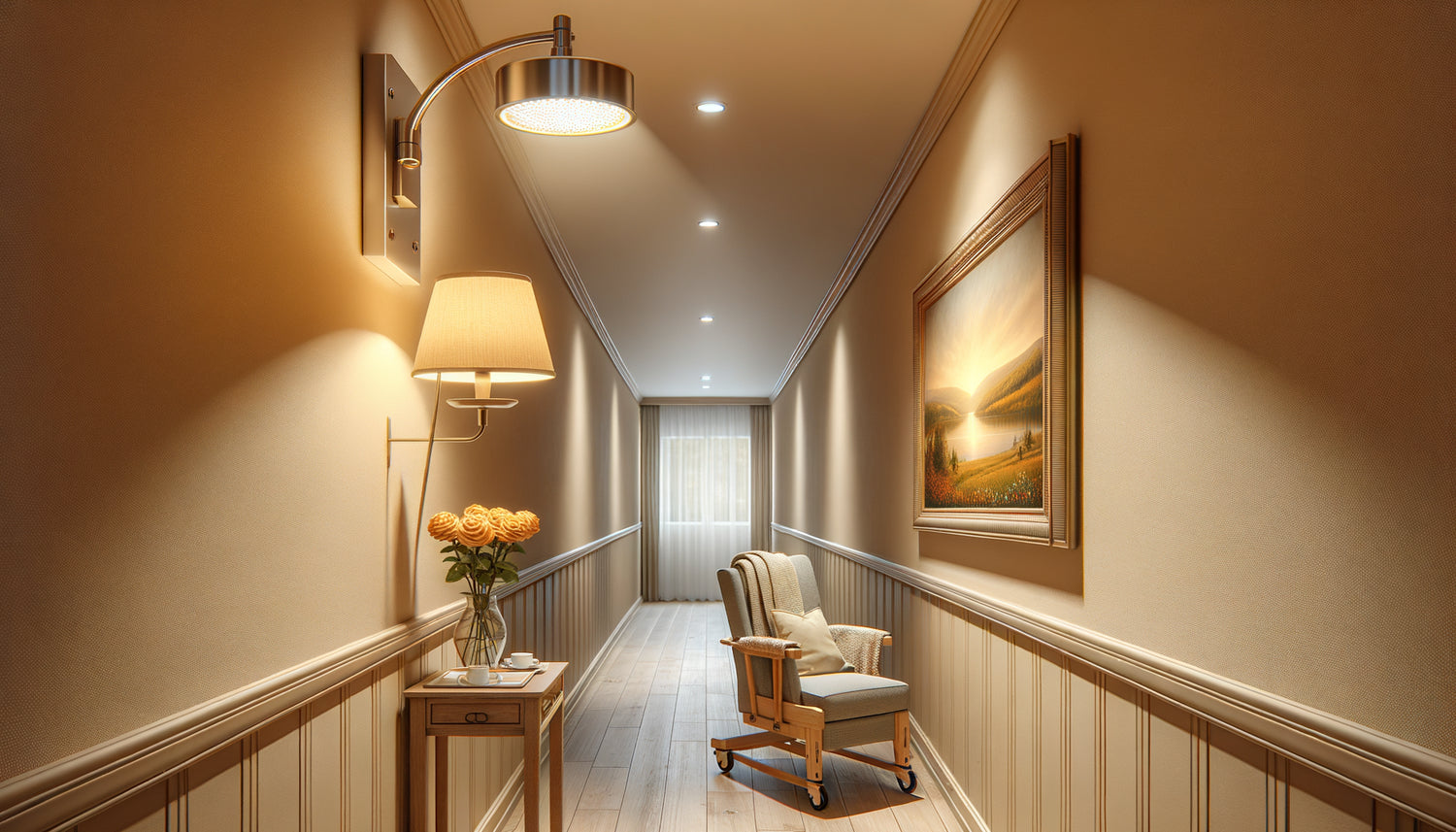
Wall sconces with articulated arms excel in narrow corridors where overhead space is limited. I recently installed brushed brass models in an Art Deco residence. Positioned 40 cm above the frame, these sconces diffuse a downward light that evenly bathes the surface of the artwork. The advantage? They also create a warm atmosphere in the passage, transforming a simple corridor into an artistic promenade where residents enjoy strolling.
Integrated LED strips represent the most contemporary and discreet option. Concealed in a cornice above the painting or integrated directly into the frame, they produce diffuse and homogeneous light that seems to emanate from the work itself. This solution is particularly suitable for large-format paintings in entrance halls, where the theatrical effect creates a memorable focal point as soon as you cross the threshold.
A detail changes everything: color temperature
A frequent trap: choosing a light that is too cold, around 5000K, which gives paintings an artificial bluish tone. For senior residences, I systematically prefer a temperature between 2700K and 3000K. This warm light respects the original palette of the artist, particularly crucial for antique works with patinated varnishes that require this luminous warmth to reveal their amber subtleties.

Protecting artworks: lighting that preserves
Experience taught me to be vigilant. In my early years, I illuminated a delicate watercolor with powerful halogens. Six months later, the result was cruel: pink hues had turned pale beige, victims of excessive exposure to UV rays and heat. This costly mistake has never been repeated.
Modern LED lighting is the ideal solution for preserving paintings in senior residences over the long term. Unlike older technologies, LEDs emit virtually no ultraviolet or infrared radiation – the two invisible enemies that gradually degrade pigments and supports. A watercolor, gouache or antique photograph can thus be displayed with complete peace of mind for decades.
I systematically add UV filters to the protective glass of frames when the artwork is particularly sensitive to light. This double protection – UV-free LED + filtering glass – guarantees optimal preservation even in spaces bathed in natural light during the day.
Intelligent management: dimmers and programming
An innovation that I now integrate into all my projects: dimmers coupled with timers. In a residence in Nantes, we programmed the lighting of paintings to automatically adapt to attendance hours. Maximum brightness during activity time slots (10am-12pm and 3pm-7pm), intensity reduced by 50% for the rest of the time. This intelligent management preserves artworks while generating substantial energy savings – up to 40% reduction in the dedicated lighting bill.
Creating atmospheres: beyond the technical function
Lighting for paintings in senior residences transcends simple functional illumination. It sculpts the atmosphere, rhythms spaces, creates micro-visual events that punctuate the daily lives of residents.
In a Provençal establishment, I designed a lighting path where each painting benefits from specific lighting creating islands of contemplation. The corridor leading to the dining room becomes a real art gallery where residents naturally slow down their pace, stop and exchange impressions. A caregiver told me that this simple arrangement had transformed routine movements into spontaneous cultural walks, fostering social interactions and stimulating memory through active observation.
Complementary indirect lighting also plays a crucial role. By adding soft ambient light around the artwork – via hidden LEDs in furniture or strategically placed accent lamps – we avoid the harsh contrast between the illuminated work and the surrounding darkness, which can cause eye strain. This layered lighting creates a harmonious transition that respects the increased visual sensitivity of senior audiences.

Practical installation: mistakes to absolutely avoid
Certain mistakes consistently recur during my lighting audits in senior residences. The most common? Positioning the light source too close to the artwork, creating a central hot spot and leaving the edges in shadow. The optimal distance is simply calculated: for a spotlight, allow a distance equivalent to 1.5 times the height of the artwork. A 60 cm high frame therefore requires a spotlight installed at a minimum of 90 cm.
Another classic trap: neglecting indirect glare. I have seen technically perfect installations become uncomfortable because the light beam, too powerful, reflected on the glazed floor and created visual discomfort for seated people. The solution? Use spotlights with anti-glare optics (UGR < 19) that concentrate the light strictly on the artwork without parasitic dispersion.
Invisible wiring: aesthetics and safety
In senior residences, safety is paramount. I systematically run cables in wall ducts or, even better, within walls during renovations. Zero exposed wire means zero risk of falls – an absolute priority for a public with sometimes reduced mobility. This requirement is not incompatible with aesthetics: modern flush-mounted wiring solutions are completely forgotten once the artworks are hung.
Ready to illuminate your living space?
Discover our exclusive collection of wall art for senior residences that thrive under adapted lighting and transform each hallway into an inspiring gallery.
The silent transformation: when light changes everyday life
Six months after the complete installation of lighting for paintings in the Toulouse residence, the director called me back. Not for a technical problem, but to share an unexpected observation: residents were showing more interest in cultural activities, conversations around the artworks had multiplied, and several families had spontaneously commented on the warmer atmosphere of the common areas.
This transformation illustrates a truth that I verify with each project: lighting adapted for paintings in senior residences does not only reveal works – it creates a cognitively stimulating environment, emotionally soothing, and socially catalytic. Light then becomes a well-being tool in its own right, just like ergonomic furniture or controlled acoustics.
Start modestly if your budget is limited. Even lighting a single strategically placed painting – in the entrance hall or facing the relaxation area – can initiate this virtuous circle. Observe how gazes naturally turn towards this luminous oasis, how footsteps slow down, how comments emerge. Then gradually extend this logic of thoughtful lighting to the entire gallery wall. The investment, reasonable with current LED technologies, is measured in daily quality of life – an invaluable value in the world of senior residences.
FAQ : Your questions about painting lighting in senior residences
What LED bulb power should I choose to light a painting in a senior residence?
For a standard size painting (50x70 cm), opt for an LED bulb of 5 to 7 watts with a diffusion angle of 36 to 40 degrees. This power offers lighting of 150 to 200 lux – the ideal intensity to reveal details without dazzling the eyes of sensitive residents. Also check the color rendering index (CRI): choose a model with CRI greater than 90 for faithful reproduction of original colors. For comparison, this is equivalent to the previous generation of 35W halogen bulbs, but with electricity consumption divided by five and a lifespan multiplied by twenty. Do not hesitate to test the bulb before final installation: turn it on in the evening in the room concerned and observe the rendering for several minutes from different viewing angles.
Does painting lighting consume a lot of electricity in a residence?
Excellent news: with current LED technologies, the impact on electricity bills remains negligible. Let's take a concrete example: a residence equipped with 20 LED spotlights of 7W to illuminate its collection of paintings, operating 8 hours per day, consumes approximately 41 kWh per month, or about €7 at the current regulated rate. That's less than a domestic refrigerator! Moreover, unlike older halogen solutions that generated significant heat sometimes requiring compensatory air conditioning, LEDs remain cool and do not increase cooling costs. To optimize even further, installing motion detectors in hallways allows lighting of paintings to be activated only during the actual passage of residents, reducing consumption by an additional 40 to 60% without any loss of comfort.
Can paintings placed near windows in senior residences be illuminated?
Yes, but with specific precautions. Fluctuating natural light requires an intelligent supplementary lighting that automatically adapts. I use systems with light sensors that increase artificial intensity when daylight decreases, thus maintaining a constant illumination level on the painting regardless of weather conditions or time. However, be careful about direct exposure to sunlight: even with perfect artificial lighting, solar UV rays irreversibly degrade pigments and supports. The solution? Install transparent anti-UV films on windows (blocking 99% of UV without altering visible brightness) or position the painting perpendicularly to the window rather than facing it. This configuration allows you to benefit from the pleasantness of natural light while protecting the artwork in the long term – an ideal compromise for collectively lit living spaces.