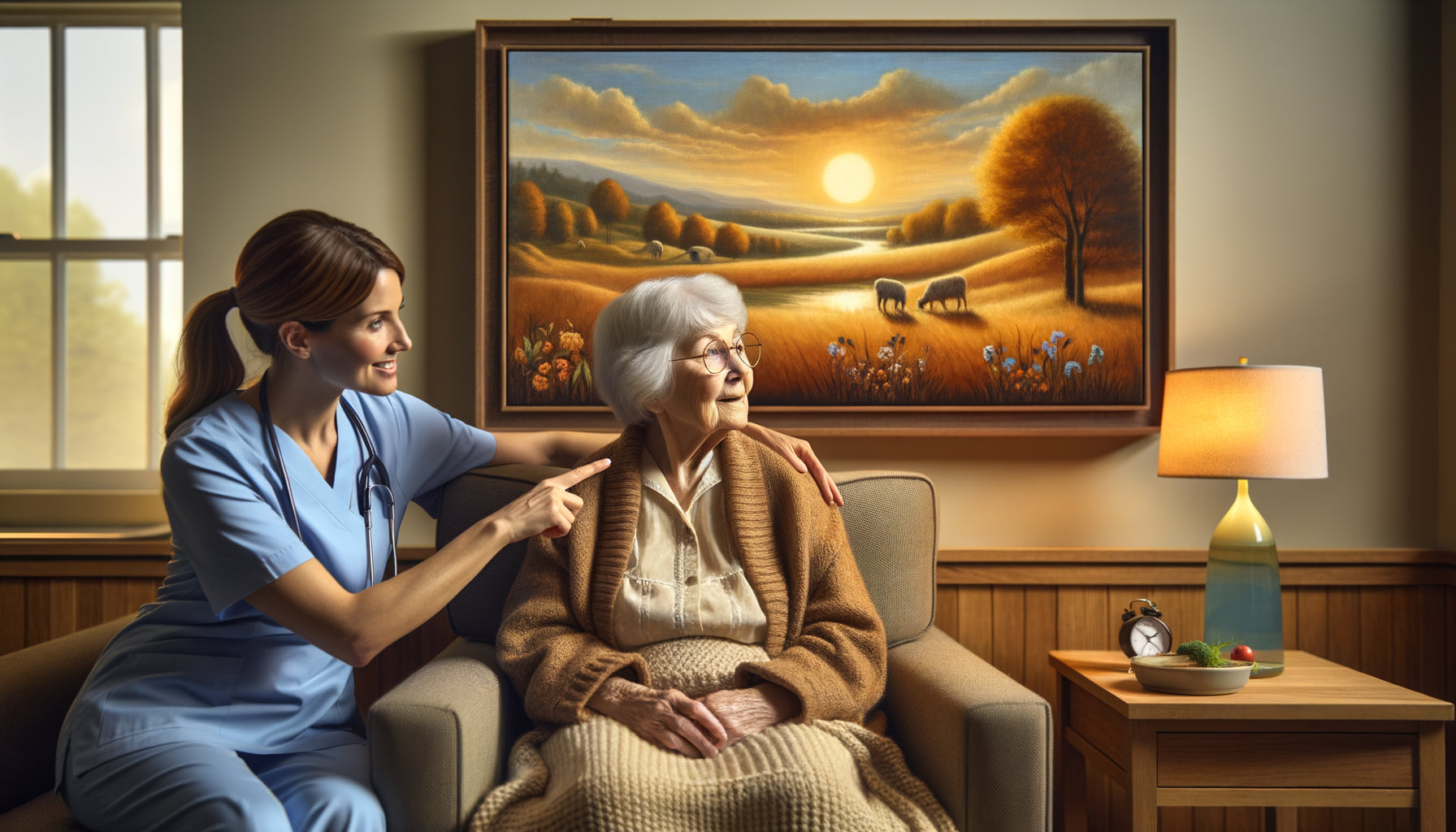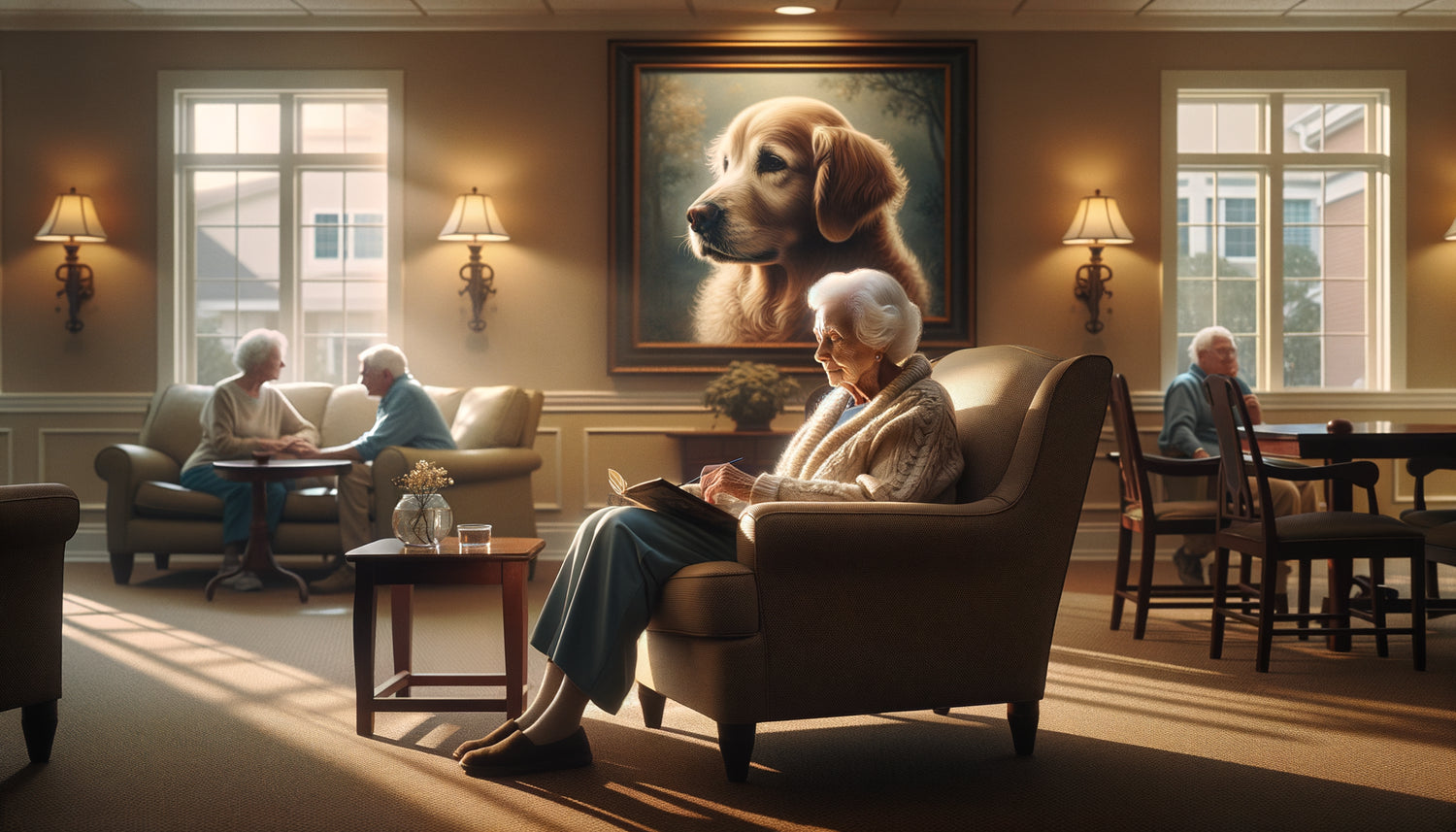
In Mrs. Fontaine’s living room, an 82-year-old woman who has lived in a senior residence for three years, stands a painting of a golden retriever with gentle eyes. Every morning, she stops in front of this canvas and smiles, as if finding an old friend. This daily ritual transforms her mood and colors her day. This scene illustrates a phenomenon that I have observed for fifteen years in the establishments that I support: the visual presence of domestic animals in living spaces creates a profound sense of calm among residents.
Here's what paintings with domestic animals bring concretely: immediate emotional comfort that recalls companions of a lifetime, cognitive stimulation that encourages exchanges and memories, and a warm atmosphere that transforms an institutional space into a true home.
Many residents in medical facilities suffer from separation from their pets, a break often as painful as a move. The white and impersonal walls of the rooms accentuate this feeling of loss and isolation. Families feel helpless facing this sadness, desperately seeking solutions to bring a smile back to their loved ones.
Rest assured: animal art constitutes a powerful emotional bridge towards well-being. Representations of domestic animals are not just decorations, but true non-pharmacological therapeutic tools that act on mood, memory and social connection.
In this article, I share with you the deep mechanisms that explain why these paintings so effectively comfort residents, how to choose the right representations according to profiles, and the mistakes to avoid to maximize their beneficial impact.
Affective memory: when a painted gaze revives an entire life
During an art therapy session that I led in a Lyon residence, I hung a painting of a ginger cat sleeping on a windowsill. Mr. Duchamp, usually silent and withdrawn into himself, spontaneously got up to approach the work. His eyes misted over: 'That’s Rouquinou, my cat for twenty years', he murmured. For an hour, he told anecdotes about his companion, rediscovering a liveliness that staff had never observed.
Domestic pets occupy a unique place in our emotional memory.
This mnemonic reactivation is not nostalgic in the sad sense of the term. On the contrary, it provides a feeling of identity continuity: 'I am still that person who loved animals'. This confirmation of self is essential for the psychological well-being of residents who may feel deprived of their identity in a new environment.
Choice of species: a specific emotional language
Not all domestic animals generate the same emotional resonances. Dogs evoke loyalty, protection and daily outings. They are particularly comforting for former active owners who keep the memory of invigorating walks. Pictures of happy dogs, in motion or peaceful rest, bring a gentle and reassuring energy.
Cats, on the other hand, embody quiet independence, contemplation and soothing presence. Their representation is perfectly suited to residents who appreciate calm and gentleness. A cat curled up in an armchair or looking out of a window creates an atmosphere of domestic serenity that immediately transforms the perception of a room.
Birds symbolize freedom, lightness and connection with nature. Particularly beneficial for melancholic residents, they bring a dimension of hope and movement. A picture of colorful parrots or a bright yellow canary can literally light up the space and mood.
Visual comfort: how an image soothes the nervous system
In a senior residence in Bordeaux, management had installed pictures of domestic animals in the corridors and common areas. Six months later, an internal study revealed a 30% reduction in anxiety manifestations and a significant improvement in overall atmosphere. How to explain this measurable impact?
The visual presence of domestic animals activates what neuroscience calls the care and attachment system. Even in image, these creatures trigger a neurological response that releases oxytocin, the hormone of well-being and social bonding. It is the same mechanism that occurs when petting a real animal, but in an attenuated version.
The facial expressions of animals in paintings play a crucial role. A dog with a confident gaze, a cat with half-closed eyes in a contented position, a rabbit with relaxed ears: these nonverbal signals of well-being are instinctively decoded by our brain and influence our own emotional state. It's a phenomenon of positive emotional contagion that is well documented.
The emotional palette: colors and composition
A pet painting does not only comfort through its subject matter but also through its artistic treatment. Warm tones – ochres, soft browns, creamy beiges – create a enveloping atmosphere that evokes the warmth of fur. These shades are particularly soothing for residents sensitive to institutional coldness.
Soft realism works better than hyperrealism or excessive abstraction. Residents seek immediate recognition that allows them to connect emotionally without cognitive effort. A golden retriever painted with sufficient detail to be identifiable, but with an artistic touch that softens the whole, finds the right balance.
The composition also influences the feeling of comfort. Animals depicted in resting positions – asleep, lying down, curled up – convey an invitation to relaxation. Conversely, animals in dynamic movement bring positive energy, ideal for common areas where interaction is encouraged.

The social catalyst: when painted animals create connections
Mrs. Leblanc and Mrs. Girard had never spoken to each other in six months of cohabitation on the same floor. One morning, in front of a painting depicting a Cavalier King Charles installed in the hallway, they spontaneously began exchanging stories about their former companions. This conversation initiated a friendship that transformed their daily lives. Paintings of domestic animals act as conversational meeting points.
In the communal areas of senior residences, these works break the ice naturally. Unlike abstract or landscape subjects which leave little room for dialogue, domestic animals generate spontaneous personal anecdotes. Everyone has a story to tell about a dog, cat or rabbit that marked their life.
This social dimension of comfort is too often underestimated. Isolation constitutes one of the greatest challenges in senior living facilities. Animal paintings create shared emotional territories where residents can express their memories, emotions and build connections around common experiences.
The Mirror Effect: Recognizing Vulnerability in Animals
A less obvious but deeply comforting aspect of domestic animal paintings lies in the touching vulnerability they exude. A puppy with big eyes, a clumsy kitten, a fragile rabbit: these representations directly touch the residents' caregiving system, reactivating their capacity for kindness.
Paradoxically, by contemplating the fragility of an animal, residents feel less vulnerable themselves. They regain a position of benevolent protector rather than a dependent person. This subtle psychological reversal restores a sense of dignity and ability to act, even symbolically.
Mistakes to Avoid When Choosing Representations
Not all depictions of domestic animals produce a comforting effect. I have observed several recurring mistakes that can even generate negative reactions. Images that are too sad – abandoned animals, excessive melancholic gazes, situations of distress – can reactivate feelings of loss rather than comfort. The goal is to soothe, not to rekindle grief.
Formats that are too small constitute another frequent mistake. A 20x30 cm painting will go unnoticed and produce no effect. Residents, often affected by a decrease in visual acuity, need works large enough to be appreciated without effort. A minimum format of 60x80 cm guarantees a visually comforting presence.
Also pay attention to styles that are too modern or deconstructed. A cubist cat or a dog in blocks of bright colors can confuse rather than reassure. Residents seek in these paintings a reassuring familiarity, not abstract intellectual stimulation. Reserve artistic boldness for other spaces.
Strategic Placement to Maximize Comfort
The placement of the painting considerably influences its comforting impact. In a private bedroom, prioritize the wall facing the bed: it is the first and last image of the day, creating a soothing visual ritual upon waking and going to sleep. This position transforms the represented animal into a true roommate.
In common areas, install artwork at eye level when seated, particularly near armchairs and sofas. Residents spend a lot of time sitting and should be able to comfortably contemplate the works. A well-placed pet portrait becomes a soothing focal point that visually structures the space.
The hallways also benefit from these representations. Instead of institutional white walls, imagine a path lined with animal companions that accompany movement. This scenography transforms a functional route into a comforting stroll.
Give your loved ones the comfort of a soothing animal presence
Discover our exclusive collection of artwork for senior residences that transforms living spaces into true cocoons of emotional well-being.

A tangible transformation of daily life
Three months after installing a painting depicting a sand-colored Labrador in her father's room, Julie contacted me with emotion. Her father, who was usually not very communicative during his visits, had spontaneously told her for an hour about Rex, his childhood dog. This reconnection with his happy memories literally transformed their relationship and his mood.
Artwork with pets deeply comforts residents because it simultaneously touches several dimensions of well-being: affective memory, emotional regulation, social connection, and sense of identity. They do not replace true companions, but they create a powerful symbolic presence that softens the separation.
If you would like to bring comfort to a loved one in a senior residence, start by identifying the animal that marked their life. Choose a soft and realistic representation, in a generous format, with warm tones. Install it facing the bed or within their usual field of vision. Then observe the transformation: spontaneous smiles, shared anecdotes, visible calm.
These canvas companions are not mere decorations. They are keepers of memory, triggers of positive emotions, and catalysts for connection. In an environment where familiar landmarks become scarce, they offer a comforting continuity with the life before, while also beautifying the present.
Frequently Asked Questions about Animal Paintings in Senior Residences
My parent has never had a pet, can a painting still comfort them?
Absolutely. Even without having owned a pet, we all develop an emotional connection with domestic animals through our culture, childhood, and social interactions. The animals depicted in the paintings activate universal neurobiological responses related to attachment and benevolence. I have observed residents with no prior pet ownership developing a genuine affection for a cat or dog painting in their room. The comforting effect comes as much from the visual softness, soothing expressions, and warm atmosphere as from personal memories. Therefore, prioritize particularly soft and expressive representations, with animals in relaxed postures that naturally invite calming contemplation.
What size painting should I choose for a small room in a residence?
For a standard senior residence room, a format between 60x80 cm and 80x100 cm represents the best compromise. This sizing ensures a significant visual presence without cluttering the limited space. Avoid small formats that go unnoticed and produce no comforting effect: residents must be able to clearly distinguish the animal and its expressions from their bed or armchair. If the room is really small, prioritize a vertical format (60x80 cm) which optimizes wall space. The essential thing is that the painting is large enough to create a real presence, as if the animal were actually there. Also consider the lighting: a well-lit painting, even of medium size, will have more impact than a large format in a dark area. Visibility is paramount over absolute dimension.
Is it better to choose a photo or a painting of an animal?
Painting generally offers a more comforting effect than photography for several reasons. The artistic treatment naturally softens details and creates a protective emotional distance: the painted animal does not recall the lost companion too precisely, avoiding acute sadness. Painting also allows for soothing color choices, with warm and enveloping tones that are difficult to achieve in photography. The textured aspect of a painted canvas adds a sensory dimension that enriches the visual experience. However, if your loved one has a marked preference for realism and has always appreciated photography, a beautiful artistic animal image can work, provided it is technically impeccable and emotionally positive. The essential thing is that the artwork exudes softness and serenity, whatever medium is used.