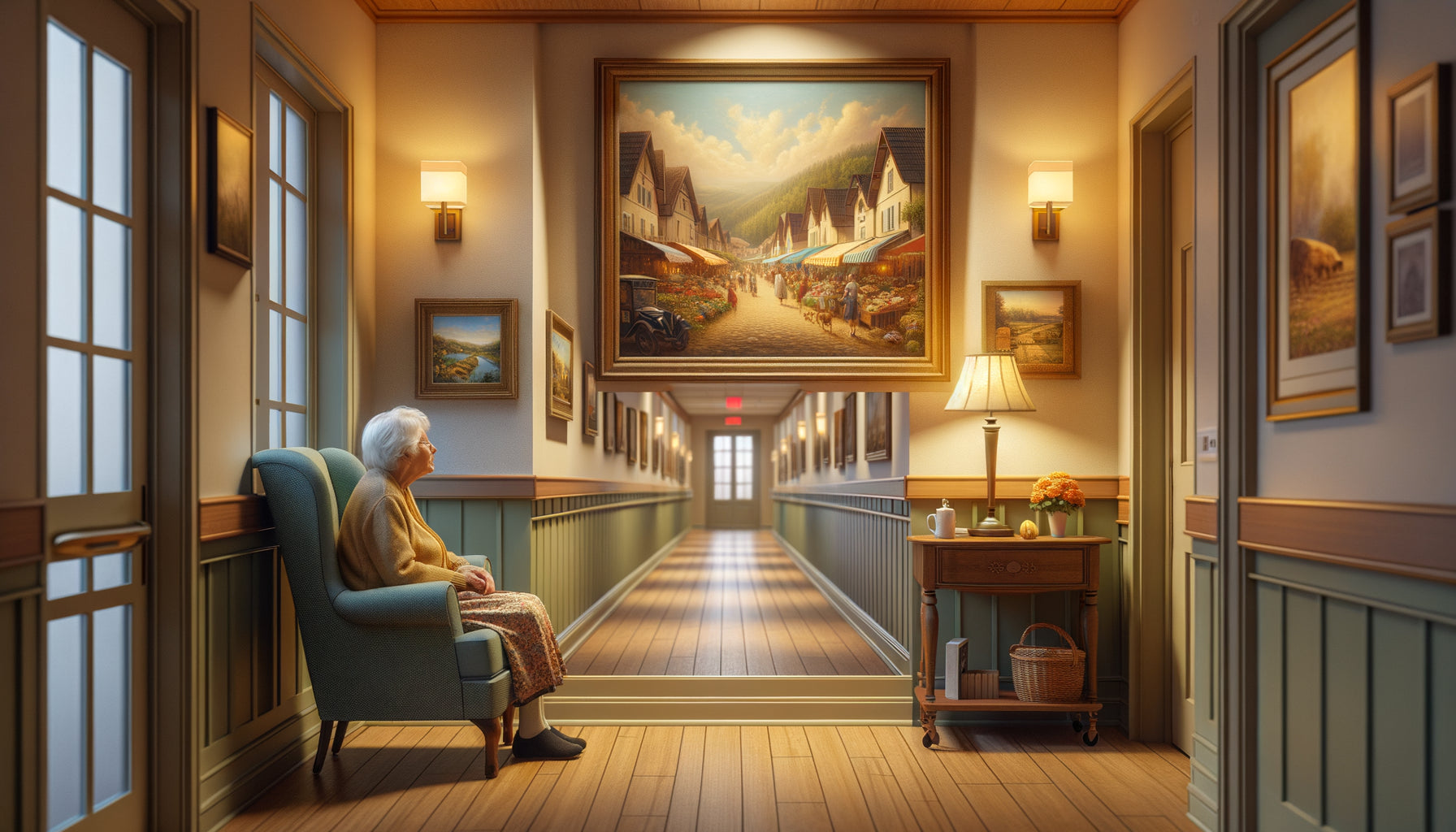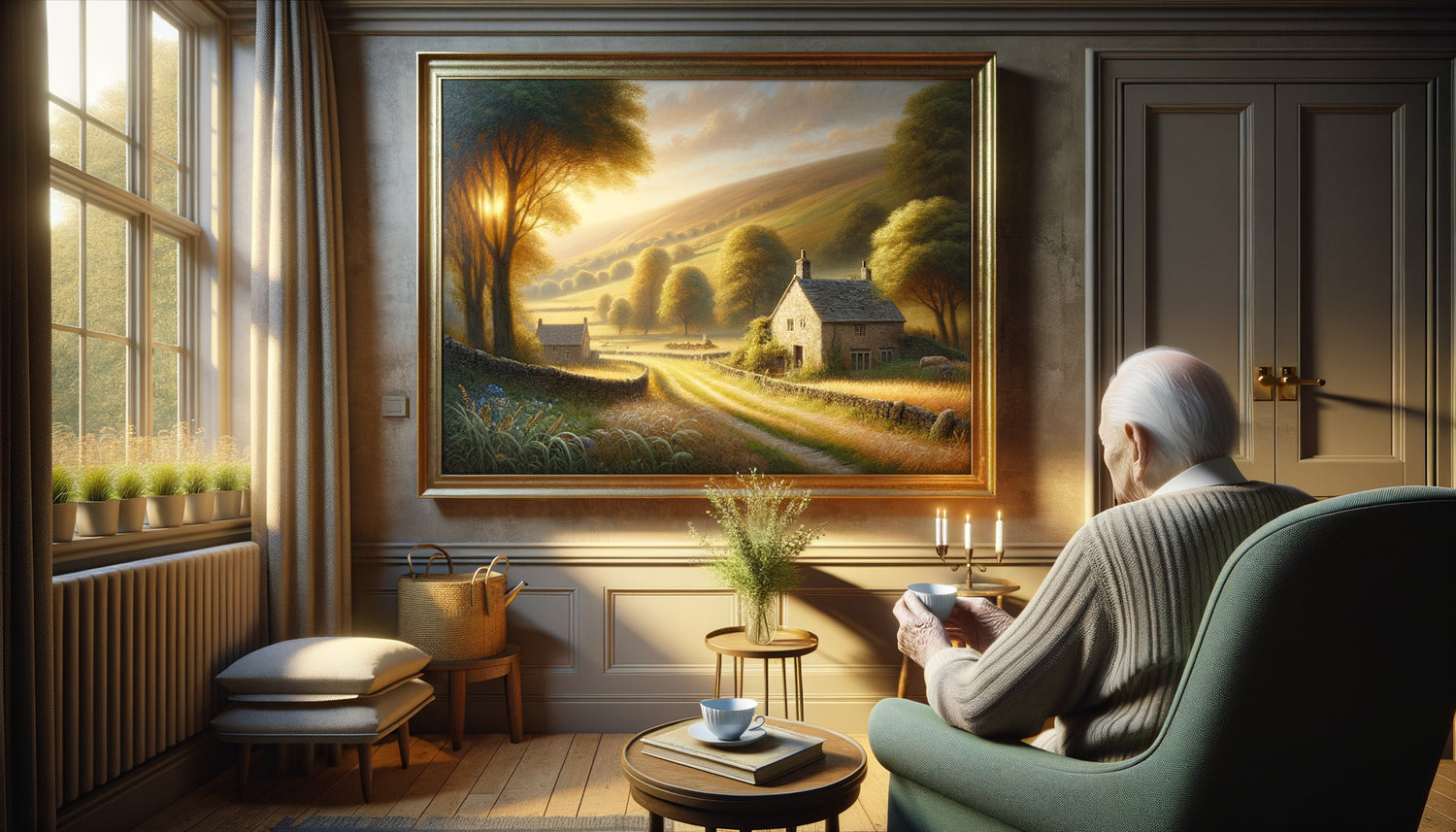
Marie, 87 years old, had been living in her new room at the residence for three weeks. With a lost gaze, she could no longer find her bearings. Until the day her daughter hung a reproduction of the port of La Rochelle, her hometown, on the wall. Since then, every morning, Marie smiles when she recognizes these familiar boats. A silent but spectacular transformation.
Here's what familiar landscape paintings bring to elderly people: a memory anchor that stabilizes their present, an emotional refuge that soothes their anxieties, and a bridge to their deep identity.
Moving into a residence or aging at home disrupts the bearings accumulated over decades. New environments, even benevolent ones, generate spatial and emotional disorientation. Neutral walls become oppressive, a feeling of strangeness sets in, and with it, anxiety about uprooting.
Yet, figurative art possesses this almost magical power to recreate lost intimacy. Recognizable landscapes are not just decorations: they weave a narrative continuity between yesterday and today. Let's discover together how these images become true therapeutic companions for our elders.
Visual memory: a refuge against temporal confusion
Neuroscience has demonstrated it: visual memory remarkably resists cognitive aging. Even when verbal or chronological memory fails, visual memories rooted in childhood and adulthood remain surprisingly intact.
A painting depicting the Provence countryside for someone who grew up there, or the roofs of Paris for a former city dweller, instantly activates brain areas linked to positive emotions. This visual recognition triggers a soothing neurological cascade: reduction of cortisol, stress hormone, and release of dopamine, neurotransmitter of well-being.
In Alzheimer's specialized units, caregivers regularly observe this phenomenon: a disoriented person who stares at a painting of their hometown suddenly regains temporary lucidity. They begin to recount forgotten anecdotes, reconnect with their personal history. The familiar landscape acts as a key temporarily unlocking the doors of memory.
The power of symbolic places
Some landscapes transcend simple nostalgia. The sea for a former sailor, the mountains for a hiker, wheat fields for a farmer: these environments constitute deep identity markers. They recall not only a place, but an active and competent version of oneself.
This identity reconnection effectively combats age-related depression, often linked to the loss of social and professional roles. The painting becomes a silent witness of what the person has been, of their intrinsic value beyond current limitations.
The soothing effect of natural rhythms
Beyond recognition, natural landscapes possess an inherently calming quality. The horizontal lines of a field, the gentle curves of a hill, the repetitive rhythm of waves: these visual compositions naturally slow heart rate and breathing.
Geriatric occupational therapists consciously use this principle. In shared living spaces, they prioritize representations of open and bright landscapes rather than densely built urban scenes or destabilizing abstractions. The reason? Natural environments activate the parasympathetic nervous system, responsible for relaxation.
A study conducted in several French EHPADs compared two groups: one exposed daily to paintings of familiar landscapes from their region, the other in neutral spaces. Striking result: 35% reduction in agitation behaviors and a noticeable improvement in sleep quality in the first group.
Captured light as therapy
Landscape paintings also convey a specific quality of light. A Provence sunset diffuses warm orange tones; a Breton landscape bathes in silvery luminosity. This familiar colorimetry creates a recognizable, almost tactile emotional atmosphere.
For elderly people with reduced mobility, this painted light becomes a virtual window to the outside world, partially compensating for confinement. It maintains a symbolic link with natural cycles and seasons, essential for our circadian balance.

When art becomes conversation
An often overlooked aspect: familiar landscape paintings are excellent intergenerational conversation starters. During family visits, which are often marked by the difficulty of finding topics of discussion, the painting offers a neutral and rich support.
“Do you remember this beach?” becomes the starting point for a story where the elderly person regains their status as narrator, memory transmitter. They become one who knows, who tells, who teaches. This reversal of the caregiver-care recipient dynamic preserves the dignity and social value of the elder.
Activity coordinators in senior residences strategically use this dimension. They organize memory workshops around paintings: each shares their memories related to the places depicted. These collective moments foster social connections between residents, reducing affective isolation.
Choosing the right landscape: a matter of personal resonance
Not all familiar landscapes are equal. The effectiveness lies in the precise correspondence between the image and life story. A native of Brittany will not necessarily be soothed by an alpine landscape, even if it is magnificent.
The ideal? Ask the person or their family about significant places: childhood region, recurring vacation destinations, professional environment. A Berry farmer will instantly recognize the authenticity of a correctly represented hedgerow. This visual veracity triggers emotional resonance.
Time also matters. Favor timeless representations over contemporary ones: a village with its steeple rather than a suburban commercial zone. Landscapes should evoke the person's prime years, generally between 20 and 50 years old, a period when autobiographical memories are densest.
The seasons of comfort
The season depicted subtly influences the effect produced. Spring and summer landscapes, bright and vibrant, stimulate optimism. Autumn scenes, with their ochre tones and gentle nostalgia, suit melancholic temperaments. Rare but powerful snowy winters evoke a sense of cocooning and protection.
Some avant-garde establishments alternate paintings according to the real seasons, thus maintaining a symbolic connection with the outside world. This subtle synchronization reinforces anchoring in the present time, particularly valuable for people suffering from temporal disorientation.

Beyond decoration: a non-medicinal care
Therapeutic approaches in geriatrics are evolving towards non-pharmacological solutions. Familiar landscape paintings fully fit into this philosophy of environmental care.
Unlike anxiolytics, which weigh down cognitive functions, familiar visual art soothes without side effects. It simultaneously stimulates memory, positive emotions and narrative identity. This holistic approach corresponds to the modern definition of geriatric well-being: preserving psychological as well as physical autonomy.
Geriatric psychologists also recommend integrating this dimension from the layout of the room in a residence. The familiar landscape painting then becomes a transitional object, like a piece of furniture or a family photo, facilitating adaptation to the new environment.
Give your loved ones the visual comfort they deserve
Discover our exclusive collection of wall art for senior residences that reconnects with authentic and soothing French landscapes.
Transforming a neutral space into a personal refuge
The strategic placement of a familiar landscape painting radically transforms the perception of a space. This previously empty and impersonal wall becomes a focal point full of affection.
Position the painting ideally within the direct line of sight from the bed or armchair. This permanent visual accessibility allows for daily interaction, almost meditative. Some elderly people develop a morning ritual: opening their eyes and silently greeting their landscape, as one greets a faithful friend.
Size also matters. Too small, it gets lost; too imposing, it can oppress. A format between 60 and 90 cm wide generally offers the optimal presence: large enough to be viewed from afar, intimate enough not to dominate the space.
Lighting deserves special attention. A frame lit by natural light or soft lighting better reveals nuances and avoids tiring reflections. This subtle enhancement transforms the painting into a source of emotional light as much as visual.
Familiar landscape paintings are not just decorative elements for seniors. They constitute true psychological anchors in an everyday life sometimes disoriented by old age or illness. By activating visual memory, soothing the nervous system and preserving narrative identity, these images become silent but powerful therapeutic companions.
For your loved ones in residence or at home, offering a painting depicting their region of origin or a significant landscape from their history is not an insignificant gesture. It's recognizing their journey, validating their memory, and offering them a daily visual refuge. Start with a conversation: what places have marked their lives? What light still shines in their eyes? The answer will guide you to the painting that transforms their space into a true home.
Frequently Asked Questions
What type of landscape should you choose for a person with cognitive disorders?
Prioritize simple and clean landscapes over complex compositions. A beach with the sea horizon, a lavender field, a pine forest: these readable scenes do not overload reduced cognitive abilities. Avoid urban scenes with many architectural details that can generate confusion. The ideal is a natural landscape from the region of origin, with easily identifiable iconic elements: a characteristic steeple, a specific type of vegetation. Immediate recognition takes precedence over aesthetic complexity. Test by showing several images and observe which reaction provokes calmness and spontaneous smiling.
Should you prefer a photograph or a painting?
Both work, but with nuances. Oil or watercolor paintings offer a particularly restful visual softness, without the sometimes cold hyperrealism of photography. Their texture and slightly stylized colors activate imagination and emotional memory more strongly. However, some people very attached to realism will prefer a beautiful work of art photograph. The essential thing is the quality of execution: absolutely avoid pixelated reproductions or low-end prints that produce the opposite effect. A well framed painting, with faithful colors and a nice presence, whether painted or photographed, will always be superior to a mediocre image. Observe the person's aesthetic preferences throughout their life to guide your choice.
Can you change pictures regularly or should you keep the same one?
For older people, particularly those with cognitive disorders, permanence is generally preferable. The painting becomes a stable reference point in a daily life where so many things change. Its constant presence contributes to the security of the space. However, for seniors without significant memory problems, gentle seasonal rotation can be beneficial: keeping the same location but in different seasons creates stimulating variety while maintaining the familiarity of the subject. If you observe that the person seems tired or no longer looks at their painting, a conversation is necessary: their emotional needs may have evolved, and another landscape from their history might better correspond to their current state. Sensitive adaptability is better than systematic rigidity.