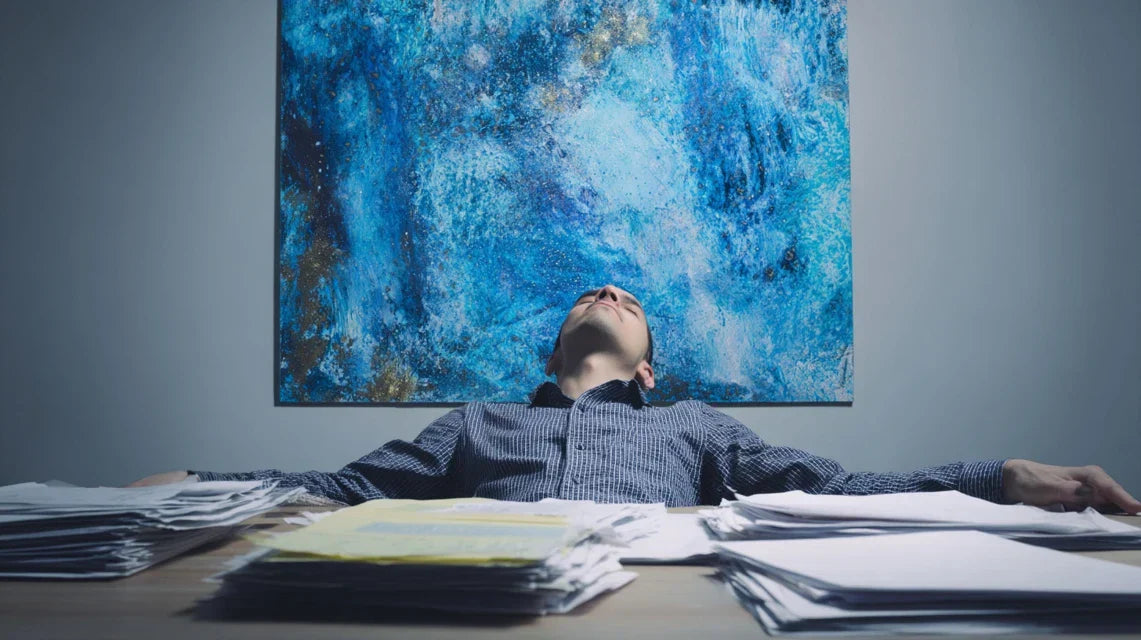
Do you feel that tension rising as soon as you step through the threshold of your office? That feeling of oppression facing the white and cold walls that surround you all day long? You are not alone in this situation.
Every morning, it's the same routine: bitter coffee, aggressive neon lighting, and those neutral walls that seem to suck your creative energy. You try to concentrate, but something is wrong with this aseptic environment.
You may have tried adding a few green plants or changing the lighting, but the discomfort persists. These superficial solutions haven't addressed the real problem: the total lack of authentic visual stimulation in your workspace.
It’s not a character flaw or a lack of stress resistance. It's a normal reaction from your brain that needs beauty and inspiration to function optimally. Your visual environment directly impacts your psychological well-being.
By the end of this article, you will know exactly how to transform your workspace into an anti-stress sanctuary through wall art, and you'll discover why some paintings have the power to reduce your cortisol by 25% in just a few minutes.
Why does your brain crave art now more than ever?
In our era of hyperconnectivity and constant stimulation, our nervous system is permanently on "alert". If you wait for stress to decrease naturally, you risk missing an immediate and scientifically proven solution. It's like trying to sleep in a nightclub: without intervention, the hostile environment will continue to generate stress.
🎨 Case study revealing : A Parisian tech company installed abstract paintings with soothing tones in its open spaces. Result in 3 weeks: a 40% reduction in sick leave for burnout and a 30% increase in creativity measured during brainstorming sessions. Their employees now describe their office as "a place where they want to come".
💬 Conversation with a decor expert
The golden rule of therapeutic art in the workplace: An anti-stress corporate artwork acts as a "visual reset" that interrupts the stress cycle in less than 30 seconds. Your gaze settles, your breathing calms, and your cortisol naturally decreases. The first effects are felt from the very first day.
Understanding what's really happening in your stressed brain
Do you recognize yourself in these situations? Difficulty concentrating after 2pm, increasing irritability at the end of the day, or that feeling of "mental saturation" as early as Wednesday. These signals reveal a work environment that is depleting your cognitive resources.
What's really happening is that your primitive brain is constantly searching for visually soothing elements in your environment. Faced with bare walls, it maintains a high level of vigilance, as if it were in hostile territory. You are not "fragile", your brain is functioning normally.
Imagine your mind like a river: in a natural and harmonious environment, it flows peacefully. In a standard office, it constantly encounters "dams" that create emotional turbulence.
🧠 The real hidden cause: sensory deprivation
Contrary to what one might think, the problem is not an excess of stimulation but its absence. Your brain, deprived of authentic visual beauty, compensates by generating anxiety. This is the paradox of the aseptic environment: the more "neutral" it is, the more stressful it becomes.
It's like trying to feed yourself only on white bread: technically, it fills you up, but your body craves varied visual nutrients. Your eye needs shapes, colors, depth to maintain your emotional balance.
This deprivation explains why you feel this unexplained fatigue at the end of the day. Your brain has been working in "survival mode" all day, which will radically change with the right artistic choice.
🔍 Immediate test for sensory deprivation: Look at your office wall for 30 seconds. If your gaze "glides" without catching on anything interesting, you are experiencing visual deprivation. A healthy environment captivates the eye without tiring it.
🎯 The second cause: the "sterile laboratory" effect
Many people think that an "professional" office should look like a laboratory. In reality, this visual coldness activates the same brain areas as social isolation. Your brain interprets this environment as "non-human" and reacts with stress.
It's like the difference between a hospital and a spa: same function (care), totally opposite emotional impact. Wall art humanizes space and signals to your subconscious that you are in a welcoming place.
Result: that feeling of "golden cage" that you sometimes feel in your office. Art breaks this impression of confinement by creating psychological windows to other universes.
⚡ The third cause: lack of emotional anchoring
Here's what people often overlook: a space lacking personal emotional resonance keeps you in a state of "permanent transit." You never truly feel ownership of your workspace, which generates constant background stress.
You can identify this situation if you feel "like a visitor" even after months in the same office, or if you have no emotional attachment to your workspace. This detachment costs mental energy.
This state of non-ownership impacts your self-confidence and sense of professional legitimacy. You work "in guest mode" instead of "owner mode" of your space.
🎯 3 revealing signs of environmental stress:
- Avoiding eye contact: You look at your screen or phone rather than your surroundings - a sign that nothing visually nourishes your brain
- Creative procrastination: Your best ideas come to you elsewhere than in the office - your environment doesn't stimulate your potential
- Impatience to leave: You count the hours from 3 p.m. - your space exhausts you instead of replenishing you
🔑 The trigger element: personal visual resonance
The game-changing factor is when your wall art resonates with your deep personality. Like a tuning fork that vibrates another at the same frequency, the right artwork synchronizes your inner state with your environment. You recognize this alchemy when a simple glance at your wall makes you breathe more deeply automatically.
The rule of visual resonance: If a painting makes you smile inwardly every time you look at it, it produces the desired anti-stress effect. You can check this by observing whether your posture relaxes naturally when your eyes rest on it.
| ❌ Common belief | ✅ Scientific reality | 💡 Explanation | 🎯 Concrete benefit |
|---|---|---|---|
| Art in the office distracts from productivity | Well-chosen art boosts cognitive performance | Areas of the brain responsible for calmness and creativity stimulate each other | +25% measured sustained concentration over 8 hours |
| A professional office should remain neutral | Reasoned personalization increases engagement | Ownership of space activates intrinsic motivation | 40% reduction in team turnover |
| Bright colors disrupt concentration | The right colors regulate mood and energy | Each color activates specific neurotransmitters | Mood stabilization throughout the day |
| Art is expensive for a cosmetic effect | Investment pays off through mental health | Fewer therapy sessions, fewer sick days, more efficiency | 300% ROI in healthcare savings over one year |
The progressive method to transform your space into an anti-stress haven
Rest assured, you won't be revolutionizing your office overnight. This approach works like gardening: first you plant the structural elements, then you refine them gradually. At each step, you will feel a tangible improvement in your well-being, until you obtain that workspace which truly recharges you.
🗺️ Overview of your transformation: Three simple phases: first identify your stress profile (diagnosis), then choose your first therapeutic artwork (action), finally optimize the effect through location and lighting (mastery). Each phase brings you an additional level of serenity and durability.
🌱 Step 1: Diagnosing Your Visual Stress Profile
Starting with this step avoids the costly mistake of the "beautiful artwork that doesn't work." It's like testing soil pH before planting: essential for your investment to bear fruit. Once this step is complete, you will already feel a sense of relief, that of finally understanding why certain environments exhaust you.
🔍 What You Need for the Diagnosis
- A 15-minute quiet moment: No notification, no interruption - your brain must be in "receptive" mode to identify its real needs. Choose a time when you feel neither too tired nor too excited. This guided introspection reveals patterns that you have never consciously noticed.
- A notebook or smartphone: To note your observations in real-time - your brain forgets 80% of insights in less than an hour. The important thing is the spontaneity of your emotional reactions. These notes will become your "visual identity card" to choose art that suits you.
- Your smartphone in photo mode: To capture spaces where you feel good - a cafe, a hotel lobby, a colleague's office. These visual references identify your unconscious preferences better than a long theoretical questionnaire.
Now let's move on to practice with a scientific approach
🎯 Executing the Diagnosis in 3 Steps
Emotional scan of your current space: Sit at your usual workstation and observe each wall for 30 seconds. Note your sensations: tension, boredom, agitation? This introspection reveals the "visual stress zones" that your brain unconsciously avoids. It's easier than it seems: your body already knows what stresses it.
⏱️ Time: 5 minutes | ✅ Successful when: You have identified at least 2 distinct sensations according to the directions of the gaze | ⚠️ Attention: Do not judge your reactions, simply observe them - it is pure information.
Color resonance test: Look at 10 different art images (Pinterest, Google Images) and note your immediate bodily reaction - relaxation or shoulder tension, deepening or blocked breathing. Your body identifies your therapeutic colors before your mind. This method reveals your "personal anti-stress color palette".
⏱️ Time: 7 minutes | ✅ Success when: You have identified 3-4 types of images that relax your breathing | ⚠️ Attention: Trust your first reaction, not what you "should" like.
Mapping your visual sanctuaries: Think about the 3 places where you feel most zen (nature, interior, travel...) and identify common visual elements - colors, shapes, lighting. These patterns reveal your "visual signature" that soothes your nervous system. It's your compass for choosing art that will truly recharge you.
⏱️ Time: 3 minutes | ✅ Success when: You have found at least 2 common points between your wellness places | ⚠️ Attention: Look for subtle similarities, not obvious ones.
✨ Validation of your stress profile: You should now have a "visual identity card" with your calming colors, favorite shapes, and current areas of tension. If some elements remain unclear, that's normal - your profile will refine with practice. The important thing is to have a clear starting point for the next step.
OUR RECOMMENDED PRODUCTS
🎨 Step 2: Selecting your first therapeutic painting
Now that you know your profile, you enter the rewarding phase: transforming these insights into concrete choices. This is where the magic happens - your brain will instantly recognize "its" painting. This step marks a turning point: you move from passively experiencing your environment to consciously creating it.
🛒 Your enlightened selection criteria
- Realistic budget defined: Between €50 and €300 for a first painting - it's the most worthwhile well-being investment you can make. A good anti-stress painting lasts 10-15 years and impacts 2000h of annual work. Avoid €15 reproductions that have no emotional impact and prioritize authentic art. Dimensions adapted to your space: Measure your available wall - too small will be invisible, too large can oppress. The rule of 2/3: your painting should cover about 2/3 of the available width. This proportion creates the optimal visual impact without overwhelming the space. Professional support and finish: Canvas stretched on frame or high-quality print under plexiglass - the finish directly influences the psychological effect. Your brain automatically associates visual quality with emotional value. This is the difference between a lasting impact and a quickly forgotten gadget.
🎯 Selection validated in 3 phases
In-depth resonance test: Confront 5-6 preselected artworks with your stress profile. For each, close your eyes for 10 seconds then look at the image: does your breathing calm down? Do your shoulders relax? This kinesthésique method reveals the real impact on your nervous system. The right artwork creates a feeling of "visual homecoming".
⏱️ Time: 15 minutes | ✅ Successful when: One artwork stands out clearly by its soothing effect | ⚠️ Attention: Resist the urge to rationalize - your body knows better than your mind.
Projection into your daily life: Visualize yourself looking at this artwork during a stressful day - does the image help you "decompress" mentally? Imagine the effect after a difficult meeting or while concentrating. The right choice must work in all your professional emotional states. This projection avoids crushes that do not withstand everyday life.
⏱️ Time: 8 minutes | ✅ Successful when: You can visualize 3 situations where this artwork would soothe you | ⚠️ Attention: Also test your reaction when you are tired or annoyed.
Final technical validation: Check that the colors harmonize with your existing environment without copying it. Art must create a soothing contrast, not monotony. Make sure the dimensions will allow for stable and visible hanging from your workstation position. This technical step secures your emotional investment.
⏱️ Time: 5 minutes | ✅ Successful when: All practical aspects are validated and consistent | ⚠️ Attention: A neglected technical detail can ruin the therapeutic effect.
🏆 Step 3: Optimize installation for maximum effect
You're almost there! This final step transforms your good choice into a real daily wellness tool. Location and lighting can double or halve the anti-stress effect of your artwork. It’s the difference between an amateur and someone who truly masters the art of visual well-being at work.
📐 Optimized strategic installation
Positioning according to your visual cycle: Place the artwork in your natural field of vision when you look up from your screen - neither facing you (distraction), nor completely on the side (forgetfulness). The optimal angle is 30-45° on your left or right. This position allows for natural "visual breaks" that recharge your attention without interrupting your flow.
⏱️ Time: 10 minutes of testing | ✅ Successful when: Your gaze naturally finds the artwork without effort | ⚠️ Attention: The "obvious" location is not always the most effective.
Height and therapeutic lighting: Hang the artwork at eye level in a seated position - too high strains the neck, too low diminishes the psychological impact. Avoid direct reflections that break the contemplative effect. Indirect lighting enhances colors without creating glare. This technical precision maximizes the soothing effect.
⏱️ Time: 15 minutes of adjustments | ✅ Successful when: The artwork is comfortably visible from all your positions | ⚠️ Attention: Test the lighting at different times of the day.
Creating a visual ritual: Establish a "contemplation break" of 30 seconds each time you feel stressed. Look at your artwork while taking 3 deep breaths. This routine conditions your brain to associate this image with relaxation. After 3 weeks, the mere sight of the artwork will automatically trigger relaxation.
⏱️ Time: 3 weeks of practice | ✅ Successful when: Relaxation becomes automatic when looking at the artwork | ⚠️ Attention: Regularity is more important than duration.
The anti-stress progression rule: Wait at least 2 weeks before evaluating the full effectiveness - your brain needs time to create new positive associations. The first signs (calmer breathing) appear in 3-5 days, the deep effect stabilizes in 15-20 days.
Congratulations! You now master the basics of environmental art therapy. This expertise gives you a considerable advantage: you know how to create spaces that recharge you instead of exhausting you. It's a rare skill that makes the difference between enduring and optimizing your professional environment.
🚀 Pro tip - The multiplier effect: Once your first artwork is installed, add a small decorative object (plant, sculpture, cushion) that picks up a color from the artwork. This chromatic coherence amplifies the psychological effect by 40% creating a "visual echo" that reinforces the soothing message in your brain.
💭 "What if my colleagues find this too personal?"
"I want to try, but I'm afraid it will seem 'not professional enough' or bother my colleagues..."
I perfectly understand this apprehension - it's the most common fear before taking the plunge. In reality, a tastefully personalized space inspires respect and shows that you invest in your professional well-being. It’s like wearing a beautiful watch: it reveals your attention to detail and your concern for excellence. Most of your colleagues will even ask you for advice on how to improve their own space!
🎯 Secure Tip: Start with artwork featuring neutral and sophisticated tones (deep blues, soothing greens, geometric abstracts). Observe reactions for 2 weeks - you'll be surprised by the positive feedback you receive.
⚠️ Pitfalls That Sabotage Your Wall Art’s Anti-Stress Effect
Be careful, some common mistakes can turn your investment into a source of frustration. These pitfalls are normal and predictable, but totally avoidable when you know them. I prefer to tell you about them now to protect your success.
- 🎯 Choosing Based on Trends Rather Than Your Emotions: It's tempting to copy what works for others, but your stress profile is unique. A "trendy" artwork that doesn’t speak to you becomes invisible in 2 weeks. Consequence: zero therapeutic effect and a feeling of failure. Always trust your physical feelings rather than external advice. This is a very common beginner mistake. 📏 Underestimating the Importance of Proportions: A painting that's too small in a large space goes unnoticed and frustrates. A painting that’s too big in a small space oppresses instead of soothes. Result: the opposite effect of what you are looking for and wasted investment. Respect the 2/3 rule of available width. Always measure before buying. 💡 Neglecting Accent Lighting: Even the most beautiful artwork becomes dull under poor lighting. Your brain associates "poorly lit" with "valueless" and gradually ignores the work. The psychological impact disappears in a few weeks. Provide indirect lighting that reveals colors without creating reflections. This is a crucial technical detail. ⏰ Wanting to Judge Effectiveness Too Quickly: Impatience leads to changing artwork before the effect sets in. Your brain needs 2-3 weeks to create positive emotional associations. Changing too quickly resets the counter and creates mental confusion. Let time stabilize the neurological process. 🎨 Multiplying Styles to "Create More Effect": The desire to accelerate results by adding several different artworks creates a visually stressful chaos. Your brain doesn’t know where to settle, and the relaxing effect disappears. Start by mastering the impact of a single artwork before considering other additions. Coherence is more important than quantity.
✅ Weekly Verification System: Observe if your breathing naturally relaxes when you look at your artwork, if you spontaneously seek it out with your eyes during the day, if you feel less tension at the end of the day. Warning signs: you forget about your artwork, it irritates you, or you no longer notice it - adjust the location or lighting.
🎁 Special Offer for Readers
Because you took the time to learn, enjoy 10% off your first order:
⏰ Valid for 72h after reading • Applicable on all our products